Category Archives: My Games
On this page you’ll find information for the games I have designed or those that are in the works.

Monday Brews 1-13-14
Welcome back to Boards and Barley! I’m so glad you’re here. Every Monday I write an article that let’s you know what beer and board games I enjoyed over the last week. I also give a little insight into my design ventures of the past week. It was another slow week in terms of beer and games, but the game design portion of my life picked up a bit.
Let’s start with the Barley…
The Barley:

That’s a chair I could sit in!
Gray’s Busted Knuckle Irish Ale: I enjoyed this Wisconsin brew while my brother visited. We got some amazing fried cheese curds and a beer. This was an enjoyable Irish ale that I would get again.
Fleming’s Scotch Ale: I had another of my homebrews. I think it is now stronger than the original 6.6%abv. I might have to measure that again. This one really packs a punch.
New Glarus Spotted Cow: Another Wisconsin beer was enjoyed while a friend was over. We watched some football and enjoyed a beer and some ranch pretzels. That makes for a pretty good evening.
Deschutes Red Chair Northwest Pale Ale: I am not an IPA or Pale Ale guy in general. I don’t care that much for hoppy beers. But this one was quite good. It wasn’t too hoppy overall and it had a hint of a sweet finish with a mild floral aroma. I would drink this again and I think it could be my gateway to IPAs.
Capital Winter Skal: I enjoyed this while playing Nothing Personal. This is a mighty fine brew from a local brewery.
The Boards:
Nothing Personal: My friends played this at GenCon while I was on a panel about Protospiel. They have played it several times since then. I finally got to play it last night. And it was awesome! Nothing Personal has an amazing level of back-stabbing, promise-breaking, deal-making interaction that I haven’t seen in any other game. There is a lot to keep track of in this game and it would be easy to make mistakes and get left behind. I’m glad I finally had the opportunity to play it because it was a lot of fun.
Tenzi: I got my friends to try this out last night. Each player has 10 dice. You roll them and try to get all of your dice to be the same number. The first player to get all of theirs the same is the winner. There are a bunch of variants in the rules that you can try out. But this was a thoughtful Christmas gift from my mom because she knew I wanted dice for game design purposes and she got me dice that are also a game. Thanks mom!
Designer’s Corner:
This prototype box will suffice for now.
Last week I worked a little bit on Quantum Orcas. I want to put together a version that I can purchase from The Game Crafter. It is amazing how much artwork really goes into a game. Not only do you need art for the cards, chits, tiles, etc. You also need artwork for the box and the rulebook. Then if you want to have a nice sales page on TGC you need artwork for that page. There is a lot of behinds the scenes artwork that is needed to complete a game.
So last week I put together a bunch of art and Quantum Orcas is getting closer. I still need to do more playtesting to make the game go from playable and “not bad” to something that is enjoyable that people will want to play. I’ll keep you posted.
The other progress I made last week was to come up with new mechanics for Brooklyn Bridge. I have shared the concept of the mechanics with several friends and none of them said it sounded awful. So I might have something there! I am pretty excited about the new utilization of workers. Brooklyn Bridge is a worker placement game, but it uses workers in ways I have not seen before. So I’ll plow forward with this to make it playable in the near future. My goal is to have tested it several times before Protospiel-Milwaukee in March.
***
So that’s the Boards & Barley I enjoyed and the game design progress I made last week. How was your week?
Design Me: Route Building
Ah… it’s an exciting day on Boards & Barley. Today is the first Design Me article of the year! What is a “Design Me” article? It is a design exercise. Like soccer players who run for practice to exercise their muscles, I think it is important for designers to exercise their brains. So every once in a while I choose a random theme/mechanic/victory condition and see if I can come up with a decent game design on a whim.
Today’s random stuff, via Boardgamizer.com, is this:
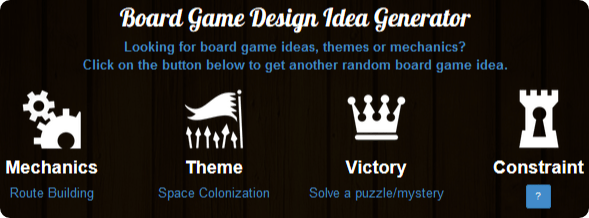
Route Building + Space Colonization? I can do this!
Note: for this design me I am changing the victory condition. Instead of solving a puzzle or mystery, the player who builds the best route will win.
Armada Galactica
In Armada Galactica you are a galactic superpower trying to create a new trade route through whichever galaxy you are currently in.
As a galactic superpower it is your job to make sure you are providing enough vacation spots for your population. The way to do that is to spread your empire throughout the galaxy. You can colonize a new location if it is within a certain location of your currently existing locations. But there are a few steps you must take. These include SCOUT, TERRAFORM, and then COLONIZE.
On your turn you can also perform some research upgrades. Each planet or moon you colonize will begin with basic capabilities based on its characteristics. As you bring technology along your colonization route, those planets/moons will get better at allowing you to reach further and explore/colonize more distant locations.
So the concept is to build a route from planet to planet by utilizing the characteristics of those planets to allow you to further colonize. The winner will be the person who has built the best route by the end of the game.
Components
- Game Board
- Planet tokens
- 12 Rocket meeples (3 each in four different player colors)
- 40 Colony tokens (10 each in four different player colors)
- Research tokens
- Population cubes
How to Play
A game of Armada Galactica is played until someone has placed their tenth colony token. To place a colony token, the desired planet/moon must be able to support enough population. A planet/moon can support enough population if it has been terraformed correctly for the type of body it is.
Players will each have a home planet (not dissimlar to Ascending Empires – I’m trying hard not to simply duplicate that game here – I feel I’m failing at that). The board is composed of a grid of planets/moons. Each location will have randomly received a planet token, so the grid is never the same from game to game.
There will be four main types of celestial bodies that you can try to colonize. These are:
- Earth-like
- Mars-like
- Europa-like
- Water worlds
Earth-like
These planets are the rarest in the game. But they are the easiest to colonize. Without the need for terraforming these are the hot spots that you’ll want to go after!
Mars-like
These planets were once Earth-like, so it will take some work to get them back to that state. That means you’ll have to devote some effort to terraforming. But these are still relatively easy to colonize.
Europa-like
These are planets that possess water under layers of ice or rock. Terraforming won’t be enough on planets like these. You’ll need specialized research that can warm the planet from the inside to sustain life on it’s surface.
Water Worlds
These planets are basically covered in water. So terraforming isn’t exactly possible. Instead you’ll have to haul a serious amount of infrastructure to the planet to essentially create boats/structures large enough to sustain a large population while floating on the water. If your terraforming research isn’t very good you may want to build a network out of these bad boys.
Those are the four main types of celestial bodies you will encounter while attempting to grasp galactic supremacy. Yet the goal is not simply to build all ten of your colonies. Scoring is also based on the populations you can sustain.
On your turn you can choose either EXPLORE, RESEARCH, or POPULATE as your main action.
The EXPLORE action allows you to use your three rockets to scout the nearby planets. All of you network must be in a continuous line, so it’s important to look ahead and see what’s coming. Also during the EXPLORE action you can transport equipment to the newly selected planet. This could be infrastructure, terraforming equipment, or research scientists.
The RESEARCH action allows you to utilize scientists that you have placed on your planets to increase that planet’s capabilities. For example, if a planet has a high exploratory research level, then if the rockets are launched from that planet they can travel twice as far, which would allow you to spread your network over a wider area. If your planet has great earth-like resources, and if you increase its terraforming capabilities, then it can become a hub for your terraforming infrastructure to expand to new locations. Research will play a key role in the game and you will want to maximize the capabilities of your planets.
The POPULATE action allows you to colonize a new location. This can only be done if that location has met the colonizability standards. Players will place a colony token on the new location. This action can also be used to increase the population in your existing colonies. This is a key to victory since population is the main scoring category.
On your turn, in addition to the main action you can also perform a secondary action. These are like dumbed down versions of EXPLORE, RESEARCH, and POPULATE. But they can allow you to take advantage of certain planetary characteristics if you really wanted to accomplish something awesome on your turn.
The Endgame
Once a player has placed their tenth colony, all players will have one final turn, including that player. At the end of the game players will total their population cubes and their colony tokens. Each colony token counts as three population cubes. So players could earn a maximum of 30 points from their colonies alone. Research levels and infrastructure will also be scored on a low-level basis. The idea behind awarding points for those is because they are what set the population limit for a player.
I expect final scores to be in the 70-90 range. I had a lot of fun coming up with this design despite not creating any graphics or images for it. That’s a rare thing. I really like this idea and I think I might move forward with it. I am still on the lookout for the other game that I’d like to put on The Game Crafter this year. If this comes together nicely maybe it will be that game.
Your Opinions…
Do you have any thoughts about this design? Are there any obvious problems? Are there areas where I really fell short?
Don’t forget to exercise your brains!
Monday Brews 12-30-13
Welcome to the final Monday Brews of the year! Oh what a year it’s been. Last year this blog didn’t even exist. And now I have tens of readers a day. The three of you who keep refreshing the page are awesome!
But seriously, this blog has been a lot of fun to write and I sincerely thank you for taking the time to read it. I only hope that you’ve learned something about board games and beer. I’ll have a “2014 Goals” article later this week which will cover my big plans for 2014. But today is Monday, so let’s see what Boards and Barley I enjoyed in the past two weeks (I was traveling last Monday):
The Barley:

Have you ever had a smoked beer?
Alaskan Smoked Porter: I enjoyed this beer and the Paulaner while listening to bluegrass at an awesome local establishment. I think a full glass of a smoked beer is about twice as much smoked beer as I can handle. It was a pretty solid smoked beer, though.
Paulaner Salvator: I used to think I liked this beer, but I didn’t care for it during the bluegrass. I’m wondering, now, if the smoked beer beforehand wrecked my palate.
New Glarus Fat Squirrel: A local brew that was brought to a game night, this brown ale is an excellent cold weather beer.
Gray’s Bully Porter: Didn’t I mention a few weeks ago that I thought I was all Portered out? Oh well. This was also available at game night so I gave it a try. It was pretty good.
Central Waters Mudpuppy Porter: I love the name Mudpuppy. And the beer was pretty good, like the Gray’s. Unfortunately all these porters I enjoyed are all blending together and I can’t quite recall if one was better than the others.
Leinenkugel’s Snowdrift Vanilla Porter: Well, this one stands out from the other porters since it has the vanilla flavor. It also has a nice crispness to it. Or perhaps it stood out in my memory because I enjoyed it with my in-laws during our Christmas morning. Newton’s Oatmeal Stout: This homebrew of mine will sustain me over the winter. (4.2% abv)

I love the bottle label!
Fleming’s Scotch Ale: This homebrew of mine will make me tipsy over the winter. (6.6% abv)
Sierra Nevada Celebration: They love a good IPA or Pale Ale over at Sierra Nevada Brewery. But this IPA isn’t so IPA-ish. It doesn’t seem as hoppy as some of those hop-forward breweries who push the limits of the IBUs in their beer. I think I liked it, but I’m not sure I would drink it again.
Monk’s Stout DuPont: The typography on the bottle is awesome! The beer inside in interesting. Made in Blegium at Brasserie DuPont, this is the first beer I’ve had from the brewery. I think I need to try it again before I really form an opinion, but I think I liked it.
The Boards:
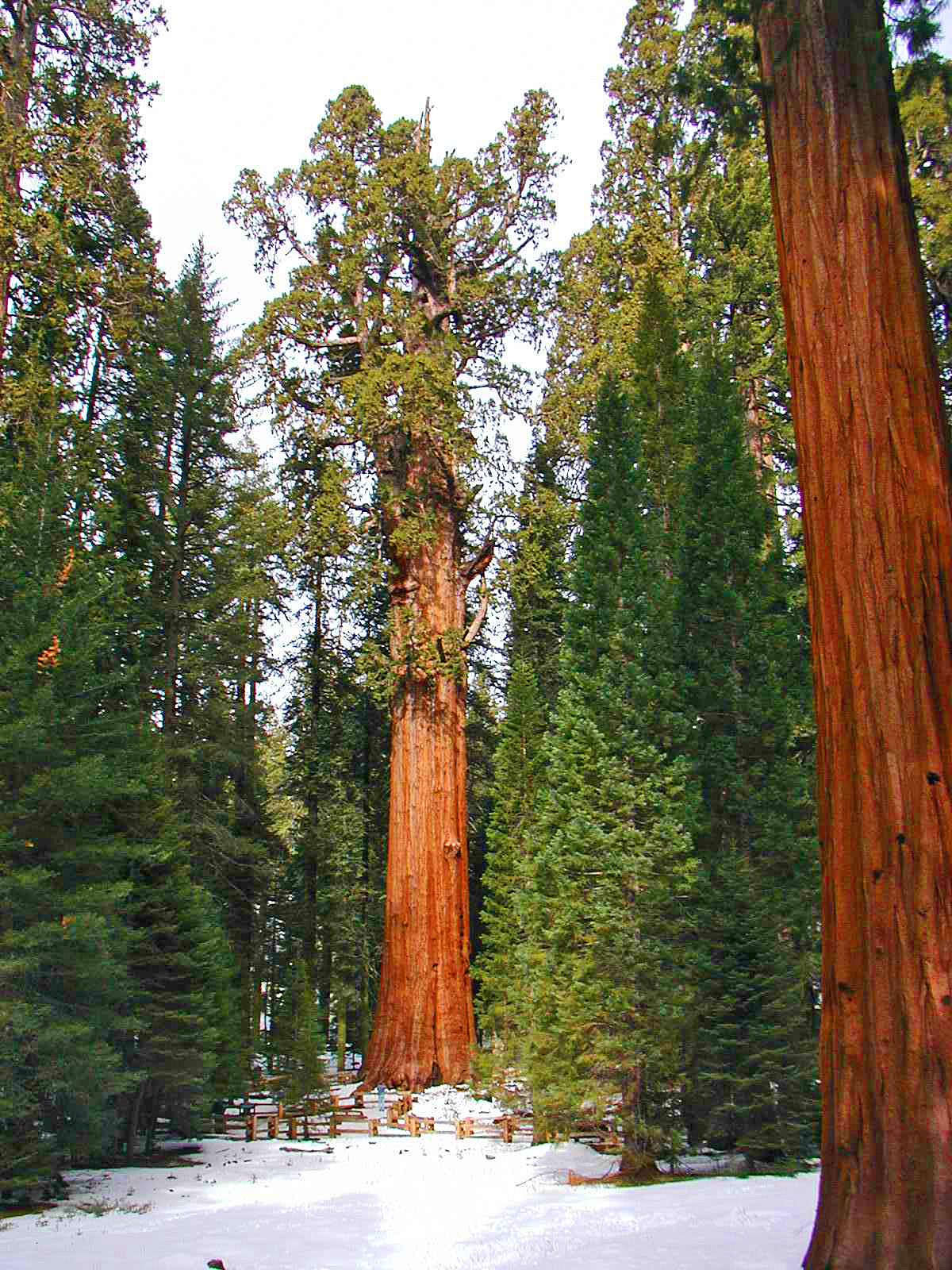
Too awesome to NOT make a game about them!
Sequoia Grove: This was supposed to be an entry into the Dice Hate Me 54 Card Challenge. The premise is that you are a researcher of trees, otherwise known as a Dendrologist. Your goal in the game it to grow the largest, widest sequoia tree possible. You can add height and girth to the tree during the game. My entry worked and was playable, but wasn’t up to the high quality expected in the Dice Hate Me line of games.
Backyard Astronaut: This is my friend Adam’s entry into the 54 card challenge and it IS up to the high quality of the Dice Hate Me line of games. It is a fantastic game and I believe it has a real shot in the contest. Nicely done A-Game!
Viticulture: Other than some cards being more valuable than others I think this is a pretty enjoyable worker placement game. It won’t take the place of Stone Age, but this is definitely a game I’ll play again. I like how you have to “save” some workers for the winter phase of the game.
Qwirkle: This game has made many a showing in 2013 and I imagine it will be the same in 2014. It is easy to teach and understand. It plays quickly. And if you have the travel size you can take it just about anywhere!
Compounded: I’ll write more about this game in tomorrow’s article. Over Christmas I was able to teach this to a new player and she won the game. It is easy enough to understand, it has a lot of awesome interaction and the theme is great! If you haven’t played it I highly recommend picking up a copy.
Dam It! Redux: You can learn more about my beaver game on it’s page. I tried reducing the game for the Dice Hate Me 54 Card Challenge and I succeeded… sort of. I successfully reduced the game to 54 cards. The game worked and the few playtesters that I played with said it was fun. But as a designer I knew it just wasn’t quite there. So I didn’t send this in. On the upside I do think this is something that I can finalize and put for sale on The Game Crafter.
Le Havre – The Inland Port: I received this for my birthday back in August and finally got to play it. It is a very interesting game of resource management that I royally lost. I’ll probably trade this game since it doesn’t get played very often. It just seemed like it was an abstract game in the Le Havre theme.
Agricola – All Creatures Big and Small x2: This game, however, had the awesome feel of Agricola. It was tight. It was nerve wracking. It was a nice mental battle. And it has the nice elements of Agricola without the fiddly cards and the need to feed your family. I’ll be keeping this one and I hope to play it again soon.
Kingdom Builder x2: I was able to set up and play a 6 player game of Kingdom Builder. The house rule for this is to add two more kingdom boards so that it is a 2 wide by 3 high board. Since all the scoring conditions are shared there is no real disadvantage to anyone by bumping it to six players. I hope that Queen Games has a few more expansions up their sleeves for this one.

Missing 14 years worth of cards.
Ultimate Outburst: My mom got me this game for Christmas because 1) I don’t own it, and 2) it’s not like all those thinky games I have. We played it together as a family and it was actually quite fun. We played men vs women and the women won. The big downside to the game was that its from 1999 and the information on the cards reflects that.
Tenzi x20: A while back I bought Farkle Party at a thrift store but it had no dice in it. (It had jewelry). I wanted the dice for prototyping purposes. My mom bought me Tenzi because instead of just 40 dice, it is also a game. You must roll your dice so that they all come up the same value. First person to get all their dice the same wins. It was a very thoughtful gift and I am happy to have the dice for design purposes. Thanks mom!
Carcassonne – The Discovery: This is an interested take on the Carcassonne world. You only have four followers and you don’t get them back right away when something is finished. That’s because you can remove them before their thing is completed, or simply wait and never remove them. I’m not sure if I liked it so I’ll have to play it again.
Scoville: I played with my family and was able to play with “final” artwork that I had printed out. While I didn’t have all of the final artwork I had enough to realize that it’s gonna be awesome! Hopefully the art can get wrapped up so we can launch the Kickstarter campaign in January, but at this point I’m not holding my breath.
The Little Prince x2: This is one of those game I was happy to get at GenCon this year. The gameplay is awesome. However, I have no nostalgic connection with the book on which the game is based, so I would prefer a retheme. Make it about colonizing Mars or something like that.
Euphoria: The second Stonemaier Game on the list and another worker placement game. This time your workers are dice and their values matter. I’ll definitely play this again as the first play was steep with learning. Overall I thought it was fun and I think that will be the case after a second play.
Designer’s Corner:
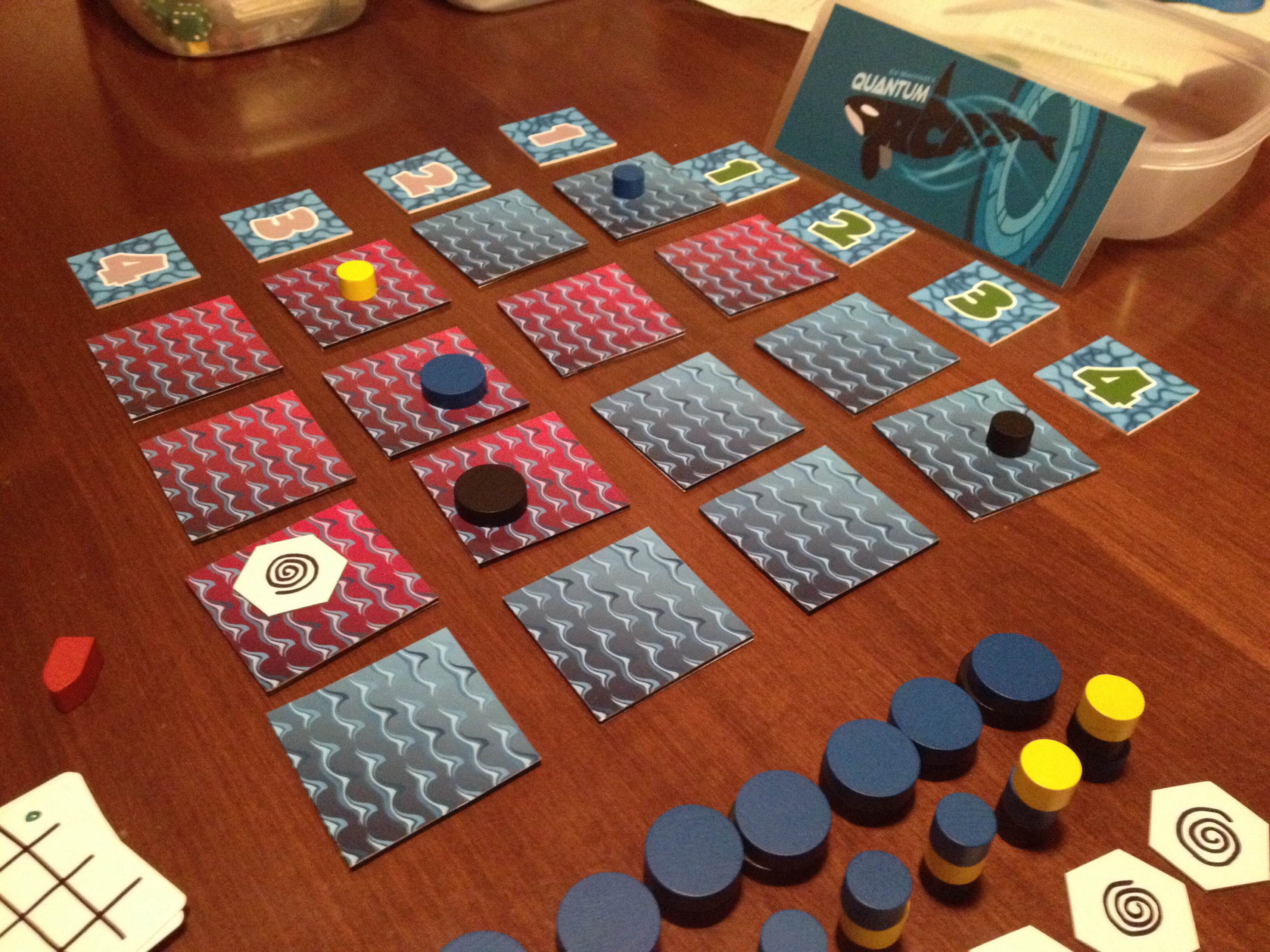
Quantum Orcas is getting there!
I have recently been making excellent strides in the design department and I owe it all to the 54 card challenge. That challenge really lit a fire under me and I tried as hard as I could to come up with something worthy of the challenge. I now have a new mechanic that I plan to utilize to the fullest in a future game design. It may or may not be awesome, but it is at least innovative.
Also I designed a card game version of Scoville that plays quickly and has the feel of Scoville. I already have it prototyped and I’ve soloed it twice. The next step is to put it in front of my friends for their analysis. I’m really excited about it.
I also worked on Quantum Orcas. It is now a better game, which wasn’t hard to achieve. I added oceanic wormholes (think of them as eddy currents) that open up the game quite a bit. I also changed things up a bit to eliminate the All-or-Nothing nature of ties. I’m hoping to submit my friends to this one as well. This is a game I would probably put up for sale on The Game Crafter, but probably not pitch to publishers. We’ll see where it goes.
And I’ve got big plans for 2014. I’ll have an article on the 1st about my Boards & Barley goals for the year, so you can look forward to that.
***
There you have it… the final Monday Brews of 2013. What Boards and Barley did you enjoy over Christmas?
Design Update 12-5-13
Every once in a while I like to step back and take a look at what I’ve been working on. Last night I was putting together some components with “final” artwork so I can make a gameplay video for Scoville and I realized that it had been a while since I made any prototypes. And that got me thinking I should step back and take a look at what I’ve been working on. Let’s start with the hottest Euro farming game ever…
Scoville
This game is currently preparing to launch on Kickstarter. That means that art is being worked on with a feverish pace. I’m not really an artist, at least in these terms, so I can’t say how much work actually goes into it, but it seems to be a lot. There are so many different components that require artwork (orders, recipes, boards, player shields, bonus abilities, bonus point tiles, box, rulebook). Each of these is no less important than any others.
My work on Scoville has been pretty minimal. I am, however, hoping to receive more final artwork so that I can put together a prototype copy with that artwork and make a gameplay video for the Kickstarter campaign. When I receive more artwork I’ll see if I can give you all a little teaser or two!
Brooklyn Bridge
I worked on this game one morning at BGG.con and made some awesome progress. I suppose it wasn’t progress as much as it was a breakthrough in the design. The game had previously been dry and lacking important decisions.
Brooklyn Bridge is a worker placement game where you send out your crew to obtain materials and build the bridge. You can also hire more crew. So far everything I’ve mentioned sounds like a re-theme of Stone Age. While elements of Stone Age are present in the design, the hook is that players not only place workers in a turn by turn order, they also remove workers and perform the actions in a turn by turn order. This adds a time dependence of when you activate workers each round. This is where the design differs greatly from Stone Age.
The breakthrough that I had at BGG.con was to incorporate public goals in the game, not dissimilar to the orders and recipes in Scoville. These goals would be for building different parts of the bridge. Pieces of the bridge should be built in a certain order and players earn bonuses for building them correctly. While Stone Age has it’s endgame scoring based on your game status (food track, # in tribe, etc.) Brooklyn Bridge scoring is based on how much your crew contributed to the bridge. I am plowing forward on this game and my goal is to have a playable prototype in January.
Dice Hate Me 54 Card Challenge
I am pretty excited for this contest. I know the awesome people from Dice Hate Me and it would be an honor to win this contest and get to work with them. For information on the contest itself go here.
Here’s the issue I have… knowing them they are seeking something that is awesome and has a unique and flavorful theme. I unfortunately currently have neither. I guess I had better start cooking something up!
Quantum Orcas
A while back I mentioned that I would be putting this on The Game Crafter once I was happy with it. Unfortunately between BGG.con, Thanksgiving, and now the 54 card challenge I have not had time to work on this most awesome of games.
On the upside I have a plan for how to make the game better. Since the time after Christmas is usually a down time for a lot of things I should have time to finalize what I want the game to be. Then after I’ve played it at least 40-ish times I might feel comfortable posting it for sale on TGC. So those of you who love time traveling killer whales shouldn’t have too much longer to wait!
Conclave
Ah, Conclave… what to do about you. We’ve had a love/hate relationship so far and I imagine that will only continue.
So Conclave is my game design about getting yourself elected as the next pope. The game includes manipulation of the Cardinals by persuading and influencing their votes. The problem with the game is that it is only pseudo-fun for one round and the game lasts 4 rounds or more.
I have a solution that could make the game fun and more interactive without adding any length to the game but I have been avoiding it. If I sat down for a day or two and worked away on Conclave I think I could have something enjoyable. I’m hoping to get to this during the long hours of nighttime in January and February.
***
That’s where I stand from a game design perspective. It’s always been fun for me to work on this stuff and I appreciate you reading about my design efforts. I hope to report back by the end of January with some awesome updates!
Monday Brews: BGG.con Recap
It’s Monday and there are two inches of fresh snow on the ground in Madison this morning. But I am back from BGG.con and am happy to provide a special recap version of The Monday Brews for you! My BGG.con experience was awesome, so let’s not delay in the telling of tales and sharing of stories in the Monday Brews.
The Barley:
While I was at BGG.con I only had a few brews. The hotel bar had a very small selection so I basically skipped the Barley portion of the week. I did sneak in a few brews and here they are…
 Shiner Bock: This seemed to be the staple both at the bar and available in the coffee shop. So I had a couple of these. Unfortunately the $7 per bottle price tag was a little steep for me so I didn’t have more. This isn’t what I would consider a great beer, but it’s from Texas, so that counts for something, I think.
Sierra Nevada IPA: This was the on tap beer for the “Cash & Carry” food section offered at the convention hall. My awesome publisher was kind enough to purchase one for me while I was demoing Scoville. I’m not an IPA guy, but it hit the spot.
Some Texas IPA: While having an entertaining evening at the hotel bar before heading to a party I was able to enjoy some other Texas IPA. I have no idea what brand it was and neither did the waitress. Oh well.
The Boards:
In a typical week I play between 2-7 games. In last week’s BGG.con week I played or taught 36 games! I’ll be recapping each BGG.con day with the games I played.
Wednesday…
On my flights I got in my first two games of the week. Those were Ascension and Le Havre. I can’t sleep on planes so having these games helped pass the time. I arrived in Dallas around 2:15 and headed straight to the convention. Since I was there to demo Scoville I immediately went to the demo area and set it up. Table D6 in Demo Land would be my home base for the next four days.
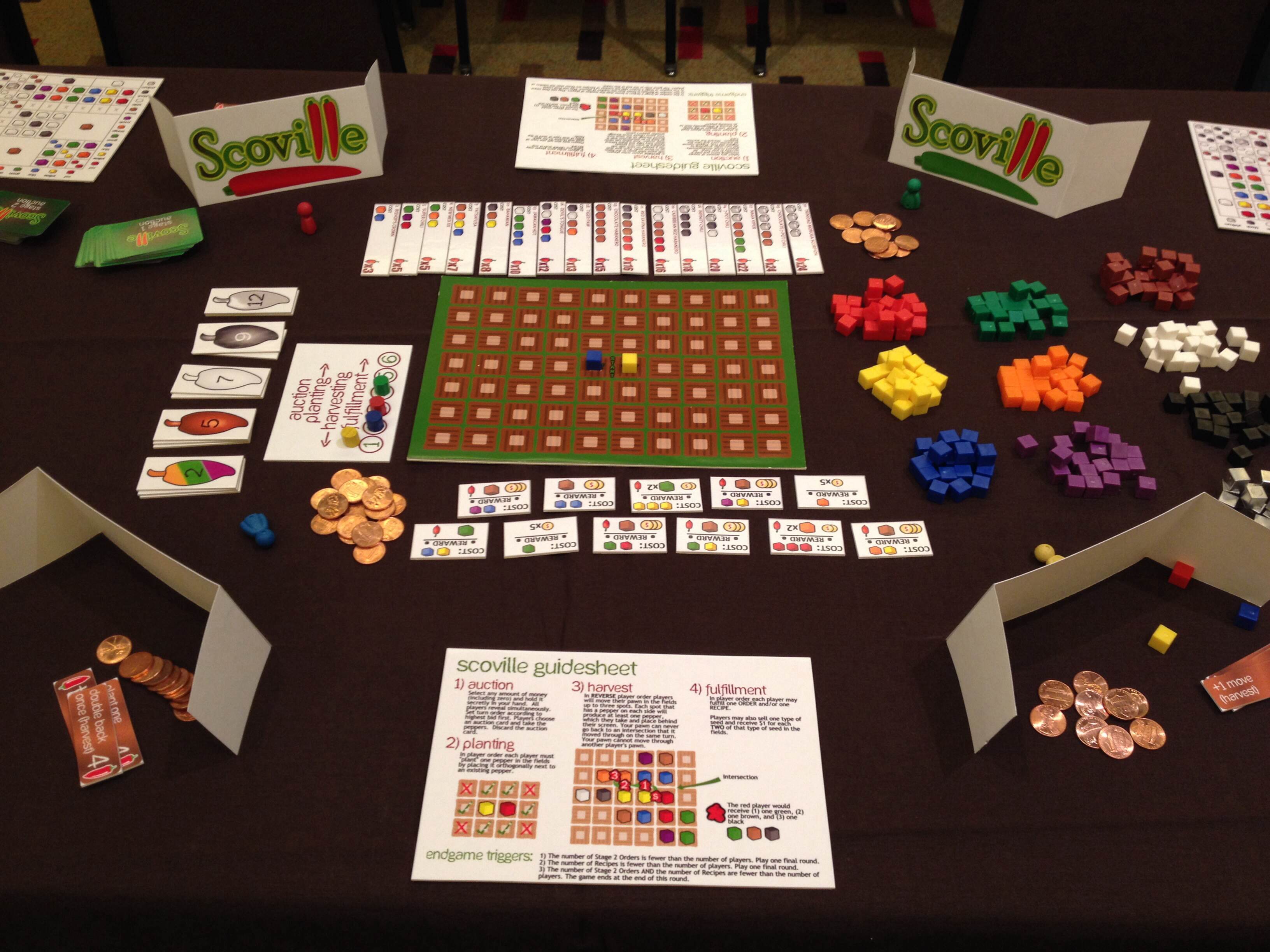
Despite prototype art people were still interested in playing!
Scoville Demo x4: Wednesday afternoon/evening I was able to run four demos of Scoville. I had already visited the exhibit hall and snagged one of the last five copies of Glass Road. I’m glad I didn’t wait to get one. My big mistake while running demos was not documenting who played them. Gil Hova has a great recap article on BGG where he links to all the players who he played with and I wish I could have done the same. At least I learned something. After four demos it seemed people were liking the game. I was pleased with that.
Glass Road: After leaving the demo hall I found the Tasty Minstrel guys in the Jonsson room and we sat down to punch and play my copy of Glass Road. Seth had already played so he was able to teach us. I was already a little brain burned from the 4 Scoville demos so I didn’t play a very good game, but I’m glad to have bought a copy since I think it is fun and interesting and short enough to make regular visits to my gaming table.
Bang! The Dice Game: I like Bang and think it’s a fun game, but with player elimination I think it’s a little too long. Enter the dice version. I played this with Chris Kirkman of Dice Hate Me, Darrell Louder of Compounded and UnPub fame, Michael Mindes of Tasty Minstrel, and Scott King of game photography awesomeness. I’m not typically much of a social gamer and my face usually gives everything away. But since this is a dice version I was able to help my team lose quickly instead of dragging things out. I’m tempted to pick this up.
One Night Ultimate Werewolf: I had never played Werewolf before. In fact I feel really bad that I always thought people looked really goofy when playing. I blame that on ignorance. The new One Night Ultimate Werewolf not only has really nice looking artwork, but it’s a lot of fun. With the same group as Bang The Dice Game we had one particularly funny moment when the reader, who shall remain nameless, was reading the part about the “Troublemaker” and instead of reading down into the rulebook like for the previous players he lifted his head while reading the troublemaker portion and gave himself away. It was really hilarious when we all lifted our heads and started laughing.
Thursday…
I woke up early to head to the coffee shop and grab a strong caffeinated beverage and worked on some game design until the exhibit hall opened at 10. After a quick walk through the hall including purchasing the new Ticket to Ride: Nederland, I was back in Demo Land for more Scoville. Here’s what the gaming hall looked like:
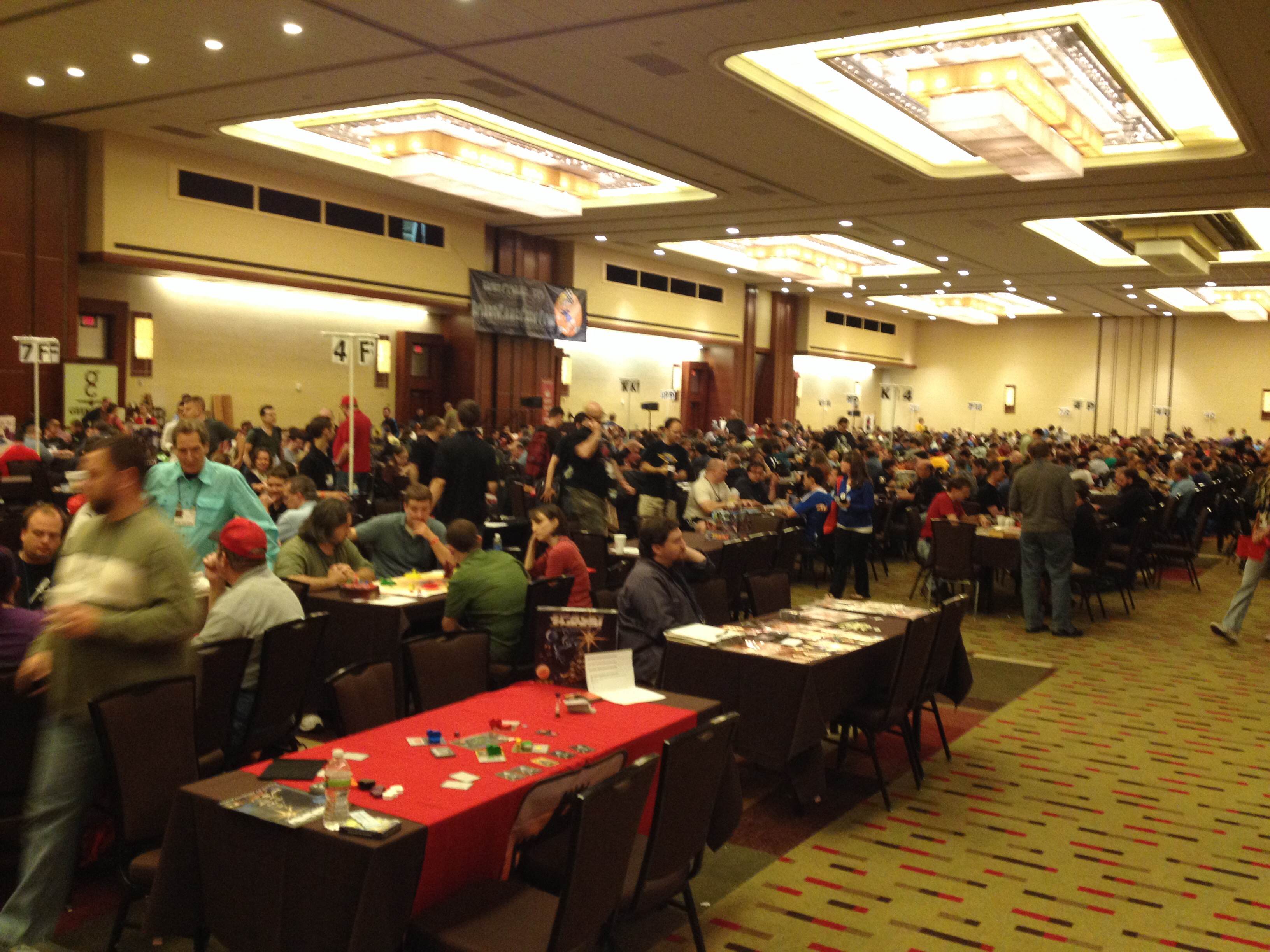
Pure gaming Awesomeness! (Apparently also pure gaming blurriness)
I was able to run 4 more Scoville demos before I realized that I was hungry. After snagging some food I joined up with the awesome Benny Sperling and his wife Jax for some non-Scoville gaming. It was a nice break.
Trains: I’ve played Trains a few times so far and I think I enjoy it. I like that it has similarities to Dominion, which makes it accessible. But I dislike that it is so similar to Dominion. While having the board gives an extra dimension, there are often turns where you can’t do anything. And that’s not due to having a lot of waste in my hand because I ended with only 4 waste cards. I’m hoping that upcoming expansions pull this game further from Dominion.
 Mai-Star: This is a game about geisha and guests by the designer of Love Letter. On your turn you can either place an advertiser or a guest. Advertisers let you entertain better guests. Guests let you have special abilities when played. This is a light and interesting game that’s played over three rounds. I’d play it again but it’s not something I would buy.
Scoville x3: After Mai-Star I hustled back to the demo table where people were waiting. I not only taught them the game, but also two other groups after them. Overall I demoed Scoville 7 times on Thursday.
New Bedford: I was fortunate to know someone who had brought a print and play version of New Bedford by Nathaniel Levan and Oak Leaf Games. It is a game about a whaling town, which is a cool theme. Your goal is to send out boats to capture whales. But the coolest part about the game is how the town itself actually gets built. Players have worker placement spots where they can gain resources or money, or build buildings. Buildings can then be used as worker placement locations. Head to the Oak Leaf Games website to learn more. My first impression was that it was a very entertaining game and I am looking forward to playing it again!
Embarrassing Moment Nominee: In case you are unaware there is a designer with the name Alan R. Moon who designed a little game called Ticket to Ride. You might have heard of that game. It’s the one in Target with the sticker that reads “Over 2 Million Copies Sold.” Yeah, the guy is sort of a celebrity in the industry. Well, he happened to be standing near my demo table and I had to walk over and introduce myself. That was the cool part. The embarrassing part was that I immediately mentioned how I had an awesome idea for the contest that they ran last year and I started to go on and on about my idea a new Ticket to Ride. Then in my head I froze and realized that the poor guy probably gets bombarded by hundreds of ideas all the time and he probably doesn’t want to hear one from some dude that he just met. I basically told myself to shut up, thanked him, and walked away feeling like an idiot.
Friday…
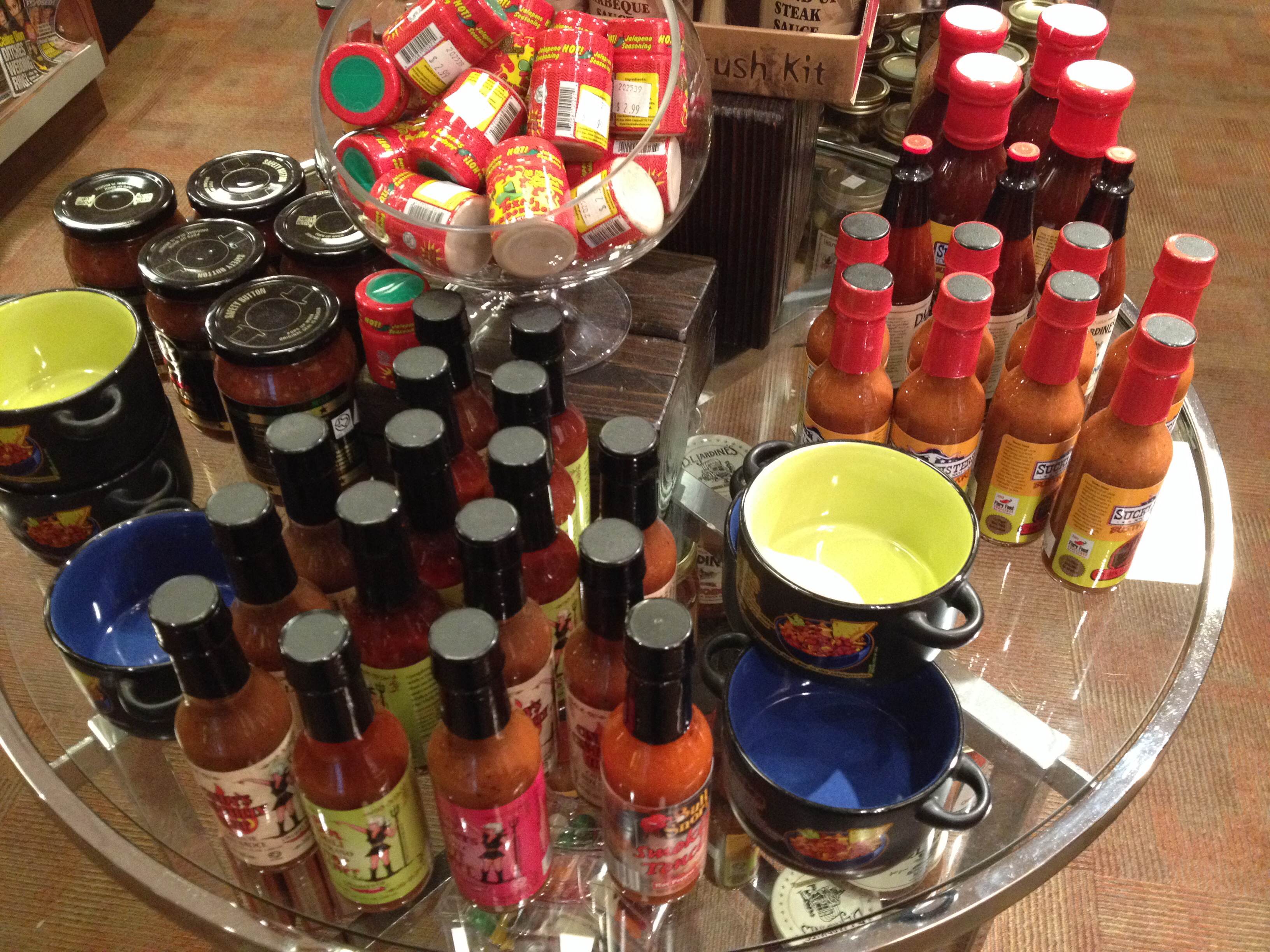
Gift shop items that reassured me I was demoing Scoville in the right state!
Friday was a down day for Scoville with only 5 demos, but when I wasn’t demoing I was connecting with people in the UnPub Proto Alley or schmoozin with publishers.
Scoville x5: Friday’s Scoville demos were the first to have a repeat player. I thought that was pretty cool.
Compounded (With possible expansion): I love Compounded and I had the opportunity to play it with the publisher and a few others in the UnPub area. The designer was demoing it with a possible expansion that I thought made the game more interesting. I won’t mention any details about the expansion because there’s nothing official, but they wouldn’t go wrong by adding it to the game!
Double Impact: This was a prototype that I would PNP immediately if I could get my hands on the files. There was just something about the game utilizing worker placement and very interesting decisions that I found fascinating. I was also drooling over the brilliant iconography. The designer was at the table and the other player was annoyed with me fawning over the game. While the game needs a little tweaking, it has a very promising future.
Belle of the Ball: I backed this game on Kickstarter nearly on artwork and graphic design alone. I finally got to play it and I am very happy to report that it was also a very good game. The Belle cards add a lot of “take that” type of action to the game, but also allow you to increase the awesomeness of your party. I’m looking forward to this one arriving next year!
Round Trip & Enqueteur by David Short: David is a Tasty Minstrel Games alum with Ground Floor and Skyline having already been published. So it was a pleasure to meet him and play some of his prototypes. Round Trip is about getting yourself to your gate at an airport. It utilizes a mancala mechanic, but does so in a more interesting way because of the interaction between other players and the cards you are trying to score. I was pretty impressed with the state of the game considering it’s only a few months old. Then we played Enqueteur, which is a very nice step up from Love Letter. It plays similar to Love Letter but adds some interesting complications to the game. David is doing some awesome designing right now and I wish him the best!
Pitch Car: After leaving the gaming hall a few of us decided to play a quick lap of Pitch Car which was set up in the open area. The track setup is shown below. It was pretty epic. What wasn’t epic was how I played. Despite that it was a fun way to cap off the night!
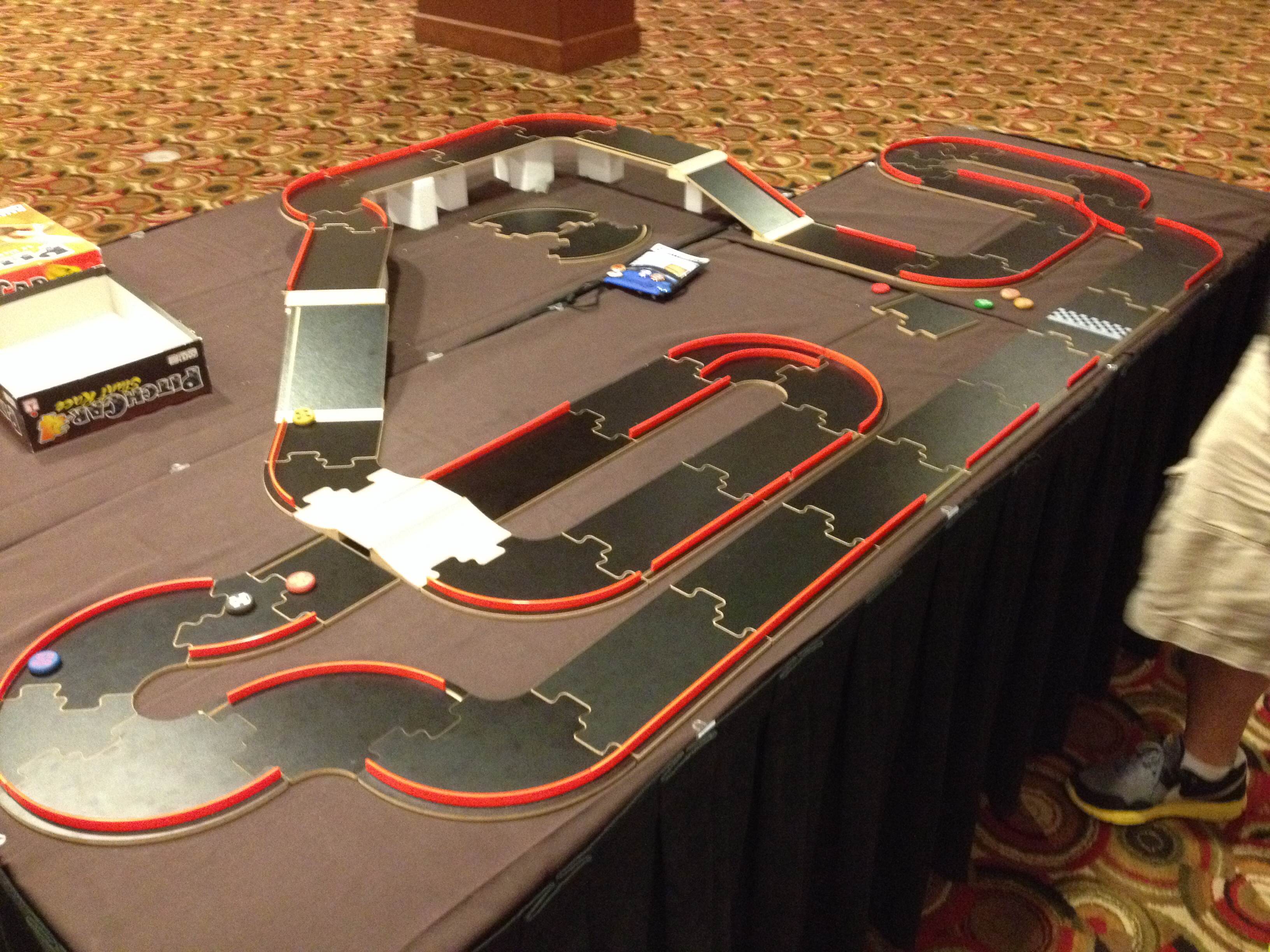
We got owned by a first-timer!
Saturday…
I started Saturday early since I wanted to get in as many demos of Scoville as I could. But it would turn out that my gaming day would begin with something called Dart Gun Desperados a.k.a. Rubber Banditos.
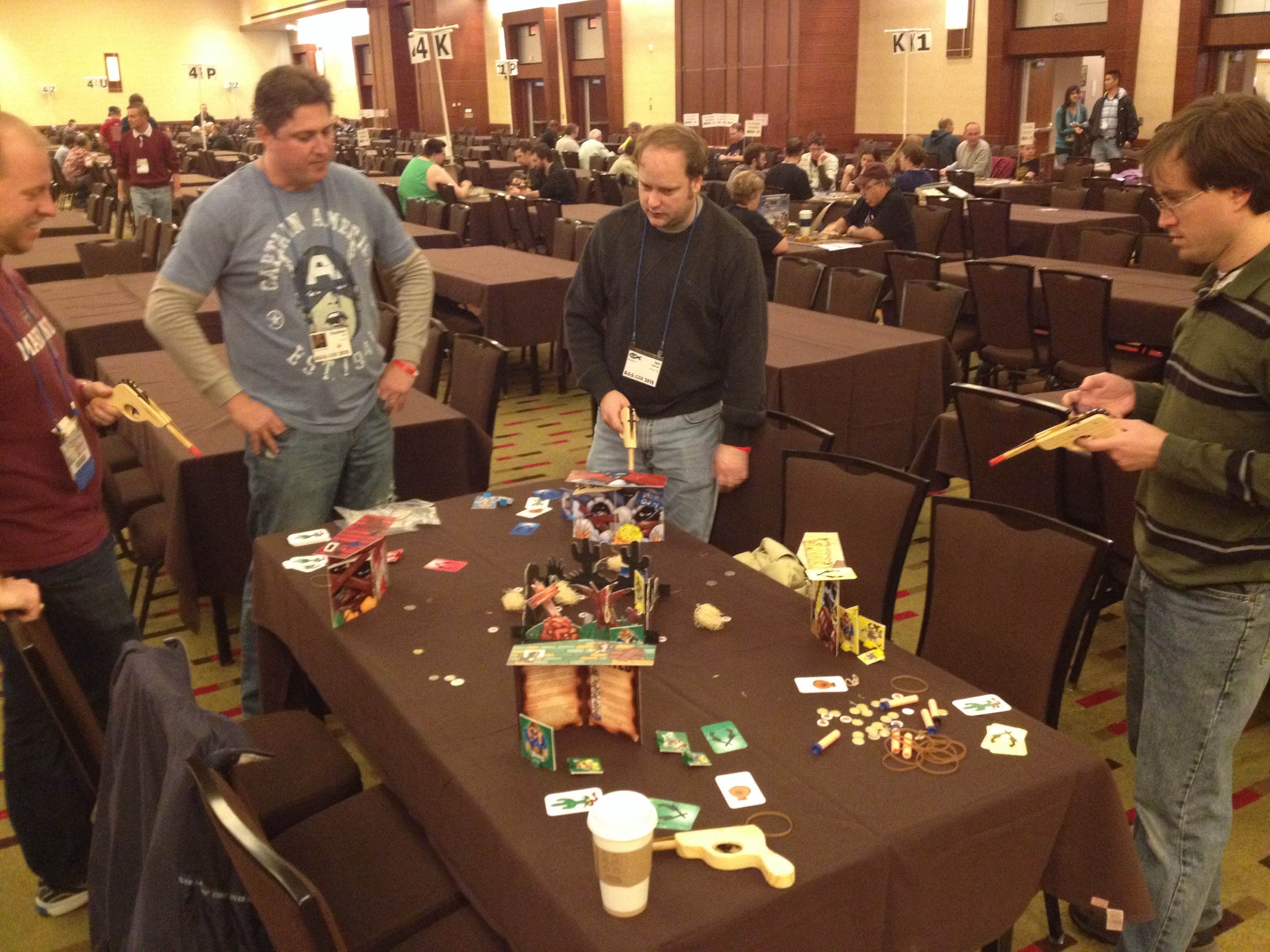
How fast an you draw your rubber band six shooter?
Rubber Banditos: This is a crazy cool game by Steve Avery, who co-designed Nothing Personal with Tom Vasel, who you may have heard of. The idea of the game is you are trying to gain money with your people. But you’d better beware or you’ll get shot by an opponent. And the shooting was done with real rubber band shooters. You would actually shoot rubber bands at your opponents figures. While I ended with no money, the gameplay itself is what made the game for me. The best part is the gun fight where you duel with an opponent. Steve was awesome to meet and talk with and I look forward to enjoying a brew or two with him in the future!
Scoville x5: One of the highlights of the convention was that I got to play Scoville with both Seth and Michael from Tasty Minstrel. It was interesting to see the strategy of how they played. And it was also very nice after the closing ceremonies when TMG gave me the okay to wrap up the demos. With 22 demos under my belt I increased my number of plays significantly. And I can honestly say that I did not get sick of the game. Thank you to all who played the game. I am honored and humbled by your kind words.
Going, Going, Gone: Appropriately enough the very last game I played was Going, Going, Gone. This is an action auction game where players try to bid on five different auctions at the same time. We were playing an adult version that featured some of the Shiner Bock that I mentioned above and we were taught by the spunky Betsy Ross. It was sheer fun, unless you kept getting beer spilled on your arm.
Embarrassing Moment Nominee #2: I have an issue with dragging out stories and Saturday night was one of those moments. I was trying to tell the story of how I met a publisher at GenCon 2 years ago and failed to pick up the check and then how I met another publisher 2 years ago and submitted a crappy game, and how ultimately those are the two publishers I am now closest with. It’s actually a really cool story but should only take about 5 minutes to tell instead of fifteen. Afterword someone with clout in the biz said, “That was the longest story ever!,” but with mildly stronger language. I felt bad about wasting their time. If you ever want to hear the story I’ll be happy to practice a short version before telling you the story.
My BGG.con experience wrapped up with the I’m Board With Life crew who were throwing a party in their rooms. We had an exceptional bartender for starters, but I was also able to meet Quinns from Shut Up Sit Down. That was pretty cool, especially since he said Scoville sounded interesting! I also had an inspirational moment about greater stuff in life when chatting with the wife of one of the I’m Board With Life guys. She helped me gain perspective on life in Central America and I am afraid to say that we in the US don’t have the right understanding of Latin American culture. If I took nothing away from BGG.con other than that conversation, then it still would have been worth it. I couldn’t thank her enough for her honesty.
Other Awesomeness:
BGG.con is a fantastic convention. I love that it is singularly focused on board games. I love the intimate feel where it’s like you’re all part of a family. And I love that there are so many amazing people who attend. I met so many of you and I’d love to list you all but I know I would forget some. Needless to say, BGG.con is great for networking and socializing with really awesome people.
I also enjoyed the exhibit hall since it wasn’t like fighting for survival the way the GenCon exhibit hall can feel at times. It’s so casual and you can just chat with people and make lasting connections. I particularly enjoyed my conversation with the awesome couple behind MeepleSource.com. They had a great booth and they offer awesome stuff to spruce up your games.
I specially want to thank Darrell Louder for his time contributions to run the UnPub Proto Alley. While I did not have the chance to participate, I understand what an awesome venue it can be for aspiring game designers. It offered the chance for designers to get and give feedback for prototype game designs. That’s the same way that I first got Scoville to the table in front of other designers. I’m not sure if there is a better way for networking and bettering your designs than things like UnPub. So make sure you thank Darrell when you get a chance. He’s an awesome dude.
My only regret of the convention is that I did not get to play most of the Hot Essen Releases. These included Amerigo, Lewis & Clark, Machi Koro, Concordia, Caverna, Nauticus, Russian Railroads, Nations and Madeira. They were sitting so tantalizingly close to my Scoville demo table.
Thanks to everyone who took the time to play a prototype of Scoville. I am humbled that so many people were willing to sit at a table and play a prototype when all the Hot Essen Releases were just mere feet away. BGG.con was a fantastic experience and I’m very much considering going back next year.
 Boards and Barley