Category Archives: Prototyping

Sourcing Game Components: Chits

Unpunched chits from Small World.
Today I’m posting the third article in a four part series about where to buy components for your game designs. Last week I posted about Meeples. The previous week I posted about cards. Today is about those obscure little components so nicely referred to as Chits. Here is a list of the four articles in this series:
- Sourcing Cards: 9-5-13
- Sourcing Meeples: 9-12-13
- Sourcing Chits: Today!
- Sourcing Dice: 9-26-13
First, a disclaimer: There is nothing quite like that fresh new board game smell when you pull off the shrink wrap and open a game for the first time. Then you have the awesome moment of getting to punch out the chits and that really makes you feel special. I love that!
Today, however, we are not talking about unpunched chits, but rather blank chits that you can use for prototyping your game design. These include circles, squares, hexes, and more.
As a reminder I want to give credit to the list that inspired me to write these articles. This list is much more exhaustive than mine since I am just highlighting a few of the major suppliers. But here’s the list so you can check it out yourself:
So today I present a few of the sources that I think are worth checking out…

SpielMaterial.de
If you are of the European contingent, then I would suggest starting with SpielMaterial.de. They have a very nice assortment of chits that you can purchase. Here is the link:
On their page you can purchase triangles, hexagons, squares, rectangles, diamonds, circles, and more. They seem like an excellent option for purchasing chits.
Print & Play Productions
 I have purchase hexagon chits from Print & Play in the past and have been very pleased. I like to buy the blank tiles with white on both sides. You can order them with your own artwork as well, so keep that in mind. Here is their page for “Counters”:
One of the nice things about Print & Play productions is that if you order the hex tiles, you’ll also receive the little rhombuses that were in between the tiles. And those could potentially be useful in a future game design! Available to you are triangles, circles, squares, rectangles, and hexes.
The Game Crafter
 While my go-to source for chits is Print & Play it is necessary to add The Game Crafter into the list as well. If you are ordering cards and meeples from The Game Crafter, then you might as well order some chits too! Here is a link to one of the chits they offer. Below the main area they link to similar items:
They don’t have nearly the variety of SpielMaterial or Print & Play Productions. And you have to deal with the lead-time issue. But it sure is convenient if you can order all of your components from the same source.
Superior POD
 While blank counters are not available, Superior POD (Print On Demand) does offer printed square and hex tiles, but only of limited sizes. Here is the link:
They only offer 2″ hexes, 1″ squares, and 5/8″ squares. So it’s pretty limited, but it appears that they might be mailed to you unpunched, which is sweet.
So there you go. I know this is a short list, but I think that’s because there just are not very many sources for board game tiles like these. If you know of other sources that have quality components available, please let me know and I’ll add them to this list.
Thanks for checking this out. I hope it helps you as you build your game prototypes!
Sourcing Game Components: Meeples

A Mash of Meeples!
Last week I posted the first in this series of four articles about sourcing components for your board game designs. That article was about sources for cards. Today I’m covering my go-to sources for meeples to use in games. Here’s the list of what I’m covering in this whole “Sourcing” series:
- Sourcing Cards – 9/5/13
- Sourcing Meeples – Today!
- Sourcing Chits – 9/19/13
- Sourcing Dice – 9/26/13
So that’s the list I’m working with. Those are probably the four main components you are likely to use in a prototype. When I refer to “Meeples” I am referring to the components that are used to mark your spot or location on the board or player mats. Meeples can mean different things to different people.
As I wrote last week I want to give credit to the list that inspired me to write these articles. This list is much more exhaustive than mine since I am just highlighting a few of the major suppliers. But here’s the list so you can check it out yourself:
I have picked a few of those sources to add to the ones I also use. And like last week I’ll start with The Game Crafter since they are my go-to source for these things.
The Game Crafter
First things first: If you order pawns or anything that doesn’t have to be printed, you still need to wait your turn in the production queue. I recently placed an order for 30 pawns that cost a total of about $5 and I started out as #550 in the queue. The estimated ship date was October first. I know that they have the pawns just sitting over there. I bet I could drive over and simply ask if I could buy the 30 pawns and get them the same day.

The avatar pawn
Here is their page for pawns: The Game Crafter – Pawns
I like to use the Avatar pawns. They cost 14 cents each and are not ugly. These have worked well for me in the past and I’m looking forward to getting my set of new pawns so that I have enough for a few more prototype copies of Scoville. They are just simple and easy. No need to get complicated for a prototype! But if you want to mix things up, this next source might be the right one for you…
Meeple Source

My favorite is the pirate with the peg leg!
I’ve never bought from Meeple Source, but after giving their site a long, drooling look I think they might serve me well in the future. They offer the following categories of meeples from which to choose:
- Standard Meeples
- Mega Meeples
- Mini Meeples
- Super Mega Meeples
- Character Meeples
- Camo Meeples
- Sets of Meeples
- “Misfit” Meeples
Wow. And if that wasn’t enough, you can also check out their Plush Meeples!
This site has a TON of meeples to offer and I’m afraid I should have listed them lower in this article because I feel there really isn’t any sense for you to continue reading. But please continue anyway!
SpielMaterial.de

Is that Gandalf the Red??
If you happen to be an awesome reader from Europe, I’m glad you’re here. If you are interested in meeples or pawns, then you might be interested in ordering from SpielMaterial.de. They are a European vendor of board game component awesomeness.
Here are some links:
They have so much to offer that it’s worth just browsing on their website. You might get inspired for a game design simply by looking at all the things they can sell you.
Boards & Bits
I have ordered from Boards & Bits in the past and was pleased with the service I received. Boards & Bits must have a HUGE warehouse to accommodate all the products that they carry. Their options go well beyond pawns and meeples. Their website isn’t the greatest since it is a little difficult to navigate, but they just offer so many things that I can easily look past that.
You will mostly find typical meeples and pawns at Boards & Bits. They don’t offer the painted meeples the way that Meeple Source and SpielMaterial do. But if you want a cheap source for prototype worthy pawns, then perhaps Boards & Bits is for you!
CraftParts.com

What a lovely little meeple family!
If you are only interested in little wooden people, then maybe you should check out Craft Parts. They offer a small assortment of wooden people figures that might work great in your prototype.
CraftParts.com – Little Wooden People
These components range in size from 1 1/8th inch to 3 9/16th inches. So these are quite a bit larger than your standard meeples. But maybe that’s what your looking for because you typically play games with giants. These will help those giants grab onto the pawns much easier!
***
So there are a few of the numerous online sources for meeples and pawns. If there are any major vendors that I have overlooked, please let me know and I will update this list. Thanks for reading!
Sourcing Board Game Components: Cards
 This is the first in a series of articles that are meant to help aspiring designers and published designers alike. The goal of these articles is to simply list some of the sources for different components that we designers like to use in our game prototypes. While I have not used all of these different sources, I’ve done my research and feel confident that you’ll receive a decent quality production from any of these sources.
Today’s post is about sourcing cards for your prototypes. But over the next few Thursdays I’ll be posting articles about other components:
- Meeples
- Chits
- Dice
They won’t be dreadfully exciting articles, but I hope they can help you out as your on your way toward a high quality prototype. But first, my inspiration comes from this post:
That is a way better list than I’m going to make. But my sources seem to be some of the more mainstream sources. If there are component sources that you use, and like, that I have not mentioned in these articles, please let me know and I’d be happy to keep these articles up to date.
So let’s get to the sources I would use for cards… Note: The Game Crafter is my go-to source, and thus they are listed first.

The Game Crafter
This is the one source that I have used. They have a large number of sizes available. They provide a template for each size. And overall I have never had any problems with my cards. They are not going to be the highest quality, linen finish, and all that, but they are great for putting together a quality prototype that you could feel confident pitching to a publisher.
Here’s the details about sizing and pricing (click the link to go to the template page for each item):
| Printed Item | Cost Per Sheet | Cost Per Item | Items Per Sheet | Image Size (in pixels) | Finished Size (in inches) |
|---|---|---|---|---|---|
| Bridge Deck | $1.56 | $0.09 | 18 | 750×1125 | 2.25 x 3.5 |
| Business Deck | $1.89 | $0.09 | 21 | 675×1125 | 2.0 x 3.5 |
| Hex Deck | $2.29 | $0.19 | 12 | 1200×1050 | 3.75 x 3.25 |
| Jumbo Deck | $1.25 | $0.21 | 6 | 1125×1725 | 3.5 x 5.5 |
| Micro Deck | $3.99 | $0.07 | 56 | 450×600 | 1.25 x 1.75 |
| Mini Deck | $2.89 | $0.09 | 32 | 600×825 | 1.75 x 2.5 |
| Poker Deck | $1.56 | $0.09 | 18 | 825×1125 | 2.5 x 3.5 |
| Square Deck | $2.29 | $0.19 | 12 | 1125×1125 | 3.5 x 3.5 |
| Tarot Deck | $1.89 | $0.19 | 10 | 900×1500 | 2.75 x 4.75 |
When you upload files you can upload a bunch at once, or one at a time. When you are ready to have them printed, you’ll have to “proof” each one. When I order cards I usually go with the Mini Deck since you can get them for a pretty good price. They are also one of my favorite sizes for games in general. They are large enough to hold a lot of information, but small enough to not be a nuisance.
ARTSCOW
 My wife has used ArtsCow for a few scrapbooking things, so I can attest to the quality of those. However, I have not used ArtsCow for any cards. So take this for what it’s worth.
On the ArtsCow page you can choose from custom playing cards, cards shaped like circles, and cards shaped like hearts. While ArtsCow doesn’t seem to have the game designer in mind with their products, I think people have had success with ordering customized cards.
The best option I’ve seen for custom double sided cards is the “Multi-Purpose Cards.” This seems like the best option for custom double sided cards from ArtsCow. They measure 2.5″ x 3.5″ and start at $10.99 for a 54 card deck, which seems quite high for 280 gsm matte paper. But like I mentioned, they don’t think like game designers.
Printer’s Studio
 I have not used Printer’s Studio for any cards, but I know people who have. Like ArtsCow most of their options for cards are decks of custom playing cards. But they do have a page for blank playing cards that can be fully customized as well.
Sizes include:
- Mini Size (1.75″ x 2.5″) starting at $4.39 for up to a 64 card deck
- Bridge Size (2.25″ x 3.5″) starting at $7.99 for up to a 54 card deck
- Poker Size (2.5″ x 3.5″) starting at $7.99 for up to a 54 card deck
- Tarot Size (2.75″ x 4.75″) starting at $1.89 for up to a 10 card deck
- Large Size (3.5″ x 5.75″) starting at $13.99 for up to a 54 card deck
Those prices seem a little high to me, but these are for 300 gsm card stock. Each card size also has an option for 310 gsm linen finish.
Print & Play Productions
 While I have not ordered cards from Print & Play, I have ordered hex chits. I was very pleased with their quality, so I would likely be pleased with the quality of the cards as well. But that’s not a guarantee.
Print & Play offers several sizes of blank or custom printed cards:
- 1.75″ x 2.5″ 270 gsm starting at $2.00 for 32 cards printed on both sides
- 1.75″ x 2.5″ 270 gsm starting at $2.25 for 78 blank cards
- 2.5″ x 3.5″ 270 gsm starting at $2.00 for 18 cards printed on both sides
- 2.5″ x 3.5″ 270 gsm starting at $2.00 for 52 blank cards
They also have an option for a letter size sheet of custom cards starting at $1.25 for double sided printing.
Other Sources: EAI / Amazon
If all you’re looking for is blank cards from which you can make a prototype, then perhaps EAI or Amazon is your best bet. Here are the details:
EAI: Single deck of 54 blank playing cards is currently $0.99 per deck (regular price = $1.55 per deck)
Amazon: 500 Blank cards for $13.50
***
So those are the sources that I am most familiar with for blank cards. The other option is to use something like nanDECK and create/print your own cards that you could then sleeve. I haven’t had much luck trying to use nanDECK, so good luck with that.
Please let me know if you use someone else. I’d love to add it to this list and make it more complete. Thanks for reading. I hope this list and the next three covering meeples, chits, and dice will be helpful to you as a designer!
Prototyping Tools of the Trade
Tools of the Trade
One topic that seems to come up a lot is how to make board game prototypes. I’m not talking about coming up with a design. I’m talking about physically creating prototype game components. Game designers are constantly trying to make their components so that they can get right to the playtesting phase of game design.
Today I want to discuss the tools I use to create my prototypes. At this point you should already have your prototype artwork created if you’re going to be printing anything. Let’s assume it’s already been printed. Now it’s time to make it awesome!
Chits…
One common component that is particularly easy to make for prototypes are chits. These are typically just printed artwork glued onto matte board. But matte board can prove to be difficult to cut.
There’s two ways that I’ll cut my chits out of the matte board.
- Straight edge and utility or X-acto knife (not ideal)
- Rotary cutter (ideal)
What we are doing here is separating the chits from one another. When creating your artwork you should line up the edges of the components so that you only need to make one cut between them.
This will help you keep your fingertips!
The straight edge and knife approach is definitely NOT my approved method and I would never recommend it. However, a lot of people use that approach so I needed to mention it. One recommendation is to use a safety straightedge like the one shown here. You only have 10 fingertips so why not spend a few extra dollars and get a straightedge like this and make sure to not lose any fingertips!
I don’t like this method for a few reasons. The first is that you need a cutting mat to go underneath so you don’t scratch your table. The second is that the blade doesn’t always stay straight as you are cutting the matte board. And that can be really annoying.

Just get this thing instead!
My preferred method is to use a rotary cutter like this Fiskars 12″ Scrapbooking version. It is super easy to use, relatively cheap (especially compared to the $40 safety straightedge), and very reliable. And since most of us don’t have printers that print on anything other than 8.5×11 paper anyway, the 12″ Fiskars tool is perfect!
So I will print my prototype artwork on photo paper, adhere it to matte board, and then cut out the individual components using the rotary cutter. Just a heads up when using matte board though: you’ll likely have to roll the cutter back and forth a few times to cut all the way through. That’s still an easier process than trying to run a blade along the straightedge.
On the topic of matte board, I recently went to Hobby Lobby and purchase two huge packs of “matboard” for $6 each. I got a pack of 12″x12″ and a pack of 11″x14″. These are so cheap that I almost felt like I was stealing. They are just the leftovers from the framing department that were cut out from the boards used to mat pictures/paintings for customers. What a great way for Hobby Lobby to reduce their waste and provide a useful product. Here’s what I got for $12:
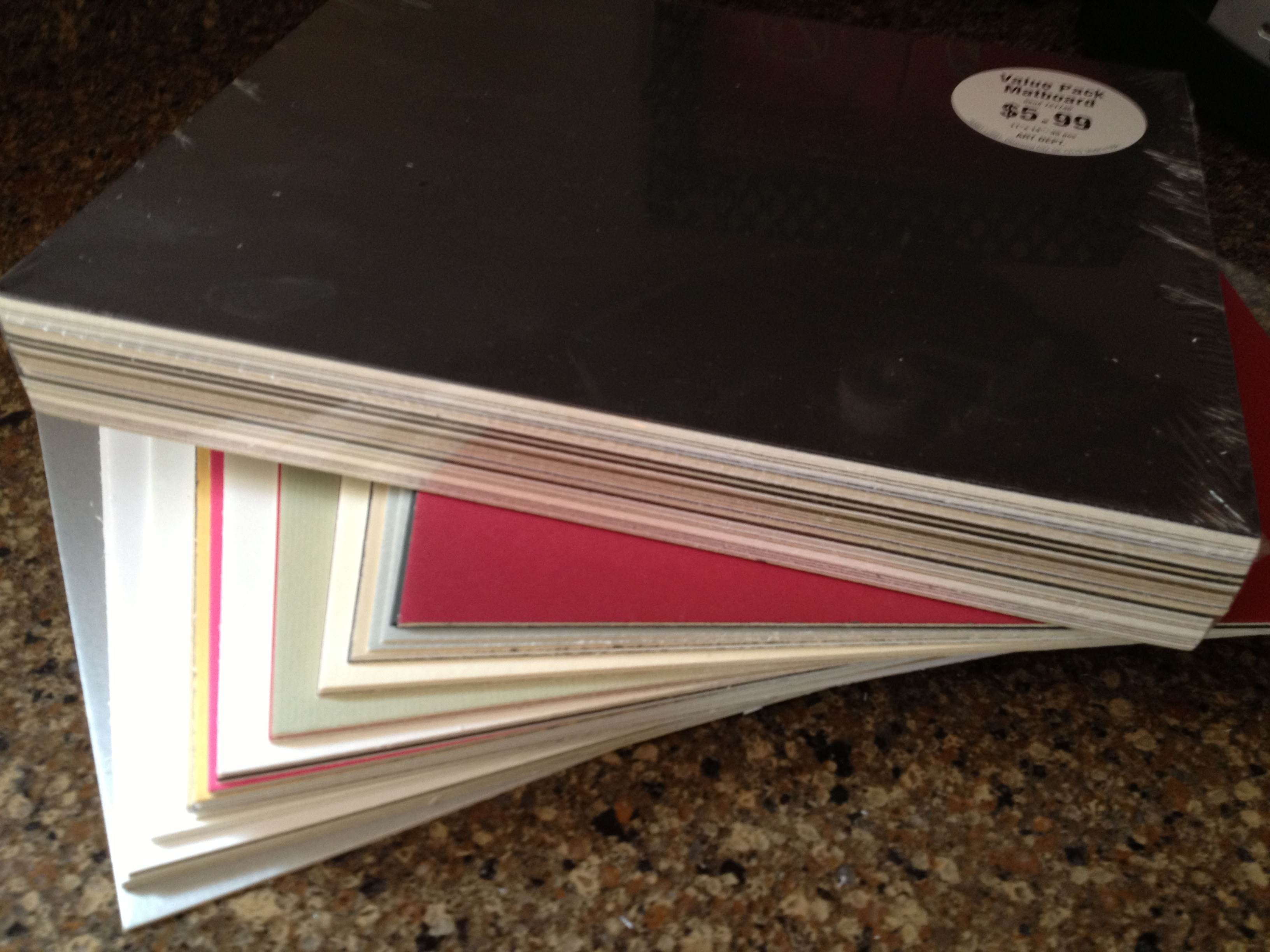
So cheap!
The other key tool of my trade is a glue stick. Some people will use standard glue, some will use spray adhesive. I prefer the glue stick to standard glue since it is simple to apply evenly. This is very helpful when trying to make sure that your components are completely glued down.
Now you know a great method for producing chits. If possible, keep them as rectangles rather than circles of hexes. But since we’re on the topic of circles and hexes let’s move on to another excellent tool…
Punches…
There are times when you don’t want rectangular components. Perhaps your game is a map building game with hex tiles. Or perhaps you require special discs for your game. If that’s the case, then I strongly urge you consider purchasing a punch.

The hex punches from Fiskars work great!
One thing to keep in mind when purchasing a punch is how thick of paper/board are you wanting to punch. Often these sorts of punches are used by scrapbookers who are only punching paper. That means they may not be able to punch through matte board. Sometimes you can only find out after you’ve bought the punch. Bummer.
Here are some recommendations, keeping in mind that I don’t know specifically how thick they can punch. OR you can just do a search for “hobby punch” and find one you’d like.
- Fiskars Squeeze Hex Punches
- Creative Memories Punches
- Older Creative Memories Hex Punches on eBay
- And don’t forget the Corner Rounder punch which can be helpful for cards that are printed on nice canvas/linen finish paper.
These can come in really handy. I use a circle punch when creating prototype coins. I have used a hex punch to create stickers for hex tiles. And here is my little tip for punching, which I mentioned in a prototyping article a long while back, but which is worth repeating.
When punching, flip the punch over so you can visually align the part that you want cut.
So now you’ve got the tools to cut out chits and punch out little bits of awesomeness! What about cards?
Sleeves…
Many game designers come across the need for cards in their game designs. I have made cards numerous times. Early on I would buy 60lb. paper and just cut out rectangles. But there is a problem with that. The edges of the rectangles can be slightly bent from cutting, which leads to great difficulty in shuffling the cards.

Mayday sleeves are convenient and cost effective!
The way to prevent that while also protecting the cards is to purchase card sleeves. These inexpensive beauties will be a little lifesaver by removing anguish from your prototypes. Plus, you can get awesome one’s like the one shown here with a kitten running through a field!
If you want a good go-to source for sleeves then look no further than Mayday Games. Here is a series of links to the sizes you may be looking for:
- Euro Cards (59×92 mm)
- Mini Euro Cards (45×68 mm)
- Card Game (63.5×88 mm)
- Standard USA Cards (56×87 mm)
- Magnum Ultra Fit for 7-Wonders (65×100 mm)
Those should offer some help. They definitely help with being able to shuffle your cards. The only downside is that when stacked they can be really slippery and your stack may tumble over.
Speaking of tumbling…
Dice…
Sometimes it becomes necessary for a game designer to create their own set of dice. Sure, you could always just make a cheat-sheet conversion table, but that can be a huge burden for your playtesters who would constantly have to recheck the sheet. So one of the tools of the trade is to purchase blank, sticker-able dice.

Just think of the potential here!
Look no further than Indented Blank Dice. The best part of their site is that they have labels that you can purchase and print on rather than having to buy blank label paper and try to cut/punch out your own labels and then peel them off.
Don’t buy blank label paper. Don’t cut/punch out stickers. Don’t try to peel them.
Just buy the sticker label paper and save yourself from the frustration.
So this concludes my little article about Prototyping Tools of the Trade. Next week I will be posting a follow-up article on Sourcing Components for Prototyping. It will cover where to purchase boards, bits, and more. So stay tuned!
Game Concept: Conclave

Of course I’ve already designed a logo!
So there I was, working on Trading Post, watching the Dan Brown movie Angels & Demons when all of a sudden a new game design hit me. I thought to myself wouldn’t a game about electing a pope be kind of fun? So I changed course and laid the groundwork for a game design I am calling Conclave. (It could also be called Preferiti, Triregnum, Habemus Papem – which is already used for a game, or Fumata Bianca).
That was back in 2011. I had the idea for the game and a sheet of paper with a few details, but, like so many other game concepts, it sat on my shelf for nearly two years.
While again working on Trading Post a few weeks ago, and yes, while watching Angels & Demons (I guess I have a liking for that movie) I again was drawn to the idea of a game about electing a pope. So this time, since Trading Post is my white whale, I diverted my attention to actually conceptualizing Conclave.
Papal Conclave: What is it?
In the Catholic Church the pope is the person elected to succeed the line of Saint Peter, Jesus’ disciple. Since the dawn of Christianity there has been a leader of the Christian Church. And the Catholic Church has referred to that leader as the Supreme Pontiff, or more simply, the Pope.
Conclave is all about electing a new pope. The word Conclave is a conjunction of two Latin words, cum (“with”), and clave (“the key”). The interpretation of the word conclave is “sealed with a key.” In 1274, due to several elections taking years to decide the next pope, it was decreed by Pope Gregory X that the elections should take place inside a sealed room. This way the college of cardinals would have to elect a pope while basically being sequestered and given small rations of food and water.
Since 1846 all conclaves have taken place in the Sistine Chapel, in the Vatican City.
During conclave the cardinals of the Catholic church are locked in the Sistine chapel. They will cast their first vote in the afternoon of the first day. To elect a pope requires a 2/3rds majority for any single candidate not including that candidate’s vote. If the vote does not result in a newly elected pope, the ballots will be burned with chemicals that result in black smoke emanating from the Sistine Chapel smoke stack. Each subsequent day the cardinals will take a vote in the morning and another vote in the afternoon. Black smoke will be displayed each vote until a pope is elected. Once a pope is elected then the smoke will be white, thus informing the world that a new leader of the Catholic church has been elected.

How are you going to earn their votes?
While this Scrutinium method (secret ballot) of electing the pope is a standard method there are three others: Compromissum, Accessus, and Quasi-Inspiratio. This game design is focused on Scrutinium.
How does the Game Work?
During a game of Conclave you represent one of the Preferiti, the preferred cardinals for the papacy. It is your objective throughout the game to manipulate the college of cardinals such that you earn their votes and get elected as the next pope.
This game is all about area influence. The game will be played using cards that represent each of the players. Each player will have their own deck of cards. Half of the cards are your own player color. The other half match the colors of the other players.
The first portion of the game represents the first afternoon vote on the first day of Conclave. During this portion of the game players take turns playing cards onto each cardinal to set their initial vote. Once all the votes are in, assuming no player has a 2/3rds majority (which is physically impossible in the first round with how I’ve designed the game), then the second phase of the game begins.
The second phase is the manipulation portion of the game. One your turn you can perform one of several types of miracles/charities, each basically giving you a specific action. These are listed here:
- Miracle of Feeding: Flip the cards of any one cardinal.
- Miracle of Healing: Swap the top cards of any two cardinals.
- Acts of Service: Lock any one cardinals vote.
- Acts of Mercy: Examine the bottom card of up to three cardinals.
So I’ve mentioned cards and tables. Let’s explain. During the first phase of the game (the first afternoon vote) players will take turns placing cards on each of the cardinals. They will place one card face down, and one card face up. The face up card is the only one that matters when counting the votes. The bottom card represents the bias that the cardinal has toward another Preferiti. So when players choose Miracle of Feeding they will flip any one cardinal’s vote over to the other card.
When players choose the Miracle of Healing they will take the top cards from any two cardinals at any tables and swap them.
Acts of Service allows for any one cardinal’s vote to be locked in for the rest of the game. This cardinal can no longer be swayed. But beware, each player has only so many “locking cubes” that they can use to lock cardinals.
And Acts of Mercy allows a player to look at the bottom cards of up to three different cardinals to see which way they might be leaning. This will help players know when it might be beneficial to choose the Miracle of Feeding (flip cards) action.
How do you win?
The game board basically represents the locked down Sistine Chapel. Your objective is not to earn a straight up 2/3rds vote as that would be boring for a game. Rather, you are trying to win different tables within the Sistine Chapel. It’s an electoral college of sorts. There are tables of 3, 5, and 7 cardinals. If you possess the majority of votes at any table, then you receive a number of votes equal to the number of cardinals at that table.
So if a table of 3 cardinals has two green votes and one blue vote, the green player would currently have 3 votes. It is an all-or-nothing system.
Players play to a certain number of votes depending on how many players are playing. Once a player has successfully manipulated their way to the right number of votes then they are elected as the new pope and the game is over.
Current State of the Game…
Currently the game is in the prototype phase. I basically have it ready for solo playtesting. Right now it is a pretty simple concept and is easy to prototype. But I’m exploring a few things that could make it both more interesting from a gameplay perspective and more difficult to prototype at the same time. So for now I’ll keep it simple. My goal is to solo it this weekend and get a better idea about how to move forward with the concept.
I’ll post more about Conclave in the future, but until then check out this awesome infographic from image-illustration.net: (click to embiggen)

 Boards and Barley