Category Archives: The Boards
Board game reviews. Board game design info. Upcoming games. Convention information. All things board game related are here!
I Rolled Three 1s: A Review of Kingsburg

In Kingsburg you take on the role of a lord sent from the king to administer frontier territories. That role involves building different structures in your territory to earn points. The game takes place over 5 years for a total of 20 turns. At the end of each year you must battle enemies that include goblins, orcs, and zombies. Building structures requires resources. Those resources are gained by influencing appropriate council members. Will you influence the right council members? Will you defeat the enemies? Will your territory be the best? Try it out by playing Kingsburg.

The board looks beautiful!
The game comes with a spectacular board, numerous dice in 6 different colors, several sets of colored cubes to represent different resources, player tokens to mark structures that have been built, cards to represent the enemies that will be faced at the end of each year, and player mats that list the structures that each player can build.
This game has a very interesting mechanic of dice placement. All the players role their colored dice. Then one at a time those dice are placed on an advisor location on the board. For example, the advisor in the #1 spot would require someone to have rolled a 1 with one of their dice. Also, the advisor in the #10 spot would require any combination of dice that total to 10. No two players can take the same advisor on any one turn. Once all the dice have been placed, then each player gains the
appropriate resources, points, or tokens. I think it is a very fun mechanic that requires you to adjust your strategy from
turn to turn based on your dice rolls.
Here’s What I Like:
Dice Mechanic: As I just mentioned, the unique dice mechanic is very strategically interesting. I really enjoy how you have to try and make the most of your dice each turn. Do you try to block other people? Do you try to maximize your resources? Do you go for victory points? There are many options which make this mechanic a fun one!
Paths to Victory: I should state a disclaimer here and say that the only way to win is by having the most victory points. However, I say there are different paths to victory because of the options of structures that you can build. You could play the game many different ways and still be able to be the winner. Each structure gives the player a different benefit so it is up to the player which series of benefits they would like in the game.
Here’s What I Dislike:
Replayability: Unfortunately I feel that after 10 plays or so this game begins to feel monotonous. While the game itself is very fun, I feel that it would become the same thing over and over. On the plus side, the game designers also have an expansion called “Kingsburg: To Forge a Realm,” which includes components that increase replayability drastically.
Dice Mechanic: I know that I mentioned it as something I like, so why is it here as well? I’m not a huge fan of games that can be won or lost based on luck. And this game is one of those. Sure, you can build the right structures to allow for re-rolls or other benefits, but I’ve played games where I constantly rolled low numbers and couldn’t make any progress. That’s frustrating.
Designer Perspective: What I would change:
The biggest problem for me is that the dice can go very strongly for or against you. Yes, you can use structures like the Market to adjust a die roll, but it can be better than that. One simple change could be very beneficial: If you roll less than10 you can flip one die over to the bottom side. So a 1 would become a 6, a 2 would become a 5 and so on. I think this rule would allow for more flexibility. The downside is that it could add to the AP in the game.
Beer Pairing:
 Everyone loves building a kingdom. And everyone loves castles. So I’m recommending a beer brand that I learned about from the esteemed designer of Jump Gate, Matt Worden.
Matt, who lives in Minnesota, has mentioned Castle Danger brewery in the past. And since Kingsburg is based on the idea of building a territory around a castle I feel it is appropriate enough for this beer pairing. While I have not had any Castle Danger beer I know that I enjoy a cream ale. And a cream ale would go well with this lightish game. So today’s preferred beer pairing is Castle Danger Castle Cream Ale.
Overall Rating:
While I enjoy the game I’ve gotten to the point that it is very samey over and over. It’s relatively simple to learn and play. The artwork is outstanding. The dice mechanic is great. And it’s a lot of fun. But I would recommend also buying the To Forge A Realm expansion. At this point I’ll rate Kingsburg a 7 out of 10 on the BGG scale:

Good game, usually willing to play.
The Game Design Queue

What would you do with an extra hour each day?
Time only offers itself once. So you’d better use it as efficiently as possible. As every designer knows, it’s rare if you are ever working on only one project. I am just the same. I am currently working on four projects, not including Scoville.And I could certainly use a few more hours in the day. So I thought I’d give you a status update for each of the games currently in my “active” queue. My hope is that by writing this I’ll get a better idea of which game(s) on which I should focus my few game design hours per week.
And I’ve decided to set a goal: I want to have a playable and fun game by Christmas.
In the past I have set emotional goals, like “I want to send a game to a publisher by October.” How is that an emotional goal? It’s emotional because it has to do with making me happy versus making a good game. So this new goal is avoidably non-emotional. It’s all about the game. So I am going to attempt to spend the next three months hammering away at the stone to reveal a beautiful sculpture, and hope that it is a decent board game!
Let’s get started with last week’s Design Me game…

Quantum Orcas
I designed it last Friday and by Saturday evening it had already been through four playtests. I’m not sure what your typical Concept to Playtest timeline looks like but this isn’t my typical timeline. There are a few things that the game has going for it to have allowed for four playtests.
- It’s simple to prototype
- It’s simple to teach
- It plays in about 10 minutes
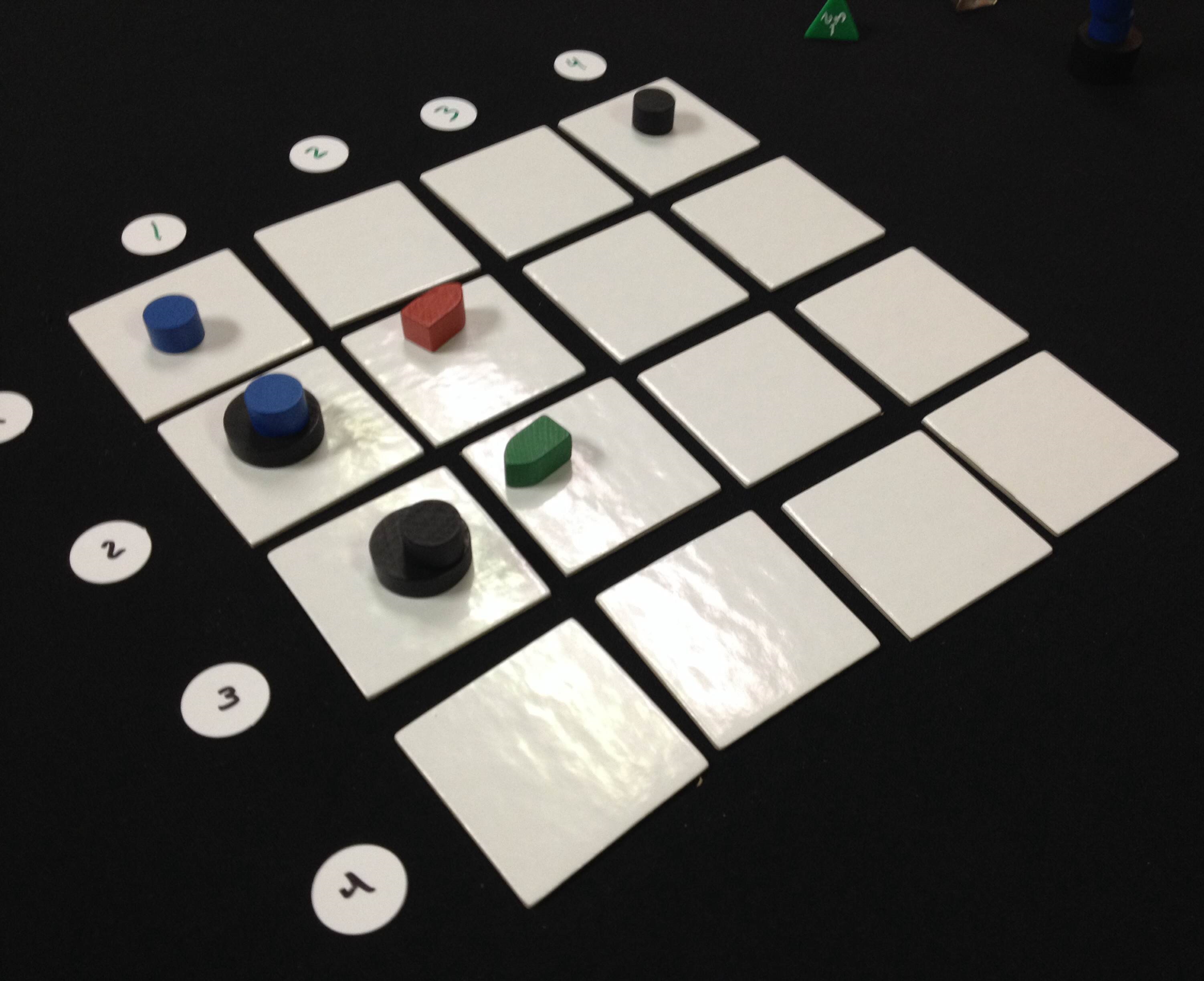
Quantum Orcas (Prototype)
So when I arrived at Protospiel-Milwaukee last Saturday I snagged a few of the free components that The Game Crafter had donated and threw together a copy.
In the game you are a killer whale who can jump across time, which is represented by jumping across the 4×4 grid. The game lasts 8 rounds. Each round two new boats are placed randomly into the grid using two d4s. Then each player chooses one card, which represents a location on the grid, to jump to. If there are boats there, they can eat them. If there are multiple boats, then they’ll have to discard cards to eat them. There are a few other rules, but the player who eats the most boats wins the game.
I think I might be able to design this into a complete game by next week, let alone by Christmas. It could also easily be rethemed. In fact, during Protospiel-Milwaukee I did retheme it based on some components available there. Several people playtested it with the theme of Space Monsters eating asteroids. So maybe I’ll have the game be dual-themed. If you like the killer whale idea you could play on that side of the tiles. If you like the Space Monsters theme you could play on that side.
The bottom line is that this game was fun, plays quickly, and comes in a small box. That’s an awesome combination.
Conclave
 I’m not typically an area control/area majority kind of guy. However, Conclave is all about area control. In the game you represent one of the Preferiti, the cardinal’s on the short list to be the next pope. You are also representing a order of Catholicism, which can allow me to do some interesting things with the design.
The current state of the game is that it isn’t very fun. While I think there are some interesting mechanics in the game, they just don’t seem to work together to make something that is fun. That’s not good.
But I have some ideas. Since the game revolves around holding the control of different tables, with varying numbers of cardinals sitting at them, then I can add in objectives to the game while keeping it reasonably thematic. The idea would be that the game can be won if a global victory condition is met, otherwise it will be won by a combination of points, which represent how well you manipulated the college of cardinals.
There would be both shared and secret objectives. Once a player completes a shared objective, they place a pawn on it and will earn those points at the end. When a played completes a secret objective it must be revealed. This card will remain in from of them and will be scored at the end.
So I have some good paths forward with Conclave. Now I just have to decide where it actually resides in my priority queue.
Trading Post
 Call me Ishmael, for I have discovered a white whale by the name of Trading Post.
Trading Post was my first experience with trying to design a really heavy game. I failed miserably. However, I love the theme and some of the core mechanics so I’d like to do a third complete reboot. Note, however, that the first two reboots were more like retrofitting rather than redesigning.
To redesign the game I want to achieve the following things:
- Make it more historic
- Make it focused on Trading, explicitly about trading furs for European goods.
- Make it fun.
- Make it complex.
So I sat down at the end of August and came up with what I think will be a really great game. The idea of the game is that you are a Trader working for a Trading Post. Your objectives in the game (read: “Ways to score points”) are to go on hunting excursions to collect furs, trade furs for goods, use goods to help build the Trading post. That’s the 10,000 foot view of the game.
There are a few other things going on in the game that I think are unique and interesting. There is a time-dependence for being able to do things in the game. For example, when you send furs to Europe, they have to ride on the boat, which takes time. There is also a concept of chopping wood and floating it down the river towards the Trading Post. So players would have to set themselves up to receive the large amounts of wood when they arrive.
Overall I’m pretty excited to be able to think about this game from a fresh perspective. It’ll be interesting to see how it comes along.
Brooklyn Bridge
This is a very recent game design of mine. As you can imagine, the theme is that of the Brooklyn Bridge. In the game you represent a crew of workers that are helping to build the bridge. It is similar to Stone Age in that you place workers in different areas of the board one location at a time. It is different from Stone Age in that one player cannot remove all their workers and take all their actions at once. Instead, players will remove their workers and take the actions one location at a time.
What that introduces is an interesting dichotomy about placing and removing workers. You might be able to get a good spot in the Materials office, but someone might beat you to building a section of the bridge. You might get lucky and not experience the bends when working in the caisson, or your worker might have to undergo a stage decompression.
This game will be a balance between obtaining goods and earning money. The goal is to contribute the most to the bridge and that will ultimately be the player who earns the most money.
As of today this is still a pretty rough concept. I’ve mocked up some tiles so that I can test a few things. I’m not sure this one (or Trading Post) could really be a full prototype by Christmas, but we shall see.
The Path Forward
So those are the four concepts currently in my active queue. This gives me enough variety and enough challenges to work on while not being overwhelming. But if I try to work on all four then I’m afraid none of them will be ready before Christmas. So I present my first ever poll, for which I am sure to get thousands of votes. Please vote for the game design you would most like to see fully prototyped:
Thanks for reading and voting! I’m hoping to bring you good game design updates over the next three months!
Design Me: Area Movement
It’s time to flex my brain muscle once again! Why? Because it’s a Design Me Friday! Every other Friday I do some exercise… of the mind! The idea behind these Design Me articles is to practice being creative and see what I can come up with in the spur of the moment.
In the last two exercises I designed a dice rolling worker placement game about brewing beer and a grid movement resource collection game about flying your aircar around a distopian world. What ever might I come up with today???
Once again I am using the tool from Boardgamizer for the inspiration for today’s exercise. Let’s see what it came up with:
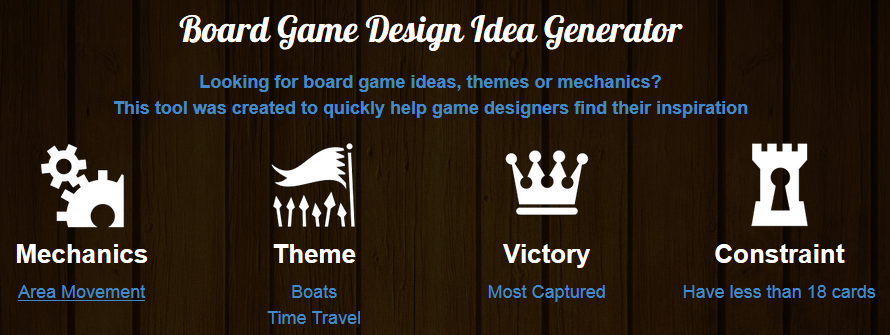
Time traveling boats capturing other boats while only having 18 cards. This could be challenging to design!
Quantum Orcas

A little closer and that boat’s a goner!
Alright, where would one begin with a time traveling boat game based on capturing other boats all while having less than 18 cards?? Time Pirates is the first thing that came to mind, but I cannot compete with the Alan R. Moon version of that game. So I’ll go a different route. Whales.
This is only my third Design Me article, but all of the names of these fake games have been terrible. So there’s no reason I can’t call this game Quantum Orcas. But I admit, it is a pretty lame title.
In Quantum Orcas you are a killer whale that likes to eat boats. You also possess the awesome ability to jump through time. Okay… you can’t really jump through time. You can merely freeze time to make it appear that you are jumping through time. I guess the whales realized that swimming was too slow so they had their scientists (Beluga whales) design time jumping suits for them to wear so they could eat more boats.
Setup
I’m designing this as a two player game of epic boat munching awesomeness. Here are the components:
- 48 Cards (16 for each player and 16 for the grid)
- 8 Number tokens to mark the grid (4 gray and 4 blue)
- 2 Four-sided dice (one gray and one blue)
- 2 Whaleeples
- 6 Large boat pawns
- 12 Small boat pawns
- Rulebook
The objective of the game is to chomp the most boats. To set up the game, shuffle and randomly place the 16 grid cards into a 4 x 4 grid. Then line up the blue and gray number tokens along the top and left edges of the grid as shown below. Then each player will roll the two 4-sided dice to determine their starting grid location. In the image below Blue rolled Gray-4 and Blue-1 while Green rolled Gray-2 and Blue-3.
Each player has a hand of 16 cards that represent the grid locations. Throughout the game you can only play each card once. The game is played over 10 rounds, so not all locations will be visited by both players.
At the start of the game each player will roll the two dice to determine the location of a small boat and a large boat. Therefore there will also be 4 boats out on the water. Note: Boats cannot be placed on the whale locations, so if that happened, the dice should be re-rolled until the boat can be placed on a vacant spot. Here’s the game after initial setup:

The orcas are getting hungry!
How to Play
In each round (except the first) players will each roll the dice to determine where to place a new boat. Once rolled, players will choose whether to place a big boat or a small boat at that location. At this point it does not matter whether or not a whale is already at that location. Place the boat there anyway because the whale will be moving off of that spot.
Once the boats have been placed then the players will choose a card from their hand, which represents a grid location. Each player will reveal their card simultaneously. Players will then move their pawns onto the corresponding grid spot.
If there is a small boat at that location, players will “EAT” the boat and move it to their area on the table in front of them. If there is a big boat at that location, players will “EAT” the boat and move it to their area on the table in front of them AND randomly discard one of their remaining cards. Over time a whale may come to a spot where there are more than 1 boat. If this is the case, the player may discard cards from their hand equivalent to the number of boats on that location and then eat them all. For example, if the green player moved to a spot where there were two small boats, that player may discard two cards and eat both of them. A player may choose to not discard any more cards and then would get to eat only a small boat from that spot. Big boats always require the discarding of a card, so if a whale came to a spot where there was a small boat and a big boat, it would cost three cards to eat them both.
Note: discarded cards are removed from the game.
Once each player has moved their whale and eaten a boat if possible, then it’s on to the next round. Note: this movement mechanism represents the whales jumping through time to come up on the boat without the boat being able to flee.
If, however, both players chose the same location then it becomes a Whale Duel! Players check to see how many boats they have eaten (Big boats count as 2 small boats). If one player has eaten fewer, that player wins the duel since their voracious appetite would cause them to womp on the other whale and win the battle. If both players have eaten the same number of ships then each player will choose and reveal a card from their hand. They will add together the blue and gray values. Whomever has the highest total will win the battle and will have to discard their card. The loser does not have to discard their card. If there is still a tie, no player eats the boat and the bosun and captain grab a bottle of rum and celebrate!
After ten rounds each player will total their value of boats eaten, keeping in mind that big boats count as 2 small boats. The player who has eaten the most boats wins the game!
Your Designer Perspective
So what would you change about this game design? Did I miss anything major? Are there holes in the design? Anything seem broken?
Those are all excellent questions that designers need to constantly be asking about their designs. I challenge you to use the Boardgamizer tool to try and come up with something on the fly. It can be a lot of fun!
Today’s Design Me exercise was actually a lot of fun. I think I could mock this game up relatively quickly and see how it plays out. Thanks for reading today, and don’t forget to exercise your game designer brain!

Sourcing Game Components: Dice

Just think of the potential game designs waiting in that pile!
Today is the final article in a series of four articles about where to find prototype worthy game components. Here is the list of articles from this series:
- Sourcing Cards: 9-5-13
- Sourcing Meeples: 9-12-13
- Sourcing Chits: 9-19-13
- Sourcing Dice: Today!
Before we get started I want to make one point clear: This article is not about standard dice or even RPG dice. You can find standard d6s and RPG dice at your favorite local game store. If you want standard dice visit your local store or local thrift store. Or if you want really nice standard dice then check out Chessex. This article is about where to find blank dice, or special dice, or even dice that you can write on!
And my disclaimer: I have not used dice in any of my game designs. While I know where to buy dice, I cannot speak to their quality, feel, or character.
As a reminder I want to give credit to the list that inspired me to write these articles. This list is much more exhaustive than mine since I am just highlighting a few of the major suppliers. But here’s the list so you can check it out yourself:
So today I present a few of the sources that I think are worth checking out…
Indented Blank Dice

They are just waiting for your awesome design!
When it comes to using blank dice for game design, look no further than Indented Blank Dice! These are six sided dice with indented sides.
Why indented sides? The sides are indented so that when you put a sticker on the side it won’t rub off or cause irregular rolls.
These are 19mm on an edge and the indented portion measures 1/2″ x 1/2″. They will also sell you sheets of labels on which you can print your game design’s custom icons. Here is their pricing for US and International:
| # | Option | Price |
|---|---|---|
| 1 | 25 Dice – Domestic US | $15.00 |
| 2 | 25 Dice – International | $35.00 |
| 3 | 50 Dice – Domestic US | $25.00 |
| 4 | 50 Dice – International | $45.00 |
| 5 | 125 Dice – Domestic US | $50.00 |
| 6 | 125 Dice – International | $70.00 |
| 7 | 250 Dice – Domestic US | $95.00 |
| 8 | 250 Dice – International | $115.00 |
| 9 | 1000 Dice – Domestic US | $300.00 |
| 10 | 1000 Dice – International | $320.00 |
Those prices seem a little expensive to me, but if you’ve designed the next Kingsburg, Alien Frontiers, or Macao, then you can probably justify the cost.
Each sheet of labels that they sell will handle 36 dice. Two sheets will cost your $6.
BlankDice.co.uk

They look similar to Indented Blank Dice, but they’re from Europe!
If you are a friend from across the pond, i.e., from Europe, then perhaps your first stop should be BlankDice.co.uk!
In addition to a nice assortment of indented six sided dice they also offer 8 sided indented dice. Here is the page for their six sided dice: BlankDice.co.uk – 6 Sided Dice
But here’s the kicker… If you were to purchase 25 of these at £0.20 each (to compare the pricing against the source above this one) you would find that it would cost roughly US$15.50 to ship to the US. That’s only $0.50 more than the above source. So if BlankDice.co.uk has a color that you desperately need, then maybe you could order from them instead.
Print & Play Productions
 They make the list again since they offer so much awesomeness! If you are looking to order a bunch of different components for your game prototype and you need dice as well, then consider ordering from Print & Play since you can get cards, chits, meeples, and dice all from the same source! Here are a few different dice options offered by Print & Play:
- 16mm Stickerable Blank Dice: $0.15 ea.
- 19mm Indented Blank Dice: $0.50 ea.
- Stickerable Polyhedral dice (d8, d10, d12): $0.99 ea.
- 16mm Translucent Dice (Red, Green, or Blue): $0.45 ea.
Side Note: I personally met the guy behind Print & Play productions at GenCon and I can safely say he’s an awesome guy. I would definitely feel confident when purchasing from him. And the fact that you can order basically all of the components you would need for your prototype from one source makes Print & Play pretty awesome!
EAI Education
 The EAI Education catalog is a fantastic one-stop-shop for game designers. You can order cards, dices, cubes, and more all from their online catalog at excellent prices!
If you do a search for “Dice” you’ll get 206 results. While they have way too many awesome options of standard dice, fudge dice, fraction dice, etc., here are some blank dice options that I think could be useful to game designers:
- Blank Dice – Set of 12: $1.99
- Blank Dice and Label – Set of 144: $26.95
- Dice Domes Deluxe (with foam dice): $13.95
- Magnetic Foam Write On/Wipe Off 1.5″ dice Set of 12 (Available in Classic or Bright colors): $8.95
- Magnetic Foam Write On/Wipe Off 3″ dice set of 36: $99.95
And if you need standard dice to compliment your game design, then you can believe that EAI carries what you need!
The Game Crafter
 The guys at The Game Crafter also offer black indented dice. If you choose “dice” from their parts selection you’ll get a bunch of standard dice as well as blank dice.
They offer 8 different colors at $0.40 each, though if you order more than 9 of any color the price will drop to $0.38 each. These prices are better than some of the other sources listed above for indented blank dice.
But as I mentioned when writing about TGC for the Meeples article, if you are ordering components like these you still have to wait in their production queue. Since I live in the Madison area I think I should volunteer my time to fulfill component-only orders with no customization of cards or boxes or rules. That way, if you order stocked components only, the order would skip the custom production queue and be able to be mailed to you much more quickly. This isn’t a huge complaint and it doesn’t hold me back from ordering from TGC. It’s just something I think they could do a little better.
Amazon
The interwebs offer a bunch of sources for dice, but Amazon seems to have some good options. Here are a few that might be good for game designers:
- 25 Blank White 16mm Dice: $2.95
- 1 Inch Foam Color Resources Cubes Set of 102: $13.21
- Chessex Set of 6 Blank White Polyhedral Dice: $3.59
- Set of 100 Colored Blank 16mm Dice: $18.95
So perhaps Amazon will be your go-to source for dice.
***
And there you have it, folks! This is the conclusion of my series on sourcing game components. You should now know where to find all of the components you need. Thanks for reading along during this series. It has prompted me to desire a large order of components from all these different sources. I’d love to simply stock up on tons of stuff so that I can have the world of game components at my finger tips in case inspiration strikes! Good luck game designers!

Monday Brews: 9-23-13
Good Monday to all of you! I hope you had a great weekend. I had a very nice weekend. I got a few games in, attended a football game, and came up with a new game design that I’m pretty excited about and am hoping to get ready for Protospiel-Milwaukee, which is this coming weekend!
Let’s see what Boards & Barley I enjoyed this past week…
The Barley:
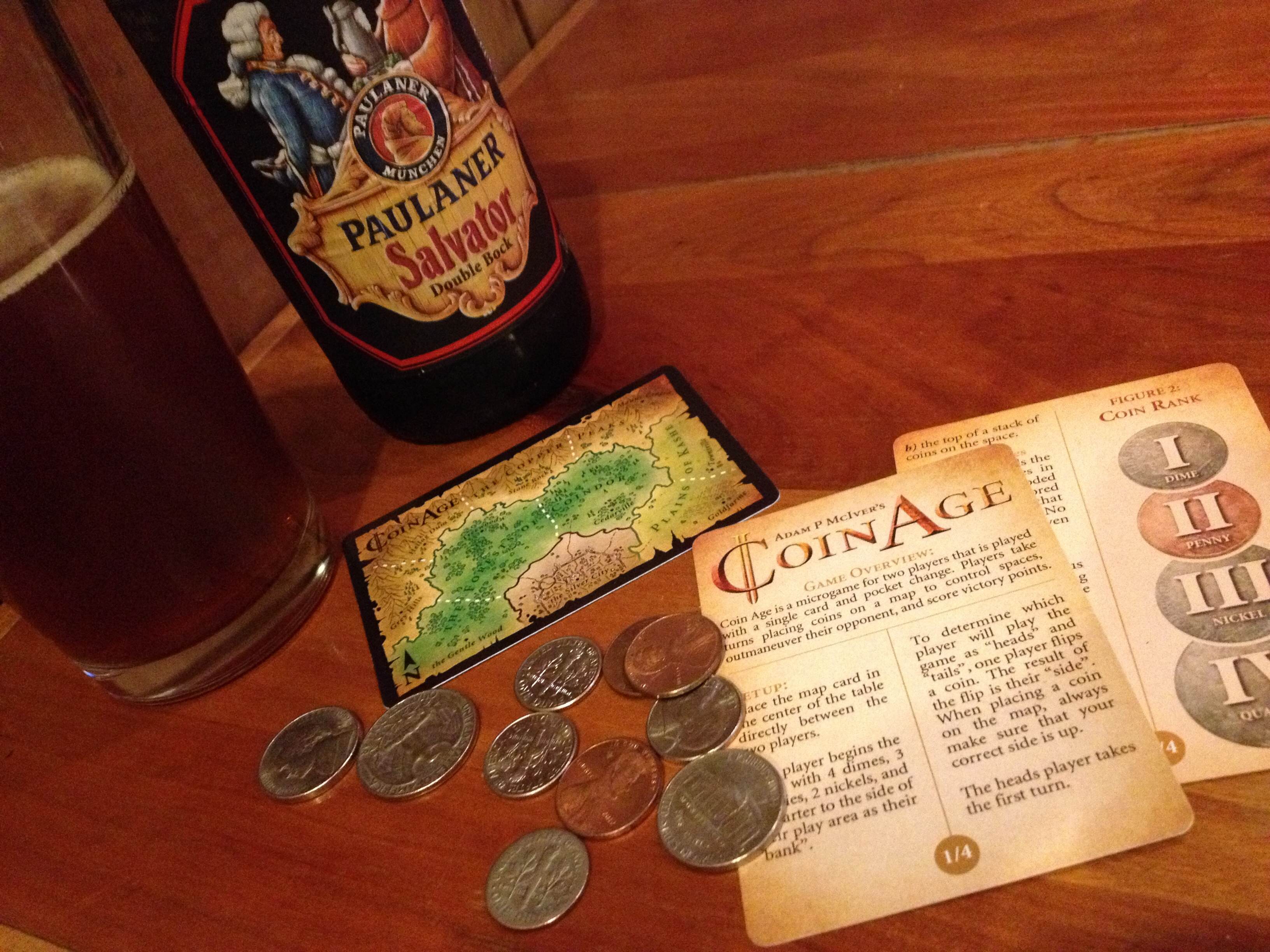
Barley and Boards are good on their own, but are unstoppable when combined!
Leffe Bruin: I love Leffe. The Blond and the Brown are both really enjoyable. I think I prefer the blond during the spring and summer and the brown during autumn and winter. We were having a game night last week so I bought a 6 pack of this. Fortunately for me only one person took one, so I had plenty for myself! Side note: a friend of mine also likes Leffe and we once had fun making up Steampunk names. His chosen name: Leffe Steampunker.
New Glarus Staghorn: Yep, I enjoyed more of New Glarus’ Oktoberfest brew. It’s so good!
Lake Louie Dino’s Dark: I’ve had other beers from Lake Louie before, but never the Dino’s Dark. The other beers they offer have all been really enjoyable. This was no different. They have a pretty small operation, but they sure put out high quality beers! I’m hoping to tour their brewery some day.
Leinenkugel’s Oktoberfest: I still had one on hand from the crate we bought a few weeks ago. I solved that problem by quickly downing this tasty beverage.
Paulaner Salvator Double Bock: Yum. I enjoyed this beer while on a date with my wife where we got three games to the table. Wife + Beer + Games = Great date night!
Tyranena Gemuctlichkeit Oktoberfest: Besides the goofy name, this was a pretty decent Oktoberfest brew. It should be noted that I will have to try another one since I drank this one from the bottle while I was also watching my kids, which ultimately lowered the overall experience with this beer. What a pity, having to re-try a beer.
The Boards:
X-Wing: Why did it take me so long to play this game? Maybe because I kept waiting to see if my local Target would drop the price to $12 like other people have mentioned. You lucky people. Fortunately my friend bought a copy (and has subsequently bought a bunch of add-ons). So I was able to get my first taste of the game. AHHH-mazing! It helps that I rolled hits on 90 percent of my rolls. It was total domination!
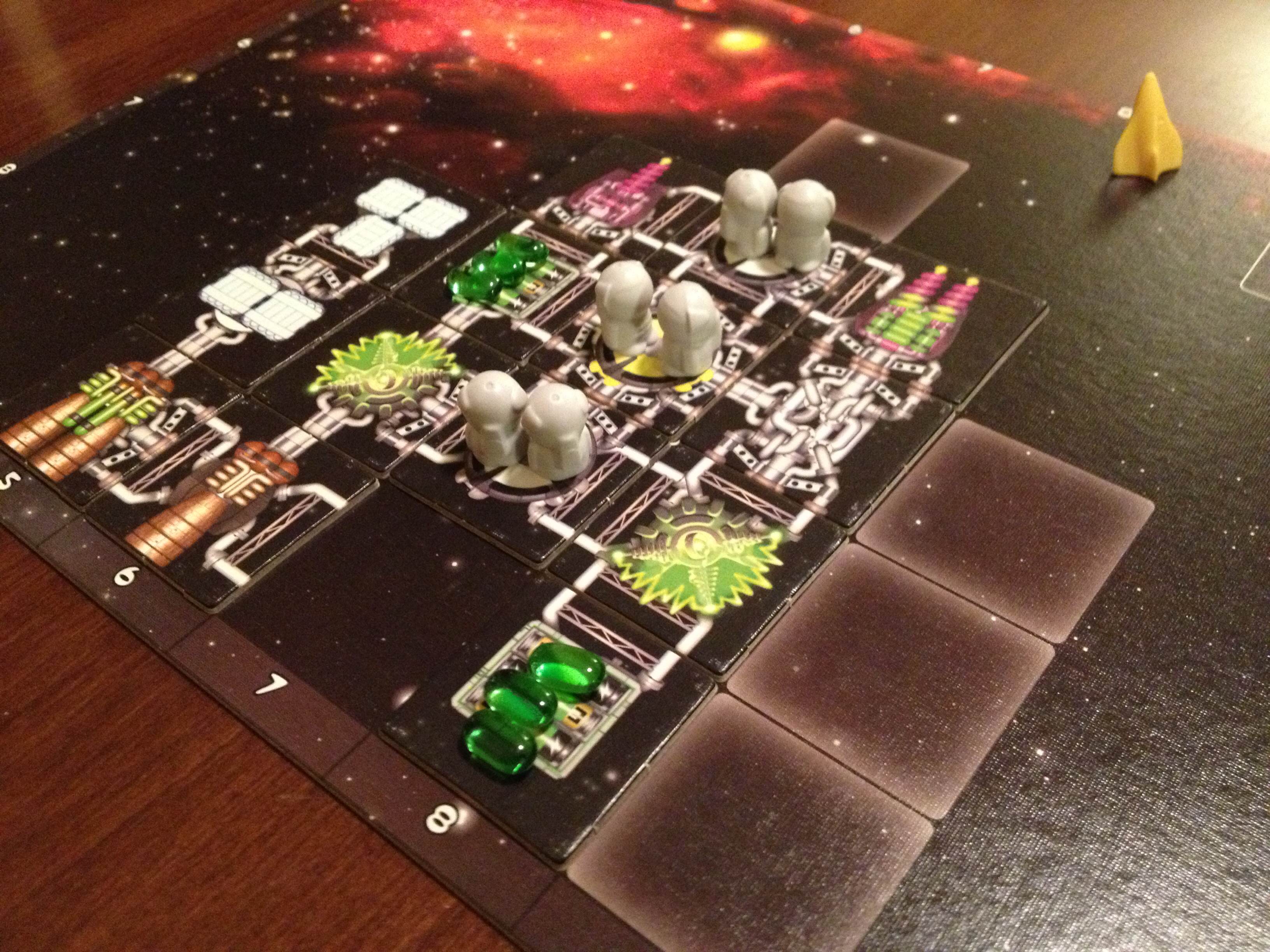
My first ever Galaxy Truck!
Galaxy Trucker: I received this game in a trade over a year ago. This past Wednesday I finally got to play it. That is unacceptable and I have offered my sincerest apologies to my copy of Galaxy Trucker. I may have to send a personal apology to Vlaada Chvatil. When we played it we realized that it was completely awesome! This is a really excellent game that I should not have waited so long to play.
Libertalia: Arrr Matey. We got Libertalia to the table on Wednesday and, as usual, thoroughly enjoyed it. Well, I enjoyed the first two rounds. I was playing my best game of Libertalia ever. Then I got Monkeyed. And the Monkey passed me 4 curses. And to add insult to injury, during dusk I had to take another curse token. Needless to say I did not win.
Tsuro: My friend’s $1.20 thrift find of Tsuro keeps making it to the table. We played a pretty fun game of it where nearly everyone was left until the last four tiles. This is such a good filler game, but I don’t think I’d pay $40 for it.
CoinAge: I got a free copy of CoinAge from the designer, Adam McIver, at GenCon. I hadn’t been able to play it until last Friday, when I taught it to my wife. For being a game of three cards, where two of them are rules, I’ve never realized how much strategy you can pack into a game that requires pocket change. This was really enjoyable and I’m looking forward to playing it with someone who likes games more than my wife.
Morels: This is a game that my wife really enjoys. I enjoy it for that fact. You can check out my review of Morels to see what I thought. But the fact that my wife will play it with me means it gets a shiny little star.
The Little Prince: This is another game that my wife enjoys. So with Morels from GenCon 2012 and The Little Prince from GenCon 2013 I’ve been able to prove to my wife that my visiting of GenCon has been worth it both years. While I don’t enjoy the 2 player version of The Little Prince as much, it is still a really fun game.
***
So those are the Boards and Barley I enjoyed last week. What did you enjoy???
 Boards and Barley