Category Archives: The Boards
Conclave Conversation

Are you the next Pope?
Welcome to Boards & Barley. Last week I mentioned that I’d be posting an article about sourcing components for board game prototypes. Well, with GenCon so nigh I figured that article wouldn’t be of much help to fellow designers anyway. So I’m postponing that article until after GenCon, at a time when many designers will likely be looking to purchase new components for their game designs that require revisions. So today I’m discussing Conclave.
Since Trading Post is my white whale and I doubt I’ll ever actually get it to a playable point I’ve been spending my time making excellent progress on Conclave.
In Conclave players take on the role of a Cardinal who is hoping to become the next pope. For those not familiar with the process of electing a pope I will give a brief background. To elect a new pope the college of cardinals, those of high standing in the Catholic hierarchy, are locked in the Sistine Chapel after the death or resignation of the previous pope. They will perform voting rounds each day until a new pope is elected. Pretty simple.
So today I want to give you an update as to my progress on the game. Let’s start with the cards, and what they do…
The Orders of Catholicism
The game is designed to play from 2 to 4 players. Those players will represent one of four different Catholic Orders: Franciscans, Jesuits (Society of Jesus), Dominicans, or Benedictines. While I’d ultimately like each of these orders to have some sort of special ability, almost like factions, they currently are all equal and are simply a better way to represent the player colors. Here’s a look at the cards (From The Game Crafter) with the icons for the different orders:
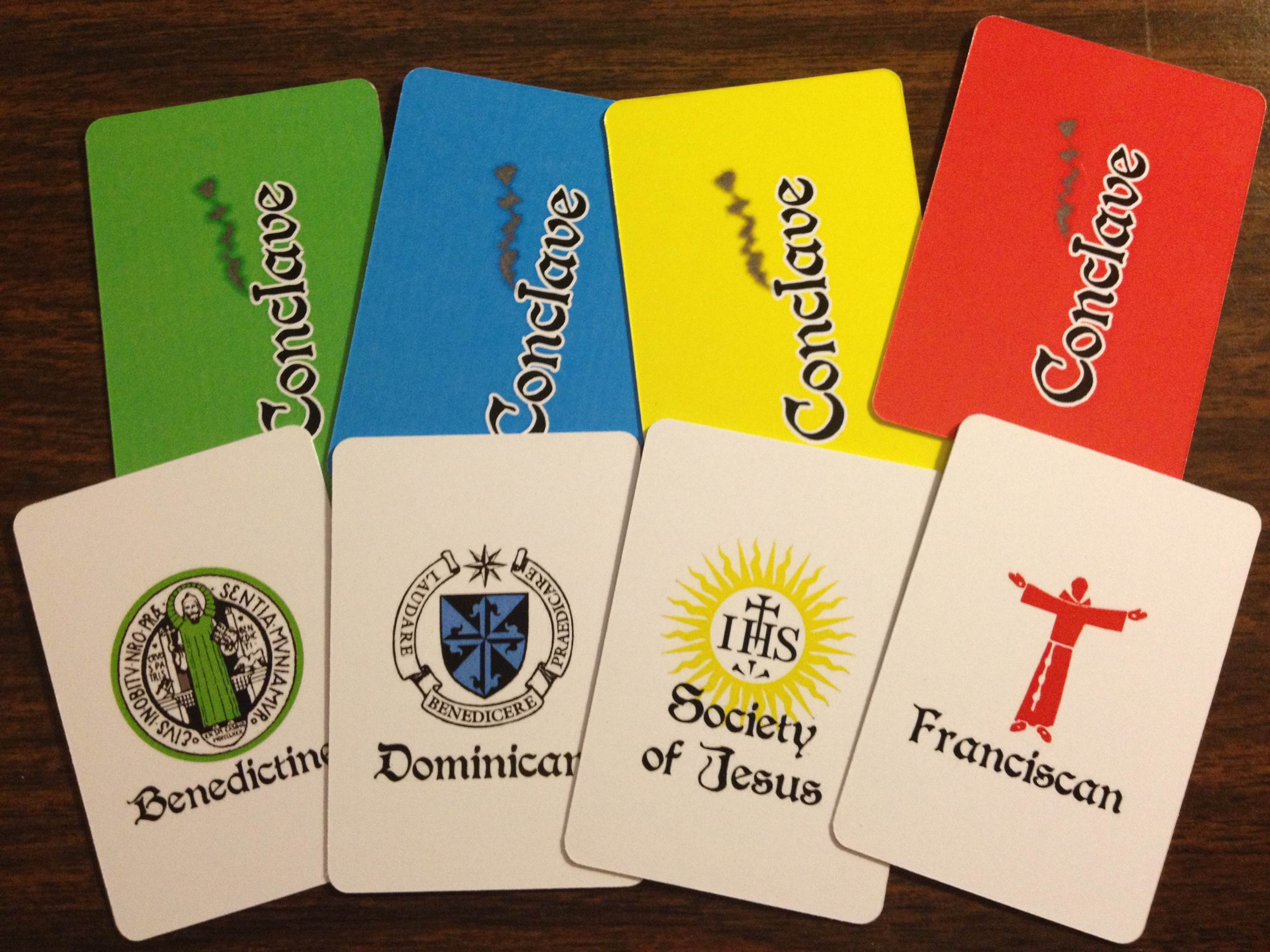
These could easily be labeled by their color, but the icons seem more real.
The cool part is that once I’ve tested the base game it would be relatively easy to add in specific traits for each of the Catholic Orders. That would allow each player to have some special ability that they could try to use to their advantage in the game.
Inside the Sistine Chapel

Sistine Chapel prior to Conclave.
Conclave is a game about area control. The areas are represented by the different tables in the Sistine Chapel. In a real conclave it looks like the setup on the right. That setup has long tables of equal numbers of Cardinals.
In the real conclave each vote counts individually. That’s not much fun from a game design perspective. So as the designer I am utilizing my creative license and splitting the tables up.
So in the game there will be anywhere from 6 to 9 tables that include from 1 to 6 cardinals. Each table will work like an electorate. Basically, whomever holds the majority of votes at any given table earns the full table’s worth of votes.
This is a decent way to mix things up. So players will be attempting to hold the majority at tables rather than focusing on any individual Cardinal’s vote.
Therefore the table with only 1 Cardinal is worth 1 total vote. But a table of 5 Cardinals, though worth 5 votes, can be won with 3 cards in place to win the majority.
So ultimately I’ve designed this to work like an electoral college where tables are worth electoral votes and a certain number of electoral votes are needed to win the Papacy. Perhaps I should switch themes to be a Presidential election in the US.
The Tables
Two nights ago I mocked up some beta artwork for the tables, mostly based on the picture above. My previous prototype had these large, cumbersome boards that were really just too large to be any good. So these new table boards are based on the mini cards from The Game Crafter (1.75″x2.5″).
Here is a mock up of a Five Cardinal table:
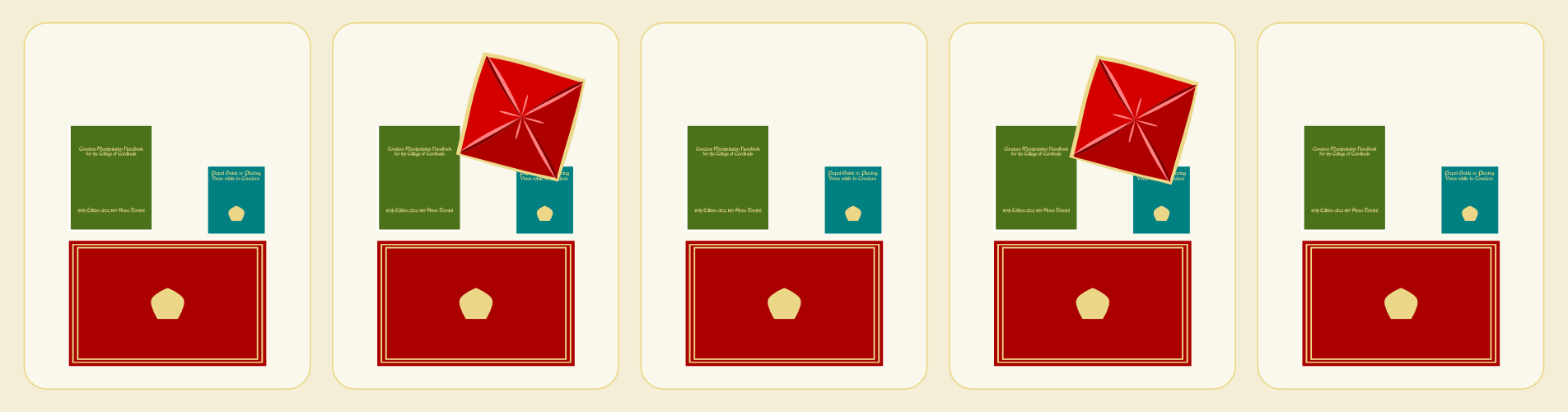
Having a majority here is worth 5 votes.
First, I need to apologize to anyone who enjoys anything about culture. It is almost blasphemous that I am designing a game that basically involves the Sistine Chapel and all I’m showing are the tables at which the Cardinals sit. How can I justify not including any imagery of the beautiful, if not scary, artwork included in one of the most historical rooms in the world?

The red box thingy in my artwork represents the papally awesome swag bags on the tables.
Second, the two spots with the weird angled red box thingy are special spots. At the very start of the game a certain number of cards are randomly drawn from each player’s deck. Those cards are distributed evenly to the spots with the weird red box thing. The red box just denotes which Cardinals receive a face up, randomly drawn card.
Once the randomly drawn cards are placed then players will take turns influencing the Cardinals. On their turn they will place one card face down on any Cardinal of their choosing. Then they will also place one card from their hand face up on that same Cardinal. The thematic idea here is that these Cardinals are voting for the face-up player, but could be persuaded to vote for the face-down player.
Play continues in this psuedo-setup phase until all the Cardinals have cards on them.
Manipulating the College of Cardinals
After all the Cardinals have cards to represent their votes then the real game begins. This phase of the game is all about manipulating the Cardinals to get them to vote for you. There are four actions you can choose and you can perform any two of them on your turn. These actions are represented by these hastily produced icons here:
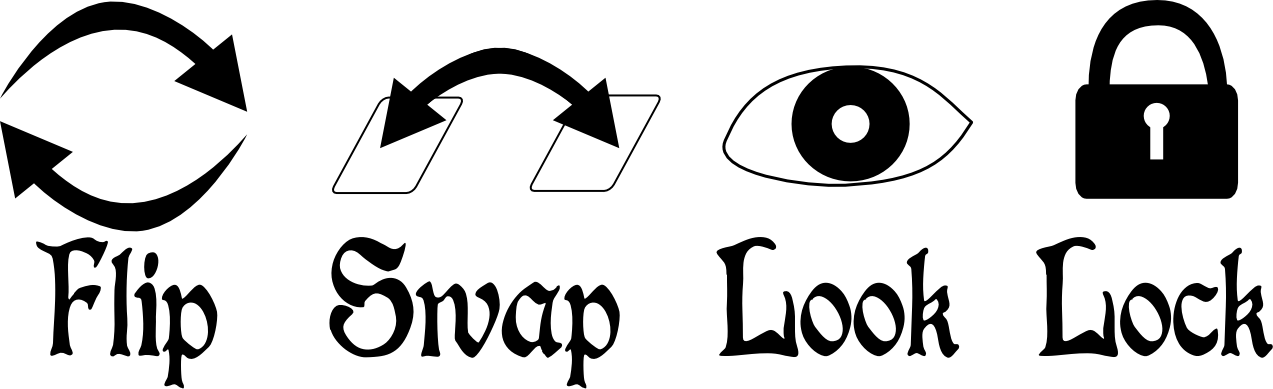 FLIP: This action allows a player to flip any one Cardinals cards over. The result is that this Cardinal will now be voting for whichever card had previously been the face-down card.
SWAP: This action allows a player to swap the locations of two different face-up cards of any two Cardinals.
LOOK: This action allows a player to investigate the Cardinals by looking at three different face-down cards for any three Cardinals of their choosing.
LOCK: This action allows a player to lock any one Cardinal’s vote into place for the rest of the game. Each player will have four locking cubes and can thus lock four Cardinals over the course of the game.
So on your turn you can perform two actions. They can be the same action if you so choose. The goal is to try and manipulate the tables so that you earn the majority, and thus their votes.
***
So I’ve described the game in a nutshell. This is the basic concept of the game and it is currently playable. My disclaimer is that I have no idea if it is any fun. All the fun so far has been in designing the game. While I think there is a nice strategic component to the game, only time will tell. And by time I mean playtesting. Thanks for reading!

Prototyping Tools of the Trade
Tools of the Trade
One topic that seems to come up a lot is how to make board game prototypes. I’m not talking about coming up with a design. I’m talking about physically creating prototype game components. Game designers are constantly trying to make their components so that they can get right to the playtesting phase of game design.
Today I want to discuss the tools I use to create my prototypes. At this point you should already have your prototype artwork created if you’re going to be printing anything. Let’s assume it’s already been printed. Now it’s time to make it awesome!
Chits…
One common component that is particularly easy to make for prototypes are chits. These are typically just printed artwork glued onto matte board. But matte board can prove to be difficult to cut.
There’s two ways that I’ll cut my chits out of the matte board.
- Straight edge and utility or X-acto knife (not ideal)
- Rotary cutter (ideal)
What we are doing here is separating the chits from one another. When creating your artwork you should line up the edges of the components so that you only need to make one cut between them.
This will help you keep your fingertips!
The straight edge and knife approach is definitely NOT my approved method and I would never recommend it. However, a lot of people use that approach so I needed to mention it. One recommendation is to use a safety straightedge like the one shown here. You only have 10 fingertips so why not spend a few extra dollars and get a straightedge like this and make sure to not lose any fingertips!
I don’t like this method for a few reasons. The first is that you need a cutting mat to go underneath so you don’t scratch your table. The second is that the blade doesn’t always stay straight as you are cutting the matte board. And that can be really annoying.

Just get this thing instead!
My preferred method is to use a rotary cutter like this Fiskars 12″ Scrapbooking version. It is super easy to use, relatively cheap (especially compared to the $40 safety straightedge), and very reliable. And since most of us don’t have printers that print on anything other than 8.5×11 paper anyway, the 12″ Fiskars tool is perfect!
So I will print my prototype artwork on photo paper, adhere it to matte board, and then cut out the individual components using the rotary cutter. Just a heads up when using matte board though: you’ll likely have to roll the cutter back and forth a few times to cut all the way through. That’s still an easier process than trying to run a blade along the straightedge.
On the topic of matte board, I recently went to Hobby Lobby and purchase two huge packs of “matboard” for $6 each. I got a pack of 12″x12″ and a pack of 11″x14″. These are so cheap that I almost felt like I was stealing. They are just the leftovers from the framing department that were cut out from the boards used to mat pictures/paintings for customers. What a great way for Hobby Lobby to reduce their waste and provide a useful product. Here’s what I got for $12:
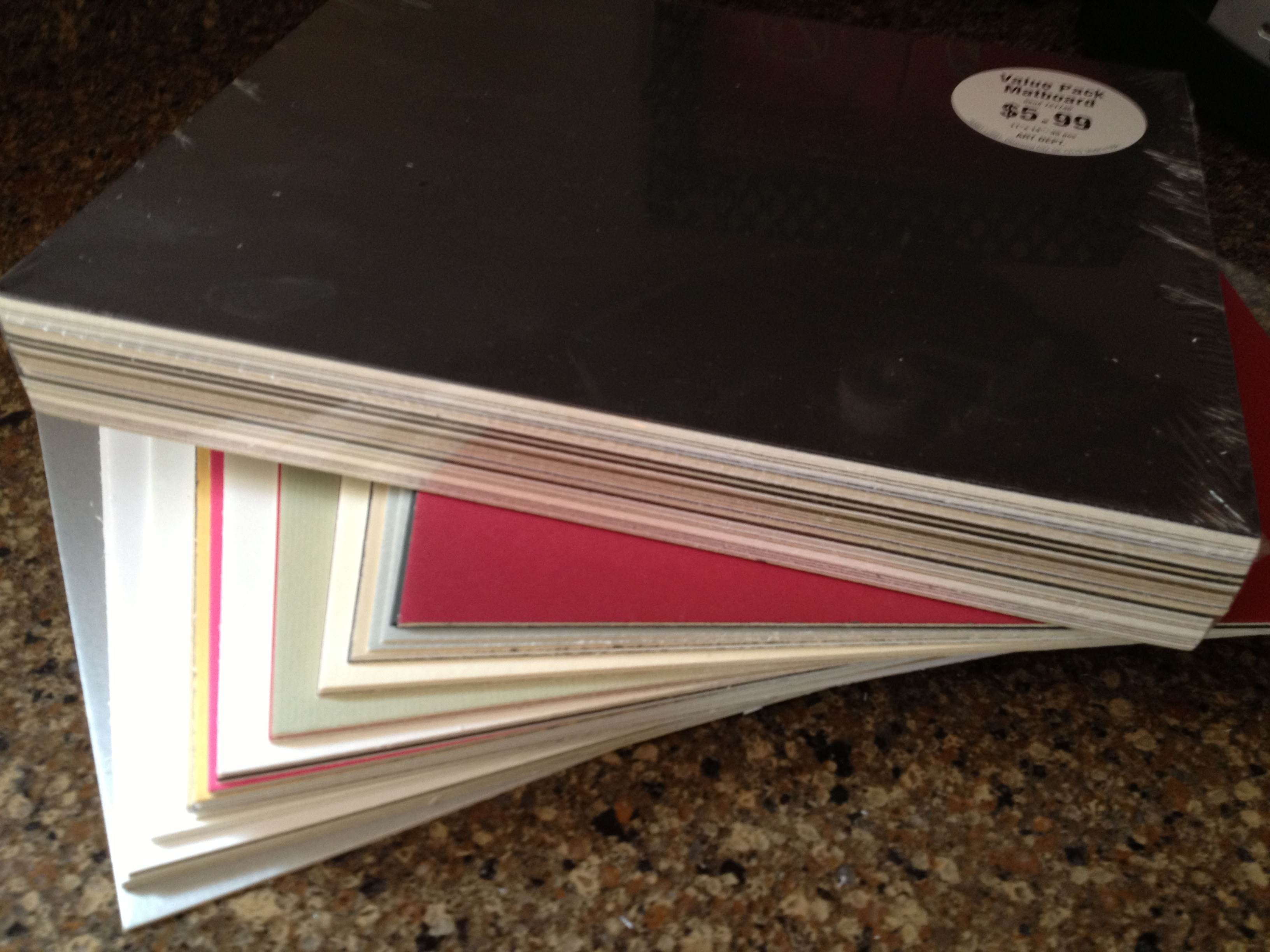
So cheap!
The other key tool of my trade is a glue stick. Some people will use standard glue, some will use spray adhesive. I prefer the glue stick to standard glue since it is simple to apply evenly. This is very helpful when trying to make sure that your components are completely glued down.
Now you know a great method for producing chits. If possible, keep them as rectangles rather than circles of hexes. But since we’re on the topic of circles and hexes let’s move on to another excellent tool…
Punches…
There are times when you don’t want rectangular components. Perhaps your game is a map building game with hex tiles. Or perhaps you require special discs for your game. If that’s the case, then I strongly urge you consider purchasing a punch.

The hex punches from Fiskars work great!
One thing to keep in mind when purchasing a punch is how thick of paper/board are you wanting to punch. Often these sorts of punches are used by scrapbookers who are only punching paper. That means they may not be able to punch through matte board. Sometimes you can only find out after you’ve bought the punch. Bummer.
Here are some recommendations, keeping in mind that I don’t know specifically how thick they can punch. OR you can just do a search for “hobby punch” and find one you’d like.
- Fiskars Squeeze Hex Punches
- Creative Memories Punches
- Older Creative Memories Hex Punches on eBay
- And don’t forget the Corner Rounder punch which can be helpful for cards that are printed on nice canvas/linen finish paper.
These can come in really handy. I use a circle punch when creating prototype coins. I have used a hex punch to create stickers for hex tiles. And here is my little tip for punching, which I mentioned in a prototyping article a long while back, but which is worth repeating.
When punching, flip the punch over so you can visually align the part that you want cut.
So now you’ve got the tools to cut out chits and punch out little bits of awesomeness! What about cards?
Sleeves…
Many game designers come across the need for cards in their game designs. I have made cards numerous times. Early on I would buy 60lb. paper and just cut out rectangles. But there is a problem with that. The edges of the rectangles can be slightly bent from cutting, which leads to great difficulty in shuffling the cards.

Mayday sleeves are convenient and cost effective!
The way to prevent that while also protecting the cards is to purchase card sleeves. These inexpensive beauties will be a little lifesaver by removing anguish from your prototypes. Plus, you can get awesome one’s like the one shown here with a kitten running through a field!
If you want a good go-to source for sleeves then look no further than Mayday Games. Here is a series of links to the sizes you may be looking for:
- Euro Cards (59×92 mm)
- Mini Euro Cards (45×68 mm)
- Card Game (63.5×88 mm)
- Standard USA Cards (56×87 mm)
- Magnum Ultra Fit for 7-Wonders (65×100 mm)
Those should offer some help. They definitely help with being able to shuffle your cards. The only downside is that when stacked they can be really slippery and your stack may tumble over.
Speaking of tumbling…
Dice…
Sometimes it becomes necessary for a game designer to create their own set of dice. Sure, you could always just make a cheat-sheet conversion table, but that can be a huge burden for your playtesters who would constantly have to recheck the sheet. So one of the tools of the trade is to purchase blank, sticker-able dice.

Just think of the potential here!
Look no further than Indented Blank Dice. The best part of their site is that they have labels that you can purchase and print on rather than having to buy blank label paper and try to cut/punch out your own labels and then peel them off.
Don’t buy blank label paper. Don’t cut/punch out stickers. Don’t try to peel them.
Just buy the sticker label paper and save yourself from the frustration.
So this concludes my little article about Prototyping Tools of the Trade. Next week I will be posting a follow-up article on Sourcing Components for Prototyping. It will cover where to purchase boards, bits, and more. So stay tuned!

The Monday Brews: 7-29-13
What a splendid week we had last week. I ordered prototype cards for Conclave. I playtested new components for Scoville. And I enjoyed a few beverages.
Here’s a recap of what I drank and what I played last week:
The Barley:
Here are the tasty beverages I was able to enjoy last week:
Leinenkugel’s Honey Weiss: This was an easy choice since we were camping. It’s a pretty easy-drinking wheat and honey beer from Wisconsin brewer Leinenkugel’s. We needed something in a can (Not Pabst!) that would be enjoyable around a campfire. I had requested Leinie’s Summer Shandy, but my wife choose Honey Weiss instead. No complaints there.
Ben Franklin’s Honey: This is my second homebrew and is rather enjoyable. Perhaps I have something for honey beers. This was enjoyed while working on game design. A perfect combination!
New Belgium Fat Tire: This fine beverage was enjoyed after our softball game where we won and became the first half champions of our league, thus locking in a spot in the championship game for our team.
Lake Louie Warped Speed Scotch Ale: This delicious scotch ale from nearby Lake Louie Brewery was also a post-game celebratory beverage. It is probably my favorite scotch ale and I hope to visit and tour the brewery someday.
Pearl St. Mills Pils: This was the last of the celebratory softball beverages and unfortunately also was my least favorite. It was a typical pils and nothing about it really stood out. Or it could have been because I had two before this one, it was late, and I was really tired. I guess I’ll have to give it another attempt.
Alberti Amber: This is my first homebrew and I only have a few of them left. I saved the very first bottle and it will remain in my basement/man cave forever! I was able to enjoy this during a game night last Friday. I think it’s pretty decent for a first go at homebrewing.
The Boards:
Here are the delightful games I was able to enjoy last week:
Conclave: This prototype of mine is still very rough. I solo tested it and learned that it needed some mathematical tweaks to make sure things are balanced for all players, and so that it can actually be played the way I want it to be played. I’ll likely have this with me at GenCon if anyone is interested.
Scoville: Four of my Level 1 friends were willing to test some new components for this game. The components are bonus abilities that let you do things you normally can’t do. But you can only do them once per game. If you use an ability, then you sacrifice the four points that it is worth. If you do not use them, then each is worth 4 points at the end of the game. This is like the train stations in Ticket to Ride: Europe.
Tsuro: This tile-laying game plays quickly and can be frustrating. We played twice, but the finish to the first was quite memorable. This picture shows the final tile placement, which resulted in all three remaining players being eliminated at the same time.
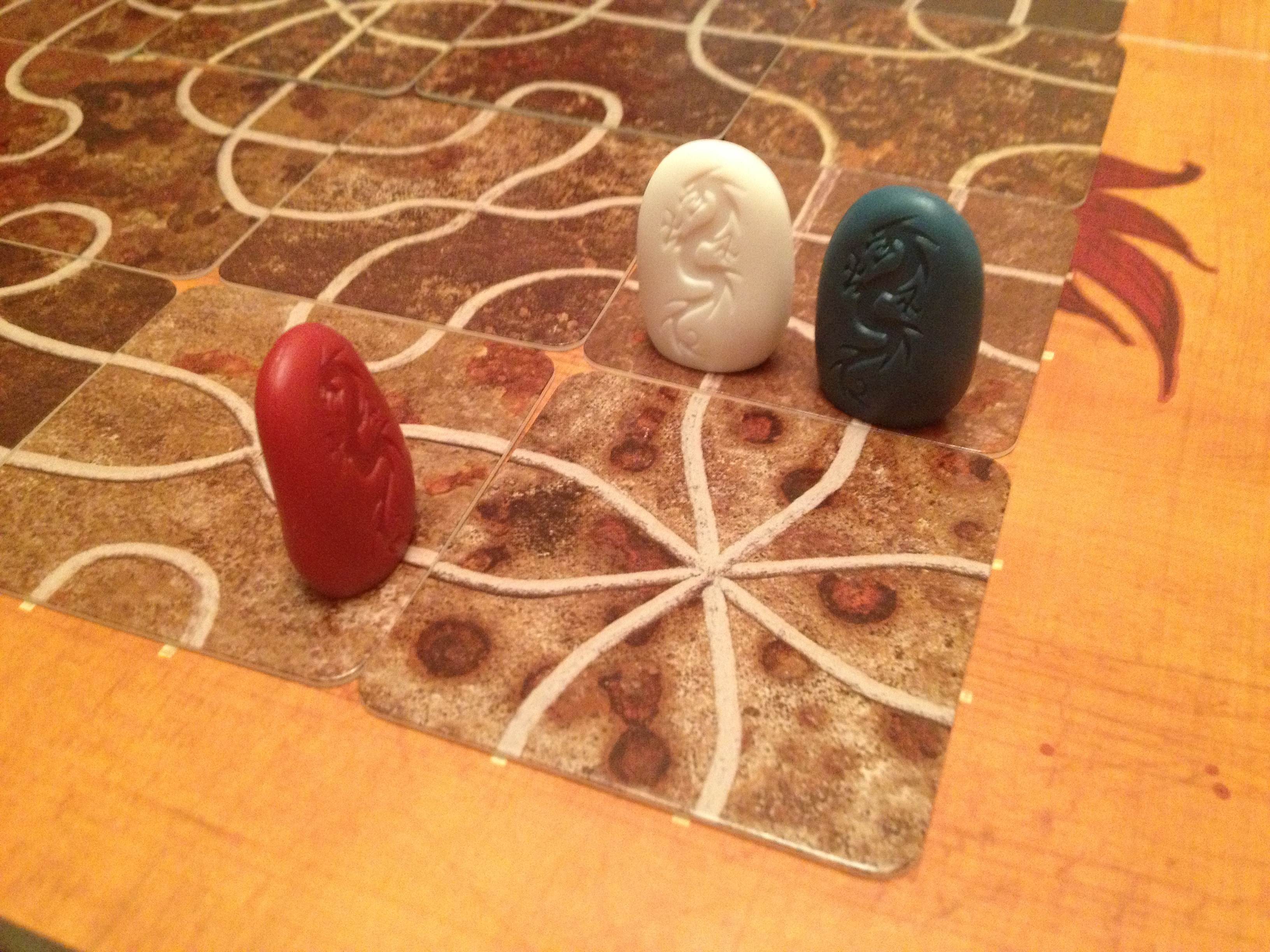
The grand elimination/victory moment for the Red, White, and Blue!
Gentlemen Thieves: This is a competitive game where you are trying to earn your own character the most loot from participating in different robberies throughout the game. On your turn you place a piece of evidence onto one of the five locations. If a location then has at least one of each of the five different types of evidence, then that location is robbed. The evidence tokens are flipped over to the loot side and divvied up between whichever team robbed the location. The team that robbed the location is the one with more evidence of their player colors in that spot. The game ends when the Brigadier makes a showing, and the player with the most loot wins. This is a fun light-ish game with a large mental aspect. I’ve now played twice (Once 2p and once 5p). I enjoy it, though it feels like my brain wants to explode each time!
***
So what Barley or Boards were your favorites from this past week? Anything you’re hoping to enjoy this week?
Symmetry in Board Game Design
My recent design, Conclave, initially suffered from a lack of symmetry. After a great playtest session with Jeremy Van Maanen, Adam Buckingham, Corey Young, and Brett Myers I received some great feedback that pointed out how the initial round could greatly influence the game due to the asymmetry. So I balanced the player decks to eliminate that asymmetry. What followed was a nice conversation on Twitter about symmetry versus asymmetry. So I though I’d write a brief guide about putting symmetry into your game design, and where it might be appropriate.
My Definition of Symmetry:
Before discussing where symmetry or asymmetry is important it is necessary for me to define the terms so that you understand what I mean throughout the rest of this article.
SYMMETRY: when conditions within a game are equal for all players.
This could be that all players have the same options on a turn or that they all start with the same cards or they all have the same opportunity to progress. Symmetry is typically only present at the beginning of a game. Once one player has taken a turn, then the game is different for the next player. So games where all players have an equal opportunity to be the first player inherently are symmetric at the start. Games where a random player goes first are not inherently symmetric since by the time the second player goes, the game conditions for that player are different than they were for the first player.
An example of a symmetric game starting condition is one where players simultaneously bid for turn order. Another example is when all players simultaneously make their first move in a game.
ASYMMETRY: when conditions within a game are unequal for all players.
I think of asymmetry as the situations where players have differing decks of cards, or different options on their turn, or different opportunities in the game. But asymmetry also applies to when games change from turn to turn and thus no two players ever face identical game conditions. There are many examples of asymmetry within games. And to provide examples could take a long time. Instead, check out Lewis Pulsipher‘s thread on BoardGameGeek: Looking at Game Design as Ways of Introducing Asymmetry.
Where to design for Symmetry:
There are definitely places within game designs for symmetry. If conditions within a game ever put a game out of balance, where one player has a distinct advantage toward victory through no means of their own, then the design calls for symmetry to remove that lack of balance.
My example, from Conclave, fits perfectly here. The original design provided each player with a 30 card deck. However, during the game not all of the cards were used. This caused a problem with probability. There was a chance that one player may end up only getting cards of their own color to place on the table while another player would only end up getting cards of the other player’s colors. This would then cause the game to be very much in favor of that first player despite them not earning that opportunity. This lack of balance called for adding symmetry to the game.
In this case symmetry refers to all players having the same amount of opportunity on the table. With balanced decks where all players play all of their cards it means all players will have the same opportunity within the remainder of the game.
This is my recommendation:
Apply symmetry where a game could otherwise randomly favor any single player.
This will not only make sure the game is fair, but it will also make sure that players can enjoy the game without feeling like they never had a chance.
Where to design for Asymmetry:
I would recommend designing for asymmetry anywhere and everywhere, as long as it does not conflict with my recommendation above.
Asymmetry for Conclave would mean adding different abilities based on the person you are representing.
Asymmetry can refer to players having unique abilities or different ways to move forward in the game or different cards and thus different opportunities. Examples of asymmetry in games are plentiful. The Settlers of Catan has a beautiful level of asymmetry that depends where players place their initial settlements. Ticket to Ride has asymmetry with the destination tickets, which determine each players individual path to victory.
Asymmetry in a game can add to the variability and replayability of games. And often it can add to the tension of a game as well. One example that comes to mind is Shipyard. In that game there is a great asymmetry in players options on their turn. This is simply due to limiting the options that a player can take on their turn. No two players turns in a row are the same. Yet the asymmetry in player options add a lot of tension and strategy.
I am definitely an advocate for asymmetry in game design.
My Bottom Line:
Now that we’ve briefly discussed symmetry versus asymmetry in game design I want to make my point one more time. When a game design creates an unfair advantage for a player that is not based on the choices of any player, the game requires symmetry and balance. Apply symmetry to a game to balance the game and make it fair. In all other circumstances, feel free to apply asymmetry to your design. It will be harder to design and require more playtesting to balance, but it adds so much to the game.
What are your thoughts about symmetry versus asymmetry in game design? Do you prefer one over the other? How would you define the two? I would love to hear your thoughts. Thanks.
Scoville Under Contract by TMG!

TMG Dragon loves peppers!
Ladies and Gentlemen,
It is with great pleasure that I can finally announce that Tasty Minstrel Games has contracted my game Scoville for publication!
As you can imagine, I am very excited about this. Scoville will be my first published game and I’m grateful for TMG taking me into their fold.
So who is Tasty Minstrel Games? TMG is a board game publishing company run by Michael Mindes. On board with Michael is game designer/developer Seth Jaffee. You can check out Seth’s blog at sedjtroll.blogspot.com.
TMG has been putting out very quality games that contain beautiful artwork and are exceptionally enjoyable. Some of their recent awesomeness includes these games:
 In Dungeon Roll the player’s goal is to collect the most experience points by defeating monsters, battling the dragon, and amassing treasure. Each player selects a Hero avatar, such as a Mercenary, Half-Goblin, or Enchantress, which provides them with unique powers. Then players take turns being the Adventurer, who boldly enters the dungeon seeking glory.
 Belfort is a worker placement game with area majority scoring in each district as well as for each type of worker. Buildings give you influence in the districts as well as income, but taxes increase based on your score so the winning players will have to pay more than those behind! Manage your resources and gold well, choose your buildings wisely, and help build the city of Belfort!
 The process is simple: Factories produce the goods (machinery, textiles, chemicals, food, and luxuries) that are coveted by the city folk. Airships – forbidden from landing in the cities but capable of carrying cargo over great distances – must be used to gather those goods and deliver them to depots along the rail network. Trains then haul the goods to the cities that want them, earning cash for the competitor who gets there first! Will you be the “King of Air and Steam?”
Also in the TMG queue and coming to stores soon is the new Stefan Feld game Rialto, the game about Florentine Medici-ness called Il Vecchio, as well as the expansion for Village (the 2012 Kennerspiel des Jahres) known as Village Inn.
But don’t forget about their other highly rated game, Eminent Domain, by Seth Jaffee. You can learn more on the BoardGameGeek page.
I will be keeping you all updated as Scoville progresses toward publication. Thanks for all of your interest. If there are any questions you have regarding Scoville, please post them as a comment below and I’ll be happy to reply!
Thanks! These are exciting times for me and for Tasty Minstrel Games! Make sure you visit them at GenCon at booth 459:

This booth will be filled with awesomeness!
 Boards and Barley