Category Archives: The Boards
Board game reviews. Board game design info. Upcoming games. Convention information. All things board game related are here!

Game Design Process: Applying Feedback
 It’s time for another article on the Game Design Process. Today I am providing a guide for interpreting feedback and applying it in beneficial ways to your game design.
This is a critical area of the game design process. It is very important to listen to what your playtesters mention. There’s usually a reason they say the things they do. But understanding what they actually mean can be tricky. Let’s start with some basics.
Common Feedback:
Matt Loomis, fellow game designer and blogger who I had the privilege of meeting at Protospiel-Milwaukee back in March, recently wrote an article all about this topic. You can find it on his blog – TheMetaGame.blogspot.com.
If you are a game designer I recommend reading his article and following his advice. One piece of advice from the article that I have also mentioned is this:
If players start the game taking the same actions every game, start the game from there.
The point of that is that if everyone makes the same decision on the first or second turns, make that decision part of the game setup. Players should start the game making unique decisions. I totally agree with Matt!
Here are a few pieces of common feedback that should be understood and interpreted:
- The game takes too long. (They are bored)
- The game isn’t fun. (They are bored)
- The game felt like work. (The game isn’t fun – see above)
- The game was really slow. (Too much downtime, or not enough to do on their turn)
- I couldn’t do much on my turn. (Not enough unique options or too limited per turn)
- My decisions felt scripted. (Not enough unique options)
- I don’t like the art. (Get over it… it’s a prototype!)
- You should use such-and-such component. (Thanks. Hey, did you realize this is a prototype?)
Obviously some of these are just not helpful. But players are saying them for some reason or another. So let’s try to examine why playtesters say the things they say…
Advice from Chevee Dodd:
I pinged Chevee about advice for interpreting and understanding feedback. For those who don’t know him, please visit his website (cheveedodd.com). He is the designer of Scallywags and a few other upcoming games that are awesome. Here’s what he had to say:
Understanding feedback is a vital part of game design that many people don’t understand. When someone tells you that you should dramatically change your game because they don’t like an aspect of it, that is not bad feedback… they may have just not worded their concern properly. Take this feedback and look at it objectively. If they want you to toss out a portion of your game, or add in a whole new layer, ask yourself “Why?” It is often because they felt that their options were limited or their actions weren’t meaningful enough. So, maybe their suggestion is to add atomic cannons that shoot rainbow fireballs, blinding your opponents and making them discard their hands. It’s very likely that this is completely wrong for your game… but at the core, maybe there IS a need for you to be able to mess with your opponents hands and not having that is making the game frustrating. So, you add a little ability here that lets you discard a card at random from their hand and suddenly you’ve added a bit of control (through chaos) to the hand-management portion of your game.

Now that’s what I’m talking about!
That is some excellent advice! I think the atomic cannons shooting rainbow fireballs sound particularly awesome!
I think Chevee’s point is that sometimes playtesters will mention something while meaning something else. When players mention things like adding awesome cannons that let you do great things, they are probably suggesting it because they don’t feel like they are able to do great things. And that is an important point of applying feedback. Before we get into interpreting feedback I want to make a more global point about all of this…
Don’t Take It Personally:
You’ve invited people over to try out your latest and greatest game design. This is the one you think will make it big and revolutionize the board game industry. You can’t wait to get it on the table because you just know people are going to laud and magnify you for it.
And then they play it. And then they hate it. Uh Oh.
They slander it. They posterize it. They straight up say it was the worst thing ever. You start to feel angry and think to yourself, “These idiots… they have no idea how awesome this is.” You get upset and ask them to leave. You feel dejected. You feel like you’ve been rocked by a rainbow fireball. You start to wonder where things went wrong and why they don’t like you. Boom… that’s the problem – It’s not about YOU!
Here is my favorite advice for applying feedback:
They are not rejecting or criticizing YOU. They are rejecting or criticizing your GAME!
The same goes for praise. Just because someone might love your game doesn’t necessarily mean they like you. The bottom line here is that we are applying feedback to the game and not to the designer. The game is what matters at this point. Don’t let your emotions cloud your opinion of your playtester’s feedback. And don’t take it personally if they think the design seems broken. Often if players feel a design is broken, it’s because it is broken. Get over it and move on!
Interpreting Feedback:
Okay. So you did not take it personally and you are ready to interpret what your playtesters were really meaning when they said they hate your game.
Often playtesters do not think like a game designer. That’s why I recommend attending things like UnPub or Protospiel where you can get feedback from other game designers. You can often find other designers at your friendly local game store. But how can you interpret feedback from non-designers who may not know the best way to state what they actually mean? Let’s examine a few scenarios of a hypothetical game about boll weevils.

Please not boll weevils again.
Your game design has players developing a colony of boll weevils. Players will build a structure for the weevils, feed the weevils, and try to claim the best territory for the boll weevils.
During your playtest someone mentions that colonization seems too valuable. Another player mentions that they think you should have different abilities for the boll weevils. A third player mentions that they got to a point where no matter what they did it didn’t seem to help. Let’s examine these three pieces of feedback and interpret what they may actually mean.
#1: Colonization seems too valuable. (Balance is the issue)
In this case I could imagine the player falling behind another player who had chosen the colonize action. The best way to interpret this feedback is to understand that the player felt like the actions they chose were not as good as those of the colonizing player. In this case, as the designer, you may need to work on balancing the short-term/long-term benefits of taking one action over the other. Balance in a game is often a very difficult thing to get correct. The result is that you will often receive feedback that is directly related to balance without the playtesters mentioning the word balance.
#2: Add Different Abilities. (Lack of interesting choices is the issue)
The playtester that wants different abilities for their boll weevils is likely feeling that they cannot do enough on their turn, or that they cannot do anything interesting on their turn. They recommend adding abilities as a way to specialize their game and give them something more interesting to do. The key to understand here is that the player doesn’t feel like they can do enough interesting things. They want abilities so that they can turn dull decisions into decisions that require more strategy. When playtesters suggest adding things to a game it is often because they feel the game is lacking interesting choices.
#3: Nothing They Do Can Help. (Results of decisions are not apparent)
When players begin to complain that there is nothing they can do that will help them there could be several reasons. The first reason is that the game is about to end and they are so far behind that it does not matter what they do because they just cannot win. The second is that the game limits how much a player can do on a turn that each decision is so insignificant that it won’t matter. And a third reason is that players may not be able to understand how their decisions are effecting the game. Keep an ear open for any time players feel like their decisions don’t matter. This is a big deal. Games are supposed to be fun and if players decisions do not matter, how much fun could they be having? Players may say things like this when they are not having fun, or when they have lost interest. This will require taking a deep look at your game design and perhaps reworking a few things. As a designer it is critical to understand that you want every single decision that a player makes to have a significant effect on their opportunity to win the game.
Those are just a few scenarios out of an infinite playbook of playtester feedback. What I hope you have understood from this is that often playtesters will say one thing and mean something else. They may be very specific about what they think should change in a game while actually meaning something very vague.
So when playtesters offer feedback I recommend asking them why they suggested the change. Asking them why can open the conversation up to the real feedback that they are really trying to tell you. Ask them what is at the heart of their comment. This can be really useful.
Applying Feedback:
We’ve discussed interpreting feedback. Now we dive into applying that feedback. This can be difficult and tedious, but now that you understand what your playtesters were actually saying, you are ready to improve your game.
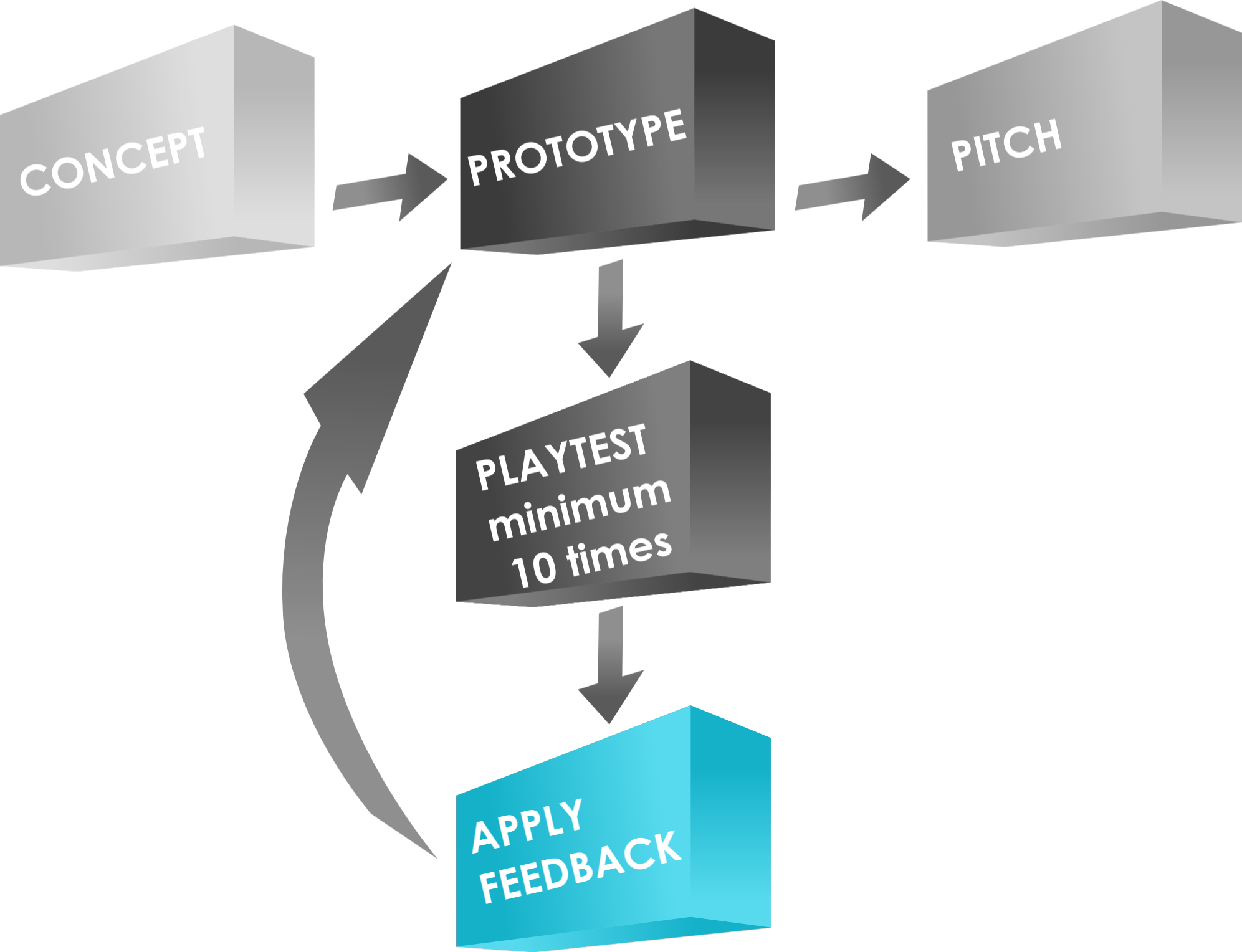
As shown in the graphic at the top of this article I prefer having ten playtests between changes in my games. Ten seems to be a good enough number where you can likely hear the same feedback from several different players. If, over the course of those ten playtests, you do hear the same feedback, then you likely know this is something that should be changed or adjusted. If you make sweeping changes between each playtest you’ll have no idea what part may or may not have improved the game.
The other thing I like to do with feedback is apply one change at a time. With Scoville, for example, several different people had mentioned that the brown cubes felt a little weird in the game. But it took several playtests to hear it from those several people. Later on other players said they loved that brown cubes introduce a way to mess with your opponents. Here’s the key:
Don’t let one person’s opinion of your game dominate how you change the design.
When multiple people mention the same thing then you know that something’s up. Then you can feel free to address that feedback.
So my two guidelines are these:
- Only apply one major change to the design at a time.
- Try to playtest each change at least 10 times before adding the next change.
Using these two guidelines should help you to understand which parts of your game design are awesome and which need some work.
***
So now you have a way to interpret and apply feedback. Get to the root of what your playtesters are saying. Apply the appropriate changes one at a time. You will be well on your way to creating a well polished gem of a game! Thanks for reading. Feel free to leave your feedback of this article below. I will try to interpret it correctly!
Giveaway #2—We Have a Winner!
I’m a winner! I won a copy of Sunrise City from the awesome bloggers at Theology of Games. They are celebrating their 1-year blogiversary and they post a ton of great stuff. Go check them out: http://www.theologyofgames.com. Or you can learn more about Sunrise City.

 Thanks to the fine folks at Clever Mojo Games, we have a copy of Sunrise City to give away to celebrate our 1-year blogiversary. Did you win…?
View original post 92 more words
Game Concept: Conclave

Of course I’ve already designed a logo!
So there I was, working on Trading Post, watching the Dan Brown movie Angels & Demons when all of a sudden a new game design hit me. I thought to myself wouldn’t a game about electing a pope be kind of fun? So I changed course and laid the groundwork for a game design I am calling Conclave. (It could also be called Preferiti, Triregnum, Habemus Papem – which is already used for a game, or Fumata Bianca).
That was back in 2011. I had the idea for the game and a sheet of paper with a few details, but, like so many other game concepts, it sat on my shelf for nearly two years.
While again working on Trading Post a few weeks ago, and yes, while watching Angels & Demons (I guess I have a liking for that movie) I again was drawn to the idea of a game about electing a pope. So this time, since Trading Post is my white whale, I diverted my attention to actually conceptualizing Conclave.
Papal Conclave: What is it?
In the Catholic Church the pope is the person elected to succeed the line of Saint Peter, Jesus’ disciple. Since the dawn of Christianity there has been a leader of the Christian Church. And the Catholic Church has referred to that leader as the Supreme Pontiff, or more simply, the Pope.
Conclave is all about electing a new pope. The word Conclave is a conjunction of two Latin words, cum (“with”), and clave (“the key”). The interpretation of the word conclave is “sealed with a key.” In 1274, due to several elections taking years to decide the next pope, it was decreed by Pope Gregory X that the elections should take place inside a sealed room. This way the college of cardinals would have to elect a pope while basically being sequestered and given small rations of food and water.
Since 1846 all conclaves have taken place in the Sistine Chapel, in the Vatican City.
During conclave the cardinals of the Catholic church are locked in the Sistine chapel. They will cast their first vote in the afternoon of the first day. To elect a pope requires a 2/3rds majority for any single candidate not including that candidate’s vote. If the vote does not result in a newly elected pope, the ballots will be burned with chemicals that result in black smoke emanating from the Sistine Chapel smoke stack. Each subsequent day the cardinals will take a vote in the morning and another vote in the afternoon. Black smoke will be displayed each vote until a pope is elected. Once a pope is elected then the smoke will be white, thus informing the world that a new leader of the Catholic church has been elected.

How are you going to earn their votes?
While this Scrutinium method (secret ballot) of electing the pope is a standard method there are three others: Compromissum, Accessus, and Quasi-Inspiratio. This game design is focused on Scrutinium.
How does the Game Work?
During a game of Conclave you represent one of the Preferiti, the preferred cardinals for the papacy. It is your objective throughout the game to manipulate the college of cardinals such that you earn their votes and get elected as the next pope.
This game is all about area influence. The game will be played using cards that represent each of the players. Each player will have their own deck of cards. Half of the cards are your own player color. The other half match the colors of the other players.
The first portion of the game represents the first afternoon vote on the first day of Conclave. During this portion of the game players take turns playing cards onto each cardinal to set their initial vote. Once all the votes are in, assuming no player has a 2/3rds majority (which is physically impossible in the first round with how I’ve designed the game), then the second phase of the game begins.
The second phase is the manipulation portion of the game. One your turn you can perform one of several types of miracles/charities, each basically giving you a specific action. These are listed here:
- Miracle of Feeding: Flip the cards of any one cardinal.
- Miracle of Healing: Swap the top cards of any two cardinals.
- Acts of Service: Lock any one cardinals vote.
- Acts of Mercy: Examine the bottom card of up to three cardinals.
So I’ve mentioned cards and tables. Let’s explain. During the first phase of the game (the first afternoon vote) players will take turns placing cards on each of the cardinals. They will place one card face down, and one card face up. The face up card is the only one that matters when counting the votes. The bottom card represents the bias that the cardinal has toward another Preferiti. So when players choose Miracle of Feeding they will flip any one cardinal’s vote over to the other card.
When players choose the Miracle of Healing they will take the top cards from any two cardinals at any tables and swap them.
Acts of Service allows for any one cardinal’s vote to be locked in for the rest of the game. This cardinal can no longer be swayed. But beware, each player has only so many “locking cubes” that they can use to lock cardinals.
And Acts of Mercy allows a player to look at the bottom cards of up to three different cardinals to see which way they might be leaning. This will help players know when it might be beneficial to choose the Miracle of Feeding (flip cards) action.
How do you win?
The game board basically represents the locked down Sistine Chapel. Your objective is not to earn a straight up 2/3rds vote as that would be boring for a game. Rather, you are trying to win different tables within the Sistine Chapel. It’s an electoral college of sorts. There are tables of 3, 5, and 7 cardinals. If you possess the majority of votes at any table, then you receive a number of votes equal to the number of cardinals at that table.
So if a table of 3 cardinals has two green votes and one blue vote, the green player would currently have 3 votes. It is an all-or-nothing system.
Players play to a certain number of votes depending on how many players are playing. Once a player has successfully manipulated their way to the right number of votes then they are elected as the new pope and the game is over.
Current State of the Game…
Currently the game is in the prototype phase. I basically have it ready for solo playtesting. Right now it is a pretty simple concept and is easy to prototype. But I’m exploring a few things that could make it both more interesting from a gameplay perspective and more difficult to prototype at the same time. So for now I’ll keep it simple. My goal is to solo it this weekend and get a better idea about how to move forward with the concept.
I’ll post more about Conclave in the future, but until then check out this awesome infographic from image-illustration.net: (click to embiggen)

4th of July Family Gaming
With the Fourth of July on a Thursday this year it is likely a few of you are taking some extra days off for a little family vacation. That means you’ll likely have a good opportunity to teach/play games with people who probably don’t typically play games. So today I present a short list of games that are accessible and enjoyable to gamers and non-gamers alike.
Here are the criteria that a game needs to meet to make it into today’s article:
- Easy to learn (Can teach in under 5 minutes)
- Easy to play (Decisions are relatively simple)
- Under an hour (Sorry Uwe, your games are awesome, but not accessible for family get-togethers)
With those simple criteria in mind here are my top five board games that you can play with your family this holiday weekend:
#5) HANABI
Disclaimer: I have not played Hanabi. But Hanabi is a fireworks game in a small box that seems like it would fit the criteria above. Here is a video by Tom Vasel showing how it’s played:
This game looks like a really fun game to try out with your family. And since fireworks are so appropriate for the Fourth of July weekend I just had to add it to the list.
#4) CARCASSONNE
 Here’s how I teach Carcassonne: Take a tile and lay it down.
This game is so simple from a mechanics perspective and yet their is so much depth in your decision of where and how to place the tile and then whether or not to put a meeple on it. That’s what I love about games like this: simple mechanics with deep strategy.
With just the base game this one definitely can appeal to non-gamers. Add in the Inns and Cathedrals expansion and it adds some depth. My favorite expansion is Traders and Builders where you’ve got wheat, beer barrels, and Fruit by the Foot to gather up for more points.
This game is just such an easy game to teach and play that I love to bring it along to family gatherings.
#3) STONE AGE
This one probably goes beyond the 5 minute teaching rule, but it’s simple enough that I like to bring it along. People really seem to like the cave-man theme. I like this game because there is some fun, deep strategy. Here’s a look at the components in the game:

If you really want to spruce it up try visiting the Mating Hut!
This game can give non-gamers a little bit of component overload. But teaching them how simple it is to play will get them going in no time. As a bonus, have them smell the cup. If you own the game, you’ll understand!
#2) KINGDOM BUILDER
 Our founding fathers were building a kingdom (of sorts) when they signed the Declaration of Indepence, so what better weekend to try this game with your family?
Kingdom Builder is another game that is really easy to teach and play. On your turn you basically place three settlements on the board. Based on where you place them you may or may not have earned points (which get scored at the end). If you place a settlement by a special location then you have earned an ability which can help you the rest of the game. This game has a rulebook that is easy to follow and is quick to learn. I also like the cool boards in the game and the replayability (I know some people won’t agree with me on that… oh well). I’ve probably played it 30 times and it hasn’t gotten old to me, though owning the Nomads expansion helps.
#1) TICKET TO RIDE
No Settlers of Catan here. That game doesn’t meet the simple to learn criteria. Ticket to Ride does meet the criteria. It is so simple to setup, teach, and play. On your turn you can do one of three things:
- Draw train car cards
- Claim a route by placing trains
- Draw destination tickets
That means the game moves along pretty quickly. And this game is a lot of fun. Players work toward connecting their routes. The inevitable blocked route will occur and someone may get a little grumpy. But the bottom line is that this game is so easy to introduce to non-gamer family members that you might just convert them into a gamer!
Here’s a video from CoolStuffInc.com describing the game:
…
So there’s my round-up of the best games to play with your non-gamer friends and family this holiday weekend!
But… what about YARD GAMES? I don’t want to be stuck indoors during the beautiful summer weather! Okay. Here’s a quick list of four fun yard games to play with your friends and family this holiday weekend:
#4 BOCCE
 Grab that palino and huck it! The palino is the name of the small white ball. One player tosses the palino and then players take turns bowling, tossing, chucking, heaving their bocce balls toward the palino. The players closest to the palino score points. This game also provides a fun way to give people a tour of your yard. If your yard is weedy and gross, maybe skip Bocce.
#3 LADDERS
Growing in popularity, this fun tossing game involves players throwing strings with balls on the ends at makeshift ladders, usually made from PVC. Players score points based on which rung of the ladder the string and balls land on. You can build yourself a set of this pretty easily. But if you choose to drill through golf balls, don’t smell the burnt plastic inside. I almost passed out by doing that!
#2 CORNHOLE / BEAN BAG TOSS
Another tossing game. This time you are throwing a bean bag into a hole. Players take turns lofting a bean bag through the air trying to get it to fall through the hole in the board. Here is a particularly striking and appropriate version of Cornhole:

#1 KUBB

If you squint it looks like a monster with a serious underbite!
We have the Vikings to thank for this game. Apparently they were into tossing things as well. Weird how all these outdoor games involve throwing things. Perhaps I should have added Croquet to the list to mix it up a bit.
Kubb is a game where you throw batons at chunks of wood. Your objective is to knock down all of your opponent’s kubbs and then knock over the king. This game is a lot of fun because of the ability to stack the kubbs when they’re knocked over. It takes a while to play, but time with family is always worth it, right? Just ask your crazy uncle!
Here’s a nice boring video about the game:
Looks pretty awesome, huh?
HONORABLE MENTION: Hammerschlagen
…
Thanks for reading! I hope that you get in some nice quality gaming with your non-gamer family and friends this holiday!
The Benefits of Pretty Prototypes
Today I’m presenting you my rebuttal for an article posted on Example of Play on May 30th. Here’s the link:
It’s an interesting article and I am currently at the prototype phase with Trading Post. So now’s as good a time as ever to post my rebuttal. I’m a big fan of the visual aesthetic of quality prototypes versus handwritten game designs on 8.5×11 sheets of paper. It’s worth the effort to me to make a quality prototype. Let’s get started…
The BEST possible prototype is an amazing looking prototype.

Prototype Cards for Trading Post and Scoville
Maybe. It’s all about perspective and approach.
When designing a board game you will have to create something physical to test the game. There are many approaches to this but here are the two genres that your prototype will likely fit into:
- Use pencil/pen/colored pencils/markers.
- Use art creation software and a printer.
These aren’t the only options, of course, but they are the basis for today’s rebuttal of that article.
It Can Be Worth the Effort to Make Nice Prototypes.
So there you are, sitting at Protospiel or an UnPub event. You’ve got your prototype on the table. It’s got a few poker chips for money. You’ve got an 8.5×11 piece of paper that has folds and creases. It’s covered with a few chicken scratches of notes, but still it serves as the game board. And you’ve got sleeved cards covered in Sharpie. Your table is empty. You glance at the exceedingly full table next to you to see what’s going on. On that table is a glowing, beautifully rendered, full art prototype on thick matte board with quality printed cards and an aesthetic that draws you in.
Uh oh.
Think of it like this. If you were an attender of Protospiel or UnPub and were looking for games to play, would you be more drawn to the nice fancy artwork where you can tell the designer put a lot of effort into his or her product? Or would you be more drawn to the 8.5×11 with Sharpie notes and no art?
One of the reasons I think Scoville had some of the buzz that it did after Protospiel-Milwaukee was due to the quality of the prototype. Several people commented on the thick, quality feel of the Orders and Recipes in the game. Others asked how I made the components. The point is that I put in a little extra effort to make things seem more like a real game rather than a prototype.
What Should Be the Focus of Your Playtester?
Let’s examine the same scenario as above. So someone sits down at your table, with your 8.5×11 covered in Sharpie. You think you’ve got a decent game here. So you teach them how to play and after a few rounds, when you believe things should really be taking off, you notice a look of confusion on their face.
Let’s get into their head a little bit. As that player you are trying to enter into whichever world the designer has built for you. Part of playing games is about stepping into a different world for a while. In this case you don’t know what world you’re entering because there is no theme and no artwork. This 8.5×11 with Sharpie thing has you in a mental police chase to try and figure out how things work in this game.
Your mind has lost it’s focus. You are staring at a white sheet of paper while trying to put yourself in some other world. Where will your focus be? I imagine it would be difficult to make the game your focus.
Let’s think of another example. It’s 1910 in Manhattan and you need a cab. You’re waiting in the rain watching for a cab to roll by. Whoops, one just drove by, but it looked just like a normal car. Aye. Wait, what’s this? A Yellow Cab? That sure was easy to spot. So you hop aboard the yellow cab and they take you on your way. And not surprisingly, you leave a nice little tip for the driver because he was so easy to spot.
Board game prototypes are the same. As I saw at Protospiel-Milwaukee and as evidenced by the plethora of games on Kickstarter alone, there are a lot of people designing games. Your game should have appropriate enough artwork to be able to draw in players, build buzz, get your name out there, and perhaps earn a publisher’s eye. I wouldn’t expect to get anywhere with my designs if they looked very poorly made.
Are You Willing To Change Things?
One of the problems with building a high quality prototype is that it can be difficult or cumbersome to make changes. With Scoville I just about wore out my rotary cutter. Every time I made some changes I’d have to print out new components and cut them and mount them to matte board.
One way around this issue is that when you make your original prototype, go ahead and make some blank components. That way you’ve got pieces that you can write on as placeholders until you’re ready to make a complete new version.
The article that I linked above discussed a card that the designers were unwilling to change for a long time. The point they made was that if you are unwilling to change it, it’s not a prototype. In their case they had an elegant card with full artwork.
I totally agree with their sentiment. And in the situation where you are unwilling to change a component then you might as well put full art on it.
Don’t Get Too Attached!
Another point of the article was that the designer expended a lot of effort to make a nice quad-fold board and then began to consider player tableaus rather than the nicely crafted board.
While I enjoy the quality feel of the components in my prototypes, I don’t let myself get attached to them. So what if I spent three hours designing a deck of cards and paid $10 to have the deck made at The Game Crafter. If the game is terrible with those cards then I have to be willing to get rid of them.
So that brings us to our balancing act of the show. There is a balance between the effort you put into making a quality prototype and the usefulness of that prototype. If you are solo testing there is absolutely nothing wrong with the 8.5×11 with Sharpie approach. If you are having friends over to try out a new game design there is nothing wrong with that approach either. If you are attending a convention and you are seeking valuable feedback, then please don’t go with the 8.5×11 approach. Put in some effort and make it look nice. Then after the convention when you apply that feedback, be willing to throw away your original quality prototype.
Why Awesome Prototypes are Better
If you’ve put in some effort and realize that you’ve made a quality prototype that you aren’t ashamed to show off then here are a few points to consider:
- You can believe that players will feel immersed in your game, and feedback will represent that.
- You will have built a prototype that you would be happy to send off if a publisher requests it.
- People are conventions will be more willing to playtest your game than the ugly 8.5×11 game at the next table.
- You will be honored as a great human being and a plaque with your image will be mounted at the Board Game Prototypers Hall of Fame!
Okay, maybe not that last one.
The bottom line is that, depending where you are in the design process, it may be time to make a nice, high quality prototype.
To Sum:
Spend a little effort and make things look nice so that you are the one that draws a crowd!
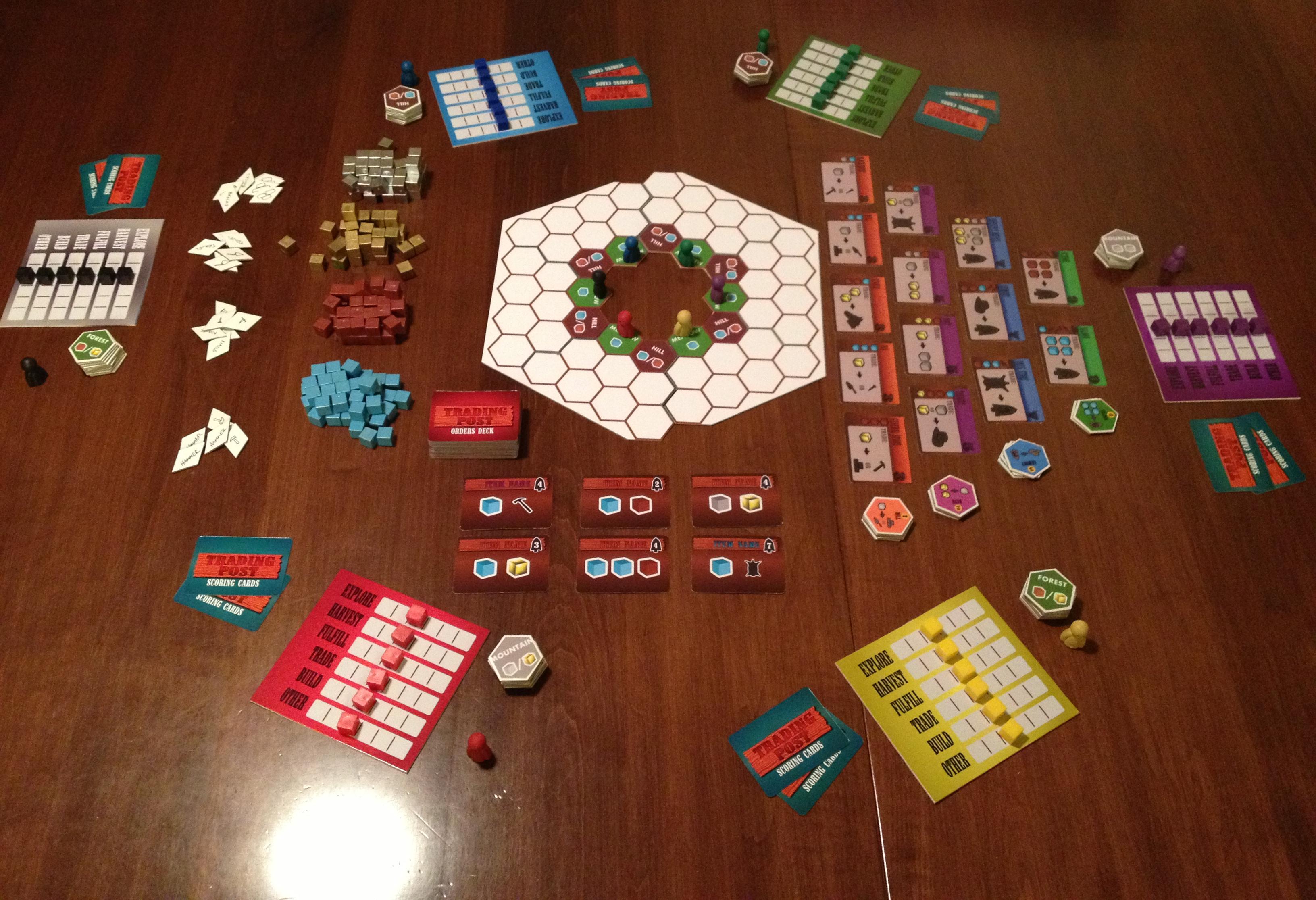
High Quality Prototype of an Untested game!
 Boards and Barley