Blog Archives
The Purpose of Expansions
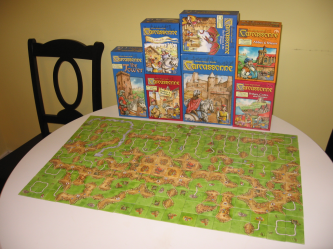
Carcassonne and several of its expansions. Photo via wordsgoneby.blogspot.com.
Scoville is on the ocean in a container on a massive vessel (info via latest KS update). That’s pretty sweet and it means that the time is rapidly approaching when all of the awesome Kickstarter backers will be able to get Scoville to the table! I couldn’t be more excited.
So naturally I might as well begin work on an expansion (which I playtested last week!). Working on it has brought me to the question of “What is the purpose of an Expansion?” Today I’ll briefly try to address that. Throughout I’ll be using Carcassonne and Ticket to Ride as examples.
From a designer’s perspective here are the three main reasons I think a game should receive an expansion :
- Increase Replayability and Variability
- Add something new
- Add depth
And here are three reasons a publisher may want to publish an expansion (in addition to those above, of course):
- Sell more of the original game
- Make money at a higher margin since expansions don’t typically cost as much
- Provide more quality products to help build your catalog
Obviously the designer reasons and the publisher reasons that I provided are not nearly exhaustive, so take that however you want. I’ll only be covering the reasons for an expansion from the designer’s perspective. At the end I’ll also provide some things that an expansion SHOULD NOT do.
Increase Replayability and Variability
One of the things I like to design into my games is the ability to play it over and over and never have the same experience.I like to define Replayability and Variability thusly:
REPLAYABILITY: When a game can be played over and over again without it feeling old and “samey” despite the setup and game conditions being identical.
VARIABILITY: When a game presents different scenarios for play such that no two plays could ever be identical.

Kingdom Builder – Variable Setup FTW!
Those sound the same and they basically mean the same thing to me. The point is that I do not want to play a game the exact same way it was played prior. That turns the players into robots seeking to find the optimal plays in a game. I prefer games where it is different based on who you are playing with or how the game is designed.
This can be accomplished in several ways but most often via randomness. Sometimes the original design doesn’t receive all the variability the game deserves. Other times the designer comes up with new ways to increase variability after the game is published. Either way, creating an expansion is a great way to bring the game to people’s tables again and make the experience better.
Some of my favorite examples of expansions increasing the replayability/variability of a game are the Carcassonne expansions. (They actually meet all three “expansion” criteria I am mentioning today, so I’ll use this example for each below as well.) The Carcassonne expansions add replayability because they implement situations that are different based on the people you are playing with and based on the tiles you draw.
But perhaps the best instance that I can think of for variability is with the random board setup and scoring conditions from Kingdom Builder. That is one of the most replayable and variable games in my collection and that doesn’t necessarily refer to the expansions.
Add Something New

Add something new… like new routes to Ticket to Ride!
Sometimes a game is deserving of a new addition that changes the game and how it is played. Adding something new to a game can make players want to play it again. It can be a new mechanic, new components, new cards, dice, etc.
Adding something new doesn’t necessarily add depth. Adding new elements can simply make the game enjoyable to play again.
In the Carcassonne world, the Inns and Cathedrals expansion did not really increase depth. Rather, by adding something new it lured gamers to play again and again. The Inns and Cathedrals addition is very minor but it adds enough to change the way people play the game.
Another example is the USA 1910 expansion for Ticket to Ride. Basically it adds a bunch of routes without changing any rules. This is such a simple and smooth expansion to integrate with the base game. Designer’s should keep these sorts of additions in mind with creating expansions.
An easy (actually ridiculously easy) way to expand Scoville is to design a whole bunch of new recipes that utilize previously unused combinations of peppers. This would add something new to the game without changing a single rule. Ironically I hadn’t thought of that until just now, while writing the article. I will be creating 20 new recipes!
Add Depth

Grain, Beer, and Fruit by the Foot!
Often an expansion will provide ways to make a game deeper strategically, tactically, or even thematically. This usually coincides with adding something new. A new mechanic can be added to the game that changes the gameplay or injects depth of decisions. Or perhaps new components are added that add depth via breadth (is that even possible?). I suppose that would be something like instead of limiting the game to four different resources, you could bump it to 6, which could add depth.
The idea behind this reason is to take a game that players have become familiar with and make it deeper. Sometimes players refer to this as “heavier.”
In Carcassonne the Traders and Builders expansion adds notable depth. Players have the objectives of finishing castles such that they earn the bonus tokens of Grain, Beer, and Fruit by the Foot (or maybe grain, wine, and cloth… not sure). This sort of depth adds a distinct layer to the strategy players utilize during the game.

What Expansions SHOULD NOT do…
I am of the opinion that expansions should not:
- Cost more than the base game (Though I suppose an argument could be made for certain situations).
- Change the base game so dramatically that it is a completely different thing.
- Detract from the original concept of the base game.
- Add an overwhelming number of new rules or exceptions to rules.
- Modify the original rules.

Not an expansion.
So the simplest way to create an expansion is to simply add some new components like the Ticket to Ride USA 1910 expansion. That expansion did not cost more than the base game. It did not change the base game at all. It did not detract from the original concept. It added zero new rules. And it did not modify the rules. That’s a streamlined expansion.
When expansions violate the 5 points I listed then they start to break away from what I consider an expansion and fall more in line with a whole new game. This would be akin to Ticket to Ride – Europe. The base game is the same but there are new components, new rules, and the original rules were modified enough that this doesn’t meet my criteria for an expansion.
NOTE: Ticket to Ride – Europe was neither marketed nor sold as an expansion.
So what do you think? What makes an expansion worthwhile to you? What are some of you favorite and least favorite expansions? Thanks for reading!

Monday Brews 10-20-14
I had meant to post a game design article last week but failed to find the time to write it. I’ll be posting that tomorrow instead. But today is Monday so it’s time to recap the Boards & Barley I’ve enjoyed over the last week.
The Barley:
BARLEY SPOTLIGHT: No spotlight this week.
- New Glarus Staghorn – An excellent local Oktoberfest
- Lift Bridge Hop Dish – A Minnesotan IPA of enjoyable character
- MKE Sasquash – Likely my last Pumpkin brew of the year
- Nobody Plays Brown (Homebrew) – My “Choke it down” Brown ale.
The Boards:
BOARDS SPOTLIGHT: Scoville + Unn amed Expansion
I recently designed a small expansion module for Scoville. I plan to design two or three more such modules. But I had the privilege to test it the other night. It was a lot of fun to work on Scoville again. The module adds another layer to the spatial element of the game, which is already awesome. There were a few interesting things that came from it and I’m pleased with how well it worked. A little tweaking and I might have to send it to TMG!
Apparently I’ve been playing some games with my kids!
Designer’s Corner:
This coming weekend I will be attending Protospiel-Madison. I will have the Scoville expansion with me and I am rapidly working toward having another prototype with me as well. It’s not Quantum Orcas, so breath your collective sigh about that.
It’s a version of Armada Galactica that I think could have some potential. I still have a ways to go to get the prototype ready, but I think it could be a fun game.
I’m also excited to see numerous game designers at the convention. It’ll be nice to see what people are working on.
That’s it for the Monday Brews. What Boards & Barley have you been enjoying? Stay tuned tomorrow for a fresh game design article!
Monday Brews 10-13-14
Welcome back to Boards & Barley! It’s been a while since I posted and I blame it all on my kids. I’ve got three little rugrats and they often find ways to fill all of my “free” time. But I’m back today with a recap of the Boards & Barley that I’ve enjoyed over the past couple weeks.
Before that, however, I’d like to mention how awesome it’s been with having kegged beer. I put the kegs into my basement refrigerator and I now have cold beer on tap. I need to thank my neighbor once again for loaning me the equipment. I wouldn’t have been able to afford two kegs, regulator, gas lines, taps, and CO2 tank otherwise. If you want a beer on tap without having to pay $5 for it, head on over and I’ll pour you a cold one!
The Barley:
Don’t be sad, little guy. You tasted pretty good!
BARLEY SPOTLIGHT: Nobody Plays Brown – Homebrew
I brewed this “Northern Brewer Caribou Slobber” kit back in May and let it age (unintentionally) in my basement for four months. This was a kit that my older brother gave me as a Christmas present last year. It’s fun to get a beer kit as a Christmas present. So the other night with some friends over I took some glasses down to the basement fridge and filled them up from the tap. It wasn’t the best brown ale I’ve ever had, but I’m not disappointed to have 4 more gallons of it either.
- Boddington’s
- Baraboo Bonfire
- Left Hand 400 Pound Monkey
- Lake Louie Golden Booty
- Ommegang Abbey Ale
- Nobody Plays Brown (Homebrew – Brown Ale)
- You’ve Been Wheated (Homebrew – Hefeweizen)
- New Glarus Staghorn
- New Glarus Totally Naked
- Finch’s Fascist Pig
The Boards:
BOARDS SPOTLIGHT: Unpublished Prototypes
The Wealthy Lazeabouts by Jeremy Van Maanen can best be described as an auction game about bidding on who will win the auction. When I originally heard about that theme I cringed a little. It seemed boring. But we played the prototype the other night and other than a balance tweak and art upgrade I’d buy this game! It was highly enjoyable, provided for interesting choices, included a LARGE amount of player interaction, and was plain fun to play!
Super Ego by Adam Buckingham is all about Super Heroes who are more interested in glory and honor than in actually rescuing innocent victims. In the game you are one of those super heroes. During the game you’ll collect skill cards and use those skills to perform rescues and earn honor. Sometimes you may be able to earn honor that you can post on your timeline on your HeroBookFace account for all the other super heroes to see and envy. This game was full of intriguing choices, options to hose the other super heroes, options for revenge, and fun gameplay.
Both of these games were amazingly successful for their first playtests. If you are interested in playing either of them they’ll both be available to play at Protospiel-Madison in a few weeks.
- The Grand Illusion
- Ultimate Outburst
- Soon to be published Prototype: Fuse
- Camel Up
- 7 Wonders
- Madeira
- Spyrium
- Glass Road
Designer’s Corner:
After playing The Grand Illusion 4 times in the past two weeks I’ve decided that the game needs to be redesigned. With a theme of magic and illusion it really needs to have awesome magical elements in the game. With the players representing illusionists I want the gameplay to feel like you are being sneaky and pulling things over our heads. I want there to be magical elements, common tricks, and other things that are generally associated with magic and illusions. So I’m turning it into less of a card based game and more of a classic Euro game. Imagine being the magician and having a few assistants to help you gather the equipment you need, market the show you’ll put on, and help you practice. Also imagine the assistants utilizing magic to help you out. Your objective is to begin as a street performer and work your way up to performing a Grand Illusion in a theater. I’m excited about upgrading this design significantly. Since the mechanics of the old design worked I think I may utilize them with a different theme.
Also on the design front I designed an expansion for Scoville. It took about three hours to scheme up the design, create the art, and make 36 new cards. I’m super excited to try it out. Also, I have three other expansion ideas for the game that I’ll try to mock up before Protospiel-Madison. It was fun to work on Scoville again, but now I’m desperately wishing the real copies would arrive!

The Grand Illusion Update 8-28-14
 As I continue to work on The Grand Illusion I get more and more excited about the potential of the game. Not only is it focused on Victorian era magicians and illusionists, but I also think that the gameplay in interesting and intriguing.
Today I’m going to discuss that gameplay a little more in depth. So far I’ve discussed the theme, the core mechanics, and the drafting mechanic. Ironically both the core mechanics and drafting mechanic are changing. I’ll explain why today. But let’s recap a few things, starting with the objective of the game:
The Objective:
As a street magician/illusionist it is your dream to work your way up and have a popular show in a highly successful theater. To do that you must win over the crowd, from the few stragglers on the street at the start of the game to larger and larger audiences as your reputation advances.
You objective in the game is to increase your skills and earn enough reputation to successfully perform your Grand Illusion to as large an audience as possible. Points are awarded based on your skill levels, the size of your audience (this potentially may change), and the number and variety of tricks you performed throughout the game.
What I want the game to be:
I absolutely love the movie, The Prestige. Here is a quote that best represents how I want things to operate:
Every great magic trick consists of three parts or acts. The first part is called “The Pledge“. The magician shows you something ordinary: a deck of cards, a bird or a man. He shows you this object. Perhaps he asks you to inspect it to see if it is indeed real, unaltered, normal. But of course… it probably isn’t. The second act is called “The Turn“. The magician takes the ordinary something and makes it do something extraordinary. Now you’re looking for the secret… but you won’t find it, because of course you’re not really looking. You don’t really want to know. You want to be fooled. But you wouldn’t clap yet. Because making something disappear isn’t enough; you have to bring it back. That’s why every magic trick has a third act, the hardest part, the part we call “The Prestige“.
I love when games escalate and this simple three-step process of Pledge, Turn, and Prestige is ideal for that. However, I don’t want players to only work on one trick throughout the game. So I would rather have the game work in three stages where things ramp up automatically as if a player were progressing from the Pledge to the Turn and finally to the Prestige. The question is whether or not I can accomplish that through the game design.
The Gameplay:
Previously I had shown these icons for the basic types of magic:

These represent the only types of magic a player can perform early in the game. It will be important to perform these because they will allow you to “unlock” new magic types by increasing your skills.
SIDE NOTE: One thing I’ve been going back and forth on for The Grand Illusion is whether I want the game to be phase based (meaning in each round players all do phase A, then phase B, then …) or turn based (meaning players have options A, B, C… and on their turn they choose one). At this point I’m going with turn based. (I’m dropping the draft mechanic for now)
So I mentioned that players can perform tricks and increase skills but I haven’t really explained that. Here we go…
ON YOUR TURN:
There are three options for each turn. These are:
- Perform a trick (Including your Grand Illusion)
- Draw magic cards
- Increase your skills
Let’s explain these in more detail.
Perform a Trick
You can turn in magic cards from your hand to complete an available face up trick on the table. These trick cards will have magic requirements. When you turn in the correct cards you will “perform the trick.” After that, take the trick card and place it face up in front of you. This card will have a magic type on it that represents a skill you can now increase. It also has an audience rating. The audience rating will be important for being able to perform your Grand Illusion.
Draw Magic Cards
It will be important to keep your hand stocked with the correct types of magic cards as you work up to your Grand Illusion. You can simply draw magic cards from the face up cards or the deck based on your skill levels.
Increase your Skills
Once you have successfully performed tricks those cards will be in front of you. To increase the skills shown on the cards you will have to turn in different sets of magic cards. When you do you can then place a skill marker on the trick card to show that you have increased that skill. If you have several cards of the same type you can simply stack them in a way that you can still see how many you have. Your skill level will tentatively be number of cards times number of skill increase tokens. Increasing your skills is necessary to be able to perform your Grand Illusion.
Scoring:
The game ends once a player has performed their Grand Illusion. When they do, all other players will have one final turn.
Points are earned from several categories:
- Number of tricks performed
- Types of magic performed
- Skill levels
- Grand Illusions (if completed)
In the game you can focus on a singular path toward your Grand Illusion and try to maximize skill points on one type of magic. Alternatively you can attempt to score via breadth of magic types and complete a high variety of tricks. Ultimately this game will be a race to complete your Grand Illusion. But hopefully along the way there will be fun and interesting decisions.
What’s Next?
It’s time to prototype this. I’m ready to get this to the table and start playing it. I’m pretty happy with the direction it is going. After the feedback from readers regarding the drafting mechanic I think I’ll save that for a different game. I believe it was distracting from the thrust of what I want this game to be. So it’s gone and I’m ready to start playtesting (once I put some cards together). It will be my goal to create a PNP file to share once I’ve playtested a few times so that I can possibly get some early feedback from gamers and designers. I’ll keep you posted. Thanks for reading!
How to (Speed) Pitch Your Game
While at Gen Con my business partners from Moon Yeti Games and I had a chance to be part of the Publisher Speed Dating event run by James Mathe of Minion Games. I will refrain from making any comments about the games themselves. However, I am writing this article because I was a little shocked at how poorly people were pitching their games.
A while back I wrote an article called How To Teach Games. I’m using a similar model for this article.
The Scenario:
You’ve got 5 minutes to pitch your game. It’s all set up, ready to go. A publisher walks up to your table. What do you do?
The Pitch:
When teaching games I like to work top down and start very vague and get more and more detailed. A pitch doesn’t really work that way. You’ve got to figure out a way to skip over a bunch of the basics of your game and dive deep into the selling points. Here is a graphic I made that should help:
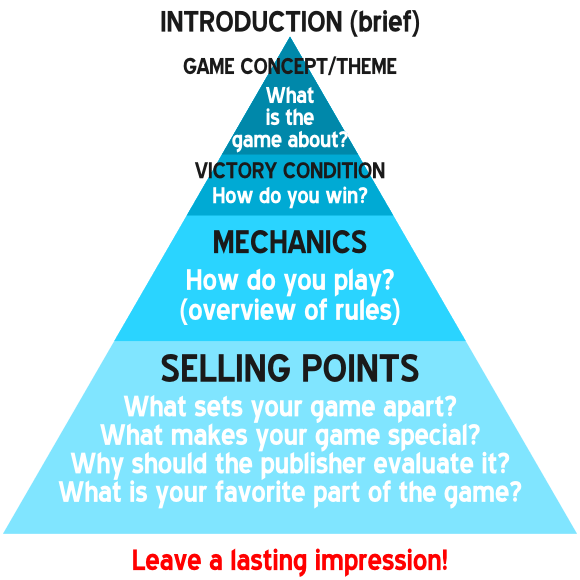
The sizes of the different portions of the pyramid represent the amount of time you should spend on that section. Let’s break it down:
INTRODUCTION:
This should be limited to your name and handshakes. Give a business card and sell sheet. Otherwise don’t waste time here.
GAME CONCEPT/THEME:
Limit this to 10-20 seconds. Basically just give the background of the game concept. There’s no reason to go into a back story of why you are designing it or how it may serve humanity. Be succinct and move on.
MECHANICS:
This part is more important and is where you should spend about 1-1.5 minutes. Publishers will need to know how a game is played. They understand that if a turn in a game requires you to work through 15 different phases, then perhaps the game isn’t as streamlined as it could be. Give a good overview of the rules and how a basic turn works. You don’t need to share every rule of the game nor do you need to share the “exception” rules that are slightly different than the norm. Just share the normal, standard rules for the game. Work through the whole thing and then come back to the selling points…
SELLING POINTS:
Here is where you make or break the deal. This should be the bulk of the pitch. Publishers want to know what makes your game special. There are a lot of games out there. There are a lot of designers out there. There are TONS of unpublished games out there. So what makes yours special?
I refer to it as the “hook.” Tell the publishers what the hook is. The hook refers to the thing that’s different than any other game.
- Are you utilizing components in a new way?
- Are you using a new mechanic?
- Are you modifying an old mechanic in a new way?
- Is your theme so amazing?
Hopefully there is something that sets your game apart. This is where you share that. This is where you emphasize how your game is special. This is where you make your case. Figure out what makes your game great and make sure the publishers understand!
LEAVE A LASTING IMPRESSION:
Hopefully your game will leave a lasting impression. It is wise to allow 20-30 seconds at the end for questions from the publisher. Answer their questions cordially and then thank them for their time.
Aftermath:
Congratulations! You just made the best sales pitch ever! Now what?
Publishers are different. Some may offer a contract on the spot (this is rare). If so, congratulations! Some may ask for a prototype. It’s a good idea to have an extra prototype on hand. Here’s where it gets a little sticky: what if two publishers ask for a prototype? (You should have a publisher priority list – meaning you’d rather work with pub A than pub B. Give the proto to pub A!) Sometimes publishers will love the game but will want to consider it before approaching the designer outside of the sales pitch. Often this is due to publishers needing time to discuss the prototype and the designer with their internal team.
Often the aftermath requires patience. Feel free to contact a publisher, but don’t be pushy. Publishers see a lot of games and often have a lot on their plates. Rest assured, though, knowing that you at least made a good sales pitch!
Have you had a successful sales pitch? Do you have a different method? I’d love to hear about them. Also, let me know if you have any comments about this method. Thanks for reading.
 Boards and Barley