Author Archives: edpmarriott
Trading Post Part 1: Origin

Trading Post Logo… for now.
I have a new game design I’m working on and today I am posting the first of 4 articles about it. Today, and the next three Thursdays, I’ll be writing about the game from it’s creation to the present state. Here’s the four articles I’ll be writing:
- TODAY 5-16-13: Origins of Trading Post
- 5-23-13: Prototyping Early Versions
- 5-30-13: Hiatus and Re-design
- 6-6-13: Path to GenCon
So let’s jump back to 2010 when I was first diving into game design and take a look at how Trading Post became a thing…
Concept: Theme
Here you are, explorer extraordinaire! You have been selected from an elite group of explorers to develop a new Trading Post. You role, should you choose to accept it, is to utilize the resources found on your section of their territory, and contribute the most to the Trading Post. Contributions include constructing new buildings for the Trading Post, successfully exploring all of your allotted territory, and completing trades that are beneficial for the Trading Post.
Concept: The Map
Normally when I start a new game design I start with a theme. Trading Post is an unusual case in that it started with both a theme and a map mechanic to be used in that theme. For some reason I thought that a square grid with spots on the corners for putting cubes would be a good idea. And it would seemingly work very well with the Trading Post concept.
Here’s a look at one player’s section of territory in very alpha artwork, if you can refer to lines as artwork:
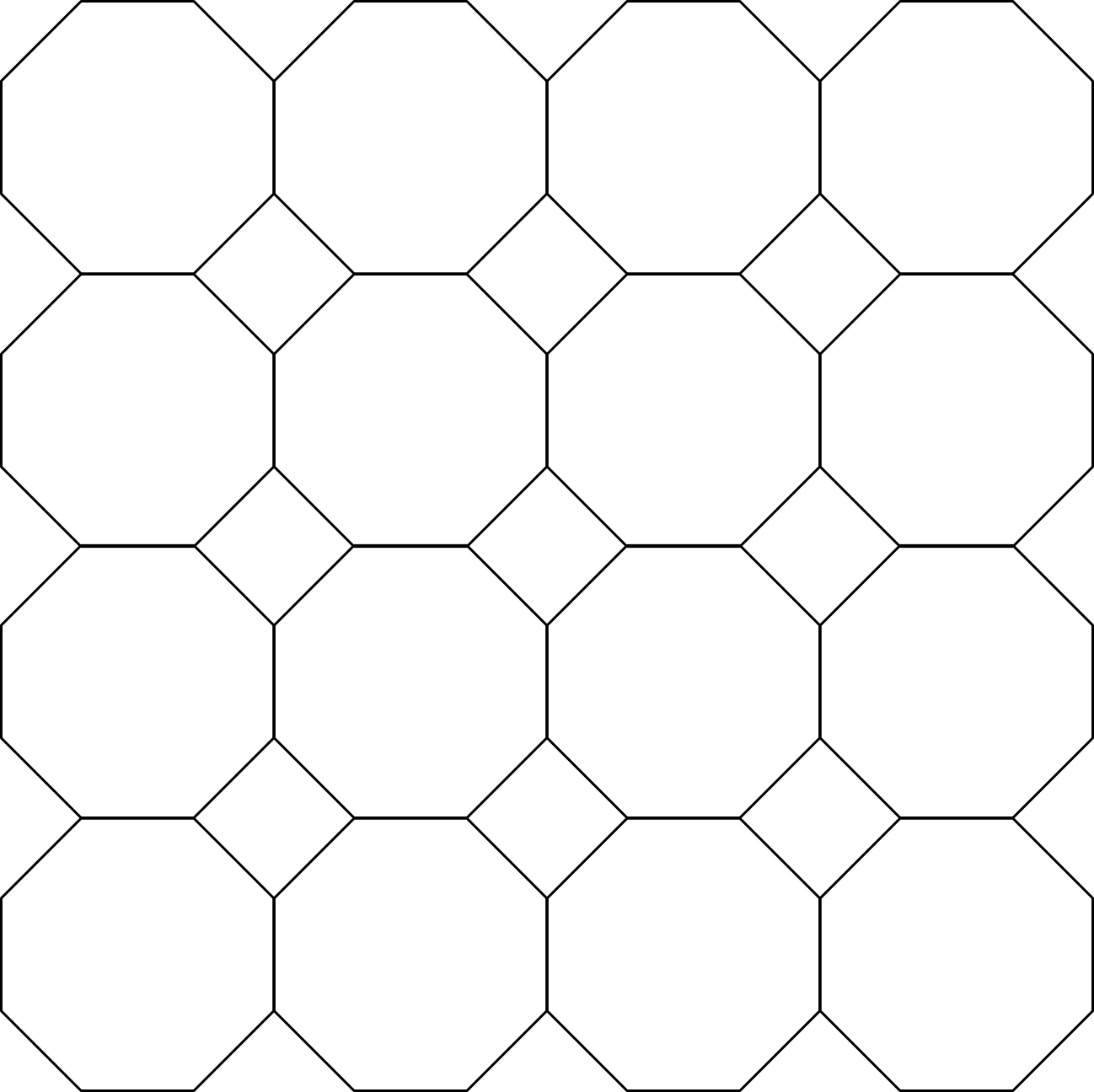
Octagons represent land/buildings. Diamonds represent resources.
The idea of the map is that you can explore the land and add buildings to the octagons. Then each building can produce something that you can place into the diamonds. The resources would be represented by cubes, which would fit very nicely into the diamonds. The really sweet part of this map design is that you have to try and move your goods into the diamonds that adjoin to your territorial neighbors so that you can trade with them without having to use the Trading post as a middle man.
Concept: Game Play
With a theme and map mechanic in place it was time to figure out how the game would actually be played. I had found a really nice article online about what makes a game good. It included things like Tension, Replayability/Variability, No Runaway Winner, No Kingmaker, No Player Elimination and more. If anyone know of the article can you share the link? I can’t ever find it. So after working through some of those things in my head I came up with a ladder type design where you would become more capable of doing more things on your turn.
The idea of this was that you would start as just a person in the Trading Post. You would thus be able to move one spot per action, and you could only explore up to two rows into your territory. Since exploring all of your land is part of the game it would be important to build up the capability. So the first step would be to purchase a horse via trade with the Trading Post.
Once you traded for a horse you would be able to move two spots per action. You would also be able to explore the next row. In the game design the tiles that would be available in this “Horse Region” were better than those available in the “Person Region” (first two rows). This would allow you to do more stuff, make better trades, and work toward the wagon.
The Wagon was the last “upgrade” you could do. To build the wagon you would have to make a series of trades to procure the necessary components: wheels, axles, canopy, box. Once you’ve upgraded to the wagon you can then move three spaces per action and explore the furthermost regions of your territory. This is vital as the most valuable resources are only available in the “Wagon Region.”
Concept: Time and Action Points
During the game each action would cost a certain amount of time. The game would be played over 7 years with each action costing a certain number of months. So moving would cost 1 month. That’s why it would be important to upgrade to a horse or wagon as early as possible to be able to move more spots with the same action. Basically with the game being 7 years of 12 months each player would have 84 action points to work with.
Because I made “time” part of the game I was able to also have the seasons play a role. Each year had a new “Event” card come up that affected something for the year. This could be seasonally dependent as well.
So I came up with a series of event cards to add several things to the game design:
- Replayability: Each game would be different since the draw of event cards is random.
- Variability: Specific scenarios of event cards could be established to promote specific game play.
- More details: Having event cards made the game deeper, in my opinion.
I found early on that having a time mechanic like this made things difficult to design. Since players weren’t always taking the same number of actions on a turn I had to incorporate a “last player gets a turn” mechanic similar to that in Glen More. By doing this I would never have to worry about how player order worked.
The other downside of having 84 actions points (84 months) in the game was that every single turn players would have to advance their “months” token and potentially their “years” token if they entered a new year. Fiddly.
Concept: Overall
I thought I really had something with this game design. I was gung ho about putting together a prototype and making this into the most awesomest game ever. With 8 different resources, 84 action points per player, upgrades to a horse and then wagon, land development, trading, exploration, etc. I knew this would be awesome. Perhaps I was being a little too optimistic.
In my mind I thought this game had a lot of potential. I put a lot of time into it early on only to realize that it was ridiculously complicated. Next week I’ll cover my initial prototyping efforts and the lessons I learned during that phase. In two weeks I’ll share with you the current re-designed version, which is night-and-day better, potentially even being a playable and fun game. And three weeks from now I’ll discuss my path forward with the game as we approach GenCon.
If you have any questions or comments about the game over the next three weeks, just let me know!
Scoville Print and Play Version 2

Version 2 awesomeness now available!
I am pleased to announce that Version 2 of the Scoville Print and Play files are available for download at BoardGameGeek.com. Here is the link:
There are no major rules revisions to the game. The only clarification to the rules is that when selling peppers you must sell peppers from your own supply. Peppers in the fields are not for sale.
There are a few changes to the Print & Play files. The most notable change is that Gold has been dropped in favor of Silver. I’d like to thank Adam “A-Game” Buckingham for the suggestion. This was done for two reasons:
- Black + White blends to gray, not gold. So from a color perspective this is much less confusing.
- There is a much lower chance of confusing yellow with silver. These two colors are now more distinct.
The PnP files also have a few other revisions. These include:
- Artwork for the Bonus Point Tiles for secondary peppers (green/orange/purple) has been adjusted to decrease confusion.
- The Field has been slightly increased in size to better fit with the pepper tiles.
- The pepper tile artwork has been changed to help with color blindness and for clarity.
Here’s a peek at the revised pepper tiles:
 By adding the pepper image to each tile it will help with color blindness. Each pepper is a different shape. And by changing the artwork to include the green border it should help to clarify where the player pawns will actually be walking. I showed this image to my wife and she said she thinks the game would be better with these rather than the cubes. This was actually a suggestion of Brett Myers (@brettspiel) during Protospiel-Milwaukee, so I must give credit where credit is due!
As usual, if you have any questions about the PnP files or the rules, or the game in general, please feel free to leave a comment here on Boards & Barley or on the BGG download page. Or feel free to email me. And I’d love to hear what you think about the game!
Board Game Review: Myrmes
DISCLAIMER: I am reviewing Myrmes after one play (2-player). Why do I review games after one or two plays? Because It’s the first two plays that will determine whether or not I want to play it again! If I don’t like a game after those first two plays then I’m definitely moving on since there are so many other good games out there. Now on to today’s review…

The Ants go marching two by two, Hurrah! Hurrah!
Time for another Friday Board Game Review! Today’s game is one with an interesting theme: Building an Ant Colony!
In Myrmes you are in control of an ant colony. It is up to you to manage your workers, soldiers, and nurses to improve your colony as best as you can. Throughout the game you are faced with thematic decisions. Should you sacrifice a worker above ground to provide food for your colony? Should you leave a nurse behind and score points by completing an objective? Should you make more babies??? These are all serious questions, people! And when you play Myrmes you’ll have to make these sorts of thematic decisions! Over and over again!
Here’s a look at the board and components (image via BoardGameGeek.com):

It looks pretty intense! But is it any fun?
So after one play what did I think? Let’s find out…
The Upside:
- COMPONENTS: This game has a bunch of components and they are almost all of very nice quality. The best, of course, are the little plastic ants even though they sort of look like spiders.
- ARTWORK: I think some of the artwork on this game is outstanding! I really like the player mats with the ant colony. The artwork there looks really nice and it feels like you are underground in an ant colony.
- THEME: I thought things fit the theme very well. It felt like you had to decide how to run a real ant colony.
The Downside:
- COMPONENTS: While quantity doth not make great a game, quality can ruin one! The hexes that are placed onto the board look and feel nice, but they are not the same size as the hex grid on the board. Therefore they don’t fit properly.
- ARTWORK: While the player mat artwork is really nice, the overall continuity of artwork in this game is non-existent. The player mats are so different from the board, which has about four different art styles (the score track leaves, the distressed seasons, the background, etc.). It just doesn’t seem to be the same style throughout all the components.
- THEME: By fitting the theme of an ant colony I asked myself, “What’s fun about an ant colony?” Aren’t I supposed to be playing a game and having fun? Are ants fun? The most fun I ever had with ants was burning them with a magnifying glass.
So that was interesting. For the first time I listed the same categories as both upsides and downsides to the game. I suppose that goes very well with my mixed feelings about this game.
Designer Perspective – What I Would Change:
While I can understand the desire to make a game that so thematically fits with the idea of running an ant colony I just wonder why they actually designed this game. There was very little interaction and I often felt like I was just doing things to do them. As a designer I would have tried to inject more tension in the game. I think this would be best accomplished by having all players be part of the SAME ant colony. Either they could each have their own role (i.e., one player could be a worker, another a soldier, a third a nurse, and so on) or they could control one part of the colony. Then the idea of the game could be to contribute the most to the colony. You could compete over the use of the colony’s resources. Doing it that way sounds like a much more fun game!
Beer Pairing:

Back to work! So play Myrmes!
This is a difficult game to pair with a beer. But since the game felt more like work than fun I suppose I should pair it with a working man’s beer. So I’m pairing Myrmes with Working Man’s Lunch by Fullsteam Brewery. I’ve never had the beer so this pairing is based on name alone.
OVERALL RATING:
I didn’t really enjoy Myrmes. It was very ‘meh’ feeling to me. It felt more like work than like fun. The decisions weren’t very intense. There was nothing that stopped me from doing what I wanted. The interaction seemed minimal, though that could have been due to it being a two player game. And overall I can’t rate this higher than a 6 out of 10 according to the BoardGameGeek.com rating system.

Ok game, some fun or challenge at least, will play sporadically if in the right mood.
Two Types of Game Nights
My friend Jeremy and I have been hosting board game nights for quite a while now and I’ve come to a realization lately that there are two different types of game night. There is the type of board game night where you get a bunch of people together and struggle to decide what to play based on number of players, difficulty to learn, setup time, etc. Let’s call this the “Big” game night. Then there is the type of board game night with only a few people where you choose to play the heavier, deeper, more intense games that typically can’t make a showing at the first type of board game night. Let’s call this the “Level 1” game night.
Today I’m going to examine the ups and downs of each type! Note: I’ll write about Board Game Days in a separate article.
Big Game Nights
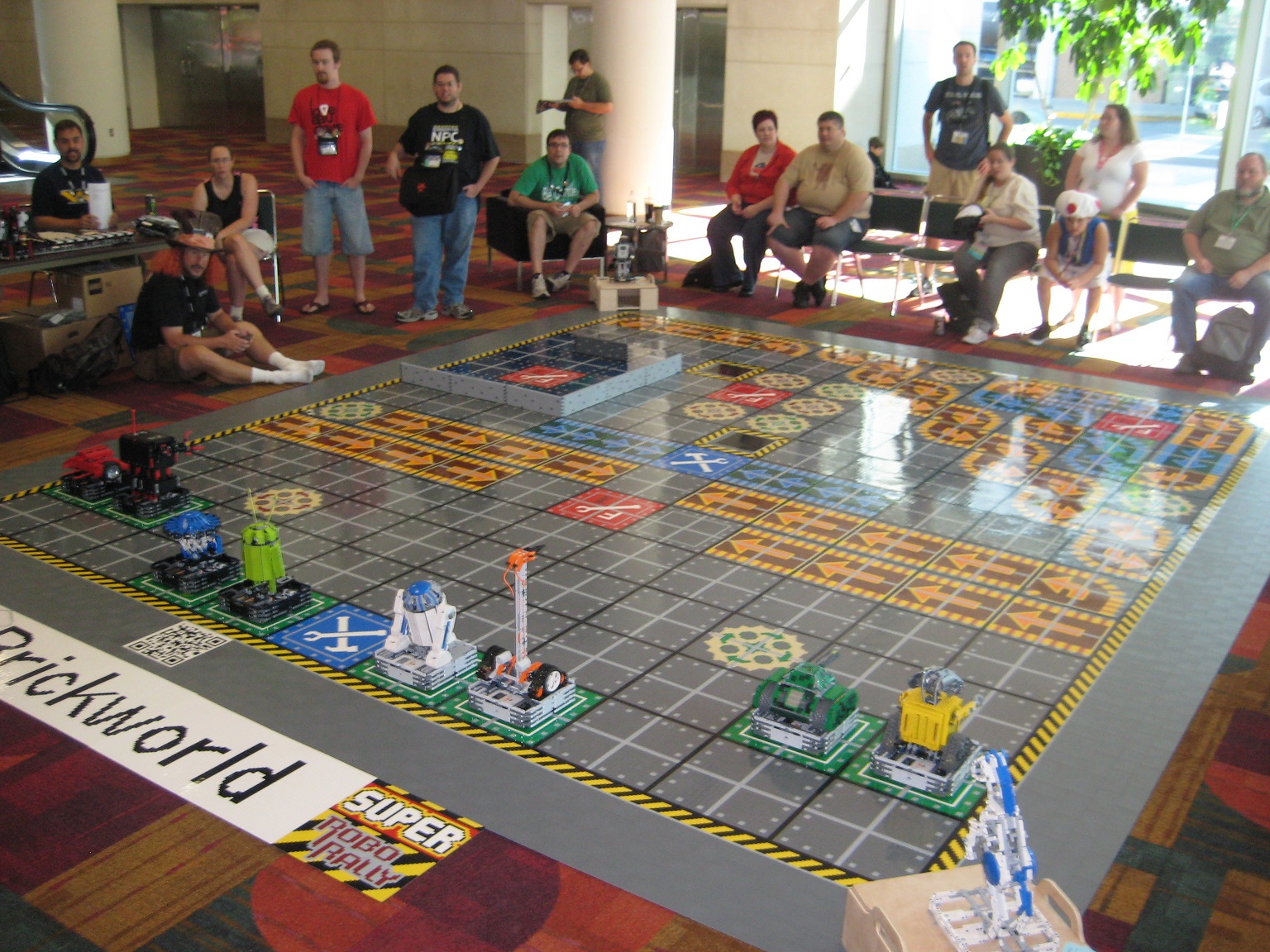
Big, as in a large number of gamers. Not the size of the game!
I love big game night. But that’s partially because I love any game night! It’s great to get a bunch of guys (note: I’m not sexist… my group is just all guys) together for some board game awesomeness. But it’s not all rainbows and unicorns. There are some downsides to the Big game night, at least compared with the Level 1 game night. Let’s look at the good things first:
- You’re playing games, perhaps enjoying a nice brew, and escaping all the other junk of life.
- You might even be enjoying some nice refreshments.
- With more gamers you often have more games to choose from.
- Robo Rally. Chaos embodied in a board game can be quite entertaining!
There you go… the upside to the Big game night. What downside could there possibly be?
- You might wreck your budget trying to buy games for 8 or 10 players.
- Nuns on the Run, a hide-and-seek nun game, just doesn’t have the right theme!
- Players might get sick of finishing the night with a lap of Bisikle every time (gasp!).
- Indecision enters the gaming arena. Players struggle to agree on what to play.
- It’s often more difficult to break out new games. It always feels like you’re teaching new people old stuff.
- It’s often more difficult to break out heavy games. Big game night is more open to the casual player.

An 8-player recommendation!
When our group was getting to 8 regular attenders I really did a search for 8+ player games. At one point I was ready to pull the trigger on Nuns on the Run. I ultimately went with Robo Rally, which ended up being a great choice. I also looked into Formula D, but never bought it. One of the issues with a larger board game night is that it is hard for everyone to play a game together. One 8-player game that I’ve found to be a lot of fun is VivaJava: The Coffee Game by designer TC Petty III and published by DiceHateMe Games.
The problem is that most games are not 8 player games. That means what was a big group of people is now split in two or three. That’s often less fun. You’ve got cross-table banter. People feel left out of the other table’s conversation, and a disconnect forms. Don’t get me wrong, it’s still a lot of fun… just not as fun as the “Level 1” game night!
Level 1 Game Nights
Several of us in our group use the phrase “Level 1” to refer to each other as awesome, tight, “I got your back” type of friends. On occasion we have an impromptu “Level 1” game night where it’s just a small group of us getting together. I wanted to refer to these game nights as “Intimate” but that just didn’t feel appropriate with all the finger-bending. These nights include the kind of friends you never hesitate to play any game with. These game nights also have an upside and a downside. This time let’s start with the downside:
- Less beer options to choose from.
- Fewer refreshments.

3 hour games are acceptable at Level 1 Game Nights!
While those two can be tough to swallow, the Level 1 game night can make up for that in the quality of the games that hit the table. Here’s the upside:
- Heavier games make the table. Enter Uwe Rosenberg and Stefan Feld!
- New games can be played since there is usually a high willingness to learn together.
- Playtesting of prototypes happens more freely.
- You’ve learned what to expect from the other players.
- Inside jokes, Jerks!
- You never have to split into multiple games.
There’s a lot to enjoy with a Level 1 game night! But the bottom line here is that any game night can be fun. Go into them with the right expectations and you’ll have a good time. And remember, playing to win and playing to have fun are not necessarily the same. So get to your local game night and have a great time!
Board Game Review: Belfort by TMG

Gnomes, Dwarves, and Elves. But no Pixies… yet!
It’s Friday, which means it’s Board Game Review day! Today I’m reviewing Belfort by Tasty Minstrel Games, which currently has an awesome expansion available on Kickstarter (KS link) for only $20. So since the Kickstarter campaign is live I figured now is as good a time as ever to post this review!
In Belfort players take on the role of a builder who has been hired to build the castle Belfort. Unfortunately, other builders were also hired in a mix-up. So you are tasked with being the best builder of the castle. To do that you have to make effective use your elves and dwarves with a worker placement mechanic in various spots throughout the city. Leftover elves and dwarves can be used to claim wood, stone, metal, or gold. Decisions in this game get tough and heavy. But that makes it awesome. The other part of the game involves building the buildings of the castle to claim a majority of a district. That’s how players can obtain points, which are needed for victory. When you’re ready to visit the Pub for some Master Dwarf action, or the Blacksmith to get some metal, then grab your friends and sit down for a game of Belfort!
Here’s a look at all of the awesomeness that is Belfort (image from BoardGameGeek.com):

This game is awesome!
I’ve played this game a bunch and I totally love it. But the real question is who can find the Ton Ton from Hoth on the game board first?
The Upside:
- ARTWORK: I must start with the artwork. This game is so visually stunning that I sometimes set it up just to stare at it (not true). It just looks so good that I must give a shout out to artist Joshua Cappel! Excellent work!
- STRATEGY: This game looks too fun to be a heavy strategy game, but that’s exactly what this is! There is a lot of strategy behind each decision from the first turn throughout the whole game. Players have to optimize their workers capabilities and then optimize which building to build and where to build it. There’s a lot to think about in this game!
- THEME: The theme of building a castle with your hired elves and dwarves is a lot of fun.It is easy to get immersed in this game and feel like you are really putting your elves and dwarves to work. And everything works together thematically, which always makes a game better!
The Downside:
- ANALYSIS PARALYSIS PRONE: While I am a player that enjoys heavy strategy and tough decisions, there are some players that I play games with that would struggle mightily with indecision throughout this game. There would be times where they wouldn’t know what to do or why they are doing it. Beware that this can lead to long games.
- SETUP TIME: This game has a ton of components. Thus, it requires a higher than average setup time. If you know you’re playing this game during your board game night perhaps you should set it up beforehand!
Designer Perspective – What I Would Change:
Belfort is a brilliantly designed game of worker placement and area control. The upcoming expansion looks like it will enhance the game greatly, so I won’t offer anything that the expansion is already doing (or at least that I know of it doing). If I were to change anything I think I’d add the ability of players to swap buildings between districts. This would add a huge “screw-you” factor to the game, but might also unbalance the game. By being able to swap my Inn in district 1 with you Inn in District 2 I could gain the majority in both! Bonus!
Beer Pairing:
 I would normally pair this game with a heavy beer since the game is a heavy game. However, I just can’t imagine the worker elves and dwarves sipping a heavy, gentlemen’s beer after a hard day of work on the castle. So my preferred beer pairing is one that drinks easily, tastes great, and would work perfectly in the hands of elves and dwarves. And that beer is New Glarus‘ Cabin Fever Honey Bock. It is a very tasty beer brewed with clover honey, but not too much. And it goes great with brats, BBQ, and Belfort!
OVERALL RATING:
This was at the top of my Christmas list a couple year’s ago and it has lived up to that! Belfort is a great game that is a ton of fun to play. There is deep strategy, awesome artwork, and a lot of tense decisions. I can’t wait for the expansion to come out! I will rate Belfort 9 out of 10 on the BoardGameGeek rating system!

Excellent game. Always want to play it.
 Boards and Barley