Category Archives: My Games
On this page you’ll find information for the games I have designed or those that are in the works.
Scoville Print and Play Version 2

Version 2 awesomeness now available!
I am pleased to announce that Version 2 of the Scoville Print and Play files are available for download at BoardGameGeek.com. Here is the link:
There are no major rules revisions to the game. The only clarification to the rules is that when selling peppers you must sell peppers from your own supply. Peppers in the fields are not for sale.
There are a few changes to the Print & Play files. The most notable change is that Gold has been dropped in favor of Silver. I’d like to thank Adam “A-Game” Buckingham for the suggestion. This was done for two reasons:
- Black + White blends to gray, not gold. So from a color perspective this is much less confusing.
- There is a much lower chance of confusing yellow with silver. These two colors are now more distinct.
The PnP files also have a few other revisions. These include:
- Artwork for the Bonus Point Tiles for secondary peppers (green/orange/purple) has been adjusted to decrease confusion.
- The Field has been slightly increased in size to better fit with the pepper tiles.
- The pepper tile artwork has been changed to help with color blindness and for clarity.
Here’s a peek at the revised pepper tiles:
 By adding the pepper image to each tile it will help with color blindness. Each pepper is a different shape. And by changing the artwork to include the green border it should help to clarify where the player pawns will actually be walking. I showed this image to my wife and she said she thinks the game would be better with these rather than the cubes. This was actually a suggestion of Brett Myers (@brettspiel) during Protospiel-Milwaukee, so I must give credit where credit is due!
As usual, if you have any questions about the PnP files or the rules, or the game in general, please feel free to leave a comment here on Boards & Barley or on the BGG download page. Or feel free to email me. And I’d love to hear what you think about the game!
Scoville Print And Play Now Available!
Let the awesomeness be printed and played!
For those interested I have posted Version 0.1 of Print and Play files for Scoville, including the Rules, onto Board Game Geek. You can follow this link to obtain them:
BoardGameGeek: Unpublished Prototype: Scoville Rules & PnP
If you decide to print it out and play it I’d be happy to answer any questions. Just leave a comment below! I’d also be VERY interested in hearing your feedback from your plays of the game. So let’s stay in touch and make this game as best as it can be!
You can also hit me up on Twitter (@EdPMarriott) if you have any questions.
Thanks!
Prototyping Techniques Applied to Scoville
 While at Protospiel I heard a lot of kind words for the quality of my prototype of Scoville. So today I am sharing my prototyping process with you. I hope that it can help you make a quality prototype that you are confident about.
When I was first getting into board game design I was a little overwhelmed by what it took to make a prototype. I watched a few prototyping videos on BoardGameGeek.com. Those only made me shy away from the whole process. It can be intimidating. But today you can learn that it isn’t perhaps as daunting as you might think.
Overview of my Process
 First things first: you need a game concept. Assuming you’ve got a great idea in mind it’s time to start prototyping. Early on in my board game career I was designing a heavy Euro game. I waited to make a prototype until I had worked through all the details of the game. That was a mistake. It is my recommendation to make prototype components of your game as early as possible. For example: If you have an auction in your game, test it independently from the other mechanics. Test each mechanic individually and test them early on. There is no point to design an entire game only to find out that the individual parts don’t work.
Once the individual elements seem to work then you can try to put them all together to make a full game out of them. Here is a rule of thumb I try to follow:
Never add complications unless they are absolutely necessary.
This is a difficult thing to do. It is always easier to add another rule or add another component. But if you want to make a good game, focus on the innovative mechanic rather than all the little rules about the rest of the game. Keep it simple.
So I start with a concept. I usually write about 10 pages of notes and sketches about that concept. Then I’ll go ahead and start prototyping (this is what I’m covering today). Once I have a prototype ready then I’ll play test it at least 10 times. This will give me a solid amount of feedback. Only after testing 10 times will I apply any changes. Here’s another rule of thumb:
Don’t try to change things in the game on the fly, and don’t change more than one thing at a time.
Following this rule is critical, especially the part about changing more than one thing at a time. If you change more than one thing it can be difficult to know which of the things you changed made the game better (or worse). Change one thing at a time and test it profusely. So I apply feedback and adjust things after 10 play tests. Once the game has gone through the PROTOTYPE – PLAY TEST – APPLY FEEDBACK phase several times to the point where there are only very subtle changes then I get to the point where I am confident about contacting publishers about it. There is no point in pitching a game unless you’ve gotten it to the point where you are proud of your product and confident to show it off.
Getting Started: What do I need?
When making a prototype I usually begin with a spreadsheet. A spreadsheet allows you to create custom tiles or cards very easily. You can print them out yourself and turn them into quality prototype components. Here’s a list of everything I use(d) to create a copy of Scoville:
- Spreadsheet software
- Graphic Design Software (I prefer Inkscape, but The Gimp is also very useful)
- Paper (Plain paper for first prototypes, Glossy photo paper for pitch-able versions)
- Thick card stock – As thick as you prefer, though the thicker it is the more difficult it is to cut.
- Components: cubes/meeples/coins
- Circle Punch
- Paper Cutter (I have this one)
- Bingo chips
- Glue Stick
- Scissors
- Gerber Baby Food Containers – if you don’t have kids find some friends who do and beg them to save these for you!
Here is a picture of all the components that go into the game:
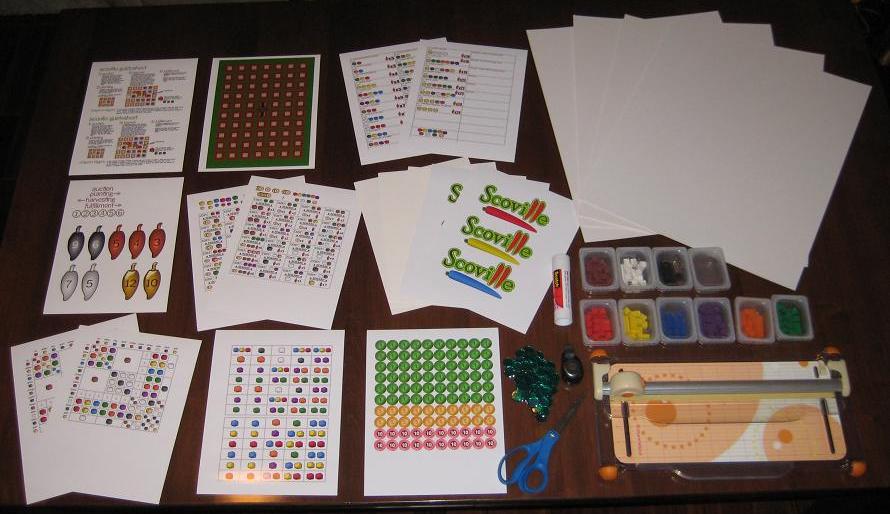
Scoville components fresh off the press!
That’s everything (except a box) I need to make a copy of Scoville. Let’s walk through the prototyping (physical creation) process.
Make it Rain! Or Something Like That
Assuming you’ve taken your concept and created artwork that suits you, it’s time to actually make something real for testing. What that means to me is that it’s time to print stuff out! Scoville has 13 pages of printing required for a full copy. The next step is to adhere those pages to the thick card stock. I like to buy the stuff that is as thick as standard board game chit board. This gives me the feeling like I am playing a real game when I test it.
So I use the glue stick and cover the back of the paper and then stick it to the card stock. Once I’ve got them all glued down I can start to cut them to size. Since the large card stock boards I buy are too big for my paper cutter I run a scissors through them to separate the difference components before using the paper cutter.

Cover with glue, adhere to card stock, coarse cut to separate.
Then I use the paper cutter to trim the fat and make them nice and clean. Shown here as an example is the first cuts done to the auction tiles:

I then go ahead and cut each tile out individually and end up with a pile of nice thick quality components:

My precious little auction tiles!
I continue this process for all of the components in the game.
Making Player Shields
Another part that seemed a little overwhelming to me was the production of player shields. But I found a nice, easy way to make them. If you don’t want pictures on them then just cut some paper and fold it. If you want pictures or logos then follow this procedure:
-
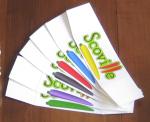
Easier to make than I thought.
Print the logos.
- Cut the logos to a rectangular size.
- Glue the logo centered on a sheet of thin card stock.
- Angle cut each edge so that it will lean when completed.
- Fold gently.

For Scoville I made the artwork on the shields include the player color. Making your own player shields rather than using shields from games you own can really spice up your prototype.
Making Money
One of the more tedious things in this process is making my own coins. I don’t have to make it as hard on myself as I do, but I prefer a really professional looking prototype.
It would be much easier to simply write a money value on the plastic bingo chips with a marker. This would make them more difficult to read and they wouldn’t look as nice.
So my process for making coins is this:
- Create the artwork.
- Insert the coin images into a document file.
- Print the document.
- Punch the coins out of the paper.
- Adhere them to the bingo chips.
Here is a tip for punching, if you use a circle punch like mine:
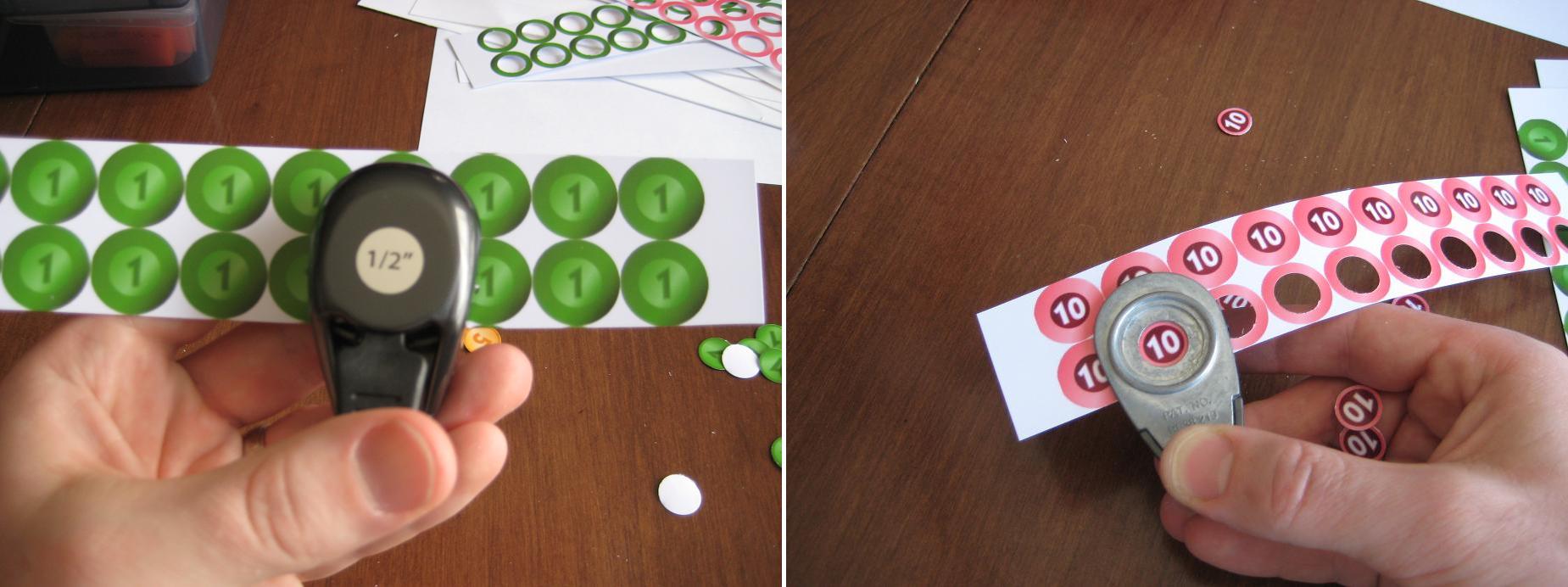
Flip the punch over for better visual alignment!
If you hold the punch like it seems it should be held then you have to rely on the little plastic bump guides on the side of it. Just flip the punch over and you can visually align the punch with the coin. This makes it so much easier!
Once you’ve got them all punched you can simply glue them to the bingo chips. I recommend watching something on TV that is really attention grabbing, so that it draws your attention from the tedium of gluing little circles to bingo chips.
If you don’t like the idea of gluing circles to bingo chips then go ahead and use the same thick card stock that you’ve been using. Just be aware that the circle punch may not punch through the thick card stock. That’s why I went with the bingo chips.
The Final Product
Once you’ve got all the components glued-punched-cut-etc. then it’s time to put it all together. Here is a before and after picture showing the reduction in volume for Scoville:
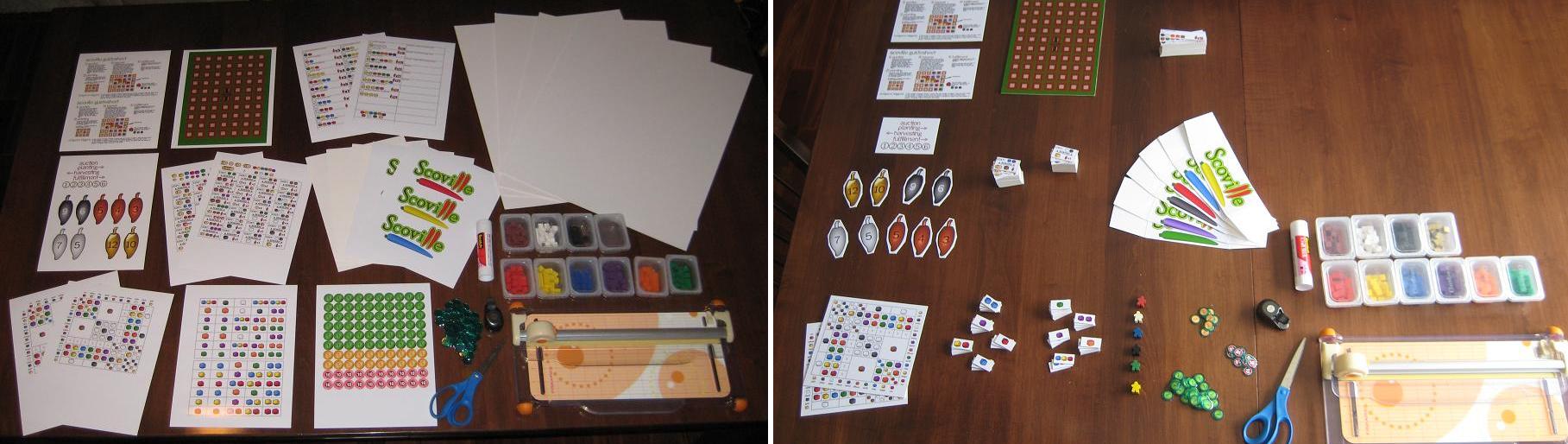
What looked overwhelming turned into a nice, quality prototype.
To continue with the theme of a quality, pitch-able prototype I like to use a nice container to hold everything. You can buy these at Target.com or you can find different colors in the store. They are only $5. I should also note that these fit into a Medium Flat Rate Priority box from the United States Postal Service. So it is pretty easy to mail one off to a publisher!
Now you’ve got your container so throw in the components, a couple copies of the rules, a business card, and you’re ready to pitch your game! Note, you do not need to have a high quality prototype to pitch a game. I am just a firm believer in making a good first impression. Here’s what Scoville looks like in it’s full prototype form:

This is the third copy of Scoville in existence! May the other two copies in the wild prosper and flourish!
How Much Is It Gonna Cost Me?
I mentioned earlier that you can make an high quality prototype that is also inexpensive. Here is a rundown of the costs for a full copy of Scoville:
- 13 sheets of glossy photo paper: $3
- Printer Ink (I buy cheap Non-OEM ink off Amazon): ~$2
- Glue Stick: $3.30
- 4-Pack of Thick Card Stock: $13
- Bingo Chips: $0.50
- Meeples ($0.14 each): $0.84 – I live near The Game Crafter so I can pick them up and avoid paying shipping costs
- Plastic Cubes (250): $7 – I bought a tub of 1000 cubes for $25 (shipping included) from EAI
So the total for a high quality prototype for Scoville costs me under $30. So maybe you wouldn’t characterize that as inexpensive. But when $30 can allow you to create a pitch-able high quality prototype that might catch a publisher’s eye, I don’t think $30 is too bad.
What techniques do you use? I wanted to point out that I did not write about making cards. Most people, when making prototype cards will purchase penny sleeves, insert their custom made cards, and make them thicker by dropping in a M:TG card. I don’t use cards in Scoville, so I didn’t include that.
I hope that you enjoyed this article. It has been a fun process for me to figure out some of the best ways to make a prototype. If you have any ways to make the process more efficient, please leave a comment so others can see!
Scoville Protospiel Recap

I had the privilege of attending my first Protospiel this past weekend in Milwaukee. Protospiel is a convention for game designers to bring prototypes and get feedback from other designers. So I took my game Scoville along and got some awesome feedback! I think that I’ll focus this recap on my game rather than provide opinions of the games I played that are unpublished. That would not be fair to the designers even if I really enjoyed their games since all the games I played are still in progress. So rather than posting a drawn out chronological recap of the weekend I will just post the drawn out highlights for the play tests of Scoville.
I was fortunate to have Scoville played five times and was pleased to play 8 other games by other designers. Protospiel is an awesome thing for a designer to attend!
Here’s a little background about my Protospiel expectations and goals…
Protospiel: First Contact
Coming to Protospiel I had two goals: 1) validate whether or not Scoville is any good and 2) connect with people who know what they’re talking about. A secondary goal was to leave a copy of the game with Grant Rodiek for inclusion in the Prototype Penpal Program. That was something I could always do later on, but I thought it could be cool to send a copy off with him.
I also had some expectations about the feedback I might receive. I knew that I wanted to adjust the auction phase of the game. So I to see the same feedback about it that I had seen from my prior play tests. I was also a little uncertain about the quality of my prototype (that thought was quickly vanquished!). Thanks to everyone for the kind words about the quality of my prototype. I’ll post an article sometime about how I make prototypes.
So if I received validation and made some connections then I would have considered this weekend a success. Let’s see how it went.
Scoville Play Test #1
Getting to the convention at 8:15am on Saturday allowed me to get my game set up right away since few people were there. I got four people to give it a go and they seemed to really enjoy it. I won’t explain the game much here since I’ll be writing a post all about the game itself. Here are the suggestions that I received after the game:
- Beware of color blindness (Cool apps: Color Blind Vision (Android: FREE) and Colorblind Vision (iOS: $2.99)).
- Stage II orders seem to provide too many points.
- If everyone bids zero in the auction, flop the player order.
- Put endgame trigger scenario onto the guidesheet.
- Tiebreaker should go to the player with the most coins.
- The game was described as a “Euro with luck but no dice.”
- There should be no randomly chosen player order at the start of the game.
- During fulfillment there should be the option to pay for becoming the first player.
That’s a lot of great feedback. The game uses 10 differently colored cubes so I have been aware of the color blindness issue. There are several solutions for this. The biggest takeaway from play test #1 was that I received the auction feedback I was expecting. My plan would be to test a new auction mechanic on Sunday.
One player, who happened to be the winner by a lot, wanted to try a strategy that I am aware of but have not yet seen attempted. Since peppers can be sold for coins based on how many of that color are planted in the fields there is a strategy that you can plant a pepper of a certain color in each round and harvest that same color each round without doing anything else. I have done the math in my head and I do not believe that this would be a winning strategy (at least I hoped not because that would make the game broken). More on this below.
Scoville Play Test #2
After working on Protospiel goal #2 of making connections and meeting some awesome people, they were willing to give Scoville a try. During this second play test there was more bidding and jostling of player order. I think that was the reason that the auction was not mentioned in the post-game discussion. This play also resulted in much closer scores than the first play. Here are the suggestions I received:
- Peppers should be worth something at the end (that are currently worth nothing in the endgame: Use Them or Lose Them!)
- The artwork on the fields should somehow better illustrate where the player pawns can be placed.
- The game was described as a “medium to heavy Euro.”
So I received quite a bit less feedback from play #2. But the fact that I still didn’t receive any feedback about how anything seemed broken meant that perhaps Protospiel goal #1 (validation) was starting to become apparent.
Scoville Play Test #3
Later Saturday night a prominent figure in the board game reviewing business was able to play Scoville. So with three other players I got play test #3 going. In terms of rounds this was the shortest game I have seen. The game lasted 6 rounds. The players again seemed to enjoy the game and nothing seemed broken to them. They did mention the auction as the weak point of the game, so I received good feedback about that that I could implement on Sunday. Here’s the suggestions:
- Possible Trademark issue with the names of peppers used on the recipe tiles.
- Turn order needs adjusting. Option 1: Flop the order. Option 2: Purchase your spot.
- Perhaps just get rid of the reverse order for the harvest action.
- Brown peppers seem too valuable.
I want to point out that the brown peppers are somewhat of an enigma in the game. They don’t breed with anything except the best peppers. They take up space on the map. But they are used quite a bit in the recipes. I had not received feedback that browns were too valuable before this. The normal feedback on the brown peppers is that they seem pointless. So this was interesting feedback from a fresh perspective.
I was also pleased, in a bittersweet way, to hear the same feedback on the auction mechanic. I now knew that I could incorporate a revised auction mechanic on Sunday and expect good things.
I was intrigued by the suggestion to remove the reverse player order for the harvest. My first thought was “absolutely not.” What that would lead to is either huge bids during the auction or rounds of the game where one player can make a huge jump in points. I’ll have to examine this further.
Scoville Play Test #4
Sunday morning I was able to play Scoville for the first time during the weekend. I had not played in the previous play tests. And this time it was just a two player game. I have tried to design the game such that it scales well from 2 to 6 players. There are no AI players necessary and the game feels nearly exactly the same with 6 players as it does with 2.
Since it was now Sunday I was going to implement the new auction mechanic: Bid for Player Order. Now during the auction phase players would be bidding for turn order. Whoever bids the most gets to choose their spot in the turn order. The next highest bidder gets to choose the next spot, and so on. This way, if a player wanted to become the first harvester they could bid high and then choose the last spot, which would allow them to harvest first.
The new auction in the two player game seemed to work, but I suppose that this new auction mechanic would work even better with more players. What the new auction mechanic provided was a way to earn the first harvester spot. That is critical to strategy in the game.
Here are the suggestions I received:
- Are points balanced on the Order tiles?
- Change the artwork on the Cross-Breeding table for the cross-breeds that result in two peppers.
The points on the Order tiles may be slightly unbalanced, but not to the point of brokenness. These can be easily revised, which I may do depending on analysis of the scoring for the first 25 play tests. The artwork suggestion is an excellent one that I will definitely change.
Scoville Play Test #5
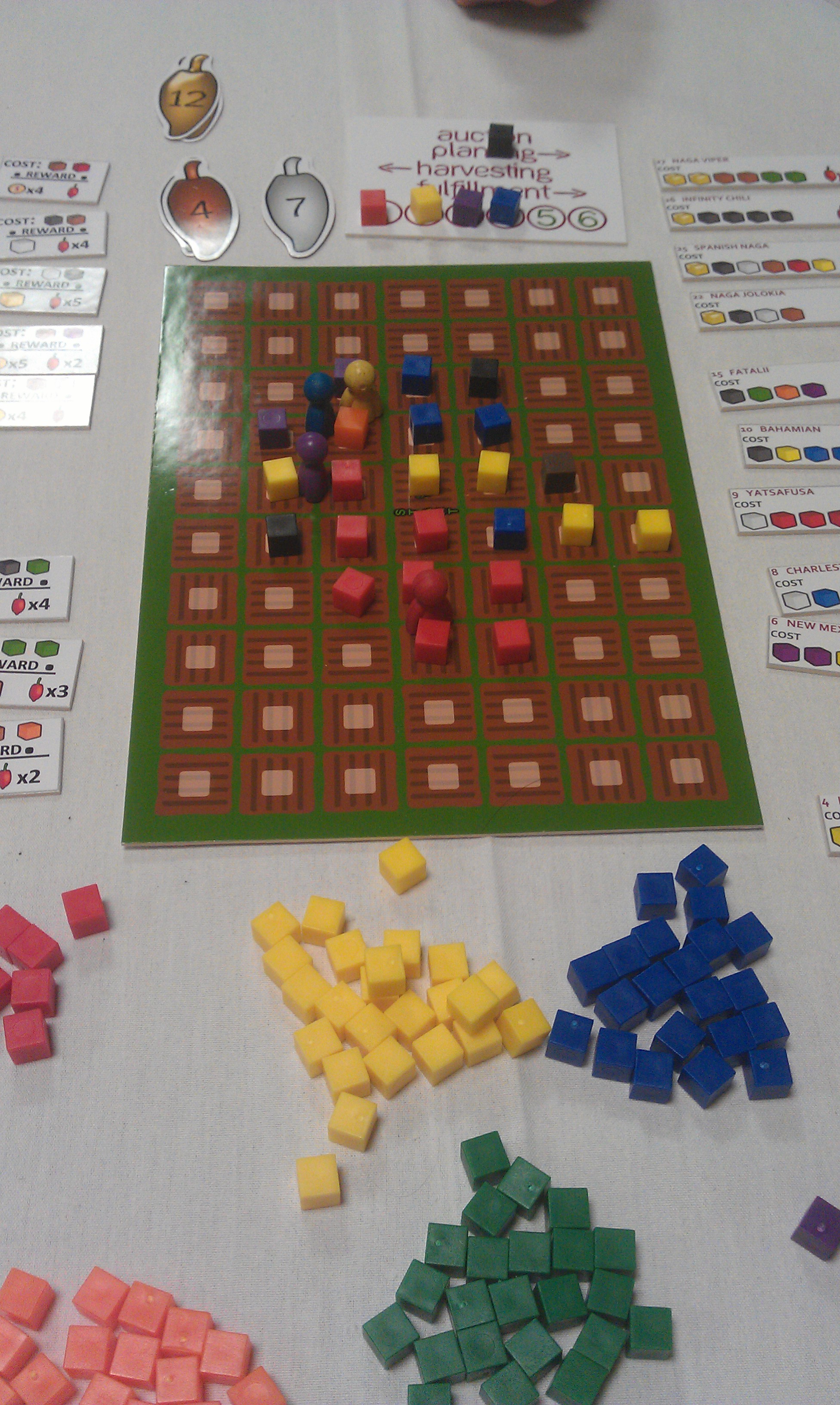
The attempt to break the game. He ended up red-faced!
The final play of Scoville included the big winner from play #1. He wanted to test the coin building theory and see if it could potentially provide a winning strategy. I welcomed him to try it but made sure that the other players were initially unaware of his proposed gameplay. It was a great final play and I was happy to see that the new auction mechanic really worked well with four players. Here are the suggestions:
- Don’t call it “harvesting, call it “breed-vesting.”
- Check out the game Santiago since there is a similar “fields” mechanic (uh oh… worried about this!)
- The different parts of the game were described by one player as Resources (Auction), Tactics (Orders), and Strategy (Recipes).
The first thing to discuss was the auction. Of note is that this game had the highest average bidding per round of all 5 play tests during the weekend. I think this is due to players now having two things to bid for (first player spot or last player spot) rather than for just moving up in player order. The thing of note was the compliment someone gave to the auction saying that the auction was a good mechanic for the game. This brought the game full circle over the weekend. Previously the auction was described as the weak point of the game. Now it was “good.” I’ll take that!
The other thing that was validated from this final play test was that the game was not broken in that attempting to get coins by planting and harvesting the same color did not result in a winning strategy. The player was going full steam ahead from the get-go with that strategy and came in last place (though could have finished in third place). I was pleased that the game wasn’t close to being won by that strategy. Overall it was a great play test.
Overall Scoville Analysis
Perhaps the best part of the analysis is that people really seemed to enjoy the game. While my goal was to validate whether or not it was any good, I came away from Protospiel very humbled by all the kind words people had for the game. Let’s dig in a little bit and check out the scoring breakdown:
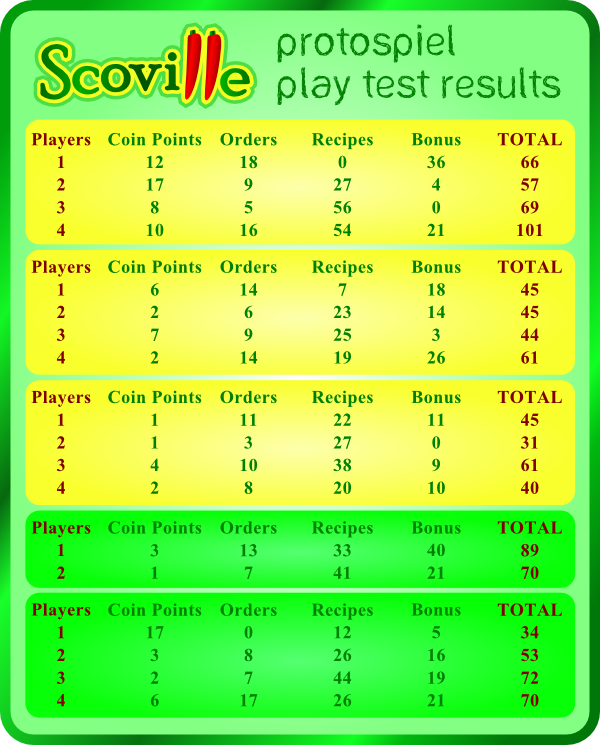
Some further analysis revealed that the number of coins bid during the game varied quite a bit. In terms of coins bid per round the numbers were 2, 6.14, 7.66, 1.38 (2-player), and 7.85 per game. The highest average was the 4-player game with the new auction, though this wasn’t unexpected.
Overall it was apparent that people had fun when playing the game. That’s the most important thing to me as a designer. There are some things that I would like to continue to develop leading up to Gen Con that I mentioned to the players. But I want to avoid the situation where I am needlessly adding complexity. That would steal from the simple elegance of the mechanics currently in the game.
Thank you to all 16 players who play tested my game. I really appreciate the feedback. It was an awesome weekend! And special thanks to Grant Rodiek for humbly accepting a copy for the Prototype Penpal Program. I know that I can expect some awesome, honest feedback!
Gearing Up for Protospiel-Milwaukee

Wow. This is happening! I am getting ready for my first designer convention – Protospiel-Milwaukee. This weekend I will be taking my game, Scoville, to have it played by other designers and see whether or not it actually has any potential.
Protospiel is a board game designer convention where designers bring games that are in work. Then you can have your game played by other designers and you can return the favor.
One of the best parts about this weekend’s convention is that I will get to meet a ton of great people in the board game industry. There are several designers that I follow on Twitter that I will have the privilege of meeting. What is especially nice about that is that those guys know what they’re talking about. Several of them have had games published. You can probably find them in your local game store right now. I won’t name any names so that I don’t exclude anyone, but I am definitely excited about meeting the designers face to face.
What do I have to offer?

Scoville – Can you breed the hottest peppers?
I will be bringing Scoville. Scoville is a game about cross breeding peppers. As a player you take on the role of someone who has been hired by the town of Scoville to fulfill their recipes for the hottest peppers. To do that each round consists of an auction phase, planting phase, harvesting phase, and fulfillment phase. But the real highlight of the game is how the planting and harvesting works.
The main mechanic of the field map is what I think has the most potential in this game. Each round players have to plant one pepper in the fields. Players can plant a second pepper for $6 if they want. Over the course of the game the fields get filled in. During the harvest phase players will move their pawn up to three spots. Each spot is a location between two fields. If those two fields have peppers on them, then that player will receive whichever pepper(s) is cross-bred from the two existing peppers. For example, if you move your pawn between a field with a red pepper and a field with a yellow pepper, then the cross-breeding result would get you an orange pepper.
Part of the goal with Scoville was to create a game where players start with basic, or primary, resources (red, yellow, and blue peppers). Those basic resources can then be used to cross-breed better, or secondary, resources (green, orange, purple). Those secondary resources can then be used to cross-breed even better peppers (black and white). And finally if players can plant a black pepper next to a white pepper, the resulting cross-breed would be a gold pepper. I really enjoy the flow of this game where players are working toward getting the best resources while at the same time hesitating to plant the peppers that could give those resources since the fields are shared by all players.
Here is a guidesheet image from a previous version of the game:
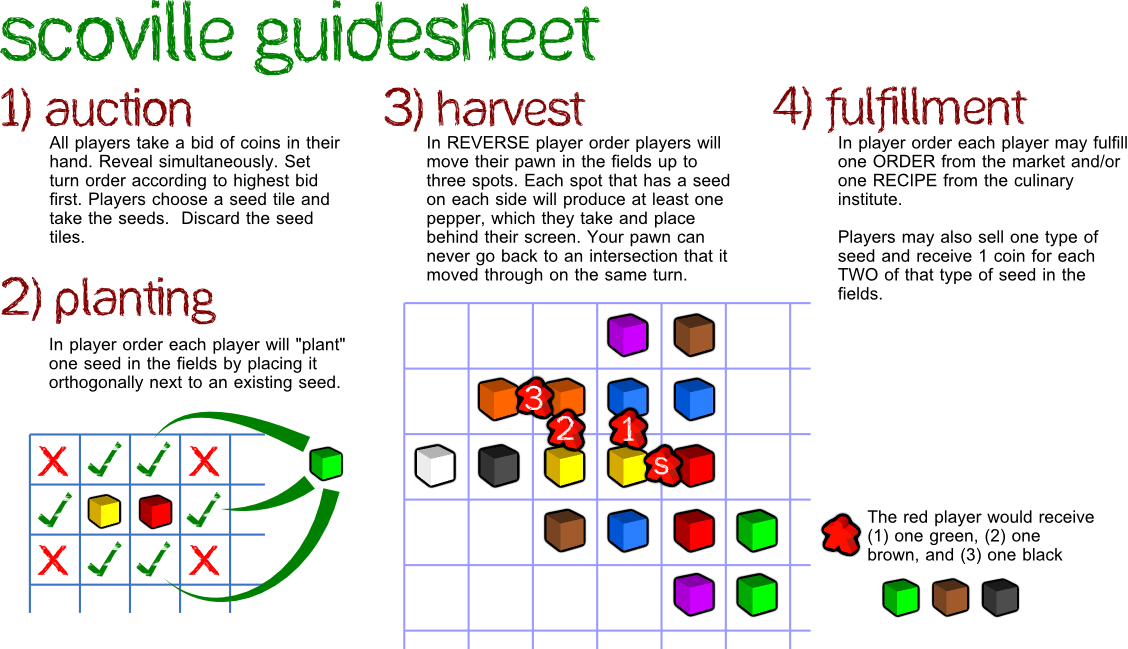
I have updated guides with the latest game revision that I will be using this weekend. It is mostly the same as what is shown.
And there is already some buzz about the game. Not really. But I did fill out the game preview form on Cartrunk Entertainment’s Unpub.net website. You can read my preview for the game there: Unpub Preview – Scoville. Thanks go to John Moller for posting that!
Preparation Left To Do:
I still have some things that I need to get put together before I attend. Here’s my to-do list before the convention:
- Write the rules – Yep. I guess I’m procrastinating here. But it is surprisingly difficult to put all your thoughts into rules on paper. And it can be tricky to make the most applicable images to add clarity to those rules.
- Finish putting together a second copy of the game. In the event of a publisher wanting to take a copy with them I’d like to have one available. In the 99.99% probability that no publisher wants a copy, then I want a second copy available to leave with a fine gentlemen for inclusion in the Prototype Penpal Program.
- Pack my bags.
I’ll probably have a long night tonight working on the rules. But if I get them done today it will give me time to revise them tomorrow. A second copy of the game is almost complete. I have everything printed. I just need to stick it to card stock and make some player shields.
Making the Most of the Convention
So since this is my first designer convention I want it to be the best it can be. That means I want to make great connections and I’d like to receive excellent feedback for Scoville so I can improve the game. Last week I posted a thread on BoardGameGeek: How to Make the Most out of a Designer Convention. I got some excellent replies. One common piece of advice from the thread and other sources is to have a good open attitude. This applies to receiving feedback for my own game and also to giving feedback for other’s games.
Another good set of advice came on Twitter today from @BrettSpiel. You can read his ten tips on Cardboard Edison: Tips for Protospiel.
So I think I am all set. I’ve got my game. I’ve got a good attitude. I’ve got a notebook for documenting all the awesome suggestions I’ll be receiving. And I’ve got a good friend attending with me as a play tester. It’s gonna be an awesome weekend!
 Boards and Barley