Category Archives: My Games
On this page you’ll find information for the games I have designed or those that are in the works.

Monday Brews 7-28-14
There are only a few Mondays left before Gen Con! Aside from game design and development it was a decent week. My mother-in-law fixed out bathroom ceiling. My softball team won the championship (back-to-back seasons)! And I was inspired by a Euro game.
So let’s get right to the coverage of the Boards & Barley I enjoyed last week.
The Barley:

Dark, smooth, tasty… and potent!
BARLEY SPOTLIGHT:
Dogfish Head Palo Santo Marron
I had this too late in the evening to fully enjoy a 12%abv brew. However, I am looking forward to trying another one. This was one potent little beast with a woodsy character that made me wish I were sitting in a nice chair by a fireplace smoking a pipe. The inside of Bilbo Baggins’ home would suffice. Ultimately this beast was an enjoyable beer and I recommend you try it if you get a chance.
- Capital Dark Voyage Black IPA
- Capital Ghost Ship White IPA
- New Belgium Blue Paddle
- Vintage Brewing Scaredy Cat Oatmeal Stout
- Paulaner
The Boards:

Four player render.
BOARDS SPOTLIGHT: Attika
Sometimes I am shocked by the simplicity of classic Euro games. In Attika you have two options on your turn: Draw buildings or Build buildings. Two choices. That’s it. How can you possibly make a compelling game from two choices? You make it compelling by adding tension, making it a race, limiting players options, and by adding a little bit of randomness so that not every game is identical. This game is so simple yet possesses an elegance that makes me jealous as a game designer. It’s not the greatest game ever made, but there is just something about it. It makes me want to start a game design by only giving players two options. It’s similar to games like Ticket to Ride where players only have three choices on their turn (play trains, draw train cards, draw route cards). That simplicity builds throughout the game and it makes for a pretty outstanding experience.
Designer’s Corner:
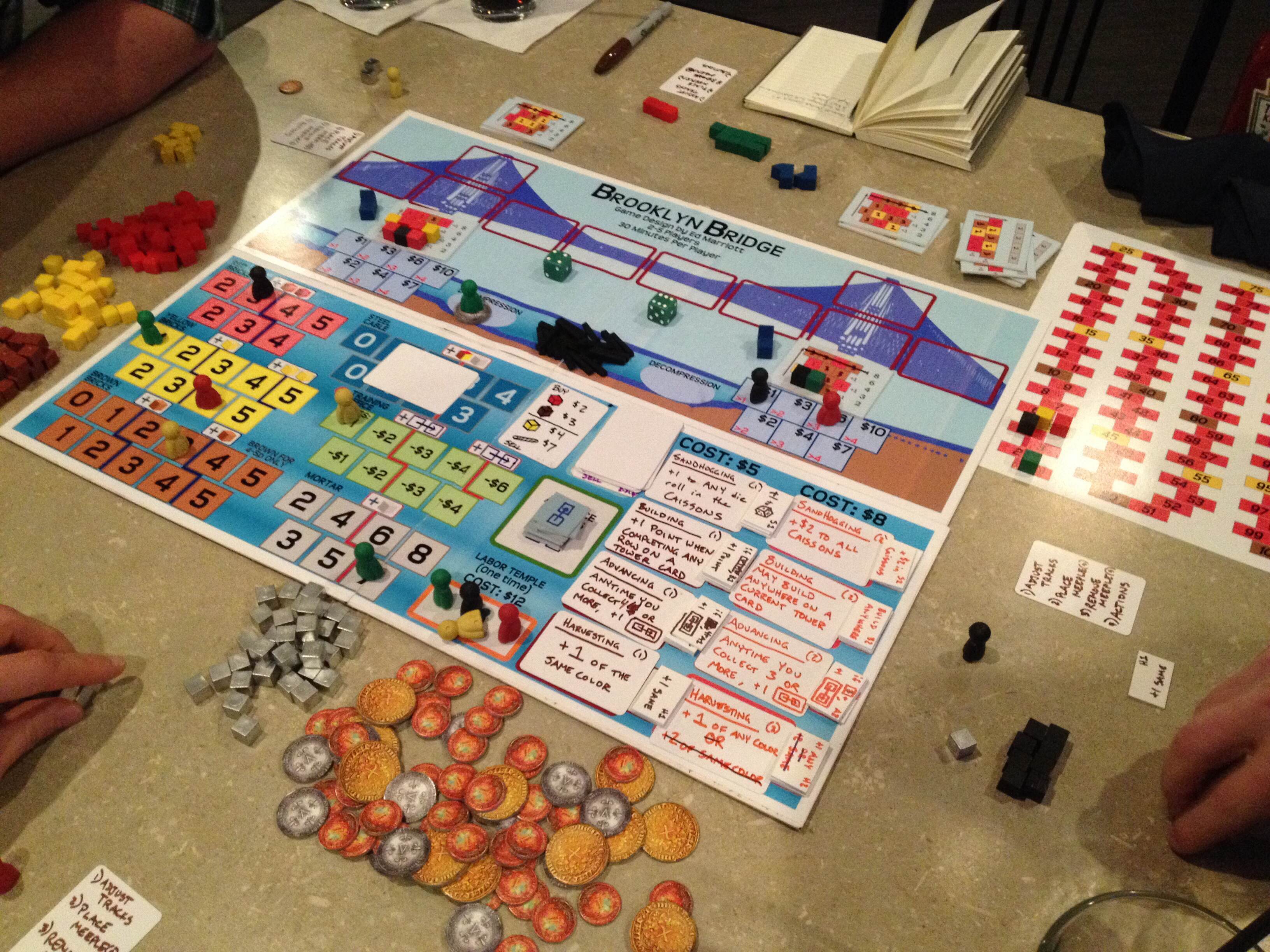
Such an old version. It’s way better now.
As Gen Con approaches I find it is once again crunch time to prepare a game for demoing/playtesting. Last year I failed miserably to have Conclave ready to go. Though Conclave only had two or three real playtests so it didn’t deserve table time anyway. But I have found that I am still making some major changes to Brooklyn Bridge.
One issue is that it takes way too long. This has always been the case. One reason for that was because players would have to build the towers first, then they could work on the cable. Having this linear progression through the game combined with the mechanic for obtaining cable bundles caused a huge halt in the action and really killed the dynamic of the game.
So I am changing how it works. Now the cable will be an important aspect from the start of the game. Players will have to choose whether to contribute to the cable (long-term points) or contribute to the bridge (short-term points). Adding in a cable mechanic that forces players’ strategy from the start of the game should not only allow for quicker gameplay but also add a layer of decision space to the game.
Another change I made was to drop mortar from the game. Previously when players wanted to contribute to the bridge they would have to have one mortar per brick they were building. The result was that since players had to spend turns gaining bricks and other turns gaining mortar, the game slowed down. Now without mortar in the game it will be more of a fast-paced race where players will have more competition for building the bridge.
The final change I am looking forward to trying is that I dropped private scoring in favor of public scoring. I had created about 12 private scoring cards. These were horribly unbalanced and ultimately didn’t drive players’ strategy as much as I had hoped. So now I am converting the scoring conditions to a more Euro approach. This is accomplished by having some cards that are “Accomplishments” and having some cards that are endgame scoring conditions. For example, if players build 3 bricks in any one section of a tower they can take one of the scoring tokens for that accomplishment card. Then the scoring token is placed face down by their player mat and will be added to their score at the end of the game. This is pretty standard Euro fair and I think it will work quite well in this situation.
I’m excited about the current state of the game but I know I have a lot of work ahead of me. Many more playtests are required for this game before I’ll be happy with it, but progress is certainly being made!

So what Boards & Barley have you been enjoying? How are your game designs coming along?

Grand Illusion: The Drafting Mechanic

Today I continue with my open design for a game based on Victorian era magicians and illusionists. Two weeks ago I talked about the core mechanics of the game. I also mentioned the “currency” in the game being the different types of magic.
What this will ultimately boil down to is a set collection card game with a drafting mechanic and an inherent build up as players try to complete their secret Grand Illusion.
Note: I have not yet decided if I want each player’s Grand Illusion to be secret or not. If it is public then the drafting mechanic becomes more important as you can see what types of magic your neighbors may be working towards. And if you can see their magic types then you may want to take a sub-optimal card because it would have been a great card for them.
So let’s talk a bit about the drafting mechanic.
The Grand Illusion Drafting Mechanic
If you are unfamiliar with “drafting” here’s how it works:
- You are dealt a bunch of cards.
- You choose one card and keep it.
- You pass the rest of the cards to your neighbor.
- You receive the cards from your other neighbor.
- You choose one of these new cards and keep it.
- You pass the rest of the new cards to your neighbor.
- …
Well, I’m not doing it quite like that. I want there to be a more random feel.
The struggle with making an awesome drafting mechanic is in the consideration of how you want players to feel throughout the process. I want the players to feel like magicians while playing this game. So how could my drafting mechanic incorporate that feeling?
I think there should be an element of sneakiness. Magicians utilize sleight of hand and I want an element similar to that. So I would want players to be able to have moments where choosing the right card was rewarding like a successful sleight of hand.
The question is: How do I accomplish that?
I would feel sneaky (or wise or clever) if:
- I put a bad card in someone else’s hand.
- I put a great card in a hand I knew I would receive.
- I was able to prevent another player from a great hand.
- I was able to craft a great hand for myself.
Those are a few things that would allow me to have a rewarding feeling and a feeling of accomplishment. Often, as a game designer, it is a challenge to take a concept of what you want and actually turn it into mechanics that meet that concept.
Concept to Mechanic
One way to accomplish this is to put out the Magic Trick cards on the table face up before the drafting occurs. This shows the players the types of tricks they have available to them that round. Then, once players have been dealt their cards, they will place one face up and one face down in front of them. Then:
- Pass to the left. Choose one card. Place face up on left neighbor’s pile.
- Pass to the left. Choose one card. Place face up on right neighbor’s pile.
- Pass to the left. Choose one card. Place face down on own pile.
What this creates is a magic hand of five cards. Three were chosen by you (one face up). One was chosen by each neighbor (face up). The other players may be able to remember what your final card was, but your first card will be a secret since you chose it before anyone passed their cards.
Now each player will have five cards in their hands. These cards will have the different currencies on them (the types of magic). In the middle of the table are the magic tricks that can be performed this round.
Players will use combinations of the magic types in their hands to fulfill as many magic tricks as they can. This fulfillment will be the topic of the next article on The Grand Illusion.
Hopefully this drafting mechanic will work to create an interesting dynamic between the cards one chooses to keep and the cards they choose to give to their neighbors.
Any thoughts about this? Remember, I would love to be designing this game with your feedback. Anything sound good, bad, or meh? Let me know.
Grand Illusion Core Mechanics
Today is the second in a series about designing a new game called The Grand Illusion. Via Twitter I asked for examples of different types of Victorian-era magic and illusions. Here are a list of some of them:
- Levitation
- Cutting off heads / Cutting someone in half
- Disappearing persons
- Escapes
- Sword swallowing
- “Anything with doves”
Of course there are others like sleight of hand, card tricks, collapsing cages, awesome tricks with electricity, etc. What I am looking for are core genres of tricks that can be used as the currency (symbols) in the game. So with that in mind I think there are several such genres that could be used. For now I’ll go with these:
- Escapes
- Sleight of Hand
- Disappearing
- Cutting (of people)
- Levitating
- Grand Illusions
That gives 6 “currencies” in the game that can be used for set collection.
Performing Magic
The real question we need to be asking is, “How exactly do you play this game?”
As I mentioned last week the idea is that you are a street performing magician looking to gain a reputation, earn some dough, and eventually find yourself on a stage performing a grand illusion for the masses.
This will be mostly a card based game unless the direction of the game changes. For now I have created preliminary icons for the 5 main magic genres listed above (excluding the Grand Illusions).

Players will begin the game with a hand of cards. They will also have their “Grand Illusion” card, which is private. There will also be a few magic tricks to perform that are laid out on the table. In each round the magicians will perform a random draft.
Here’s how that will work. Each player will decide which card they want in the pool of available cards. So each player will take one of their cards and put it face down in the middle. Once all players have chosen a card, then one random card from the deck will be added. Then the player with the smallest reputation will pick up the pile, look at the cards, and play one face up in front of them. All other players will follow in order of smallest reputation.
Once all players have placed one of the cards face up, each will have the opportunity to perform a magic trick. To perform a trick you must have a set of cards that appropriately matches one of the face up magic trick cards. So a trick might require 2 “Escape” skills and 1 “Levitate” skill. If you have played these cards in front of you then you can complete the trick. Turn in the three cards you used and take the completed magic trick card and place it in front of you.
These completed magic trick cards will have an icon or icons on them that allow you to perform better magic. Some will have icons that are not available in the standard pool of cards that are dealt to players. So players must complete magic tricks to gain the skills they need to complete their Grand Illusion.
Once a player completes their Grand Illusion, the end of the game is triggered. All players will have an equal number of turns to attempt to complete their Grand Illusion. If only one player completes their Grand Illusion, they are the winner. If several people complete their Grand Illusion, then a tie breaker goes to the player with the most completed magic tricks.
What’s Next?
So now that the framework is set for how to play, the next step is for me to mock up some cards and solidify the actual gameplay. Here’s where you all can join me in the design. I want you to provide names for magic tricks. I’ll use these as the names on the prototype cards. If they are really good names then I’ll use them as one of the Grand Illusions.
Also, I would love your feedback on the basic gameplay here. As I was writing this article I realized that this game has a feel very similar to Splendor or The Builders. There is definitely some engine building with simple card mechanics. I’m not too worried about that since I think the drafting mechanic makes it different enough. But I really want your suggestions!
Design: The Grand Illusion
Ladies and Gentlemen, I welcome you to the big show. Tonight I will be performing a series of illusions of the highest grandeur. You’ll see things that no human has ever seen before. And then you won’t see them! Tonight it’s all about the magic. For my first trick I’ll need a volunteer…
I came up with a new game design theme a few weeks ago and it’s still rattling around in my brain. So I figure I should try to turn it into a real game design. For some reason I’ve decided to do all the design publicly on this blog. I think this will be a fun way to show people what is all involved with the game design process and I’m also looking for involvement from all of you!
So these design articles, starting today and continuing on Thursdays, are meant to be an open source forum of sorts where I welcome your comments, ideas, suggestions, etc.
Game Theme

I love the look and feel of vintage magician posters from that era.
I love the movie The Prestige. It’s a fascinating movie about competing illusionists in the early 1900s. If you’ve never seen it, I highly recommend it. For me magic has always been an intriguing thing. Last year I had the chance to visit the Harry Houdini museum in Appleton, Wisconsin. It was neat to learn about his story and more about the era as well. It seems like an interesting time to have lived.
So I want to make a game about competing illusionists from that time. Therefore The Grand Illusion is all about magicians and their competition to earn the best reputation.
You are a street magician in the early 1900s beginning your career. You’ve got a few tricks up your sleeve that no one else has mastered. It’s time to build a reputation and become a household name in the field of magicians.
You start small doing a few tricks for small crowds on the street. Do them well and your skills will increase, as will your reputation. When you’ve got enough of a following then it’s time to take your show to a real stage. But beware, the crowd will always be expecting bigger and better!
If you can find a way to continually master new tricks and perform them flawlessly, then you may end up as the greatest magician of all time!
Basic Concepts and Components
My original thoughts for the gameplay involve card drafting and set collection. The concept is that you have to collect sets of cards that allow you to perform certain tricks. The bigger the set, the more likely you are to perform the trick flawlessly.
But there’s a catch. You know the old “Ball and Cup” trick? The idea of the trick is that there will be a ball under one of three cups. Then the magician will move them around and try to get you to lose track of which cup the ball is under. I want to utilize this as a mechanic in the game. If players each contribute a card to a common hand these would represent the cups. Then if there were a special card added to that hand it would represent the cup with the ball. Then players would blindly draft and whomever pulled the cup-ball card would get to perform the best trick. That’s my basic original concept for one of the mechanics in the game.
What I want players to feel throughout the game is a sense of accomplishment while teetering on a sharp edge. Players should attempt tricks and illusions throughout the game but always with some risk of failing and letting down the fans.
Each set of cards used for performing tricks will have several different symbols on them. These symbols represent different illusionary skills such as sleight of hand. When you complete a trick you can increase your skills in any or all of those categories. One emphasis for that decision making process would be that each player has a Grand Illusion that they are working toward completing.
The Grand Illusion
Like a private scoring condition, the Grand Illusion card that each player holds is a trick that could provide a huge boost near the end of the game. It is a trick that can only be attempted once, so players will want to make sure they have a skill set that will help them perform the trick with high success.
The idea is that as players become better magicians and build an audience and a reputation they realize that they have to keep increasing the awesomeness of their tricks or else the audience might go to another magician. So by performing their Grand Illusion it could put them at the top.
What’s Next?
So that’s the current state of the design. It is just a bunch of basic concepts. But that’s where you all come in. What would you like to see in a game about Victorian era magicians? What mechanics, themes, components would you like to see?
Let’s design this together. Please comment on this article or reply on Twitter. I’m looking forward to designing this publicly with all of you. Thanks for reading!
Monday Brews 5-19-14
After a week off from my Monday Brews articles last week I’ve wrangled up a long beer list. It was aided by the fact that my city was having a Craft Beer Week. And it was also aided by two playtests of Brooklyn Bridge. So I’ve got a nice long beer list for you this week.
I also brewed another beer. I’ll be writing about that later this week unless my new baby pops out of my wife’s belly. It is a wheat beer that I’m calling “You’ve Been Wheated.”
So let’s jump right in and start with the barley…
The Barley:

Best word to describe it: Yum!
BARLEY SPOTLIGHT: Tyranena Doubly Down and Even Dirtier Barrel Aged Chocolate Vanilla Double Stout
I enjoyed this most amazing beer with possibly the longest beer name ever during a Madison Craft Beer Week event. It was on tap and it was amazing. It was very rich with a beautiful flavor and a solidity to it that made it feel as though you just ate a full meal. I will definitely drink this again. Also, it’s baby brother, “Down & Dirty,” is also very good and more accessible.
- Sprecher Special Amber
- Boddingtons
- NEW! New Belgium Snapshot – I liked it at first but then it seemed to have a characteristic closer to a Sour beer. I’ll try it again.
- Young’s Double Chocolate Stout
- Lucette Hips Don’t Lie
- NEW! New Glarus Spiced Ale – Not as spicy as I was expecting, which was pleasant.
- NEW! Boulder Shake Chocolate Porter – Warm this one up a little and you’ve got yourself a full-on dessert!
- NEW! Potosi Steamboat Shandy – This was a very enjoyable shandy.
- NEW! Blakkr Imperial Black Ale – This brew is actually a partnership between three breweries. (Three Floyds, Surly, Real Ale). I didn’t particularly enjoy this brew.
- New Belgium Trippel
- Hofbrau Original
- Bridgeport Kingpin
- NEW! Green Flash Double Stout Black Ale – This was an excellent, deep, dark double stout.
The Boards:

How good of a Euro could this be? They don’t really look that bored.
BOARDS SPOTLIGHT: Aquadukt
This isn’t a new game, but it was new to me. And I loved the simplicity of it! The options you can choose on your turn are simple (build houses OR build a well OR build canals). But with those three simple choices comes a game with surprising depth. Which house tiles do you build – 1s, 2s, 3s, or 4s? When/Where should you build a well? How/Where should you build canals. This is a euro and it doesn’t try to hide it. The board is basically a big grid sectioned into 20 areas. I love games that use simple mechanics but yet have deep and interesting decisions!
- Targi – such a fun 2 player game!
- Quantum Orcas – Ran another successful playtest. Still not sure what I want to do with this game.
- Love Letter
- Unpublished Prototype – oh man… this one is SOOO good!
- Qwirkle
- Brooklyn Bridge – more below.
Designer’s Corner:
The progress currently being made on Brooklyn Bridge is making me feel much better about the game. While there are interesting mechanics that people seem to enjoy it has been all the other stuff in the game that has been needing the work.
The most major change is that money is no longer a part of the game. (Side note: I may bring money back with money being the points in the game. Currently the points are set up such that they could be equivalent to $$.) Previously players could earn money without having to build the bridge. That meant that early in the game they would focus on money to buy abilities. With the change the only way to buy abilities is with points and the only way to get points is to actually build the bridge… imagine that!
I am extremely happy with how the latest playtest went. The first half of the game worked really well, consisted of interesting decisions, and players overall seemed to be having fun. A big thing that was an improvement was the new player mats. These allowed me to get rid of the 30 red, 30 yellow, 30 brown, and 30 silver cubes that represent the bricks and mortar. Now players have one cube of each color and they move it along on their player mat.
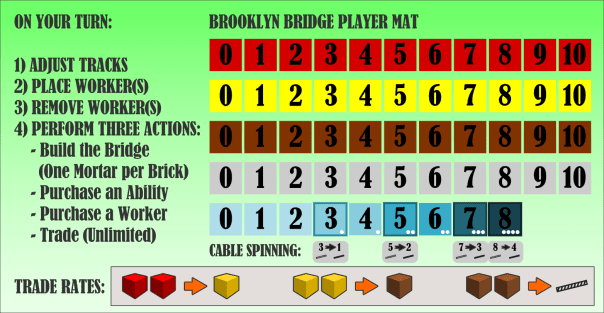
It wasn’t all good though. The second half of the game imploded. It was as if the game ran into a brick wall (no pun intended). The upside is that I have implemented a few changes which should circumvent that issue. I can’t wait to get it to the table again. This is probably the first time with Brooklyn Bridge where I really feel like there is “publishing potential.”
There you go… the late, great version of two weeks of Boards & Barley. What Boards & Barley have you been enjoying???
 Boards and Barley