Category Archives: Board Games

Monday Brews – 1-12-15

Scoville can heat up your frigid winter!
It’s a glorious Monday morning! Scoville is burning up twitter. The feedback so far from people on Board Game Geek is overwhelmingly positive. I’ve very thankful that people are enjoying the game. If you like it, head over to BoardGameGeek.com and rate it or write a review.
Side note: I haven’t yet received my Kickstarter copy. So if you haven’t received yours yet, you’re not alone.
One complaint I have been reading is that people seem to run out of the peppers. This was a very rare occurrence when playtesting the game, though my prototype did have slightly more peppers than the final production. But if you run out, please feel free to download and use this image to help keep peppers in the supply.
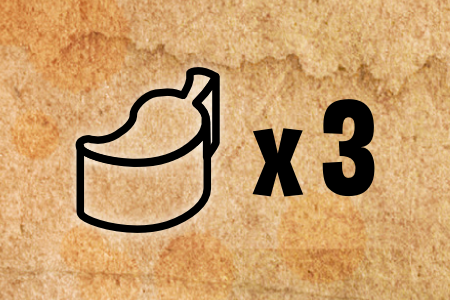
Use these multiplier tokens when you have a bunch in your stash and the supply is running low.
As we start another week I am feeling inspired. I chatted with my mom a little bit yesterday after the Green Bay Packers game. We were discussing game design and how it wasn’t ever one of my goals in life as a kid. She reminded me that I wanted to be a Police Sketch Artist when I was little. It’s funny to me that only five or so years ago I wasn’t that big into gaming (or “real” gaming). But I met some awesome people along the way and started to think I could design a game. And here we are, with Scoville about ready to hit retail. So amazingly exciting!
Anyway, enough of the touchy-feely stuff. Let’s get onto the Boards & Barley that I enjoyed over the last week…

The Barley:
 BARLEY SPOTLIGHT:
Tyranena Sheep Shagger Scotch Ale
After having the McEwan’s Scotch Ale last week I didn’t think I could ever enjoy a different brand. Obviously that’s not true, it’s just a way of stating how enjoyable the McEwan’s was. But I enjoyed the Tyranena Sheep Shagger quite a lot as well. It has a wonderful taste and nice body which makes it quite enjoyable on a cold winter night.
- Capital Winter Skal
- Deschutes Red Chair NWPA
- NEW! – Perennial Dual Artisanship – I picked this up because I had heard awesome things about Perennial and Prairie Artisan Ales out of St. Louis. It is a Belgian style brewed with Brettanomyces yeast. It was lovely, though I doubt I’d get another one since it was $13.
- Capital Supper Club
The Boards:
 BOARDS SPOTLIGHT:
NEW! – Caverna: The Cave Farmers
“I’ll never play Agricola again.” ~ Tom Vasel
Me either, Tom! Playing Caverna was an amazing experience. There is so much going on in the game that it is easy to lose track of things. However, the improvements over Agricola make this game far superior to me. Feeding your family is no longer a singular focus. Adding the Adventuring reduces the importance of Family Growth. There are numerous paths to victory. And the components! There are so many components. Literally tons. And they’re great components. Sticks. Dogs. Rubies. Donkeys. I cannot wait to play again.
- Machi Koro
- NEW! – Abyss – The board is a bit unnecessary since this is basically a card game. However, the artwork on everything is truly epic. The game was enjoyable with interesting decisions, quick play, and feel-good moments. I’d play it again and enjoy the beautiful artwork.
Designer’s Corner
I’ve been pretty lax with my design efforts lately as the Scoville roll-out has been ongoing. But I did sit down the other day to work on Ziggurat. I thought of a fantastic way to ditch the singular path to victory while making the game more interesting, more intense, and more enjoyable. Now it’s time to put all that stuff together into a new prototype and get it to the table.
Thanks for reading. What Boards & Barley have you been enjoying?
2014 Year in Review
You’ve probably been seeing this sorts of articles all over the interwebs. If so, thanks for reading mine as well.
First things first, my wife and I had our third baby this year. That means I didn’t accomplish as much as I wanted. And that’s still the case. I’m lucky to have signed Scoville when I did since we were sort of “between kids.” Since we had our third my homebrewing and board game design endeavors have faded.
But I’m not one to make excuses. Having our third child was our biggest accomplishment of 2014. However, this blog isn’t about babies and being a daddy. It’s about beer and board games. So let’s start with the Barley and see what I actually managed to accomplish…
Barley Review
My goal for homebrewing in 2014 was 6 batches of beer. In that list was a pumpkin ale, an IPA, and a lagered Oktoberfest. I did none of those.
I ended up brewing three batches, one of which is sitting in a carboy waiting to be bottled. The brews were a brown ale called “Nobody Plays Brown,” a hefeweizen called “You’ve Been Wheated,” and the third is a Belgian dubbel called “Rolling Dubbels.” For each I created a beer label, which was quite fun to do. Here are the labels:


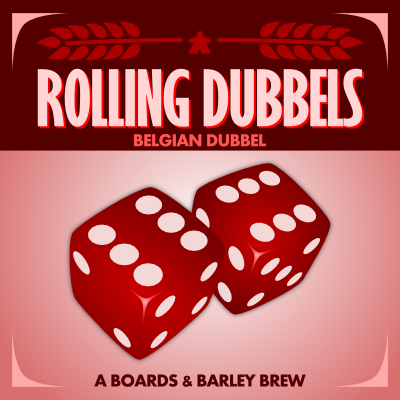
The brown ale and hefeweizen are currently in corny kegs in my basement refrigerator. I have a very generous neighbor who has loaned me a bunch of brewing equipment including the kegging stuff. The dubbel is sitting patiently for me to devote an evening to bottling.
Overall I’m a little disappointed that I didn’t brew more. That’s something I’ll try to remedy.
On the consumption end of brewing I had a pretty successful year. I began using UnTappd and have been able to have a great record of the brews I’ve enjoyed. In 2014 I logged 107 distinct beers. That’s a new brew every 3.4 days… not too shabby.
So despite the lack of homebrewing I’d say that it was a successful beer year. It’s unlikely I’ll be able to log 100+ new unique beers in 2015, but I’ll try my best.
Boards Review
 Obviously the highlight of my 2014 from a board game perspective was the successful Kickstarter campaign that Tasty Minstrel Games ran for my first published design, Scoville. It raised over $106,000! It was amazing to watch all that support come in during the campaign and I cannot thank all you backers enough.
The next highlight was getting to play Scoville with a final production copy at Gen Con. Punching out the little peppers, holding the pepper shaped bits, and planting and harvesting on the nice thick board with my close friends was a great memory.
On the design front, I didn’t sign any games in 2014. But I blame that on the fact that I didn’t really design any games in 2014. The biggest effort was for The Grand Illusion. This is a game where you are a street performer trying to work your way up to having a big time show in a theater where people come to watch you perform a grand illusion. Thematically it was my favorite game to work on. I love the theme of Victorian era magicians competing over audiences. My efforts for The Grand Illusion included making several prototypes, ordering a deck of cards from The Game Crafter, and playtesting it about a half dozen times. The end result was that it felt like it was lacking. So I shelved it.
Otherwise the only other thing of consequence from 2014 was a new design called Ziggurat. This is a resource management game where players are trying to be the best contributors to build the ziggurat. This game has one of those unique elements which sets it apart. It has been played about a dozen times now. While it plays through to the end, plays smoothly, and players are generally positive about it, it too feels lacking. It currently struggles from a “One path to victory” mentality and is devoid of any catch-up mechanisms. To alleviate that I want to add some private scoring conditions as well as allow scoring via different paths. This will make the game more “Euro-y” as well as more enjoyable. I’m hoping that Ziggurat will become my next signed game and I have big plans for it in 2015.
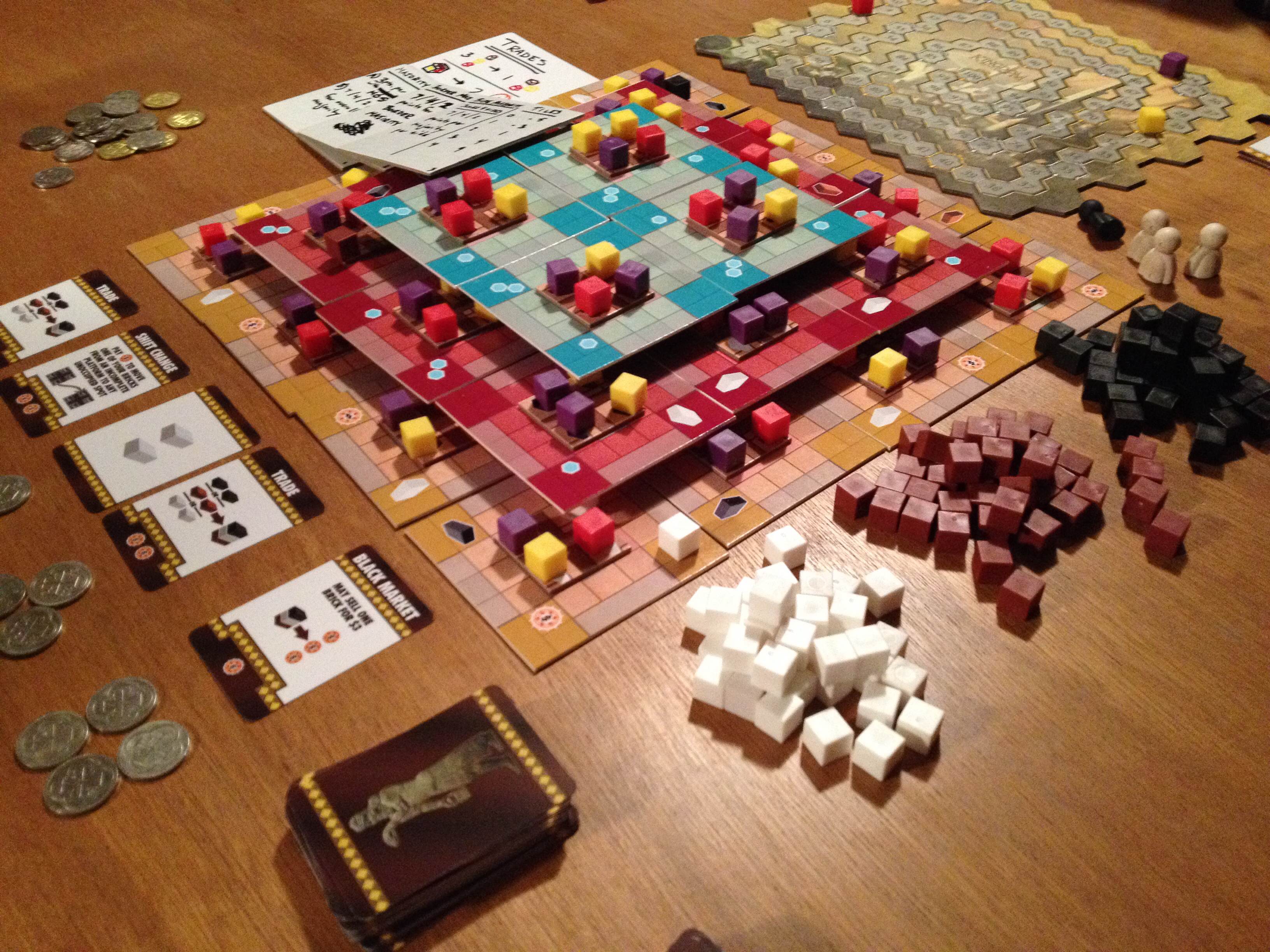
2015: Year of the Ziggurat
Unlike beer consumption, which I track with UnTappd, there is no app to track board game plays. Please don’t tell me to use the Board Game Geek site to track my plays as I do not care for that interface. I’ve documented the games I played all year in my Monday Brews articles. However, I do not feel like reading through all of them and trying to figure out how many games I played, let alone how many unique games. It was a lot. But I have one favorite…
2014 Game of the Year – Five Tribes
 When my friend Ben and I were in the exhibit hall at Gen Con we wandered past a demo of Five Tribes by Days of Wonder. We were immediately in awe of its beauty. The game simply looks fantastic. As we stood and watched the demo we quickly realized that this would be a good game, and a game we would like to own. Ben went to the counter and asked if they had any left, which they did not. However, he was told that they would have something like 50 or 100 copies the next morning when the exhibit hall opened.
So Ben got in the hall and in line as early as he could and was fortunate enough to snag a copy. His copy has since been played more than any other game by our gaming group.
The game not only has beautiful artwork, but it also has excellent wooden components. The palace and oasis pieces are particularly nice. Days of Wonder has a really excellent game with this one.
HONORABLE MENTION:
Istanbul: This game is clever and interactive. Players move their merchant around the markets in Istanbul trying to purchase or earn rubies. By making clever use of their assistants they create opportunities to earn those rubies. I love that the game is pretty easy to learn and understand while simultaneously creating interesting and deep decisions.
Moon Yeti Games
 The final thing of note for this 2014 Year in Review is that three friends and I decided to begin a board game publishing company. We will be Moon Yeti Games and our plans are to publish great games with beautiful art and high quality components.
The highlight of 2014 for Moon Yeti was that we gave away about 100 copies of our first game, Mutiny, at Gen Con. Adam Buckingham designed a 4-card social deduction and back-stabbing game to go on the backs of our business cards. We played it a ton and settled on a design, had them printed, and gave them away at the convention. That was pretty awesome.
Moon Yeti is currently developing a version that goes up to 8 players. We hope to have it for sale through our website over the next few months.
For more information, check out moonyeti.com. Thanks for reading and I wish you a fantastic 2015!
Monday Brews – 1-5-15
A new year is upon us. It was 8 degrees below zero (F) this morning and will snow 2-4 inches tonight. Oh joy. But Boards & Barley is back! So there’s that.
If you are new to Boards & Barley or made a New Year’s resolution to read this site more regularly, then I welcome you with open arms. On Mondays I like to recap the beer and board games I’ve played since the last Monday Brews article. It’s been a couple weeks and we had gaming friends over for a few days so the Boards and Barley are both longer lists than normal.
But before we get into that I wanted to mention that I’ll be posting my 2014 Recap article tomorrow and a Scoville article on Friday. As a reminder, if there are topics you would like me to blog about, please let me know via Twitter or via comments on this article.
Now let’s start with the Barley…
The Barley:
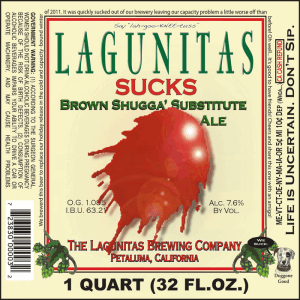
But it doesn’t suck!
BARLEY SPOTLIGHT:
Lagunitas Sucks Brown Shugga Substitute
This brew was a gift from my wife. She found a beer with a 100 rating on Ratebeer and wisely purchased it. Lagunitas’ brews are usually hoppy, as was this brew. But this brew had 63 IBUs, which is about perfect for me. This enjoyable brew had a nice balance between hops and body. I’d drink it again.
- Samuel Adams Winter Lager
- Leinenkugel’s Snowdrift Vanilla Porter
- Central Waters Bourbon Barrel Ale
- Capital Winter Skal
- Labatt Prohibition Series Bourbon Barrel Aged Blonde Ale
- Point Brewery St. Benedict’s Winter Ale
- Capital Schwarz in a Box – Don’t get it. It smelled like wet dog and tasted like Dinty Moore Beef Stew.
- McEwan’s Scotch Ale – Probably the best Scotch Ale I’ve ever had!
The Boards:

Your objective is to settle… Imperially!
BOARDS SPOTLIGHT:
Imperial Settlers x3
I love this game. I love the combo-ing or chaining of cards. I love figuring out how best to obtain and spend the resources. I love that it’s easy to teach and play. I love the artwork. I love everything about it with the exception of some downtime. But the downtime can be used to figure out what you are going to do next. The other thing I love about it is that my wife enjoys it. That means it will hit the table more often than some of the “heavier” games I own. If you haven’t already done so, check out Imperial Settlers by Portal Games.
- Kingdom Builder
- Dungeon Roll
- Scoville x3 – I love those little peppers!
- Charades for Kids – My daughter was having an absolute blast with this game.
- Tenzi
- Flash!
- The Logo Game
- Sushi Go
- Mundus Novus
- Istanbul
- Unpublished Prototype – Ziggurat – This is my design, but it still needs a lot of work.
- Garden Dice – Love that Joshua Cappel artwork! It was a really clever game.
- Undermining
- Trajan – Such a great Feld!
- Euphoria
- Skyline
- Camel Up
- Yardmaster
- The Little Prince
- 7 Wonders with Leaders, Cities, and Babel expansions
- Sequence for Kids – My daughter won 3 out of 4 games with 3 players. And I don’t let kids win. She earned it!
- Hi-Ho Cherry-O
What Boards & Barley have you been enjoying? What were your favorites of 2014? Thanks for reading and I hope to bring you lots of great content in 2015!
Christmas Gift Guide for Gamers

I would be remiss if I didn’t post an article sharing what I believe are some of the best games to give to family members for Christmas. So with Christmas a week and a half away, today I present my Christmas Gift Guide for gamers and non-gamers!
It’s always a little tough trying to decide what games your friends and family might like. Are they gamers who like strategy? Are they non-gamers that just like to hang out? It’s important to understand who you are buying for and what gaming environment they live in.
I’m breaking my recommendations into 3 categories: Party Games, Family Games, and Gamer Games. Check out the description for each to get a better idea from which category your gifts should come.
Let’s get started with “Party Games.”
Party Games:
“Party Games” are games played with larger groups of people in a typically social, laid-back atmosphere. They often involve guessing, shouting, and laughing. These types of games also serve to help you learn about people.
Here are some solid games you can check out:
 Dixit – In Dixit one player is the storyteller. They will choose a card and make up a story or one-liner about what they see on their card. Then all other players choose a card they think matches that story. The Storyteller’s goal is to get at least one player, but not everyone, to guess the correct card. Points are awarded for the guesses and the next player becomes the storyteller.
 The Resistance (and The Resistance – Avalon) – This is a social deduction game. In this game each player is either a Resistance Operative or an Imperial Spy. For three to five rounds, they must depend on each other to carry out missions against the Empire. At the same time, they must try to deduce the other players’ identities and gain their trust. Players attempt missions and either support or sabotage them. Once the Resistance or the Imperials have won three missions, they win the game.
 Telestrations – This game is also known in finer circles as, “Eat Poop, You Cat!” It is basically the game “Telephone” but in this case you are drawing the phrase and then the next player writes down what they think the drawing is showing. Then the next player draws that new guess and so on. We played this the other night and one of the pictures ended up with Three Wookiees at a beauty pageant.
 Wits and Wagers – In Wits and Wagers players will guess a number for the question currently being asked, like “In what year did the Edmund Fitzgerald sink?” Then all the guesses are revealed and players will bid on the guess or guesses that they think are the closest without going over. Correct answers earn more bidding chips. Wrong guesses lose the bidding chips.
Family Games:
“Family Games” are games for people who enjoy games but don’t want behemoths that are difficult to learn or take a long time to play. Often these games are accessible, quick to learn, easy to play, and have engaging themes. To me the word “accessible” typically refers to games that have a small decision space. Ticket to Ride, my first recommendation, is a great example of this since there are only three things you can do on your turn.
Here are my recommendations for Family Games:
 Ticket to Ride – In Ticket to Ride players are competing to build the best rail network. Each player will have specific routes they need to connect. On your turn you either draw train cards, build connections with train cards, or draw new route cards. Throughout the game you will be building your network and hopefully connecting the cities on your route cards. The player with the most points at the end wins the game.
 Sushi Go – Sushi Go is a fast and fun card drafting game where players are trying to score the most points with the cards they have. Each player is dealt a hand of cards. They will choose one card and pass the rest to their neighbor. Once all players have chosen they will then display their card face up. Then with the passed cards that they received they will choose another and display that as well. Each type of card has a different scoring condition. So choose your cards wisely. The player with the most points after three rounds will win.
 King of New York – In King of New York players represent monsters trying to earn 20 points or be the last monster standing. Points are earned several ways. On your turn, you roll six dice up to three times, then carry out the actions on those dice. Actions include attacking other players and purchasing special monster abilities. You can also try to become the most Famous Monster in the city.
 Camel Up – In Camel Up up to 8 players can participate in the camel race. On your turn you can move a camel, bet on a camel for the round, bet on a camel to win or lose the whole race, or place your track modifier. This game can get pretty chaotic and is good, light fun. I’ve never played where it wasn’t an awesome experience.
Gamer Games:
“Gamer Games” refers to games that are more strategic and take longer than family games. Often these have more complicated rules than family games. But for that gamer in your family that needs more than Ticket to Ride to quench their gaming appetite, then check out these options:
 Five Tribes – This is my game of the year because it is awesome. It uses a “worker displacement” mechanic where players try to unite the five tribes. Your objective is to score points via about 8 different scoring categories. You can also obtain Djinns (Genies) that allow you to do special things. There are a lot of clever moments where players feel rewarded for making good plays. The art is fantastic and the game is fun. I highly recommend it.
 Puerto Rico – This is a “classic” role selection game where players are trying to build and develop the island of Puerto Rico. Each round players will choose one role each. When they choose the role they get a bonus ability for that role, then all other players get the option to copy the main ability of the role. Players have to manage resources while building buildings, hiring workers, and shipping goods. It’s a great gamer’s game.
 Concordia – This is a sort of a deck building game. Players start with a hand of cards. Each card allows a specific action to be performed. Throughout the game players can build their deck by adding cards they believe to be beneficial. The cards also represent the scoring conditions so it is good to add cards to your deck. Players will also be trying to expand their control over the map by building settlements in different regions. The box cover art is hideous but the game is fantastic!
 Star Wars: X-Wing Miniatures Game – Players will choose the Imperial Forces or the Rebels. These are represented by awesome minis of the ships from the Star Wars series. Each ship will be accompanied by a pilot with unique abilities or skills. Players control the flight of their craft and then one ship at a time they will have a chance to fire on the opposing fleet. This game is a lot of fun and is very thematic. There are also plenty of expansion ships you can
 waste spend your money on. Very fun game.
I hope this helped you out. If you have other recommendations, please feel free to share them in the comments. Thanks for reading and I wish you a very blessed Christmas season!
The Purpose of Expansions
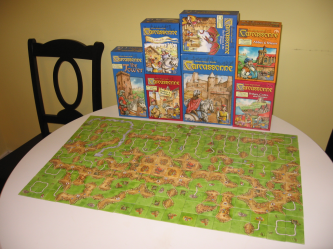
Carcassonne and several of its expansions. Photo via wordsgoneby.blogspot.com.
Scoville is on the ocean in a container on a massive vessel (info via latest KS update). That’s pretty sweet and it means that the time is rapidly approaching when all of the awesome Kickstarter backers will be able to get Scoville to the table! I couldn’t be more excited.
So naturally I might as well begin work on an expansion (which I playtested last week!). Working on it has brought me to the question of “What is the purpose of an Expansion?” Today I’ll briefly try to address that. Throughout I’ll be using Carcassonne and Ticket to Ride as examples.
From a designer’s perspective here are the three main reasons I think a game should receive an expansion :
- Increase Replayability and Variability
- Add something new
- Add depth
And here are three reasons a publisher may want to publish an expansion (in addition to those above, of course):
- Sell more of the original game
- Make money at a higher margin since expansions don’t typically cost as much
- Provide more quality products to help build your catalog
Obviously the designer reasons and the publisher reasons that I provided are not nearly exhaustive, so take that however you want. I’ll only be covering the reasons for an expansion from the designer’s perspective. At the end I’ll also provide some things that an expansion SHOULD NOT do.
Increase Replayability and Variability
One of the things I like to design into my games is the ability to play it over and over and never have the same experience.I like to define Replayability and Variability thusly:
REPLAYABILITY: When a game can be played over and over again without it feeling old and “samey” despite the setup and game conditions being identical.
VARIABILITY: When a game presents different scenarios for play such that no two plays could ever be identical.

Kingdom Builder – Variable Setup FTW!
Those sound the same and they basically mean the same thing to me. The point is that I do not want to play a game the exact same way it was played prior. That turns the players into robots seeking to find the optimal plays in a game. I prefer games where it is different based on who you are playing with or how the game is designed.
This can be accomplished in several ways but most often via randomness. Sometimes the original design doesn’t receive all the variability the game deserves. Other times the designer comes up with new ways to increase variability after the game is published. Either way, creating an expansion is a great way to bring the game to people’s tables again and make the experience better.
Some of my favorite examples of expansions increasing the replayability/variability of a game are the Carcassonne expansions. (They actually meet all three “expansion” criteria I am mentioning today, so I’ll use this example for each below as well.) The Carcassonne expansions add replayability because they implement situations that are different based on the people you are playing with and based on the tiles you draw.
But perhaps the best instance that I can think of for variability is with the random board setup and scoring conditions from Kingdom Builder. That is one of the most replayable and variable games in my collection and that doesn’t necessarily refer to the expansions.
Add Something New

Add something new… like new routes to Ticket to Ride!
Sometimes a game is deserving of a new addition that changes the game and how it is played. Adding something new to a game can make players want to play it again. It can be a new mechanic, new components, new cards, dice, etc.
Adding something new doesn’t necessarily add depth. Adding new elements can simply make the game enjoyable to play again.
In the Carcassonne world, the Inns and Cathedrals expansion did not really increase depth. Rather, by adding something new it lured gamers to play again and again. The Inns and Cathedrals addition is very minor but it adds enough to change the way people play the game.
Another example is the USA 1910 expansion for Ticket to Ride. Basically it adds a bunch of routes without changing any rules. This is such a simple and smooth expansion to integrate with the base game. Designer’s should keep these sorts of additions in mind with creating expansions.
An easy (actually ridiculously easy) way to expand Scoville is to design a whole bunch of new recipes that utilize previously unused combinations of peppers. This would add something new to the game without changing a single rule. Ironically I hadn’t thought of that until just now, while writing the article. I will be creating 20 new recipes!
Add Depth

Grain, Beer, and Fruit by the Foot!
Often an expansion will provide ways to make a game deeper strategically, tactically, or even thematically. This usually coincides with adding something new. A new mechanic can be added to the game that changes the gameplay or injects depth of decisions. Or perhaps new components are added that add depth via breadth (is that even possible?). I suppose that would be something like instead of limiting the game to four different resources, you could bump it to 6, which could add depth.
The idea behind this reason is to take a game that players have become familiar with and make it deeper. Sometimes players refer to this as “heavier.”
In Carcassonne the Traders and Builders expansion adds notable depth. Players have the objectives of finishing castles such that they earn the bonus tokens of Grain, Beer, and Fruit by the Foot (or maybe grain, wine, and cloth… not sure). This sort of depth adds a distinct layer to the strategy players utilize during the game.
What Expansions SHOULD NOT do…
I am of the opinion that expansions should not:
- Cost more than the base game (Though I suppose an argument could be made for certain situations).
- Change the base game so dramatically that it is a completely different thing.
- Detract from the original concept of the base game.
- Add an overwhelming number of new rules or exceptions to rules.
- Modify the original rules.

Not an expansion.
So the simplest way to create an expansion is to simply add some new components like the Ticket to Ride USA 1910 expansion. That expansion did not cost more than the base game. It did not change the base game at all. It did not detract from the original concept. It added zero new rules. And it did not modify the rules. That’s a streamlined expansion.
When expansions violate the 5 points I listed then they start to break away from what I consider an expansion and fall more in line with a whole new game. This would be akin to Ticket to Ride – Europe. The base game is the same but there are new components, new rules, and the original rules were modified enough that this doesn’t meet my criteria for an expansion.
NOTE: Ticket to Ride – Europe was neither marketed nor sold as an expansion.
So what do you think? What makes an expansion worthwhile to you? What are some of you favorite and least favorite expansions? Thanks for reading!
 Boards and Barley