Category Archives: Board Games

Monday Brews 5-19-14
After a week off from my Monday Brews articles last week I’ve wrangled up a long beer list. It was aided by the fact that my city was having a Craft Beer Week. And it was also aided by two playtests of Brooklyn Bridge. So I’ve got a nice long beer list for you this week.
I also brewed another beer. I’ll be writing about that later this week unless my new baby pops out of my wife’s belly. It is a wheat beer that I’m calling “You’ve Been Wheated.”
So let’s jump right in and start with the barley…
The Barley:

Best word to describe it: Yum!
BARLEY SPOTLIGHT: Tyranena Doubly Down and Even Dirtier Barrel Aged Chocolate Vanilla Double Stout
I enjoyed this most amazing beer with possibly the longest beer name ever during a Madison Craft Beer Week event. It was on tap and it was amazing. It was very rich with a beautiful flavor and a solidity to it that made it feel as though you just ate a full meal. I will definitely drink this again. Also, it’s baby brother, “Down & Dirty,” is also very good and more accessible.
- Sprecher Special Amber
- Boddingtons
- NEW! New Belgium Snapshot – I liked it at first but then it seemed to have a characteristic closer to a Sour beer. I’ll try it again.
- Young’s Double Chocolate Stout
- Lucette Hips Don’t Lie
- NEW! New Glarus Spiced Ale – Not as spicy as I was expecting, which was pleasant.
- NEW! Boulder Shake Chocolate Porter – Warm this one up a little and you’ve got yourself a full-on dessert!
- NEW! Potosi Steamboat Shandy – This was a very enjoyable shandy.
- NEW! Blakkr Imperial Black Ale – This brew is actually a partnership between three breweries. (Three Floyds, Surly, Real Ale). I didn’t particularly enjoy this brew.
- New Belgium Trippel
- Hofbrau Original
- Bridgeport Kingpin
- NEW! Green Flash Double Stout Black Ale – This was an excellent, deep, dark double stout.
The Boards:

How good of a Euro could this be? They don’t really look that bored.
BOARDS SPOTLIGHT: Aquadukt
This isn’t a new game, but it was new to me. And I loved the simplicity of it! The options you can choose on your turn are simple (build houses OR build a well OR build canals). But with those three simple choices comes a game with surprising depth. Which house tiles do you build – 1s, 2s, 3s, or 4s? When/Where should you build a well? How/Where should you build canals. This is a euro and it doesn’t try to hide it. The board is basically a big grid sectioned into 20 areas. I love games that use simple mechanics but yet have deep and interesting decisions!
- Targi – such a fun 2 player game!
- Quantum Orcas – Ran another successful playtest. Still not sure what I want to do with this game.
- Love Letter
- Unpublished Prototype – oh man… this one is SOOO good!
- Qwirkle
- Brooklyn Bridge – more below.
Designer’s Corner:
The progress currently being made on Brooklyn Bridge is making me feel much better about the game. While there are interesting mechanics that people seem to enjoy it has been all the other stuff in the game that has been needing the work.
The most major change is that money is no longer a part of the game. (Side note: I may bring money back with money being the points in the game. Currently the points are set up such that they could be equivalent to $$.) Previously players could earn money without having to build the bridge. That meant that early in the game they would focus on money to buy abilities. With the change the only way to buy abilities is with points and the only way to get points is to actually build the bridge… imagine that!
I am extremely happy with how the latest playtest went. The first half of the game worked really well, consisted of interesting decisions, and players overall seemed to be having fun. A big thing that was an improvement was the new player mats. These allowed me to get rid of the 30 red, 30 yellow, 30 brown, and 30 silver cubes that represent the bricks and mortar. Now players have one cube of each color and they move it along on their player mat.
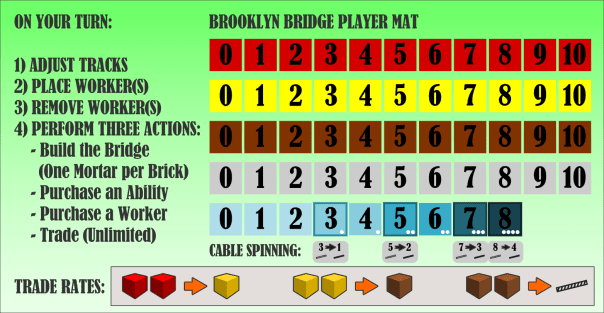
It wasn’t all good though. The second half of the game imploded. It was as if the game ran into a brick wall (no pun intended). The upside is that I have implemented a few changes which should circumvent that issue. I can’t wait to get it to the table again. This is probably the first time with Brooklyn Bridge where I really feel like there is “publishing potential.”

There you go… the late, great version of two weeks of Boards & Barley. What Boards & Barley have you been enjoying???
How to Teach Games

Teaching games is like an upside down pyramid. Photo Credit: ©hassansagheer via DeviantArt, Inverse Pyramid, Louvre Museum. I do not own this material.
I’ve had several friends tell me that I am good at teaching games. So I sat down for a while with a nice brew and thought about why they might have said that, and about what makes someone good at teaching games. So I’ve postulated and hypothesized some ideas that I want to lay out for you today.
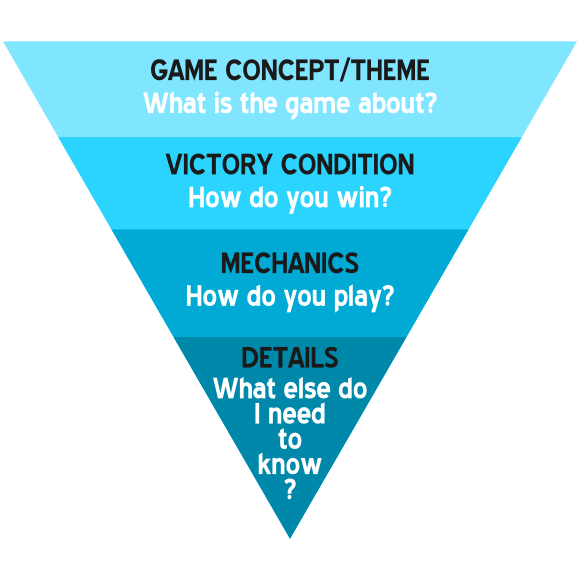
There are some rules and some guidelines. But the overall idea of how to teach games can be summarized in this upside down pyramid table with the idea being that you teach from the top down:
 Before we get into those concepts I want to address Rule #1 of teaching games…
RULE #1: Know How To Play!
That seems pretty straightforward, right? It is really annoying when someone is all excited to teach you a game and then they keep looking through the rules for all the weird little oddities. Don’t be that person.
Learn the game. Read the rules. Watch videos about how to play the game. Set the game up. Pretend to play it solo. Do whatever you need to do to know the game before you attempt to teach it to others. Don’t waste their time.
Ok… glad I got that off my chest. Now let’s hop on top of that inverted pyramid!
1) Explain the GAME CONCEPT/THEME
I always like to start at the beginning. Tell the players what the game is about. Tell them about the theme. Tell them the overall idea of the game. Players will want to know what is exciting about the game. They will want to somehow relate to the theme, if at all possible. At a bare minimum, players will want to understand what the theme is so that they can try to immerse themselves in it.
Games are supposed to be fun and it is often more fun if you can immerse yourself in the theme*.
* Does not apply to abstract games.
2) Explain the VICTORY CONDITION
Now that your players know what the game is about, they’ll want to know how to win or at least how/when the game ends.
I think this is very important to know early on. I dislike when someone is teaching a game and they have told you about 30 different rules and then someone says, “How do you win?” That’s annoying.
So after I explain what the game is about, I tell them how they win the game.
3) Explain the MECHANICS
Players should now know the victory conditions. It is now time to explain how they can reach those victory conditions.
At this point you will teach the mechanics of the game. You will be teaching the actual things that you will be doing during the game. This is the most time-intensive portion of teaching a game. Also, there are a few guidelines during this portion of teaching that I like to follow:
- Teach along the flow of the game
- Teach the basics of each portion of the game… save the details for later.
- As you teach, remind the players how the mechanics relate to the victory condition.
- Give examples of how one decision can help you make the next.
Teaching along the flow of the game means don’t skip around. If the game follows a progression of things, teach them in order.
Teaching the basics means telling players the overall idea of what is happening. The details can come later on.
Remember to relate the different phases of the game to the victory conditions whenever possible. That way players can quickly learn which mechanics are the most helpful along their path to victory.
And giving examples of how decisions affect future decisions can be really helpful.
4) Explain the “necessary” DETAILS
Once you have taught the basics of the mechanics, go back and fill in the details. Once players know the overall flow of the game, then revisit each of the portions of the game and dive deep enough where people aren’t lacking anything that they will need to know.
These are the sorts of things players will need to know, but don’t need to know until after they have learned the general flow of the game.
Got all that? Here’s an example…
 I’ll attempt to “teach” you how to play Compounded from designer Darrell Louder and publisher Dice Hate Me Games. I love this game and it is a great example for this article. If you haven’t played it, I highly recommend it. Let’s start with step 1) Concept/Theme.
1) CONCEPT/THEME: You are a lab manager working on the greatest compounds known to man. Your objective in the game is to manage your lab workbench better than your opponents. To do that you will have to complete compounds, increase your experiment levels, and gain the most atomic points.
It’s that easy and quick. Give the players the basic idea of why they are playing the game, and what their overall objective is while playing.
2) VICTORY CONDITION: To win the game you will have to score the most Atomic Points. To earn Atomic Points you will have to complete compounds. To complete compounds you will have to place elements on these cards (*points to cards). Once you have completed a compound you will earn points and bonuses, which I’ll explain in a moment. The game ends when someone reaches 50 Atomic Points (or condition A, or condition B, etc.).
Okay, in that portion I started from the top and worked my way down. Score Points. How? Complete Compounds. How? Place elements on compounds. Start at the top and then fill in the details. It allows players to understand the grand scheme of things.
3) MECHANICS: Now that you know how to earn points, let’s discuss how we actually play. Each round is made up of a few different phases. (*points to top of player mats where the phases are listed). First is the Discovery phase where we will draw elements from the bag and possibly trade with other players. After Discovery is the Study phase where we will claim compounds by placing our discs on them. After the Study phase is the Research phase where we can place elements on compounds and try to complete them. After the Research phase comes the Lab Managing phase where we check for completed compounds and restock the lab with new compounds.
So when I teach Compounded I like to run quickly through the four phases of a round before I give too much detail about any one of them. This way players will become familiar that each round of the game has four phases where you are doing certain things. Once players understand the flow of the game, then I get into the details.
3) DETAILS: Those are the different phases. Let’s discuss each one. So in the Discovery phase players will draw a number of elements shown by their DISCOVERY research level. Each player starts the game at “2.” Also during the discovery phase players will have the opportunity to trade things. You can trade anything EXCEPT Atomic Points and research levels. No future trades are necessarily binding. That depends on your real life integrity. Then in the Study phase you each have one disc to place on a compound. …
I could go on and on, but the idea here is that for each phase of a game you should be mentioning the details. Like during the explanation of the Lab Managing phase of Compounded you should point out the little symbols on the corners of the cards that either give you a bonus or start a lab fire or whatever they may be. Players will want to know those things.
So that’s the basic way that I teach a game of Compounded to new players. I follow the four major steps shown in the inverted pyramid.
I want to point out that Dice Hate Me did an awesome thing by listing the phases of the round right on each player mat. Here is a picture showing how Dice Hate Me incorporated my Steps 3 & 4 onto the player mat to help players learn and play the game:

Having the overview of the game flow and the details where all players can see it serves as a constant reminder throughout the game. It also helps to prevent players from asking the same questions over and over again.
I know that not everyone will agree with how I think games should be taught. If you don’t agree, let me know about your way. I’d love to hear how others teach games. If you have a way that works really well, post it in the comments! Thanks for reading!
Scoville and Me

Scoville – Where dreams come true!
I was thinking the other day about how strange all of this Kickstarter stuff is and that people are pledging money toward a game that I designed. It’s all been a really wild ride and it’s awesome to see a dream come true like this. If you are reading this, you are likely a backer, and for that I thank you.
On the flip side, I run this blog and it hasn’t exactly been running like normal while Scoville has been on Kickstarter. For that I apologize. Today won’t be like normal either. I realized that the truth is I may never have a game on Kickstarter again. So I’m trying to enjoy all of the stuff going on around the campaign, both good and bad. I’m taking the perspective of just enjoying it.
So today I thought I would share with you all the awesome opportunities that people have presented me with. These are the interviews and podcasts that I’ve had a pleasure of being a part. But first, for those who have not seen it, Undead Viking has a video review of Scoville for you visual and audible pleasure.
Undead Viking Video Review
Interviews
I had the pleasure of being involved in three different interviews. The #BoardGamersAsk was a live interview on Twitter where anyone could ask me anything. It was pretty awesome!
 Indie Cardboard: January 26, 2014
 #BoardGamersAsk via Ministry of Board Games: January 31, 2014
 Cardboard Republic: February 14, 2014
Podcasts
It turns out that the guy who runs My Board Game Show lives in my town. So I was able to go over to his house and record the podcast live with him. And I had the pleasure of joining the Dice Hate Me crew, who are always fun to chat with. Here’s the four podcasts I had the privilege of being on:
 My Board Game Show – Scoville & Mob Town: February 4, 2014
 Dice Hate Me State Of Games: The one about the hot games of 2014: February 7, 2014
 Let’s Level Up: February 11, 2014
 G*M*S Magazine Boardgame Review Room: February 11, 2014
In the meantime…
Thanks for checking out Scoville on Kickstarter! It really means a lot to me. I’ve got other games I’m working on that I hope will end up as awesome as Scoville.
Scoville on Kickstarter!
I was originally planning on posting an article about Decision Space in game design but certain events have caused me to postpone that article. It’s still coming at some point and I think it’s a pretty good article, but today I can’t help but share about Scoville.
Scoville has Launched!
If you are interested in the game and seeing the art or watching me in a video, then head over to the campaign page. The first 24 hours of the campaign saw 498 backers pledge $20,876. I am truly amazed at the response so far for Scoville.
Also, if you are a backer or are on Twitter, feel free to use this image as your avatar! The more we can spread the word, the more likely we will be at hitting our funding goal and the stretch goals.
Designing vs. Publishing
On the Kickstarter page you’ll notice that two of the stretch goals are to add a 5th and 6th player. While some people might grumble that the Print and Play files have always had the capability for 6 players, why does the Kickstarter version only have 4 players out of the gates?
This is a great debate between designing games and actually producing games.
As a designer I could add whatever I wanted into my designs. It could have 2000 wooden bits, 500 cards, 100 modular boards, and so on.
A publisher would never sign a game like that.
So there comes a time when designers must start to think like publishers. In order for Scoville to be up to a 6 player game, it would require more Market Orders, more Recipes, more Player Screens, More Pawns, More Coins, and more Bonus Action Tiles. Each of those elements are things I could easily produce for the few prototype copies that I made. But their are actual cost considerations for a publisher to produce them.
So while it is easy for a designer to add whatever they want into a game, it ultimately takes real money to make it happen.
That’s the case with the 5th and 6th player stretch goals for Scoville. I hope you all understand.
Go Check It Out!
The artwork for Scoville was done by Josh Cappel, who is a pleasure to work with. I love his style and it is clear that he really brought the town of Scoville to light in the artwork for the game. Here’s a picture of the box:

Will you be the best pepper farmer and win the Scoville trophy?
I’ll be sharing more art with you here and on Twitter as the campaign moves forward. Thanks so much for checking out my game.
Holiday Gaming Guide

Image via http://www.theguardian.com
‘Tis the season to be jolly! Whether or not you celebrate Christmas, you can still see that this time of year is special. Winter is nearly here, snow may be on the ground where you live, and the year is about to end. As we scramble to get in as many games as we can before the end of the year we usually find that we get the privilege of gaming with friends or family that don’t normally play games.
So today I present my guide to holiday gaming. Let’s get started with the best introductory games for non-gamers!
Non-Gamer Games…
When gathering together with family for Christmas I usually like to “dumb down” the level of games that I bring along. While I think they would probably enjoy longer, heavier games I find it’s just not worth it to try and teach those types of games. So I like to bring games that are light and accessible, yet still fun to play.
The other day I sent out a tweet and asked what games people like to bring for non-gaming family members. I got a great response:
So let’s run through some of my favorites from those that people mentioned (that I have played before):
-

Have you got your ticket? All Aboard!
Qwirkle: This is such a simple game but has such excellent tactics. I have the travel version so it’s so easy to bring along!
- Dixit: It’s like Balderdash without the fiddlyness and with beautiful cards. Can you make up a story? Then try out this game. Plus, it can play up to 12 players so know one will be left out at your Christmas gathering!
- Ticket to Ride: A classic gateway game renowned for simplicity and accessibility! My non-gaming sister-in-law put it on her Christmas list a few years ago. If you haven’t taught this to your non-gaming family members yet, this is the year!
- Apples to Apples: It’s simple… play a card that you think the player will choose. While that sounds a little boring, this game is a lot of fun with family members. And it can help you learn about them. So invite your crazy uncle to play so you can learn to avoid what he likes!
- Farmageddon: This is a fun “take-that” farming game where you scrape by to get any points you can. The theme is funny and the artwork is great. Plus, the price is ideal!
- The Great Heartland Hauling Co.: For small box games with big strategy this one is a winner. You are a trucker utilizing a pick up and deliver mechanic. It plays quickly and has awesome wooden 18 Wheeler Meeples!
- Hanabi: It can be infuriating! But it is so much fun. This is a hidden information game where you build fireworks. The info that is hidden are the cards in your own hand. Everyone else can see what you have except you. Work together as a team in this cooperative game to build all the fireworks!
- Love Letter: About as quick as they come, Love Letter is a card game about winning the princess’ heart. It’s so quick and easy that it would be a crime not to play it with non-gamers.
Any of those games listed above would be good games to play with non-gamers. They are all accessible, relatively light, and all are fun to play. But if you’ve got people who want a little more strategy, here are my mid-tier recommendations for Christmas holiday gaming:
For those wanting more…
Sometimes family will want a slightly heavier game. You may have already piqued their gaming interest with one of the games listed above. So now what? Here are a few games that I think fit the “gateway” mold very well. These are games for people who want to play more and want a little more strategy.
-

How would you build a kingdom?
Stone Age: I love teaching this game to non-gamers who want a little more. It has excellent strategy. But moreso, there is the idea of trying to do the absolute best with your tribe on every single turn. And the theme is fun.
- Carcassonne: I would have put this in the upper list, but some people don’t always quite get the placement strategy. Fundamentally it is simple: Take a tile, Place a Tile, Put a meeple on it if you want. But there is a serious amount of fun going on here.
- Dominion: I have had my fill of this game, but it definitely is a great one for those wanting more strategy and depth. This is the original deck-building game where each turn you can add cards to your personal deck. As the game progresses, the better cards in your deck allow you to do more and better stuff. It’s also pretty easy to teach and learn.
- Pandemic: While I’m not huge on the cooperative thing in games, this game is greatly loved and adored my many people. You have to work together to stop the viruses from spreading and creating epidemics. The theme is pretty cool and there was recently a newly revised version out. So this might be something for those who want more.
- Kingdom Builder: I love this game. And I love the variability with the expansions. The concept is simple, but the strategy is deep. Kingdom builder is another fun game where you try to maximize each and every turn. I highly recommend this one.
- Bohnanza: This is a card game about planting beans. But the strategy here is pretty awesome. When should you harvest? Should you wait one more turn? Should you buy that 3rd bean field? This game involves a lot of fun decisions.
Those are some very good options for mid-tier games that you might want to try with your families. Finally, here are my gamer games that I might try to push on people this Christmas season:
The Big Dogs…
These are games that are deep, strategic, and heavier than what your family of non-gamers might be into. But if you can teach them well and quickly explain the games then they might be worth trying to get to the table.
-

Agricola: The game of farming and family growth.
Power Grid: This can is a nice heavy game with a ton of strategy and interesting decisions. You are trying to build a power grid and supply power to the most cities. But there is a balance of overentending yourself for money or hanging back and trying to leapfrog for the win. Excellent game.
- Anything Rosenberg: Agricola, Le Havre, Ora et Labora, Glass Road, Caverna. You can’t go wrong. These are heavy games that allow you to spend a long time sitting down with your family. But these games are intense and challenging. I recommend them.
- Anything Feld: If you want something slightly less intense, but no less awesome, then check out games by Stefan Feld. Macao, Notre Dame, Trajan, In the Year of the Dragon, The Castles of Burgundy, Rialto, Bruges, Bora Bora. Seriously… this guy is a designer of awesomeness!
- 7 Wonders: The learning curve is a little too steep for this to have been in the previous lists. But this game is seriously awesome. You are trying to build one of the 7 Wonders and you are trying to make yours the best! A cool card drafing mechanic is the main concept behind the game and it works really well.
- Lords of Waterdeep: If you’ve got any Dungeons & Dragons people in your family then I recommend trying out this worker placement game with them. It’s a fantastic game that works really well.
- Empire Builder: A classic. This game involves players drawing routes on the board with crayons. Routes allow your trains to access different cities. This is probably my favorite pick up and deliver game.
There you go. I’ve provided three different game categories for you to push on your families. After the holidays I’ll report back since I’m going to ramp up my efforts this year. And I’ll be looking forward to hearing how it went with you all! So pour yourself some egg nog, eat too much food, and play games with your family!
 Boards and Barley