Category Archives: The Boards

Monday Brews – 7-14-14
First things first: Today is July 14th… Gen Con starts August 14th. That means we are 1 month away from Gen Con! Woo Hoo!
Now let’s get to the bi-weekly Boards & Barley that I have enjoyed. As usual we’ll start with the Barley.
The Barley:

Clean and friendly with some delicious beer!
BARLEY SPOTLIGHT:
Next Door Hammerhead IPA
As one of my goals for the year I am “adventuring” out of my beer comfort zones and into more varieties of beer. IPAs are one of those varieties that I previously would never have chosen. But I am now embracing them.
In the past I have typically stayed away from hoppy beers. But this beer was actually very drinkable and enjoyable. The hop level wasn’t too strong and it seemed to provide just the right about of character. If you are ever in the Madison area I recommend stopping by Next Door Brewing!
- Oskar Blues Old Chub Nitro Scotch Ale
- New Belgium Fat Tire
- Summit Summer Ale
- Young’s Double Chocolate Stout
- Potosi Cave Ale
- Next Door Egon’s Revenge (Gose)
- Next Door Rockets Red Ale
- Oskar Blues Dale’s Pale Ale
- Leinenkugel’s Red
- Leinenkugel’s Original

The Boards:

Simple and elegant artwork and gameplay!
BOARDS SPOTLIGHT: Sushi Go
I played this at Next Door Brewing and I really enjoyed it. It is quick, has beautiful and simple artwork, and the gameplay is elegant.
Sushi Go has a card drafting mechanic similar to the game 7 Wonders. Ultimately, Sushi Go is like 7 Wonders Lite. Take a card, pass the rest, then play the card. The cards present different scoring opportunities. Some have you build a set to score. Some score straight away. Some score at the end of the game. The design is so smooth and simple that it is easy to see why people enjoy this game.
Designer’s Corner:
With Gen Con one month away it’s really crunch time in terms of the designs I want to show. Brooklyn Bridge is really at the forefront and will be where I place the most effort over the next few weeks. It’s at the point where some of the cards need some tweaking, but ultimately it just needs to be played more.
I would also like to see if I can prototype The Grand Illusion and get in some preliminary playtests, even if it means the first time it gets played is at Gen Con.
Grand Illusion Core Mechanics
 Today is the second in a series about designing a new game called The Grand Illusion. Via Twitter I asked for examples of different types of Victorian-era magic and illusions. Here are a list of some of them:
- Levitation
- Cutting off heads / Cutting someone in half
- Disappearing persons
- Escapes
- Sword swallowing
- “Anything with doves”
Of course there are others like sleight of hand, card tricks, collapsing cages, awesome tricks with electricity, etc. What I am looking for are core genres of tricks that can be used as the currency (symbols) in the game. So with that in mind I think there are several such genres that could be used. For now I’ll go with these:
- Escapes
- Sleight of Hand
- Disappearing
- Cutting (of people)
- Levitating
- Grand Illusions
That gives 6 “currencies” in the game that can be used for set collection.
Performing Magic
The real question we need to be asking is, “How exactly do you play this game?”
As I mentioned last week the idea is that you are a street performing magician looking to gain a reputation, earn some dough, and eventually find yourself on a stage performing a grand illusion for the masses.
This will be mostly a card based game unless the direction of the game changes. For now I have created preliminary icons for the 5 main magic genres listed above (excluding the Grand Illusions).

Players will begin the game with a hand of cards. They will also have their “Grand Illusion” card, which is private. There will also be a few magic tricks to perform that are laid out on the table. In each round the magicians will perform a random draft.
Here’s how that will work. Each player will decide which card they want in the pool of available cards. So each player will take one of their cards and put it face down in the middle. Once all players have chosen a card, then one random card from the deck will be added. Then the player with the smallest reputation will pick up the pile, look at the cards, and play one face up in front of them. All other players will follow in order of smallest reputation.
Once all players have placed one of the cards face up, each will have the opportunity to perform a magic trick. To perform a trick you must have a set of cards that appropriately matches one of the face up magic trick cards. So a trick might require 2 “Escape” skills and 1 “Levitate” skill. If you have played these cards in front of you then you can complete the trick. Turn in the three cards you used and take the completed magic trick card and place it in front of you.
These completed magic trick cards will have an icon or icons on them that allow you to perform better magic. Some will have icons that are not available in the standard pool of cards that are dealt to players. So players must complete magic tricks to gain the skills they need to complete their Grand Illusion.
Once a player completes their Grand Illusion, the end of the game is triggered. All players will have an equal number of turns to attempt to complete their Grand Illusion. If only one player completes their Grand Illusion, they are the winner. If several people complete their Grand Illusion, then a tie breaker goes to the player with the most completed magic tricks.
What’s Next?
So now that the framework is set for how to play, the next step is for me to mock up some cards and solidify the actual gameplay. Here’s where you all can join me in the design. I want you to provide names for magic tricks. I’ll use these as the names on the prototype cards. If they are really good names then I’ll use them as one of the Grand Illusions.
Also, I would love your feedback on the basic gameplay here. As I was writing this article I realized that this game has a feel very similar to Splendor or The Builders. There is definitely some engine building with simple card mechanics. I’m not too worried about that since I think the drafting mechanic makes it different enough. But I really want your suggestions!
It’s Time For A Mutiny!
 It is with great pleasure that I can announce that several of my friends and I will be starting a new board game publishing company called Moon Yeti Games. (Website up but still under construction).
Our philosophy is that we are enthusiast gamers seeking to publish great games. That’s it. Plain and simple. We love gaming. We love all different kinds of games. But the one thing that will be consistent across all of our games is that they will be great games produced with the highest quality.
So as a fun thing to help with publicity we decided to not just make business cards but rather make business cards that are also a microgame. That’s where the Mutiny begins!
Welcome Aboard!
You are the crew of the HMS Moon Yeti. One of you is planning a mutiny. The Mutineer’s goal: to survive while the others attempt to discover you.
Players take on the role of one of the 4 crew members on the ship: Chaplain, Boatswain, Helmsman, or Navigator. Roles are public knowledge, but the identity of the mutineer remains hidden. Over the course of two rounds, players try to discover the mutineer through discussion, accusation, denial, and special actions. The game ends with a vote to convict one player as guilty of mutiny. If the mutineer is voted guilty, all the other players win. Otherwise, the mutineer wins.
Each role has unique abilities that may help reveal the mutineer or allow them to exert control over the the voting. Since any player could be the mutineer, an accusation could be helpful, or a clever attempt to re-direct suspicion elsewhere. Mutiny is a social game with a minimal rule set. The game instead relies on player discussion and interaction to drive the game.
Mutiny was designed by Adam Buckingham. It is simple, clever, and hilarious. This is a game for 4-6 players that takes about 10 minutes to play. Play it in line with friends at your favorite coffee shop. Play it at the bar when your enjoying a nice craft brew. Play it anywhere you want!
The Characters
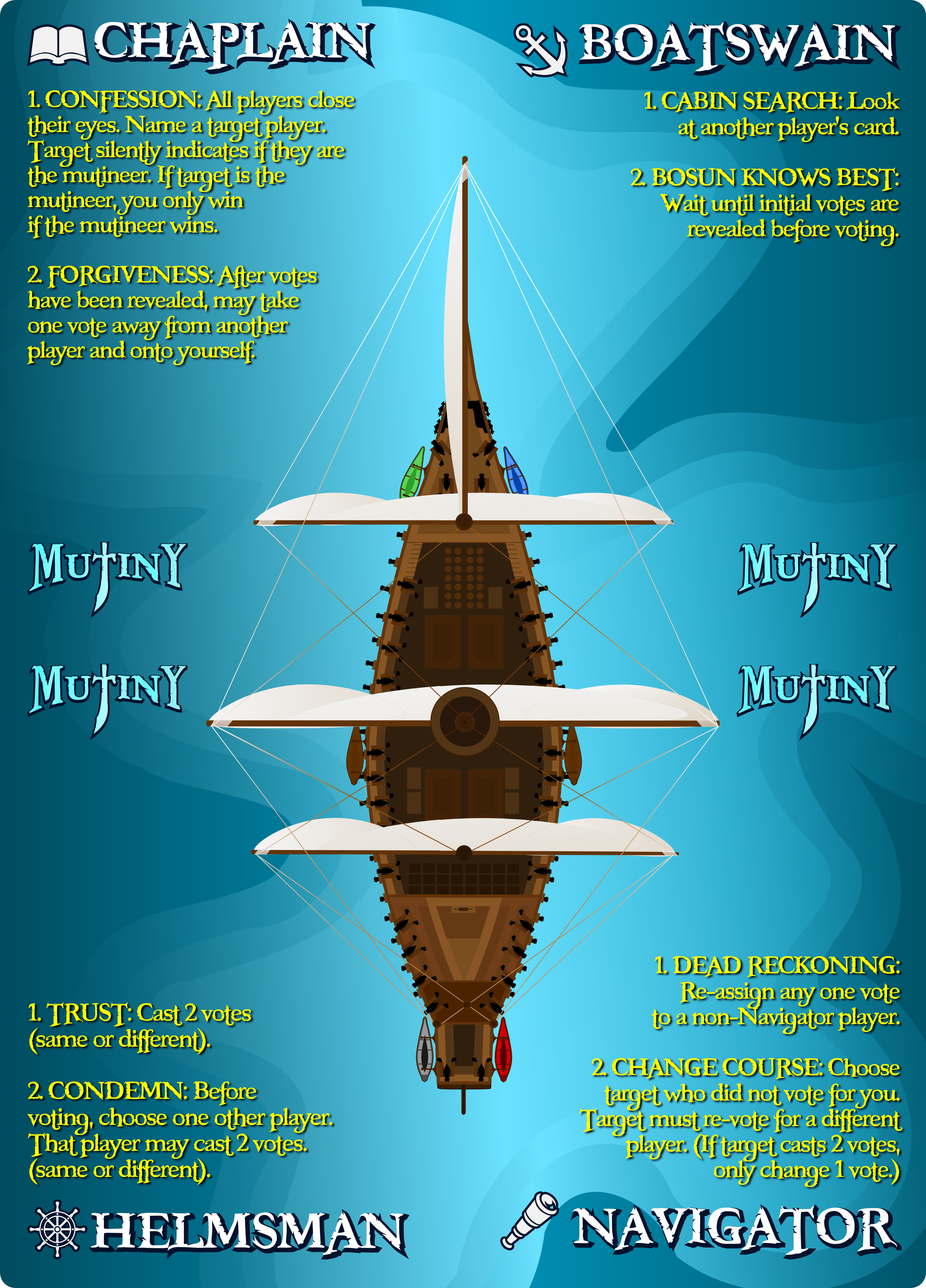
All four cards together form the HMS Moon Yeti.
CHAPLAIN: The Chaplain is the moral center of the ship. They provides counsel for the virtuous, and cover for the depraved. Crew mates may find themselves compelled to confess their sins, but can rely on the complete discretion of the Chaplain. Desperate crew mates covet the forgiveness that only the Chaplain can provide. Be wary, the Chaplain’s piety may be wielded in an attempt to cover seditious intentions.
BOATSWAIN: The Boatswain is the foreman of the ship’s deck crew. With unprecedented access to crew cabins, crew mates will find it hard to keep their secrets hidden. Bosun keeps ears open and knows how the votes will fall before they are cast. With the rabid loyalty of the crew, there is nothing so dangerous as a defiant Boatswain.
HELMSMAN: The Helmsman steers the ship. While the title puts them a step below the Captain, the crew trusts them more than any other crewmember. The Helmsman’s position manifests as greater influence over the crew’s decisions. A rebellious Helmsman wields a power that is very hard to contain.
NAVIGATOR: The Navigator sets the course for the ship. When the ship isn’t headed in the right direction, it’s the Navigator who sets things right. Holding tight to the tools of their trade, the crew may not recognize a rogue Navigator until it’s too late.
Each character has a first round and second round ability that strongly influence the game. Each time you play it you might be a different character. Or you might be the mutineer. Or the people you are playing with might be terrible liars. There is a lot of fun packed in this 4-card game!
Will You Join The Mutiny?
 Here’s the deal… we want to start getting our name out there. So we printed up over 100 copies of Mutiny that we will be handing out at Gen Con. Our goal, through publishing great games, is to become a household name synonymous with gaming awesomeness. We believe Mutiny is an awesome 4-card game and we are excited to hand them out.
If you are so excited about it, we have a PNP available on BoardGameGeek.com. Click here. We’d love to hear what you think and we can definitely answer your questions.
So climb aboard and let’s set sail on this most grand adventure together!

Design: The Grand Illusion
Ladies and Gentlemen, I welcome you to the big show. Tonight I will be performing a series of illusions of the highest grandeur. You’ll see things that no human has ever seen before. And then you won’t see them! Tonight it’s all about the magic. For my first trick I’ll need a volunteer…
I came up with a new game design theme a few weeks ago and it’s still rattling around in my brain. So I figure I should try to turn it into a real game design. For some reason I’ve decided to do all the design publicly on this blog. I think this will be a fun way to show people what is all involved with the game design process and I’m also looking for involvement from all of you!
So these design articles, starting today and continuing on Thursdays, are meant to be an open source forum of sorts where I welcome your comments, ideas, suggestions, etc.
Game Theme

I love the look and feel of vintage magician posters from that era.
I love the movie The Prestige. It’s a fascinating movie about competing illusionists in the early 1900s. If you’ve never seen it, I highly recommend it. For me magic has always been an intriguing thing. Last year I had the chance to visit the Harry Houdini museum in Appleton, Wisconsin. It was neat to learn about his story and more about the era as well. It seems like an interesting time to have lived.
So I want to make a game about competing illusionists from that time. Therefore The Grand Illusion is all about magicians and their competition to earn the best reputation.
You are a street magician in the early 1900s beginning your career. You’ve got a few tricks up your sleeve that no one else has mastered. It’s time to build a reputation and become a household name in the field of magicians.
You start small doing a few tricks for small crowds on the street. Do them well and your skills will increase, as will your reputation. When you’ve got enough of a following then it’s time to take your show to a real stage. But beware, the crowd will always be expecting bigger and better!
If you can find a way to continually master new tricks and perform them flawlessly, then you may end up as the greatest magician of all time!
Basic Concepts and Components
My original thoughts for the gameplay involve card drafting and set collection. The concept is that you have to collect sets of cards that allow you to perform certain tricks. The bigger the set, the more likely you are to perform the trick flawlessly.
But there’s a catch. You know the old “Ball and Cup” trick? The idea of the trick is that there will be a ball under one of three cups. Then the magician will move them around and try to get you to lose track of which cup the ball is under. I want to utilize this as a mechanic in the game. If players each contribute a card to a common hand these would represent the cups. Then if there were a special card added to that hand it would represent the cup with the ball. Then players would blindly draft and whomever pulled the cup-ball card would get to perform the best trick. That’s my basic original concept for one of the mechanics in the game.
What I want players to feel throughout the game is a sense of accomplishment while teetering on a sharp edge. Players should attempt tricks and illusions throughout the game but always with some risk of failing and letting down the fans.
Each set of cards used for performing tricks will have several different symbols on them. These symbols represent different illusionary skills such as sleight of hand. When you complete a trick you can increase your skills in any or all of those categories. One emphasis for that decision making process would be that each player has a Grand Illusion that they are working toward completing.
The Grand Illusion
Like a private scoring condition, the Grand Illusion card that each player holds is a trick that could provide a huge boost near the end of the game. It is a trick that can only be attempted once, so players will want to make sure they have a skill set that will help them perform the trick with high success.
The idea is that as players become better magicians and build an audience and a reputation they realize that they have to keep increasing the awesomeness of their tricks or else the audience might go to another magician. So by performing their Grand Illusion it could put them at the top.
What’s Next?
So that’s the current state of the design. It is just a bunch of basic concepts. But that’s where you all come in. What would you like to see in a game about Victorian era magicians? What mechanics, themes, components would you like to see?
Let’s design this together. Please comment on this article or reply on Twitter. I’m looking forward to designing this publicly with all of you. Thanks for reading!
Monday Brews 5-19-14
After a week off from my Monday Brews articles last week I’ve wrangled up a long beer list. It was aided by the fact that my city was having a Craft Beer Week. And it was also aided by two playtests of Brooklyn Bridge. So I’ve got a nice long beer list for you this week.
I also brewed another beer. I’ll be writing about that later this week unless my new baby pops out of my wife’s belly. It is a wheat beer that I’m calling “You’ve Been Wheated.”
So let’s jump right in and start with the barley…
The Barley:

Best word to describe it: Yum!
BARLEY SPOTLIGHT: Tyranena Doubly Down and Even Dirtier Barrel Aged Chocolate Vanilla Double Stout
I enjoyed this most amazing beer with possibly the longest beer name ever during a Madison Craft Beer Week event. It was on tap and it was amazing. It was very rich with a beautiful flavor and a solidity to it that made it feel as though you just ate a full meal. I will definitely drink this again. Also, it’s baby brother, “Down & Dirty,” is also very good and more accessible.
- Sprecher Special Amber
- Boddingtons
- NEW! New Belgium Snapshot – I liked it at first but then it seemed to have a characteristic closer to a Sour beer. I’ll try it again.
- Young’s Double Chocolate Stout
- Lucette Hips Don’t Lie
- NEW! New Glarus Spiced Ale – Not as spicy as I was expecting, which was pleasant.
- NEW! Boulder Shake Chocolate Porter – Warm this one up a little and you’ve got yourself a full-on dessert!
- NEW! Potosi Steamboat Shandy – This was a very enjoyable shandy.
- NEW! Blakkr Imperial Black Ale – This brew is actually a partnership between three breweries. (Three Floyds, Surly, Real Ale). I didn’t particularly enjoy this brew.
- New Belgium Trippel
- Hofbrau Original
- Bridgeport Kingpin
- NEW! Green Flash Double Stout Black Ale – This was an excellent, deep, dark double stout.
The Boards:

How good of a Euro could this be? They don’t really look that bored.
BOARDS SPOTLIGHT: Aquadukt
This isn’t a new game, but it was new to me. And I loved the simplicity of it! The options you can choose on your turn are simple (build houses OR build a well OR build canals). But with those three simple choices comes a game with surprising depth. Which house tiles do you build – 1s, 2s, 3s, or 4s? When/Where should you build a well? How/Where should you build canals. This is a euro and it doesn’t try to hide it. The board is basically a big grid sectioned into 20 areas. I love games that use simple mechanics but yet have deep and interesting decisions!
- Targi – such a fun 2 player game!
- Quantum Orcas – Ran another successful playtest. Still not sure what I want to do with this game.
- Love Letter
- Unpublished Prototype – oh man… this one is SOOO good!
- Qwirkle
- Brooklyn Bridge – more below.
Designer’s Corner:
The progress currently being made on Brooklyn Bridge is making me feel much better about the game. While there are interesting mechanics that people seem to enjoy it has been all the other stuff in the game that has been needing the work.
The most major change is that money is no longer a part of the game. (Side note: I may bring money back with money being the points in the game. Currently the points are set up such that they could be equivalent to $$.) Previously players could earn money without having to build the bridge. That meant that early in the game they would focus on money to buy abilities. With the change the only way to buy abilities is with points and the only way to get points is to actually build the bridge… imagine that!
I am extremely happy with how the latest playtest went. The first half of the game worked really well, consisted of interesting decisions, and players overall seemed to be having fun. A big thing that was an improvement was the new player mats. These allowed me to get rid of the 30 red, 30 yellow, 30 brown, and 30 silver cubes that represent the bricks and mortar. Now players have one cube of each color and they move it along on their player mat.
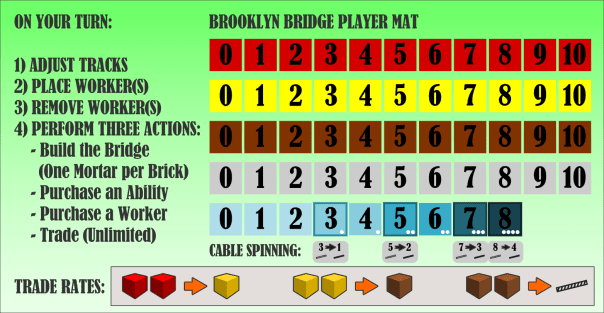
It wasn’t all good though. The second half of the game imploded. It was as if the game ran into a brick wall (no pun intended). The upside is that I have implemented a few changes which should circumvent that issue. I can’t wait to get it to the table again. This is probably the first time with Brooklyn Bridge where I really feel like there is “publishing potential.”
There you go… the late, great version of two weeks of Boards & Barley. What Boards & Barley have you been enjoying???
 Boards and Barley