Blog Archives

Monday Brews – 2-16-15
Welcome back from a busy Valentine’s day weekend. I hope you all treated each other with love! My wife was out of town most of the day Saturday so I took part in a local Math Trade (where I received a Dixit expansion, Splendor, and Cinque Terre). Then we grabbed a pie from a local diner as a gift for my wife. Then some friends came over and we played Deus, which is inspiring me to build a deck-based engine builder game utilizing similar but unique mechanics.
Then yesterday I had the privilege of demoing Scoville at a local game store. A 13 year old loved Scoville and his grandpa ended up buying it for him. I hope it inspires him to become a gamer!
But you aren’t here to read about my weekend. You’re here to see what awesome Boards & Barley I’ve been enjoying! So let’s begin with the Barley…

The Barley:
Dubbel-y delicious… compared to my previous homebrews, at least.
BARLEY SPOTLIGHT:
Homebrew Belgian Dubbel
Despite having several new beers this past week I had to make my homebrew the spotlight this week. It is by far my best homebrew yet and finally one that I’m not at least mildly gun-shy about offering to people. It is really excellent. My colleague requested the recipe after I gave him a six-pack. And my friends actually enjoy it.
- Guinness Draught
- Boddington’s
- NEW! Weltenburger Barock Dunkel
- Tripel Karmeliet
- Deschutes Black Butte
- Flight: North Coast Old Rasputin Russian Imperial Stout
- NEW! Flight: Wisconsin Brewing Betray Ale
- NEW! Flight: 3 Sheeps Cashmere Hammer
- NEW! Flight: Abita Andygator
- Flight: Blue Moon White
- NEW! Flight: Port Huron Hefeweizen
NEW BEER COUNT FOR 2015: 13
The Boards:

Sort of fun.
BOARDS SPOTLIGHT:
NEW! Madame Ching
There is a neat and interesting card mechanic where you utilize the cards in your hand to move your ship across the sea. Using a similar color as your previous card moves you straight across. Using a different colored card moves you diagonal down and across. The goal is to earn points, which is done most regularly by completing objectives, which are earned based on how far your expedition traveled across the sea.
I thought the artwork was nice and colorful. But the gameplay seemed really dependent on the cards you were able to procure. I found it difficult to put together a nice expedition. But I’d like to play it again to see if it was just a case of bad luck.
- Scoville x2
- NEW! Hacienda
- NEW! Province
- Viticulture
- Dungeon Roll
- Deus
- NEW! Bullfrogs
NEW BOARD GAME COUNT FOR 2015: 8
So what Boards & Barley have you been enjoying? Are there any games or brews you would like me to try? Just let me know!
Aether Magic Kickstarter by Happy Mitten Games
 Today we have a guest post by the fine folks at Happy Mitten Games in conjunction with their new Kickstarter campaign for their game called Aether Magic. The game is designed by a friend of mine, Matt Worden. But I won’t make you listen to me ramble. Here are some important links:
Kickstarter Link: happymittengames.com/kickstarter
Happy Mitten Website: http://www.happymittengames.com/
And now the guest post from Kyle at Happy Mitten about working with an illustrator…
Aether Magic and its Beautiful Artwork

We are in an exciting time for the board game industry. An industry often incorrectly perceived as old-fashioned, has embraced new business models, social networking, and a positive community to see new growth and ambitious products. Crowd funding sites have made it easier for game creators to get the funding they need to publish unique games, and the internet has made it easy to introduce yourself to talent from all over the world.
Before our game, Aether Magic was able to launch on Kickstarter today in its current form, Jeff, Lee, and I explored social media, Kickstarter, and art blogs for an illustrator that could accomplish our vision for the game, while complementing Matt Worden’s terrific foundational mechanics. We were fortunate to have a few options after reaching out to many artists via email, but easily selected UK artist Jacqui Davis for her use of bright colors and style we were looking to achieve for Aether Magic’s fantasy environments.
Working with Jacqui has been a treat, and to prevent myself from doing her life story injustice, I encourage you to learn more about her and her previous board game work on Stonemaier Games’ “Euphoria,” and Dice Hate Me’s “Belle of the Ball,” on the forty sixth episode of the Happy Mitten Games Podcast. There is no reason you can’t find a great artist for your own game, but I feel it’s important to do your part before ever reaching out to illustrators.
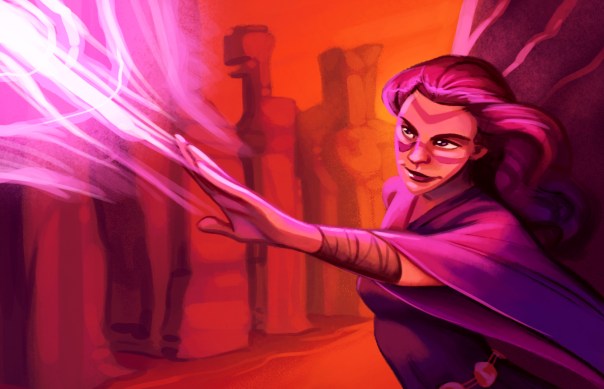
Stunning artwork for Master Spell 1.
In courting an illustrator it is crucial to lay out exactly what you need by creating an organized and unintimidating art asset list. Google spreadsheets are great for this task by ensuring your format is clean, and being flexible in their ability to be shared and edited by multiple parties in real time. For Aether Magic‘s art asset list, I detailed each art deliverable, dimension, deadline, and overall description using four columns. Our description included specifics on color tone, emotion, and appearance, with complimenting examples of illustration that embodied what we were looking for next to each description. Here’s an example of an Aether Magic art asset line item coming to life. https://docs.google.com/spreadsheets/d/19f5htLXg99R5HbyiE_1HkGKuIx-OgHDNBpHBt0mRiOc/edit?usp=sharing
Reflecting back on my initial thoughts for illustration, I originally felt that illustrators would enjoy less structure on their projects. I love to listen to interviews and I often hear from entertainers that company executives get in the way of their original ideas, which often result in uninspiring versions of their initial intentions and a hostile environment for free expression. Being sensitive to that, I wanted to apply that point of view to how we were initially approaching our art asset list, but was met with resistance from Jeff, who believed in having more structure. So who was right? In our experience of going through the process and interviewing multiple illustrators, it has become clear to me that Jeff’s point of view is widely preferred among board game artists and has likely saved us a lot of time. Though I am still curious to explore ways in which we could mold the two points of view together, I would now recommend having as specific instruction as possible in your own art asset list.
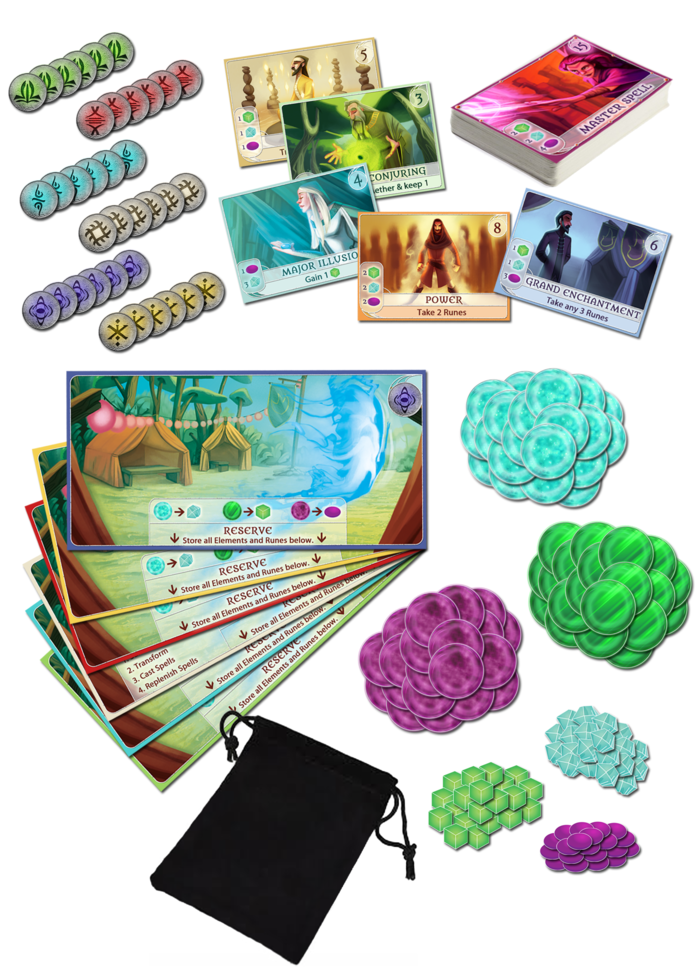
All the beautiful components for Aether Magic
While the artist is working on the illustration, be sure to communicate that you would like to see the progress of the illustration through each stage of the illustration’s development. The three of us reviewed what Jacqui was doing about four times during this process and Jacqui was able to make the small tweaks we needed without having to completely redo what she already invested her time in. While it’s true you should get what you want when you hire an artist, you should be sensitive to the fact that any contractors time is valuable and you should be doing your part to make sure you are not wasting it!
Be sure to check out Jacqui Davis’ final illustration for Aether Magic, on Kickstarter February 10th.
http://www.happymittengames.com/kickstarter
– Kyle Hogendyk
Monday Brews – 1-26-15
Welcome back to Boards & Barley. I hope you had a great weekend! My weekend was pretty slow. I didn’t play any games over the weekend, though I did work on some game design stuff. But since I skipped the Monday Brews last week we at least have a few games to cover! Let’s start with the Barley…
The Barley

Not terrible at all, until the bottle is empty!
BARLEY SPOTLIGHT:
NEW! Unibroue Terrible
I bought one of these for my uncle as a Christmas present so that I could joke with him and say that I bought him some terrible beer. Alas, he didn’t attend our Christmas celebration so I failed to deliver the joke. I did, however, get to try this beer for the first time recently and it is anything but terrible. In fact it is quite tasty, which is usually the case for anything coming from Unibroue!
- NEW! – Orkney Skull Splitter Scotch Ale
- NEW! – Karben4 Fantasy Factory
- NEW! – Ale Asylum Mercy Grand Cru
- You’ve Been Wheated – Homebrew Hefeweizen
Woo hoo! Four new beers! Not bad at all.
The Boards
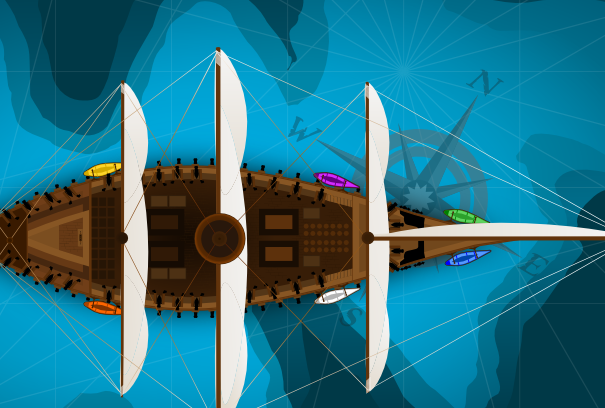
Can you catch the mutineer?
BOARDS SPOTLIGHT
Mutiny
I do not possess good social gaming skills. That is why I have a strong love/hate relationship with Mutiny.The game is so excellent. The social deduction aspect is hilarious. Make accusations, charge other people as the mutineer, use your special abilities, and watch out for knives flying at your back!
For those unfamiliar with Mutiny, it is a 10 minute social deduction game for up to 8 players by Moon Yeti Games. We handed out about 100 copies of the 4-player business card edition at last year’s Gen Con. I imagine we’ll have a few more to give away this year. 🙂
Thanks for reading! What Boards & Barley have you been enjoying?
Set Phaser to Stun – A discussion of Phases vs Turns
When designing a game I usually start by picking a theme that I think would be fun and unique. Then I start to build some mechanics around that theme that seem to fit it well. Eventually I get to a point where I have to figure out how the game is actually played. That’s where today’s article comes in.
There seems to be two main ways that games are played. Some games have turns and some games have rounds with phases.
What follows is a discussion on each of those as well as some of my opinions about how to choose which option is right for your game design. But first I wanted to make sure we are all on the same wavelength in terms of terminology. In this article I refer to “turns,” “rounds,” and “phases.” The best succinct definition I found online was in this thread and is a quote by Sen-Foong Lim, co-designer of Belfort among many other games:
Players take turns executing phases within a round. A game is comprised of several rounds of play.
That’s how I am understanding each of the terms I use throughout this article. Thanks Sen-Foong!
Turn Based Games…
A turn based game is one where a player takes their turn and then plays proceeds to the next player. Each turn is performed in a similar manner as the previous turns.

Turn based awesomeness.
Example: Ticket to Ride
On your turn in Ticket to Ride you perform one of three actions: building a route, drawing train cards, or drawing destination card.
Every turn presents you with those same three choices.
Every turn is the same.
The game builds from turn to turn, so the choices you make vary, however, the options are always the same.
This form of gameplay is usually more accessible and easier to teach and learn.
Round Based Games…
Round based games can further be separated into two main categories:
- “Pause” Type – Games where rounds separate the gameplay for a special event.
- “Seasonal” Type – Games where rounds establish differences in available actions.
Pause Type
A Pause Type round based game is one where players perform a standard action on their turn. This repeats until all players have performed as many actions as they are allowed. Then the round ends and an intermediate event occurs.

Round based torment of making sure you can feed your family.
Example: Agricola
On your turn in Agricola you place one of your family members on an action spot and perform the action. This continues until all players have taken their turns with their associated family members. Once all players have done so, the round ends.
The intermediate step between rounds is often a harvest where players gather crops and feed their family. Then a new round begins.
The turns are the same, but there are breaks that separate the gameplay, dividing the game into rounds.
So while each turn itself offers the same choices, the game is broken up to include more than just the turns you take. Players must deal with the requirements of the intermediate events.
Seasonal Type
A Seasonal Type round based game is one where players take actions specific to the current phase of the round. These are games where only specific actions are available depending on the current phase of the round. So each turn a player takes offers different options.

Auction, Buy Fuel, Build Network, Exert Supremacy!
Example: Power Grid
What you do on your turn in “Seasonal” games like Power Grid depends on the “season” you are in. Power Grid rounds begin with a power plant auction. So this portion of a round involves deciding if you want a power plant, which one, and how much you are willing to pay. After that players purchase fuel and determine the type(s) and how much fuel they will buy. Then players must decide if they will expand their power grid by building on the board. After that phase comes a sort of “clean-up” phase where players use fuel to power their grid and earn income.
In these types of games each round offers a series of different types of choices for players.
Seasonal type games are usually the least accessible in terms of teaching and learning the game. However, they often offer greater and deeper strategy.
Choosing Turn Based vs Round Based
This can be a difficult part of game design. On one hand most designers would agree that they want their game to be as easy to teach, learn, and understand as possible. On the other hand most designers would also like their game to have a nice deep level of strategy that present difficult and interesting decisions to the players.
I want to make it clear that turn-based doesn’t necessarily equate to “easy to teach, learn, and understand,” and round-based doesn’t necessarily equate to “deep strategy and interesting decisions.” But I would say, in general, that turn-based are simpler to teach and learn, which makes them more accessible.
So how do you decide if your game should be turn based or round based? In general I always start my designs as turn-based and then modify that if it becomes apparent that round-based would be better. But let’s take a look at a few things that might help you make your decision.
What does the theme call for?
If you are designing a game where there is no reason for phases, then design for turns. Qwirkle and most other abstract games are deserving of being turn-based.
Sometimes a theme makes it obvious that round-based play would be better. If you want players doing different things throughout the game it might make sense to have phases where each player works through the different aspects of the game.
I recommend that you choose turns or rounds with your theme in mind. If it fits thematically then you’re on the right track!
What are your desired mechanics?
The things you want a play to do during a game can help you make the decision. If you are using a worker placement mechanic, most often you will have a round based game. Stone Age is a great example. In each round players put there family members on different spots. Once all are placed then the next phase begins, of bringing your family back. Then there is a phase of feeding your family and resetting the board.
But that’s not always the case with worker placement. An exception is The Manhattan Project. In that worker placement games there are no rounds with phases. Rather, once your workers are out on the board you will spend a turn bringing them back.
It’s important to consider what you actually want players to do during a game. This can help you choose the mechanics and whether you want the game to be turn-based or round-based.
What’s more fun for the game?
One of my game design principles is to make things fun. That may seem obvious but I’m surprised by how often I pick a theme or a mechanic that ultimately would not be fun. So throughout my design process I continually ask myself, “Would this be fun?”
As the designer I recommend you ask that same question about your game. Would turn-based be fun? Would round-based be fun? Which option would be more fun?
We are designing board games here, not water bottles or bicycle gears. What we are doing is all about fun. So don’t forget to include that in the design!
Well I hope I’ve provided you with at least something to get you started. The bottom line regarding turns or rounds is that both can be fun, interesting, and can make for a good game. How do you choose which one works best for your designs?
When you receive Scoville…

Awesomeness coming soon to a table near you!
Hello Ladies and Gentlemen. With people posting pictures of their copies of Scoville on Twitter and Facebook I figured I should post something about Scoville. This has been an extremely fun ride from the start of the design process all the way through to this point. I can’t wait to start reading reviews and hearing what people think.
So today I have a few tips regarding the game and the components. I will also link to a different version of the cross-breeding chart for those who are more equation oriented.
Before we get into the tips, if you have received your copy, please go ahead and Tweet it, Facebook it, Instagram it, BGG it, or anything else. Let’s spread the word about Scoville and make it a big hit. (Disclaimer: if you don’t like it, please keep your mouth and social media shut. 🙂 Thanks!)
Components:
OCD vs. non-OCD: The board has pepper punch-outs so that the peppers can be “planted” and all line up perfectly. This is great for people who want things all orderly and such. HOWEVER, if you would prefer to be able to put the peppers on the board in any direction, then just don’t punch out the pepper punch outs.

Would you prefer those peppers to be sloppily arranged?
Pepper Punch-outs: “Pepper Punch-outs” is not the name of an expansion I’m working on (though I suppose it could be!). These are the little cardboard pepper shaped pieces you can punch out of the board. I mention them because they come in really handy if you happen to run out on any specific color of pepper during the game. I recommend saving these little cardboard peppers in the box, just in case you need them.
Sleeve the Cards?: Some people sleeve cards for every single game they own. Others sleeve them for games with high-use cards. The cards in Scoville are what I would call “low-use.” The cards are only handled when obtaining them and scoring them at the end. Otherwise they just sit around. So I personally don’t feel they need to be sleeved. However, if you prefer them sleeved, check out this thread on BGG which can give some guidance about the right size of sleeves. The recipes are 44x67mm and the market cards are 51x51mm.
Gameplay:
One of the biggest issues I hear from new players is that the cross-breeding chart is too much to grok. So I made a new version that is simpler to read and lists the rules of thumb for cross-breeding. You can download the doc file from Board Game Geek. Or you can save this picture and print it:

An alternate Scoville Cross-Breeding Guide.
That should help you out in case you don’t like the 10×10 grid version.
As I designed the game I struggled mightily about choosing the form of the cross breeding chart. This equation version was easy to read and put things succinctly. But the grid put every breeding combo right in front of you. So I went with the grid. If you prefer this equation version, please let me know.
Beginner Tips
Bonus Plaques and Market Orders: Recipes are mighty appealing, and they should be. But don’t count out the bonus award plaques from the town mayor. Also, don’t neglect the market orders. Many of the afternoon orders are worth 4 points. So if you can get a few of those they really add up.
Bonus Abilities: These are worth 4 points each if unused, but I recommend using them. They can be used to create a huge advantage in the game. One way I like to use them is to gain multiple phantom peppers at a time while preventing all other players from getting any. Plus, the game is meant to be played for fun and I believe it is fun to use those special abilities.
Block other Players: I love how you can block other players from spots on the field. Use this to your advantage. Plant a good combo in a spot only you can reach and then end your turn there even if you’ve only moved one or two spots. This can induce frustration from the other players, which can be fun.

The Yellow and Red player are mired in battle for the peppers in that part of the board.
Thanks so much for your interest in Scoville. I believe copies will be moving to retailers and online stores in the very near future. If any of you have issues with your components in your copy, please let me or Tasty Minstrel Games know right away. And if you enjoy the game, feel free to rate it a 10 on BoardGameGeek.com!
 Boards and Barley