Blog Archives
Decision Space in Game Design

New Belgium Brewery offers a nice decision space! Photo via Flickr user quan ha @2009
Decision Space:
– the range of options at the decision maker’s disposal
That simple definition is from a paper titled Supporting a Robust Decision Space from the Association for the Advancement of Artificial Intelligence. It is a nice definition for what I mean by “decision space.”
Decision space is an important concept for game designers to consider when working on their designs. One of the best things a game can offer is a plethora of interesting decisions. One of the worst things a game can do is limit your decisions or take them away completely. There’s nothing worse in a game when it’s your turn and you only have 1 option. It’s as if you have become a robot just going through the motions.
Today I’m going to cover how game designers should consider Decision Space in their designs. At the forefront of game design is the notion that games are supposed to be fun. With that in mind, let’s cover 3 examples of Decision Space in your game can make it better.
- Unlimited Decision Space
- Limited Decision Space
- Tailored Decision Space
Some times it’s good to offer a lot of choices. Some times it’s good to limit a player’s choices. But the point of this article is that the decision space available to players is an important concept to consider in your game designs.
Unlimited Decision Space
Okay… first off, “Unlimited” is a bit of a misnomer. I do not believe there are any games with a truly infinite decision space. Rather, this is meant to point out situations where the decision space is so large that the players do not feel limited in any way. The world is their oyster, in essence.

Build as you see fit!
One great example of an unlimited decision space is the route-building aspect of the classic game Empire Builder. There is a huge map and you have your special little crayon. You can stare at the board and your cards for a long time while yielding the power of the unlimited. Where should you begin your route? Where should the route go? Should you cross the rivers/mountains or go around? How much track should you lay? There are a lot of decisions you could make about the route you want to build.
How is “Unlimited” Fun?
There is a nice liberty in having an unlimited decision space. Players often enjoy being able to choose freely, to mess up freely, to make an awesome move freely.
Consider utilizing an unlimited decision space in games where you want players to have full control and to be fully accountable for their decisions.
Limited Decision Space
Sometimes it is prudent to limit the decisions a player can make. These situations are common at the start of a game.

Starts “Limited,” ends “Awesome!”
Two great examples are Dominion and Eminent Domain. These are both deckbuilding games. In standard deckbuilding games you start with a very limited hand of cards. One your first few turns you will be limited in what you can do.
Limiting the decision space early in a game can be beneficial to help a player get used to how the game operates.
Another example of “limited” decision space comes from the popular game Ticket to Ride. In the game you have three options on your turn. You can draw more route cards, play trains to the board, or draw train cards. And even the choices within those options are limited. You can only play trains to the board if you have the right cards in your hand. You can only draw train cards from the face up cards or the face down pile.
How is “Limited” Fun?
One of the ways that Limited decision space can be fun is by adding tension to game. Using Ticket to Ride as the example again, players have tension due to the limitation. Maybe they just need one more green train to claim that big route. But perhaps another player has already built near the green route. Not that first player is hoping that the other player doesn’t take that green connection that they’ve been working on. But because the decisions are limited, the player has a slight feeling of helplessness.
Limiting the options on a player’s turn can also speed up the game. Sometimes (or perhaps often) the Unlimited decision space games tend to get into the Analysis Paralysis (AP) regime. Limited decision space games tend to decrease the amount of AP in games.
Tailored Decision Space
Tailored decision space refers to situations in games where the decisions you previously made will shape the decisions you have available in later turns in the game. Often games with tailoring offer multiple paths to victory where once a path has been chosen it is better to continue following that path than to start working on a different path.

How will you shape the countryside?
Some of the best examples that I can think of are Uwe Rosenberg’s games Le Havre and Ora et Labora.
In Ora et Labora players start with a plot of land that they are looking to develop. Throughout the game players will add buildings to the land that provide new actions. Then on their next turn, those previously placed buildings add to the decision space available for the player.
This is actually a common thing in engine building games. Engine builders are games where you build something and increase your skills/options/capabilities. In most of these games you can build something, that let’s you improve it, and then make it really awesome. All along the way you can either diversify and build a bunch of stuff that might be mediocre. Or you could possibly build one type of thing and make it really awesome.
The card game 7 Wonders also has a “tailored decision space” feel to it. In each of the three stages you can play cards to tailor your wonder in one of several different types of things. By adding resource production you can set yourself up for different types of things. For example, if you produce the manufactured goods (gray cards) then you can usually do pretty well with the science cards (green). So the cards you choose throughout the game will tailor the decision space that makes the most sense as you move your way toward victory.
How is “Tailored” Fun?
I think having a tailored decision space in games allows players to feel like they are really accomplishing good stuff throughout the game. In Scoville the field acts as a tailored decision space. Each round as new peppers are added you are creating new opportunities for breeding peppers. Each new spot opens up the number of decisions you can choose.
Tailored decision space is also a way that you can steer your strategy in a game. By choosing card A it might make card B much more attractive. Then by choosing card B it might make card C more attractive.
Why Should You Care?
As a gamer none of this really matters. Just find a game that you think is fun and play it.
As a designer, it can be worthwhile to consider the way decision space works in your game designs. Are you limiting players? Are you allowing them freedom of choice?
Decision space is an easy thing to neglect when designing a game. Normally we’ll pick a theme or pick a mechanic and start designing. But I wonder how things would go if a designer chose the type of decision space they wanted and then added a theme and mechanic after the fact.
What are your thoughts about decision space in games? Did I get it completely wrong? Does it make sense?

Monday Brews 1-13-14
Welcome back to Boards and Barley! I’m so glad you’re here. Every Monday I write an article that let’s you know what beer and board games I enjoyed over the last week. I also give a little insight into my design ventures of the past week. It was another slow week in terms of beer and games, but the game design portion of my life picked up a bit.
Let’s start with the Barley…
The Barley:

That’s a chair I could sit in!
Gray’s Busted Knuckle Irish Ale: I enjoyed this Wisconsin brew while my brother visited. We got some amazing fried cheese curds and a beer. This was an enjoyable Irish ale that I would get again.
Fleming’s Scotch Ale: I had another of my homebrews. I think it is now stronger than the original 6.6%abv. I might have to measure that again. This one really packs a punch.
New Glarus Spotted Cow: Another Wisconsin beer was enjoyed while a friend was over. We watched some football and enjoyed a beer and some ranch pretzels. That makes for a pretty good evening.
Deschutes Red Chair Northwest Pale Ale: I am not an IPA or Pale Ale guy in general. I don’t care that much for hoppy beers. But this one was quite good. It wasn’t too hoppy overall and it had a hint of a sweet finish with a mild floral aroma. I would drink this again and I think it could be my gateway to IPAs.
Capital Winter Skal: I enjoyed this while playing Nothing Personal. This is a mighty fine brew from a local brewery.
The Boards:
Nothing Personal: My friends played this at GenCon while I was on a panel about Protospiel. They have played it several times since then. I finally got to play it last night. And it was awesome! Nothing Personal has an amazing level of back-stabbing, promise-breaking, deal-making interaction that I haven’t seen in any other game. There is a lot to keep track of in this game and it would be easy to make mistakes and get left behind. I’m glad I finally had the opportunity to play it because it was a lot of fun.
Tenzi: I got my friends to try this out last night. Each player has 10 dice. You roll them and try to get all of your dice to be the same number. The first player to get all of theirs the same is the winner. There are a bunch of variants in the rules that you can try out. But this was a thoughtful Christmas gift from my mom because she knew I wanted dice for game design purposes and she got me dice that are also a game. Thanks mom!
Designer’s Corner:
This prototype box will suffice for now.
Last week I worked a little bit on Quantum Orcas. I want to put together a version that I can purchase from The Game Crafter. It is amazing how much artwork really goes into a game. Not only do you need art for the cards, chits, tiles, etc. You also need artwork for the box and the rulebook. Then if you want to have a nice sales page on TGC you need artwork for that page. There is a lot of behinds the scenes artwork that is needed to complete a game.
So last week I put together a bunch of art and Quantum Orcas is getting closer. I still need to do more playtesting to make the game go from playable and “not bad” to something that is enjoyable that people will want to play. I’ll keep you posted.
The other progress I made last week was to come up with new mechanics for Brooklyn Bridge. I have shared the concept of the mechanics with several friends and none of them said it sounded awful. So I might have something there! I am pretty excited about the new utilization of workers. Brooklyn Bridge is a worker placement game, but it uses workers in ways I have not seen before. So I’ll plow forward with this to make it playable in the near future. My goal is to have tested it several times before Protospiel-Milwaukee in March.
***
So that’s the Boards & Barley I enjoyed and the game design progress I made last week. How was your week?
Design Me: Route Building
Ah… it’s an exciting day on Boards & Barley. Today is the first Design Me article of the year! What is a “Design Me” article? It is a design exercise. Like soccer players who run for practice to exercise their muscles, I think it is important for designers to exercise their brains. So every once in a while I choose a random theme/mechanic/victory condition and see if I can come up with a decent game design on a whim.
Today’s random stuff, via Boardgamizer.com, is this:
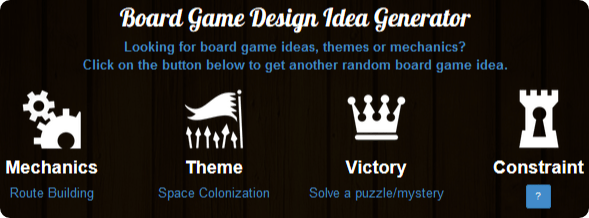
Route Building + Space Colonization? I can do this!
Note: for this design me I am changing the victory condition. Instead of solving a puzzle or mystery, the player who builds the best route will win.
Armada Galactica
In Armada Galactica you are a galactic superpower trying to create a new trade route through whichever galaxy you are currently in.
As a galactic superpower it is your job to make sure you are providing enough vacation spots for your population. The way to do that is to spread your empire throughout the galaxy. You can colonize a new location if it is within a certain location of your currently existing locations. But there are a few steps you must take. These include SCOUT, TERRAFORM, and then COLONIZE.
On your turn you can also perform some research upgrades. Each planet or moon you colonize will begin with basic capabilities based on its characteristics. As you bring technology along your colonization route, those planets/moons will get better at allowing you to reach further and explore/colonize more distant locations.
So the concept is to build a route from planet to planet by utilizing the characteristics of those planets to allow you to further colonize. The winner will be the person who has built the best route by the end of the game.
Components
- Game Board
- Planet tokens
- 12 Rocket meeples (3 each in four different player colors)
- 40 Colony tokens (10 each in four different player colors)
- Research tokens
- Population cubes
How to Play
A game of Armada Galactica is played until someone has placed their tenth colony token. To place a colony token, the desired planet/moon must be able to support enough population. A planet/moon can support enough population if it has been terraformed correctly for the type of body it is.
Players will each have a home planet (not dissimlar to Ascending Empires – I’m trying hard not to simply duplicate that game here – I feel I’m failing at that). The board is composed of a grid of planets/moons. Each location will have randomly received a planet token, so the grid is never the same from game to game.
There will be four main types of celestial bodies that you can try to colonize. These are:
- Earth-like
- Mars-like
- Europa-like
- Water worlds
Earth-like
These planets are the rarest in the game. But they are the easiest to colonize. Without the need for terraforming these are the hot spots that you’ll want to go after!
Mars-like
These planets were once Earth-like, so it will take some work to get them back to that state. That means you’ll have to devote some effort to terraforming. But these are still relatively easy to colonize.
Europa-like
These are planets that possess water under layers of ice or rock. Terraforming won’t be enough on planets like these. You’ll need specialized research that can warm the planet from the inside to sustain life on it’s surface.
Water Worlds
These planets are basically covered in water. So terraforming isn’t exactly possible. Instead you’ll have to haul a serious amount of infrastructure to the planet to essentially create boats/structures large enough to sustain a large population while floating on the water. If your terraforming research isn’t very good you may want to build a network out of these bad boys.
Those are the four main types of celestial bodies you will encounter while attempting to grasp galactic supremacy. Yet the goal is not simply to build all ten of your colonies. Scoring is also based on the populations you can sustain.
On your turn you can choose either EXPLORE, RESEARCH, or POPULATE as your main action.
The EXPLORE action allows you to use your three rockets to scout the nearby planets. All of you network must be in a continuous line, so it’s important to look ahead and see what’s coming. Also during the EXPLORE action you can transport equipment to the newly selected planet. This could be infrastructure, terraforming equipment, or research scientists.
The RESEARCH action allows you to utilize scientists that you have placed on your planets to increase that planet’s capabilities. For example, if a planet has a high exploratory research level, then if the rockets are launched from that planet they can travel twice as far, which would allow you to spread your network over a wider area. If your planet has great earth-like resources, and if you increase its terraforming capabilities, then it can become a hub for your terraforming infrastructure to expand to new locations. Research will play a key role in the game and you will want to maximize the capabilities of your planets.
The POPULATE action allows you to colonize a new location. This can only be done if that location has met the colonizability standards. Players will place a colony token on the new location. This action can also be used to increase the population in your existing colonies. This is a key to victory since population is the main scoring category.
On your turn, in addition to the main action you can also perform a secondary action. These are like dumbed down versions of EXPLORE, RESEARCH, and POPULATE. But they can allow you to take advantage of certain planetary characteristics if you really wanted to accomplish something awesome on your turn.
The Endgame
Once a player has placed their tenth colony, all players will have one final turn, including that player. At the end of the game players will total their population cubes and their colony tokens. Each colony token counts as three population cubes. So players could earn a maximum of 30 points from their colonies alone. Research levels and infrastructure will also be scored on a low-level basis. The idea behind awarding points for those is because they are what set the population limit for a player.
I expect final scores to be in the 70-90 range. I had a lot of fun coming up with this design despite not creating any graphics or images for it. That’s a rare thing. I really like this idea and I think I might move forward with it. I am still on the lookout for the other game that I’d like to put on The Game Crafter this year. If this comes together nicely maybe it will be that game.
Your Opinions…
Do you have any thoughts about this design? Are there any obvious problems? Are there areas where I really fell short?
Don’t forget to exercise your brains!
Flavor Text: What’s the Verdict?

Flavor text on this card: “Ribbit”
Yesterday I solicited opinions on Twitter regarding flavor text:
I was interested in finding a consensus on whether or not it is worth the time to add flavor text to cards, or game components in general. I was pleased with the number and variety of responses the tweet received.
For those who do not know what flavor text is, here is a definition from Wikipedia:
Flavor text is the name given to text for action figure character backgrounds, playing cards, or within the pages of a role-playing game’s rulebook. While appropriate to the product’s or game’s story concept, it usually has no effect on the mechanics of the game, but instead serves to add realism or characterization to the item in question. Flavor text is often the last text on a card or on the rear of a toy card or package, and is usually printed in italics or written between quotes to distinguish it from game-affecting text.
Flavor text is used to full effect in Magic: The Gathering. Here is a page from Wizards of the Coast listing some favorite flavor text additions to cards (Thanks to Matt Loomis for the link). While the flavor text in the M:tG cards is typically used to describe the character on the card, I think there are other ways of utilizing flavor text. But before I get to that, let’s take a look at a few of the responses I received from my tweet…
All Those in Favor:
Adam Buckingham: “It’s fun, but I tend to ignore it mostly.”
Seth Jaffee: “I like flavor text, gives me something to read while waiting for others to go. But don’t bury game text in flavor text!”
Isaac Shalev: “I love it when it’s good. MTG is the best-in-show at it. Evocative, haunting, immersive.”
Thomas Eliot: “Enjoyable! I love the flavor text on Professor Pugnacious: it’s all thematically appropriate quotes”
Stephanie Straw: “Noooooo! I *love* flavor text! But if you do it, don’t just toss it on there. Make it LEGIBLE and allow it to add value.”
David Chott: “Thanks for reporting back! I like flavor text, but have been leaning against using it in Lagoon to reduce cognitive clutter.”
All Those Not in Favor:
I was surprised at how few negative responses there were. I thought more people would hate it and wish it didn’t clutter things up.
Alex Strang: “Usually distracting IMHO”
Grant Rodiek: “I’m generally against it mostly because most people are bad at writing. Being creative does not mean good at writing.”
Check out Grant’s awesome blog post about flavor text!
All Those Who Are Indifferent:
Nolan Lichti: “When it’s tiny, like in Ascension, I don’t mind, and it can be enjoyable. Just don’t sacrifice clarity of game play for it.”
Matthew Riddle: “I ignore it but it doesn’t bother me.”
Danny Devine: “I also always ignore it, but as long as its clear that its flavor text “italicized and tiny” I don’t mind it.”
Jason Smith: “rarely look at it except when I’m bored from waiting on other players to take their turn”
Chris (@copax): “I rarely look at it to be honest. I’d prefer larger iconography or more detailed “power” descriptions”
Chris Darden: “ignored”
64oz Games (Richard): “I think it depends a lot on the game. On a Euro style game I expect it to be ignored, but a more thematic one it could be read”
Rob Lundy: ignored… “Unless it’s funny…. like…. very funny”
Brian Henk: “I believe it can add some fun to the experience, but it’s not worth the complexity of more words on the cards.”
My Verdict: I Favor Flavor!
Based on the feedback I think flavor text can be used on game components, but that it should be done in subtle, non-distracting ways.
The M:tG cards include flavor text to immerse you more into the world of the game. That works really well. It is there for those who want to read it, and others can ignore it. And it occupies a portion of the card that would likely otherwise just be background art.
So I am in favor of flavor. I like it when subtle, creative, and clever information can be added to a game that further immerses you into the world of the game under the following conditions:
- It doesn’t distract.
- It doesn’t take long to read – keep it short!
- It adds to the game’s experience.
Thanks to everyone who responded to my tweet. I am planning on using flavor text for Quantum Orcas, but only on the backs of cards that do not flip during the game. Since I have the backs of those cards available I could easily slap on the logo or some artwork. But I decided that I would prefer some flavor text instead.
The bottom line for Quantum Orcas is that people can completely ignore it. And that won’t bother me at all.
Monday Brews 1-6-14
It is -16 degrees out (as of 7am) and I’m happy that I don’t work outside. I think I’d rather have a foot of snow than -16 degrees. Never the less, today is Monday, so I am reporting on the Boards & Barley that I enjoyed last week, which sadly were few.
The Barley:
Redhook Game Changer: I had the privilege of a private tour (my wife and I were the only guests on the normal tour, so I can refer to it as a private tour) at Redhook in 2010. It is a really awesome brewery in the wine country region northeast of Seattle. They also have a restaurant, which was greatly enjoyable. At the time they did not offer The Game Changer. But I am glad to have tried it. It is a “sessionable” ale according to the website, with 25 IBUs and 4.6% abv. I’d get it again if it happens to be present.
New Glarus Cabin Fever Honey Bock: For a New Year’s party we were hosting I chose to purchase an assortment of local New Glarus beer. This Honey Bock may be one of my favorite beers. It is very clean and has an excellent taste. The honey presence is very mild, but adds significantly to the beer. I wish this were offered year round, though it is probably good that it isn’t.
New Glarus Snowshoe: The other seasonal New Glarus brew I purchased is the Snowshoe Ale. It is an Irish Amber and is deeper in color than the Honey Bock. It is also a very enjoyable brew. New Glarus’ two winter seasonals are outstanding!
The Boards:
Kingdom Builder: We played this on New Year’s Eve with 8 people. And it was pretty awesome. We played with teams where you would site opposite your teammate and you would both play at the same time. We also expanded the board to have 8 sectors instead of 4. I got some cubes from my design supply for the extra players. Overall it worked pretty well with 8. Since the scoring conditions are public knowledge there isn’t a huge disadvantage to any player in the game. And, as with all games of Kingdom Builder, it does sort of come down to the terrain cards that you get.
Balderdash: With the right group Balderdash can be really fun. We had the right group on New Year’s Eve. Unfortunately I am terribly bad at being the reader. I laugh way too hard and people can tell that when I’m laughing it’s not the right answer. But overall, this game can be a lot of fun.
Designer’s Corner:
It was a pretty low key week for me overall. On the design front I came up with two new ideas, neither of which I really want to pursue. One was about a game themed around the White Pass & Yukon Route but focused on how many horses you can keep alive. The other was about the Phoenix and the game would revolve around the idea of the Phoenix dying several times in the game and being reborn, which would change what you can do in the game. So you would have to maximize what you accomplished right before the Phoenix died.
While I think those are both awesome game design concepts, you will recall my article last week about my goals for the year. I’ve already got 6 games that I want to “finish” in 2014. If I start to take on new game concepts then I’m afraid I wouldn’t end up completing any of them.
This week I plan to incorporate some bonuses to Quantum Orcas that will help incentivize players to visit the wormhole locations. If that works well enough, then it will be time for 20 playtests. After 20 playtests, if the game works and is enjoyed by players, then I’ll put together the artwork and post it to The Game Crafter. That is my path forward with Quantum Orcas.
Also this week I plan on moving ahead with a full Trading Post redesign. A while ago I tweeted an image for the redesign:
What I want to accomplish is to make the game centralized on the concept of obtaining goods and trading them. So i now have different areas of the board where your workers can go to obtain different types of goods. They then bring them back to the trading post and trade them for points/abilities/bonuses. Also, the trading portion of the game is now extended to player-to-player trading, which is something that should have been in the design from the beginning. So I’ll sit down and work on the overhaul of Trading Post and see if I can turn it into something fun and awesome!
***
So that’s what I’ve been up to. Did you enjoy any Boards or Barley last week?
 Boards and Barley