Author Archives: edpmarriott
GenCon Preview 2013
 Yes! GenCon is upon us!
I’m giddy. I’m like a kid in a candy store. Actually, I’m like an adult in a board game store. A really, really big board game store. And I have the freedom to purchase whatever I want. “Psyched” falls far short of how excited I am!
I was planning on writing a nice long article about all the awesome things I’m planning on doing, and all the awesome games I’m planning on playing, and all the awesome people I’m planning on meeting. But I’m so excited I just can’t focus enough to put all the words together.
So instead, here are links to the games I’m interested in checking out:
- Bruges
- Robinson Crusoe
- Rialto
- Kingdom Builder: Crossroads
- Mars Needs Mechanics
- Lewis & Clark
- The Little Prince
- The Phantom Society
- Relic Runners
- Compounded
- Francis Drake
- Relic Expedition
- Spyrium
- Tomorrow
- Pay Dirt
- Maximum Throwdown
- Trains
- RARRR!!
There are also a ton of unpublished games that I’m looking forward to playing. You can find a good list of unpubbed games that are available for demoing on Grant Rodiek’s Hyperbole Games GenCon 2013 Prototype Preview.
I would also like to mention all the awesome people I’m going to meet, but I know I’d leave some people off the list by mistake. There are a ton of you out there! I can’t wait to meet you in person!
Finally, if you want to demo Scoville feel free to tweet at me (@EdPMarriott) during the convention and we’ll figure something out. The after hours open gaming area is probably the best bet. On Friday and Saturday I’ll likely be wearing these shirts:

Just follow the pepper for your chance to play Scoville!
SWAG! Want one???
And my GenCon contribution to society is that I will be giving away SWAG buttons to the people who want to demo Scoville! I am grateful to Ken Grazier (@demo_ken) of Geek-Craft.com for making the buttons for me! I’m very much looking forward to handing them out!
So if you’re going to be at GenCon, let’s get together for some boards or barley! I’m looking forward to meeting so many awesome people and making so many awesome memories.

Monday Brews: 8-12-13
Oh baby! It’s GenCon week! That means I’ve already been staying up way too late as I prepare for the convention. I’ll be providing my GenCon Preparation blog post tomorrow with tons of awesome goodness (maybe). But today is Monday.
That means it’s time to review the Boards and Barley that I enjoyed this past week. Let’s start with the Barley as usual…
The Barley:
Ben Franklin’s Honey: I am nearing the end of my supply of my second homebrew. I had hoped to have a few of these left to bring to GenCon but that’s not the case anymore. Sorry fellow designers. At least we still have PBR!
Leinenkugel’s Honey Weiss: This excellent Wisconsin beer is enjoyable to drink, goes down smooth, and has a refreshing taste of honey. This is a favorite summer beer of mine, especially when I’m camping.
Lake Louie Warped Speed Scotch Ale: Lake Louie makes my favorite Scotch Ale. Located in Arena, WI, they have made tasty beer for a while now. But just recently, I believe, they just re-opened their doors for tours. This scotch ale is a really good beer.

Warning: May make other game designers jealous!
Boddington’s Pub Ale: A can of Boddington’s isn’t just an enjoyable beverage. It’s also an enjoyable experience. I brought a couple to Protospiel-Milwaukee and could feel the jealousy of our fellow designer’s as Adam and I cracked the can and listened to the widget exhale. This British pub ale is a very excellent beer, even outside of game designer events! The only downside is that it’s a product on InBev.
Alberti Amber: I have had the last of my first homebrew ever. There’s a little tear running down my cheek. My friend’s seemed to enjoy this one so I may brew it again. Alberti and I had an enjoyable ride.
Sierra Nevada Pale Ale: I purchased this and the Leinie’s Honey Weiss for our softball team to enjoy after our last game of the season. Thankfully we won the game and became the league champions! That made this beer much more enjoyable, since I’m not typically a Pale Ale or IPA kind of guy.
The Boards:
It was another slow gaming week for me. I’ve been pretty busy prepping for GenCon and haven’t had as much time to actually play games. But here are the two lonely games I played this week:
Qwirkle: This is a great abstract game. In Qwirkle you are trying to complete sets of six tiles of either the same shape or the same color. There is a fun amount of strategy in this game. It’s pretty easy to teach. And since I have the travel edition it is pretty easy to take anywhere!
Scoville: I had the pleasure of testing Scoville with a good friend of mine. He had previously played the game twice, including the 4th ever playtest in Scoville history. We played a very close game until the end when he beat me to a 16 point recipe and I had nothing to fall back on. I love that about the game though; Sometimes you just have to make sure you get what you want first! I ended up losing, but the game was a lot of fun. Here’s a picture from early on in the game at our camping table:
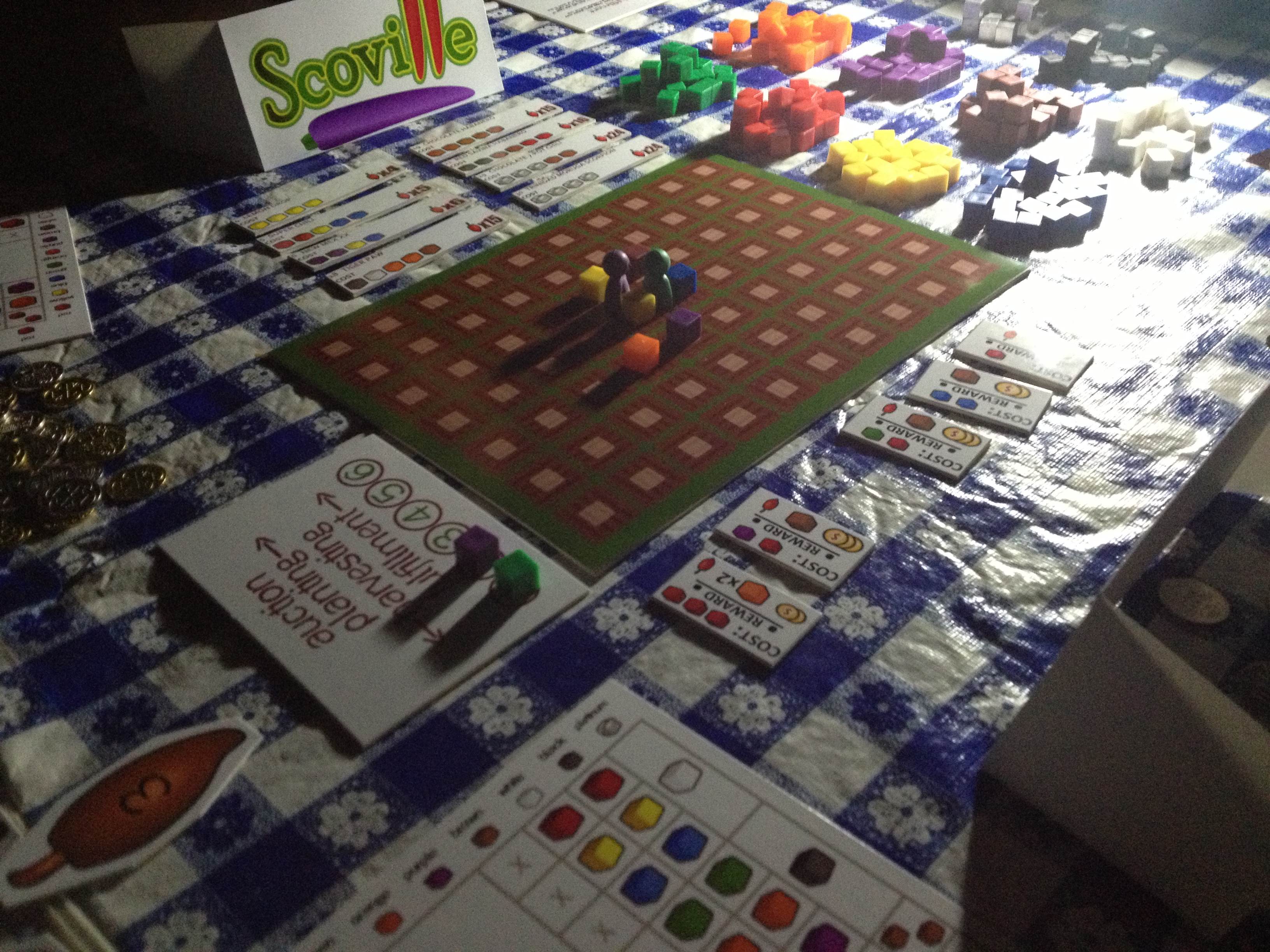
Sometimes playing by the light of a lantern is really fun!
Miscellany…
Last Friday was my birthday. And it happened to coincide with the receiving of two Kickstarter project rewards and one Blogiversary prize!

The special Kickstarter variant “Mimic” box.
On Friday before we left for camping I received my Dungeon Roll game from Tasty Minstrel Games. Dungeon Roll comes is a sweet treasure chest box. It includes a bunch of custom dice and hero cards. I have not yet played, but since there were over 10,000 backers there’s no shortage of people who have gotten it to the table. Congrats to Tasty Minstrel on a very successful campaign!
Then when I got home from camping I learned that my Catan Board had arrived. This was expected to arrive in April, so that’s a little disappointing. But the product looks really nice. I’m hoping that it works as advertised.
And finally my prize arrived for being the randomly chosen winner of the Theology of Games Blogiversary Contest #2. The game I won is Sunrise City, by Clever Mojo Games! I’m very excited to get this game to the table!
Add in the fact that I also received Le Havre: The Inland Port and a set of Beer Glasses for my birthday and you’ll see that all the gifts I received had to do with either Boards or Barley. (Disclaimer: I also received Seasons 1 & 2 of MacGyver, but I already had those so I returned them and bought something for my kids with the money).
And now we’ve got GenCon week! So I’ll pretend it’s my birthday all week!
***
So that’s the Boards and Barley that I enjoyed this past week. Any of you try a new game or new brew that left a lasting impression?
Board Game Preview: Tessen

A bright idea from Cardboard Edison and Van Ryder Games!
It’s time for another board game review. But this is more of a board game preview. On Monday I had the privilege of meeting Chris and Suzanne Zinsli, the designers of Tessen. They happened to be in town on a drive halfway across the country. I didn’t have much time with them, but I was able to learn Tessen. And I was able to beat Adam Buckingham at it! So today I Review/Preview the game and I recommend you back the project on Kickstarter!
Normally I provide 3 “likes” and 3 “dislikes” and then an overall rating. I’m not doing that today since this is more of a preview. Ultimately you should decide for yourself if you think this game is worth backing. Though if you continue reading I’ll tell you that it’s worth backing. So I guess I’m a bit of a hypocrite. Oh well.
Disclaimer: I was not contacted to provide a preview. I am previewing the game because I really enjoyed it.
Akita or Nambu?
Tessen is a fast playing, real-time card game for two players. One player will represent the Akita clan and the other player will represent the Nambu clan.
The object of the game is to gather sets of animals. To do that you’ll be playing cards quickly from your hand. If you can stack three or more of a kind of animal then you can “save” them into your save pile. The player with the most cards in their save pile at the end of the round wins that round.
The player decks are composed of eight different animals and two different warriors. There are 4 of each type of animal, 9 warriors, and 1 super warrior.
Here are some examples of the cards:
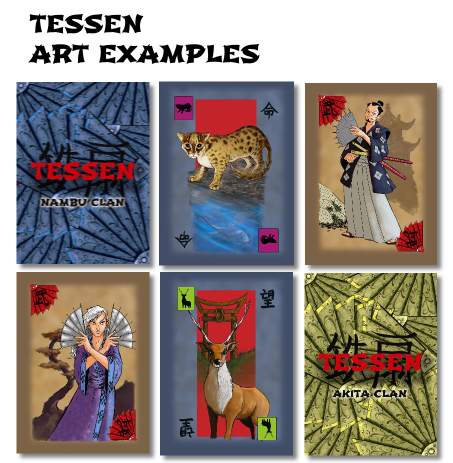 The animal cards each have a different color in the corner which helps you to see which animals you have in your hand. Now that we’ve seen the cards, let’s learn how to play…
Battle Ensues!
Each player shuffles their deck and places it face down in front of them. When both players are ready they’ll say, “Tessen!” and the battle will begin. Players will draw cards from their deck into their hand and begin laying them on the table. There is a 5 card hand limit, so be sure that you don’t draw too many. I made this mistake a few times and I’m sure Adam will want a rematch where I don’t accidentally cheat.
When you’ve got cards in your hand it’s time to start playing them to the table. You have five spots you can play cards in front of you. Each spot can only hold one type of animal. So you’ll be playing sets of the same animals on each spot. If any pile gets to three or more cards, then you can say, “Save,” and move that pile into your save pile.
The Warrior cards allow you to attack or defend. If you’ve noticed the other player stocking the same animal type, you might want to attack their pile. To attack just announce that you’re attacking and play your warrior card at their pile. They cannot take any other actions until they’re resolved the attack. If they want to use a warrior to defend and repel the attack they may do so. If they don’t have a warrior then they must let you take the cards. You can add those cards to your pile. If you cannot add the cards to any of your piles, then they go into a discard pile that your opponent can use to draw from.
The super warrior card basically counts as a double warrior. So to defend against a super warrior attack would take two warriors or your own super warrior.
Once one player has reached the end of their deck they announce, “Tessen,” and the round is over. Whoever saved the most animal cards to their save pile wins the round. They will then have to start the next round without one of their warrior cards. The game winner will be the first player to win three rounds.
My Thoughts…
 I am always looking for games that I’ll be able to play with my wife. This is definitely one of those games. This game is very accessible. It is also very fun.
I was trying to play my cards as quickly as possible and I think I did alright at that. The fact that individual rounds only take a few minutes means this game plays pretty quickly. It’s a really solid game design that is really enjoyable to play.
What I liked the most was the emotion it brought up in me. I really felt like I was battling against Adam. I was trying so hard to beat him. And when I heard him saving a bunch of cards I got anxious. I think to have a game draw out such emotions from a player is really cool.
What I disliked the most is that since this is a real-time game I think it suffers from player’s abilities a little. You have to be quick to draw cards. You have to be quick to comprehend cards. You have to be quick to play cards. And you have to be quick to see what your opponent is playing. So I think that as players play more and more they’ll be able to hone their Tessen skill’s such that new players may not stand a chance against them.
Overall this is an excellent game. I really enjoyed playing it and I highly recommend it. For the low price of $12 you can receive a copy and help Van Ryder Games produce the awesomeness. Go and back the project on Kickstarter today!
Conclave Conversation

Are you the next Pope?
Welcome to Boards & Barley. Last week I mentioned that I’d be posting an article about sourcing components for board game prototypes. Well, with GenCon so nigh I figured that article wouldn’t be of much help to fellow designers anyway. So I’m postponing that article until after GenCon, at a time when many designers will likely be looking to purchase new components for their game designs that require revisions. So today I’m discussing Conclave.
Since Trading Post is my white whale and I doubt I’ll ever actually get it to a playable point I’ve been spending my time making excellent progress on Conclave.
In Conclave players take on the role of a Cardinal who is hoping to become the next pope. For those not familiar with the process of electing a pope I will give a brief background. To elect a new pope the college of cardinals, those of high standing in the Catholic hierarchy, are locked in the Sistine Chapel after the death or resignation of the previous pope. They will perform voting rounds each day until a new pope is elected. Pretty simple.
So today I want to give you an update as to my progress on the game. Let’s start with the cards, and what they do…
The Orders of Catholicism
The game is designed to play from 2 to 4 players. Those players will represent one of four different Catholic Orders: Franciscans, Jesuits (Society of Jesus), Dominicans, or Benedictines. While I’d ultimately like each of these orders to have some sort of special ability, almost like factions, they currently are all equal and are simply a better way to represent the player colors. Here’s a look at the cards (From The Game Crafter) with the icons for the different orders:
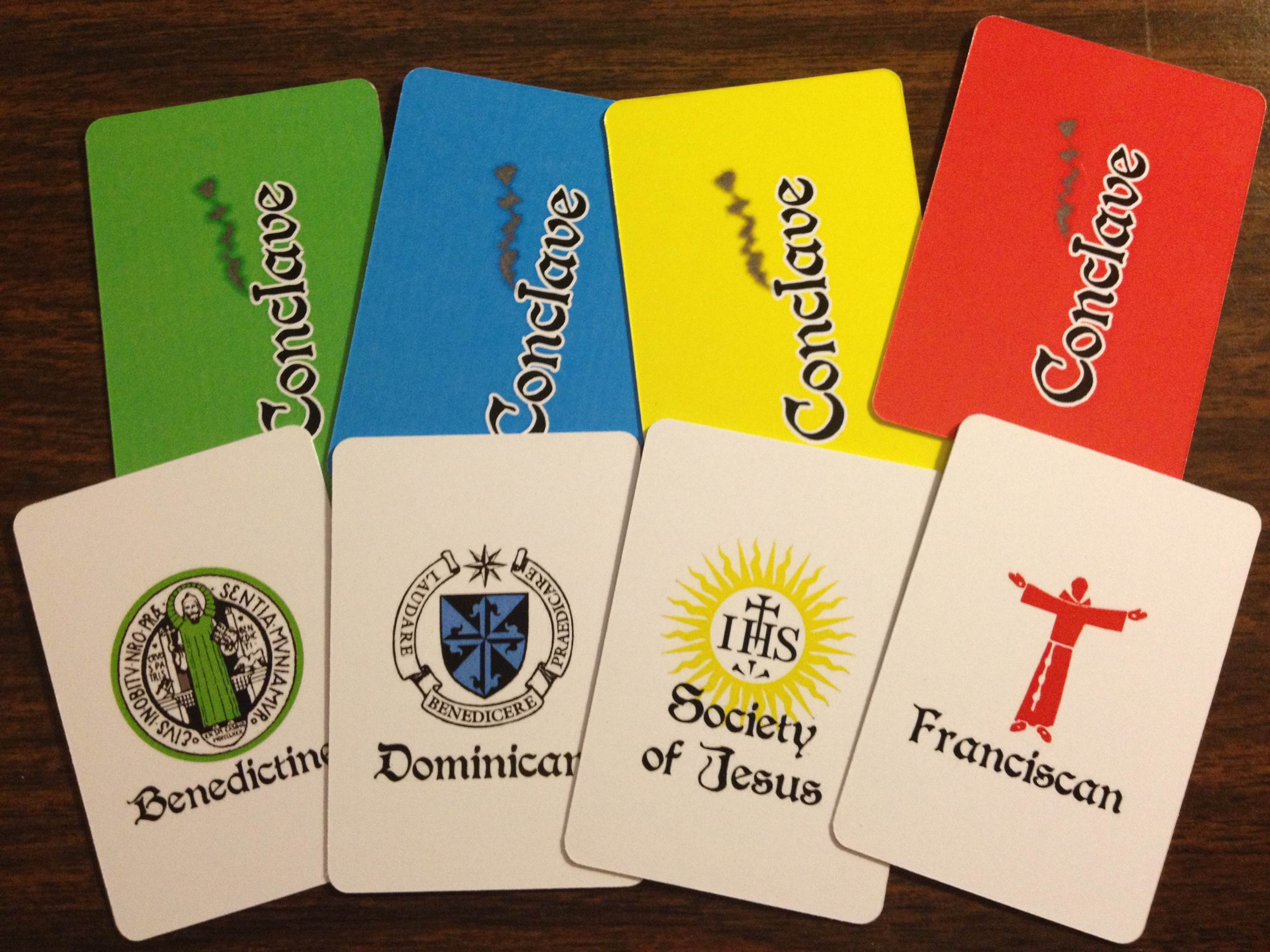
These could easily be labeled by their color, but the icons seem more real.
The cool part is that once I’ve tested the base game it would be relatively easy to add in specific traits for each of the Catholic Orders. That would allow each player to have some special ability that they could try to use to their advantage in the game.
Inside the Sistine Chapel

Sistine Chapel prior to Conclave.
Conclave is a game about area control. The areas are represented by the different tables in the Sistine Chapel. In a real conclave it looks like the setup on the right. That setup has long tables of equal numbers of Cardinals.
In the real conclave each vote counts individually. That’s not much fun from a game design perspective. So as the designer I am utilizing my creative license and splitting the tables up.
So in the game there will be anywhere from 6 to 9 tables that include from 1 to 6 cardinals. Each table will work like an electorate. Basically, whomever holds the majority of votes at any given table earns the full table’s worth of votes.
This is a decent way to mix things up. So players will be attempting to hold the majority at tables rather than focusing on any individual Cardinal’s vote.
Therefore the table with only 1 Cardinal is worth 1 total vote. But a table of 5 Cardinals, though worth 5 votes, can be won with 3 cards in place to win the majority.
So ultimately I’ve designed this to work like an electoral college where tables are worth electoral votes and a certain number of electoral votes are needed to win the Papacy. Perhaps I should switch themes to be a Presidential election in the US.
The Tables
Two nights ago I mocked up some beta artwork for the tables, mostly based on the picture above. My previous prototype had these large, cumbersome boards that were really just too large to be any good. So these new table boards are based on the mini cards from The Game Crafter (1.75″x2.5″).
Here is a mock up of a Five Cardinal table:
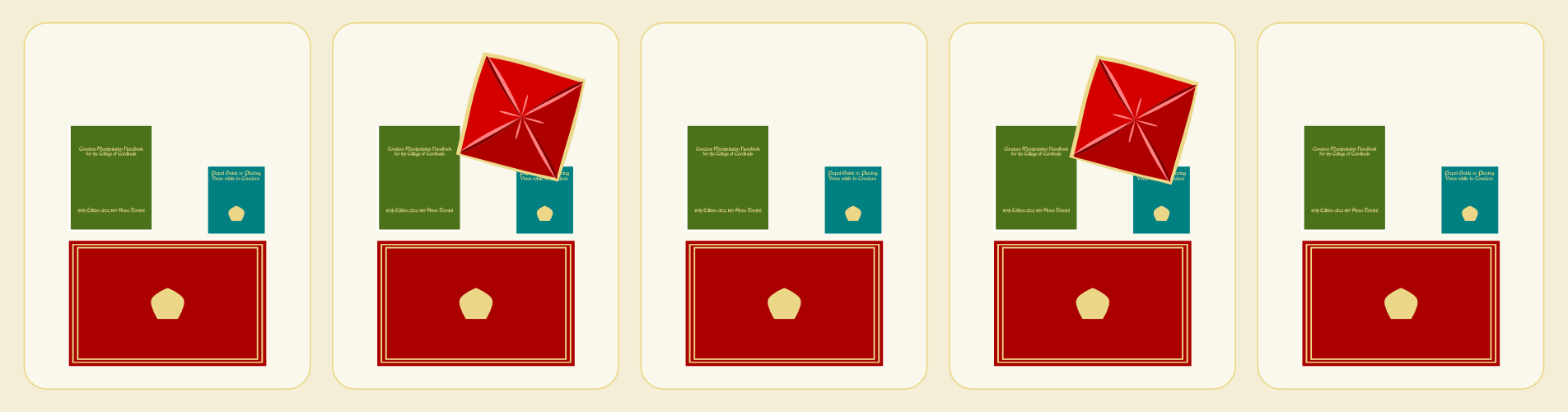
Having a majority here is worth 5 votes.
First, I need to apologize to anyone who enjoys anything about culture. It is almost blasphemous that I am designing a game that basically involves the Sistine Chapel and all I’m showing are the tables at which the Cardinals sit. How can I justify not including any imagery of the beautiful, if not scary, artwork included in one of the most historical rooms in the world?

The red box thingy in my artwork represents the papally awesome swag bags on the tables.
Second, the two spots with the weird angled red box thingy are special spots. At the very start of the game a certain number of cards are randomly drawn from each player’s deck. Those cards are distributed evenly to the spots with the weird red box thing. The red box just denotes which Cardinals receive a face up, randomly drawn card.
Once the randomly drawn cards are placed then players will take turns influencing the Cardinals. On their turn they will place one card face down on any Cardinal of their choosing. Then they will also place one card from their hand face up on that same Cardinal. The thematic idea here is that these Cardinals are voting for the face-up player, but could be persuaded to vote for the face-down player.
Play continues in this psuedo-setup phase until all the Cardinals have cards on them.
Manipulating the College of Cardinals
After all the Cardinals have cards to represent their votes then the real game begins. This phase of the game is all about manipulating the Cardinals to get them to vote for you. There are four actions you can choose and you can perform any two of them on your turn. These actions are represented by these hastily produced icons here:
 FLIP: This action allows a player to flip any one Cardinals cards over. The result is that this Cardinal will now be voting for whichever card had previously been the face-down card.
SWAP: This action allows a player to swap the locations of two different face-up cards of any two Cardinals.
LOOK: This action allows a player to investigate the Cardinals by looking at three different face-down cards for any three Cardinals of their choosing.
LOCK: This action allows a player to lock any one Cardinal’s vote into place for the rest of the game. Each player will have four locking cubes and can thus lock four Cardinals over the course of the game.
So on your turn you can perform two actions. They can be the same action if you so choose. The goal is to try and manipulate the tables so that you earn the majority, and thus their votes.
***
So I’ve described the game in a nutshell. This is the basic concept of the game and it is currently playable. My disclaimer is that I have no idea if it is any fun. All the fun so far has been in designing the game. While I think there is a nice strategic component to the game, only time will tell. And by time I mean playtesting. Thanks for reading!
The Monday Brews: 8-5-13
Another week has left us. And what a glorious week we have upon us. Just as we are gearing up for GenCon it turns out that I have a birthday this Friday! So of course this week will be a good one. I suppose I should try to get some playtesting in so that I’m not taking garbage to GenCon. But we’ll worry about that later.
Here’s a recap of my boards and barleys from the past week…
The Barley:
Capital Brewery Supper Club: This is an excellent beer to enjoy when you’re not worried about anything. Sit back, put your feet up, and realize this beer’s “not bad.”
O’So Big O: This was another decent beer to enjoy while relaxing. It had a little tanginess, but that didn’t hinder the enjoyment. This beer is from the wonderful town of Plover, WI.
Ben Franklin’s Honey: I again enjoyed some of my own homebrew. However, I have a big problem. I am almost out of my own beer and I don’t have a batch currently fermenting. We are approaching mission critical here. I’d better start brewing!
Here’s glimpse of a cooler I was able to rummage through at a party I attended this weekend. Some of the better beers were in a different cooler.

Some excellent Wisconsin beers. One not-so-excellent Wisconsin beer. And then there’s Corona.
Horny Goat Watermelon Wheat: Rule #1: No fruit in beer unless it’s a Lambic and it’s done correctly. Rule #2: If you’re using fruit in beer, please just not watermelon. Yeah… I didn’t care for this beer and won’t be having it again.
Pabst Blue Ribbon: Out of reverence for fellow game designers that I had the privilege to meet at Protospiel-Wisconsin, I hoisted a cold PBR this weekend. And I realized that it wasn’t that bad. I’d have another, especially if it was available at GenCon!
The Boards:
Unfortunately I didn’t get to play as many games as I had hoped. Here’s the three that I did manage to play:
Tsuro: My friend’s $1.20 thrift store find has made the table a bunch lately. And we got it out again this past week. This is a great filler game that doesn’t take much though, has minimal downtime, and is also fun to play. unlike last week we didn’t have a three-way tie for the win.
Guillotine: This is a fun card game where players try to get the most points over the course of three days. During each day different cards are placed on the table. On a player’s turn they can play a card from their hand, and then they must take the card closest to the guillotine. The card they played hopefully allowed them to put a better card in that spot so that they didn’t have to take a bad one. It’s a pretty fun game despite some dude’s butts on some of the cards.
The Settlers of Catan: We always have fun when we play this game, even with 6 players. When we play with 6 I get to use my two different versions and the table looks pretty funny. But it’s always a fun game, even if I know I’m going to lose after the initial placement phase. Here’s a picture of our setup:
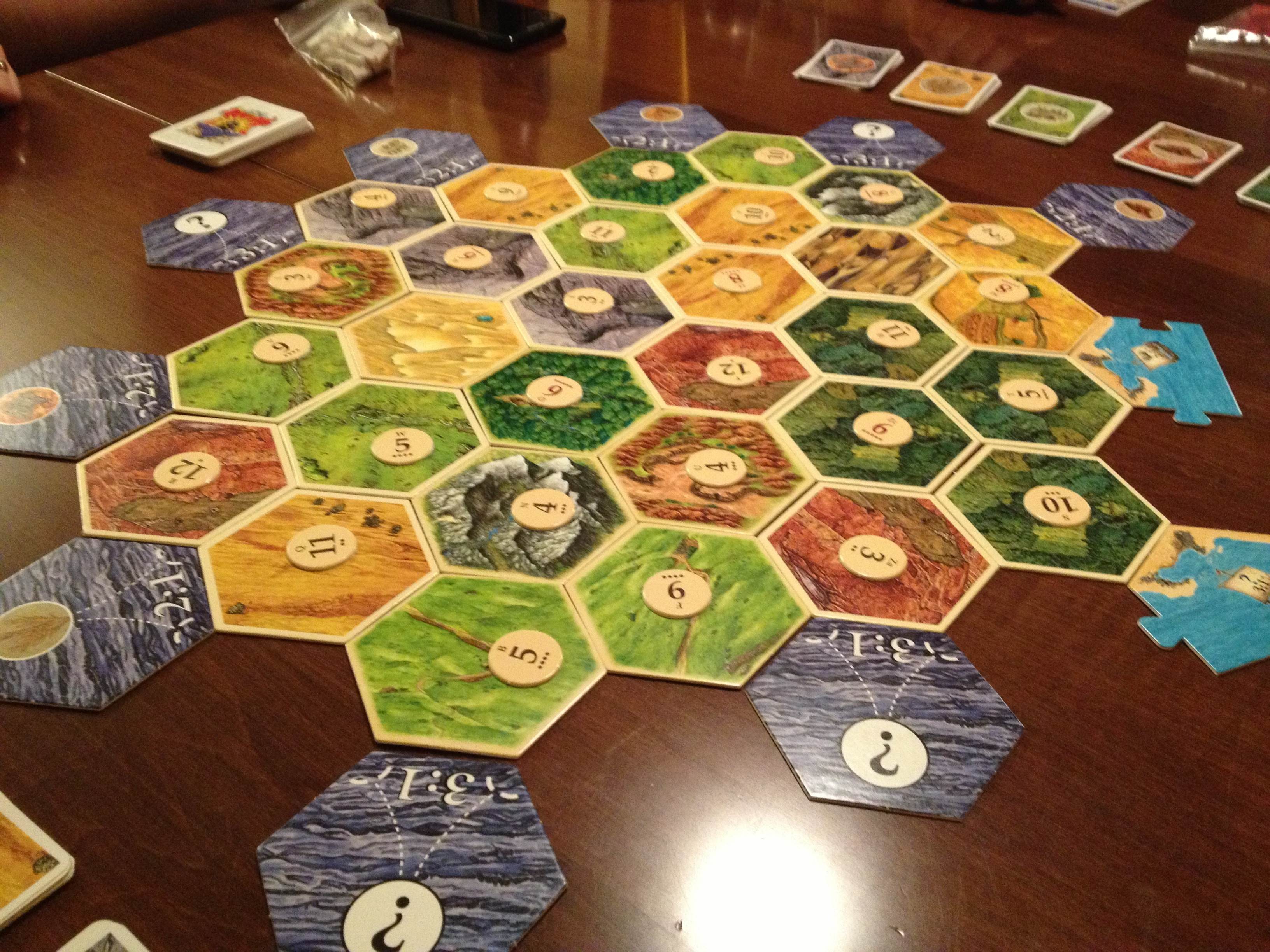
Mish-mash at its best! Excuse the blurriness.
***
Another week under the belt. What Barley or Boards did you enjoy this past week?
 Boards and Barley