Category Archives: Game Design
Interview with Bellwether Games
 Today is Friday so I should be posting a board game review, but instead I will provide something even more awesome.
About a month ago Bellwether Games (@BellwetherGames) tweeted that they were looking for aspiring game designers who wanted to be interviewed. Since I am an aspiring game designer I figured I should see if I would be the right person for the interview. They took a look at my website (this website) and replied that I was in fact the right kind of person for the interview.
I might have done a little dance with my hands in the air at that point. Don’t worry, no other humans eyes were injured by watching me dance. I was alone.
So they sent me an email with a few starter questions and I got right to filling them out. After a few back and forths with follow up questions they told me that the interview would be posted at the end of the month. Well, today is the end of the month and right on time the interview has been posted!
Ed Marriott Designer Interview with Bellwether Games.
Let me know what you think!
Trading Post Part 3: Hiatus and Redesign
Redesigned Logo… Let’s just redesign everything!
I have a new game design I’m working on and today I am posting the third of 4 articles about it. This is the third article about the game from it’s creation to the present state. Here are the four articles in this series:
- 5-16-13: Origins of Trading Post
- 5-23-13: Early Prototying
- Today 5-30-13: Hiatus and Re-design
- 6-6-13: Path to GenCon
Today we’re looking at the current state of the game, and how I got there. In my opinion today’s article covers the most important details of game design. Let’s call it “distilling” and “skimming.” But first let’s look at why I took a break from the game.
The Hiatus, or “This game stinks… let’s take a break!”
 If you’ve read the past two articles on Trading Post then you’ve learned what I want the game to be like (week 1 – Origins), and you’ve learned how I don’t want to be (Week 2 – Early Prototyping). At its heart I want Trading Post to be a competitive game about exploration and development of a western Trading Post. I want the game to flow smoothly, create tense decisions, feel thematic, and be easy to teach/learn.
My previous version was none of those. I had spent a lot of time on this game. I thought I had something very thematic. But I realized that I had a big pile of garbage that didn’t work together. It had several things in it that felt like busywork rather than a game. And ultimately it was not any fun. That’s a huge problem. Remember that we are game designers and games are supposed to be fun!
So I decided to put Trading Post on the shelf. That must have been early in 2012. At the time it was a pretty easy decision because I really didn’t know how to move forward with the game. I could easily have abandoned the project overall.
During the hiatus I worked on a few other games. The most notable (at this point) was my card game Dam It! But I was working on another game with a level 1 friend. It used several of the same elements of Trading Post but in a more thematic and historical context. Ultimately I realized that Trading Post was a game I wanted to bring back. To resurrect.
So after having Scoville turn in to the PnP behemoth that it has I figured now would be a good time to try and bring back Trading Post from the dust in my basement.
A Fresh Start – Land Exploration
There were certain elements that I thought would be good to carry over from the first version of the game. And there were others that I knew I should ditch. I figured a good way to redesign the game would be to start with the elements I wanted and add from there. I could then completely ignore the bad things from version one.
My starting point was the land exploration portion of the game. I knew that this could be dramatically simplified. To get things more simple I decided that the game would have only four natural resources – Water, Lumber, Stone, and Gold. The previous version had more – Lumber, Grain, Animals, Fruit, Cotton, Steel/Iron, and Water. That was too many. And four would allow me to do what I want with the game.
So I set up a way to make things be as equal as possible, without forcing identical conditions on players. I devised a set of ten tiles that each player would have. Throughout the game, as they explore their territory, they would draw seven of the ten tiles. It was designed at that number so that no player would be without any of the resources. Here are the ten tiles from which each player draws when they explore:
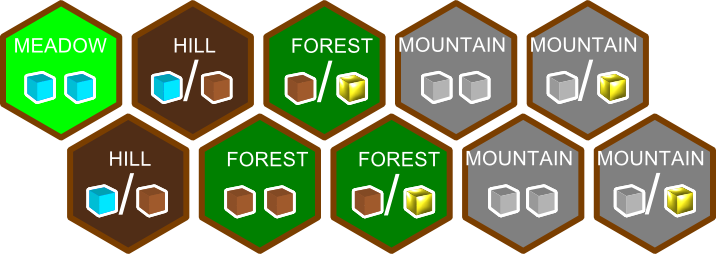
Each player has a set of these ten tiles, 7 of which will fill their territory.
Players will add these to their portion of land that the Trading Post has given them to explore. Each player starts with a Meadow (1 Water) and a Hill (One Water OR One Lumber).
With this design players will always have access to all of the resources. Sometimes players may end up with all four mountain tiles and thus a bunch of stone. Likewise players may end up with only one mountain tile and thus very little stone.
Here’s a look at the starting region for each player:
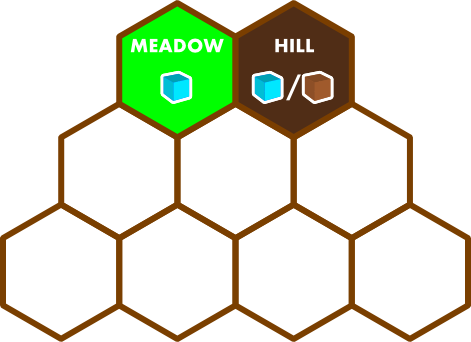
Each player starts with a meadow and a hill. Therefore they have access to water and lumber.
With the understanding that some players may have only one gold tile or stone tile while others may have four stone tiles or four gold tiles I knew that I’d have to design the game so that you can win under any of those conditions. That leads me to my next design element that has carried over from version 1… the buildings.
Building Buildings!?!
In the original version of the game the buildings only entered into the mix late in the game. They acted the same way as the Orders – that is, they came out four per year and you could fulfill them from the pool of face up cards. I didn’t like that.
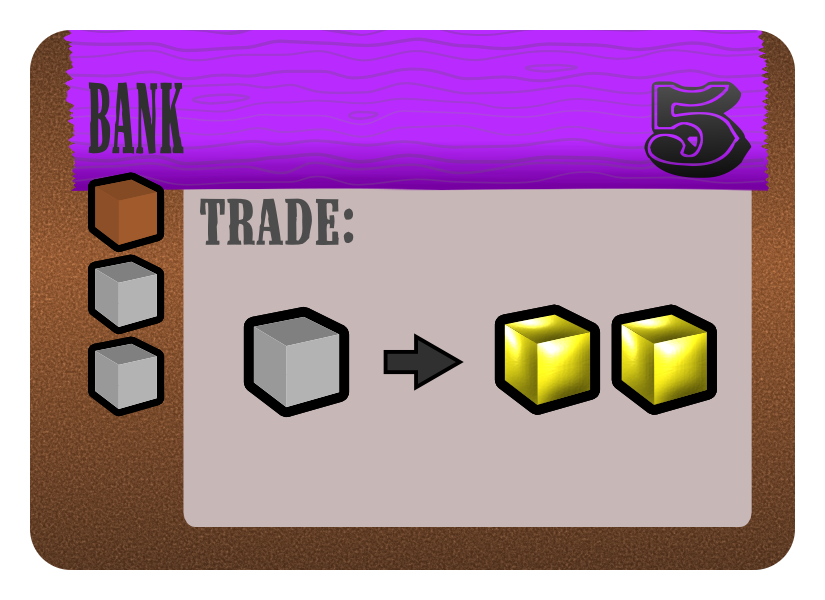
Bank costs 1 lumber and 2 stone. Can trade 1 stone for 2 gold. Builder earns 5 points when Bank is built.
So I decided to make buildings a more integrated part of the game by allowing them to be entered for some benefit to a player. Also, I decided that buildings should be available from the start of the game. Thematically the idea of building buildings is that you are developing the Trading Post so that it offers more to any guests that may visit. So buildings are a part of the game play from the get go.
There are 14 different buildings in the game. Each building offers players some sort of trading opportunity. Players can purchase buildings and build them on their land. Once they build a building they will earn points for building it, but will also cover up the natural resources that they could produce on that territory tile.
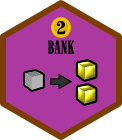 When a player purchases a building they will take the associated hex for that building and place it onto a section of their territory that they have already prepared for a building. Note: preparing land is a separate action.
Whenever another player enters the bank tile, the owner is to be paid two coins as a sort of “trade fee.” These buildings will be critical to success in the game. You want to own them, but you also don’t want to give up the resources of the land that they are covering. It’s a sort of Catch-22. But that’s part of the fun of a game, right?
My objective with the design of the buildings was to utilize both stone and gold equally. This would aid the differing land resource conditions that I mentioned above. As an example, there is another building where you can trade one gold for two stone. Imagine owning both that building and the bank! You’d be able to create a huge supply of both stone and gold.
Now that I had redesigned the buildings in a much simpler manner that will be more integrated into the game play it was time to give players options for scoring points. And it made me ask the very important question that I seem to neglect until the late stages of game design: How do you win the game?
Let’s Get to the Point(s)!
I struggled a lot with how I wanted scoring to be handled in Trading Post. So far we’ve only discussed earning points via buildings. In the previous version of the game players could earn points from fulfilling orders. I wanted that element to remain in the game.
But I also wanted more opportunity for scoring. And I wanted that scoring to be hidden. This mechanic is the core of the famous game Ticket to Ride. In that game players play the game and attempt to complete routes from one city to another. They are the only person who knows the route. At the end of the game the routes are revealed and players score positive or negative points based on whether or not they connected the two cities.
You Can’t Order Me Around!
So I decided to distill my original set of Orders from the first version of the game. Maybe now is a good time for me to explain what I mean by distill. Here’s a definition of the word “distill:”
to extract the essential elements of; refine;
That is exactly what I’ve been doing with these game elements. I am extracting the parts of the elements that make sense and work as a game. You could also look at it like separating the wheat from the chaff. Version 1 had a lot of chaff and very little wheat. But the wheat that was there was very good wheat. I recommend to all game designers who have projects that they’ve shelved to try and distill them. This is a great way to get back to the core elements that you originally desired while removing the garbage that you added needlessly.
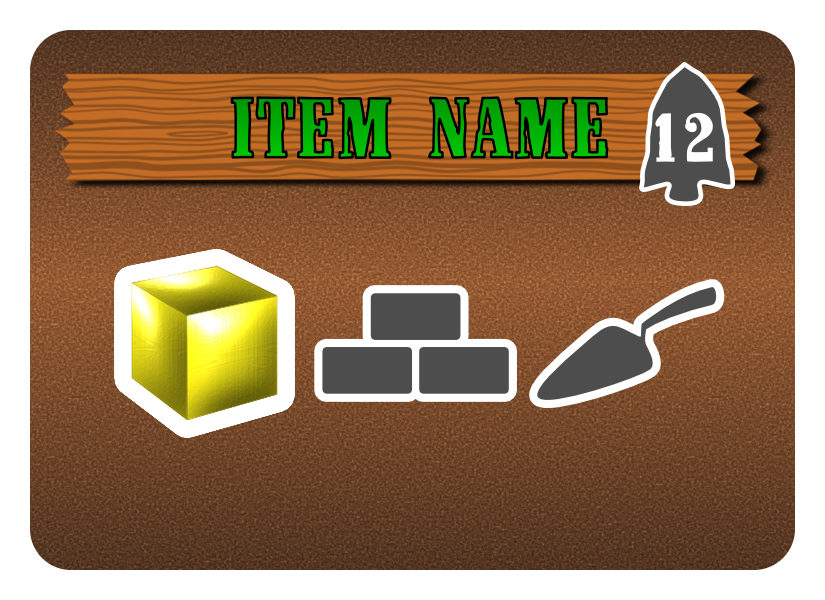
Fulfilling this order requires 1 gold, 1 bricks, and 1 trowel.
So I took the concept of orders and basically “Mathified” it. What I mean by that is I basically designed the orders to be different combinations of the resources used in the game.
Version 1 had a huge list like the spreadsheet that I showed last week. These were things like hats, pies, and musketballs. I decided that with the redesign I would ignore the naming of the items and just use the mathy combination of things.
So there are orders that cost 1 wood or 1 lumber or 1 stone or 1 gold. Then there are orders that cost any combination of two of those resources. Then there are orders that add in the secondary resources (hammer/nails/bricks/trowel). And it gets more complicated from there.
The design has a scale for how many points each order should be worth based on the costs. In the example shown the gold may be worth 2 and the bricks and trowel each worth 5 to get to a total of 12 points. So players are able to earn points during the game by fulfilling orders. (I know… that seems similar to Scoville. Oh well.)
You’ve Got a Hidden Agenda!
The other scoring I mentioned is hidden scoring. There are many games that have scoring conditions that are revealed at the end of the game. So I’m not doing anything groundbreaking here. But having hidden scoring conditions that only get revealed at the end of the game is a great way for players to never feel out of a game!
So I designed a set of scoring condition cards that have a two-fold purpose:
- Give players hope.
- Give players goals.
Hope is a big deal in board games. If a player doesn’t think they can win they may as well give up. I’ve seen players who know they can’t win start to help their favorite player win the game. I do not like that in a game. If a player has hope that they are doing a great job meeting their own scoring conditions then they have hope that they could pull it out in the end. Games like this include Stone Age, Archipelago, Ticket to Ride, and Suburbia to name a few.
Goals are also important. It helps guide a player’s strategy. It gives a player something to plan for. And it can help eliminate analysis paralysis. One of the newer games that has goals that definitely guide my strategy is 7 Wonders. In 7 Wonders each player has their own “Wonder” which is shown on a player mat in front of them. Each of these is different and provides some sort of bonus. The wonder that you receive can steer your strategy in the game.
I designed a deck of scoring condition cards to meet those requirements. These include having certain sets of buildings or certain combinations of fulfilled orders. So players can have hope throughout the game and never feel completely out of it. They may not be totally thematic, but I can give up a little theme for a better game. If players want to think of these scoring conditions more thematically then they can think of them as private commissions from the Trading Post.
Here are two examples of scoring conditions. The card on the left would award points to the player only if they managed to own two blue buildings and a green building. The card on the right would award different numbers of points based on how many orange orders they fulfilled.
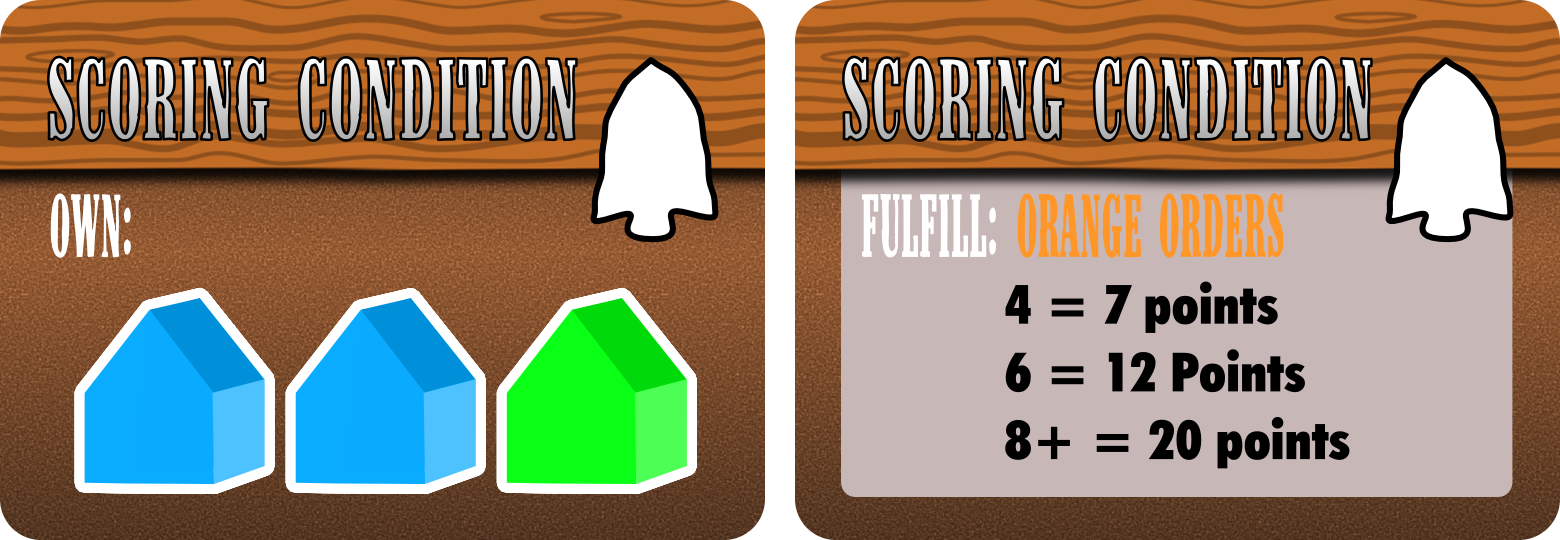
Left: a “Buildings” scoring condition. Right: an “Orders” scoring condition.
But How Do You Play?
Ironically this is probably the one question to which I don’t know the answer. I am debating about having the game play several different ways. Options include:
- Role Selection a la Puerto Rico, Race for the Galaxy, Carson City.
- Turn based game play with players choosing one thing to do per turn.
- Turn based with an action point allowance system.
- Rounds where players each do action A, then action B, and so on.
I truly have not decided which is the best approach for this game. I may end up testing all four options and seeing which works best. Here are the things I am trying to design for in the game:
- Minimal downtime
- No runaway winner
- Tense decisions
- Ramping up of awesomeness
- Accessibility – Easy to learn, easy to teach, easy to play
So I’m going to choose the game play option that best fits those game design goals. I am initially leaning toward the role selection option but making it less about a role and more about providing a specific set of actions that a player can do. I’m not sure that makes sense.
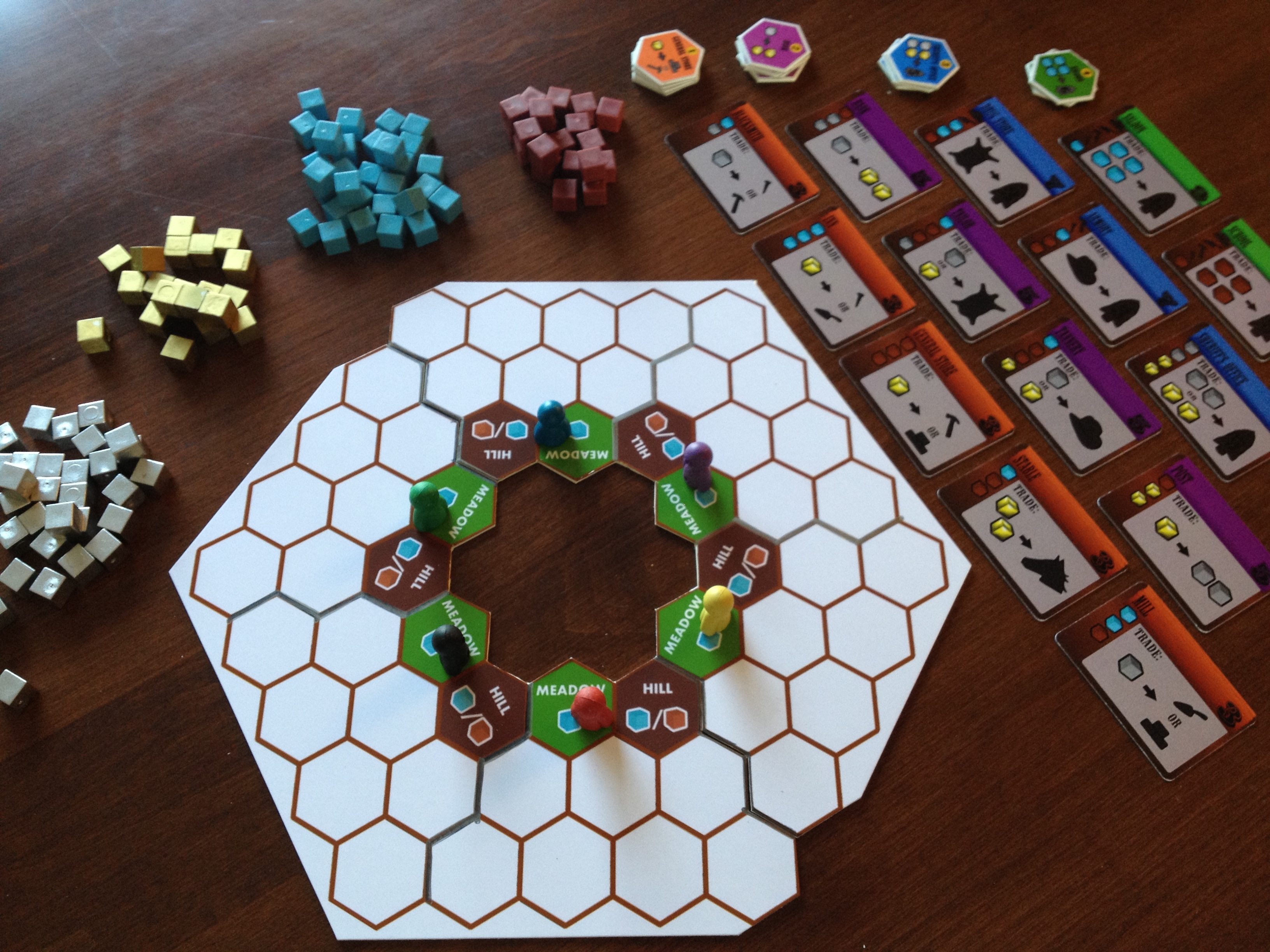
The current state of Trading Post minus half the components.
The bottom line is that I have several game play concepts within the game but I don’t have an overall picture of the game play. That’s what I’ll be discussing more in depth in next week’s article about my path to GenCon with Trading Post.
So next week I’ll cover the game play options for the game. I’ll also cover how to get this game ready to potentially pitch it to publishers at GenCon. Stay tuned! As usual, your comments are welcome. I’d love to hear what people think about this game design.
Trading Post Part 2: Early Prototyping

Trading Post Logo… for now.
I have a new game design I’m working on and today I am posting the second of 4 articles about it. Including last week, today, and the next two Thursdays, I’ll be writing about the game from it’s creation to the present state. Here’s the four articles in this series:
- 5-16-13: Origins of Trading Post
- TODAY 5-23-13: Prototyping Early Versions
- 5-30-13: Hiatus and Re-design
- 6-6-13: Path to GenCon
So today let’s again jump back in time a few years and take a look at my early prototyping attempts, from when I didn’t know anything about prototyping games!
The Board:
One of the first things I attempted to make when I thought I had the design “together” enough was a board. I figured black and white was a great place to start. So I drew a few sketches about the layout and then opened The Gimp.
For those of you who don’t know what The Gimp is, here’s where you can go to learn more: http://www.gimp.org/
It is an open source image editing software. While it used to be my weapon of choice for image editing and graphic design, I now use Inkscape since it is a vector graphics software (and still free).
So in The Gimp I got a 21″ x 21″ file open and began by creating the main hex grid. Last week I wrote about a grid of squares with truncated corners where cubes could fit. Well, that was gone by the time I decided to make a prototype. So here we are already discussing a hex grid map with square tiles. In the earliest designs all the tiles were going to be 1″ squares. So the board reflected that. You’ll understand why I went with squares a little more in the discussion about components below.
The hex shaped grid for player territories was a beast to design. I actually had to do math to get the grid to be a hex in The Gimp. This would have been relatively easy in Inkscape. But it wasn’t very fun in The Gimp.
After wrestling with the hex grid territory region I added a few other smallish things to the board. This included the title, resource areas, a time track, and a spot for cards. After spending a completely ridiculous amount of time on a board for a prototype that hadn’t even been played, here’s what I ended up with:
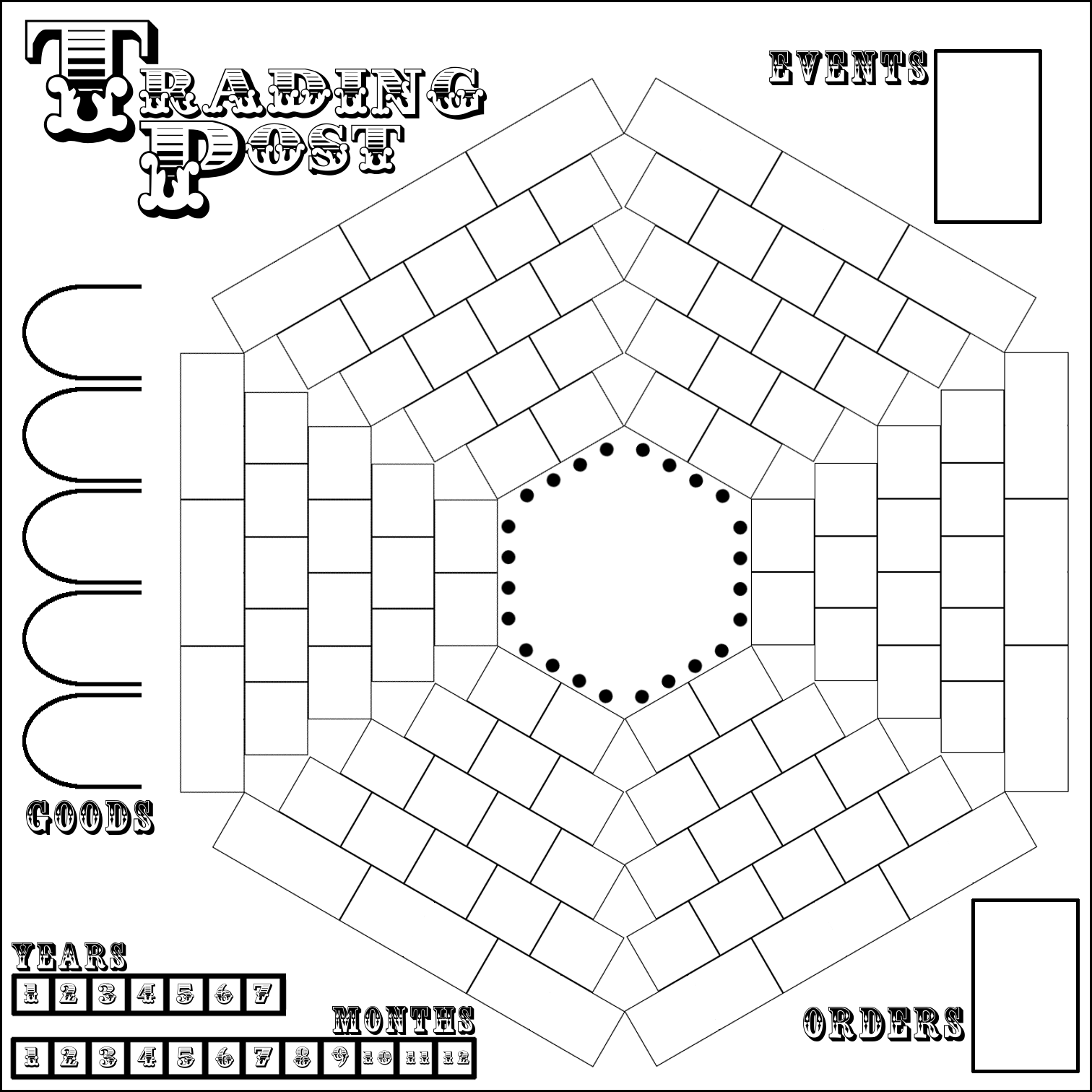
Well, it’s better than nothing, right?
As you can see it values function over form. Ugly though it be, it would still get the job done. So I printed it on 9 different sheets of paper and tried to get all the edges lined up. Maybe my struggles with creating a full size game board when working on Trading Post are what subconsciously led me to not having a full size board for Scoville.
The Territory Tiles:
The main concept of the design involves exploration of your territory. Players start with their pawns in the center and eventually should try to explore all of their territory. So I had to make tiles to put on the sections of your territory as you would discover them.
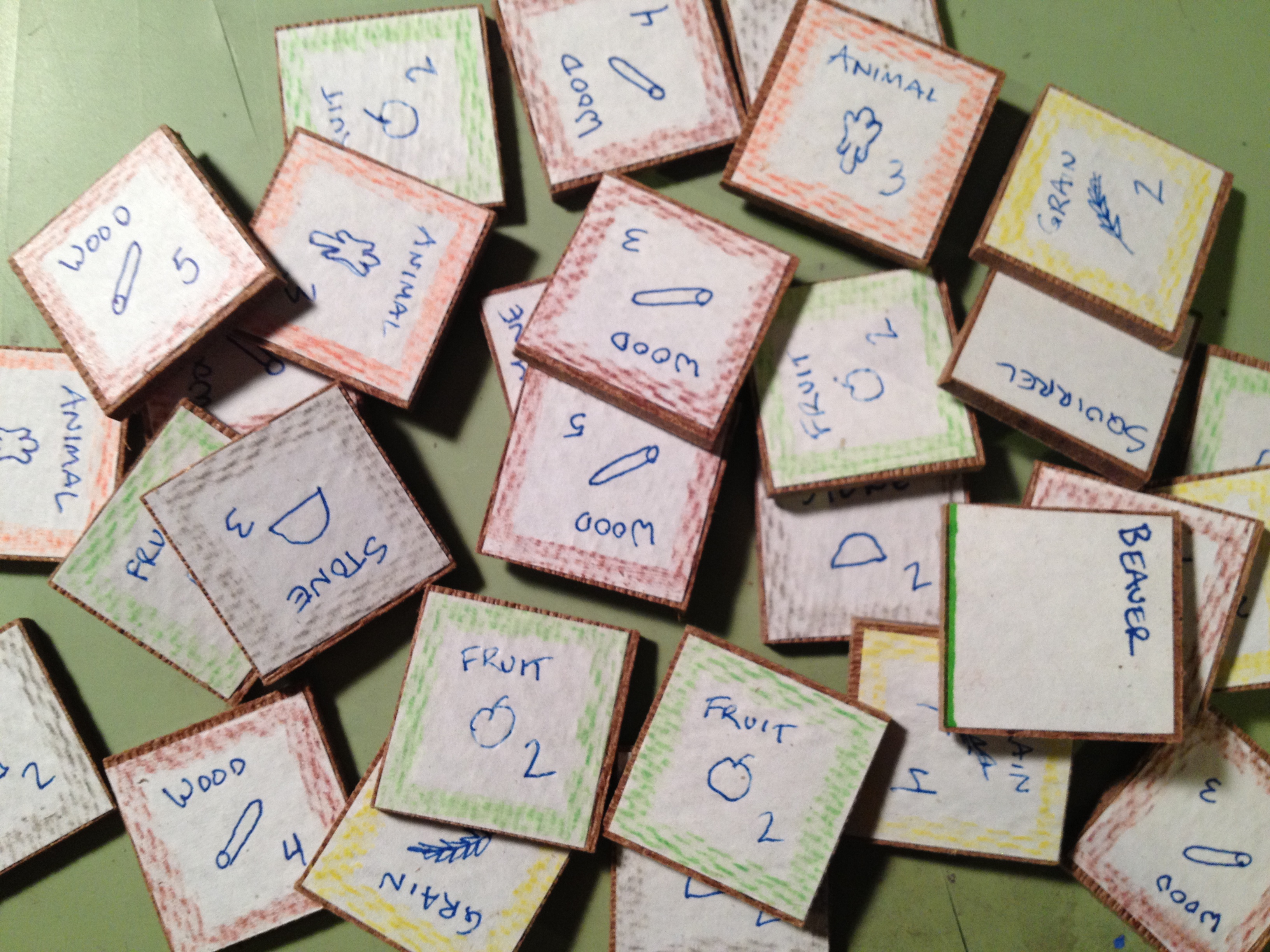
Wood tiles with hand drawn icons and colored pencil edges. Wow.
These tiles would represent different resources that could be available, AND the amount of that resource that the piece of land would produce… for the rest of the game. This included things like Wood, Stone, Fruit, Grain, and more.
Here is a lesson I learned when prototyping the territory tiles: Just buy chipboard components from someone like Printplaygames.com. For the cost you can get just about everything you would need to get your game to the prototype phase.
Did I make such a wise decision? Not even close. I actually bought a wood board and went to a friend’s house to use their table saw to cut 1″ square tiles. Then I cut out square pieces of paper. The paper got glued to the tiles. Then I drew little icons on each one and colored the edges to match the icon. Here’s a recommendation: Don’t do it like that!
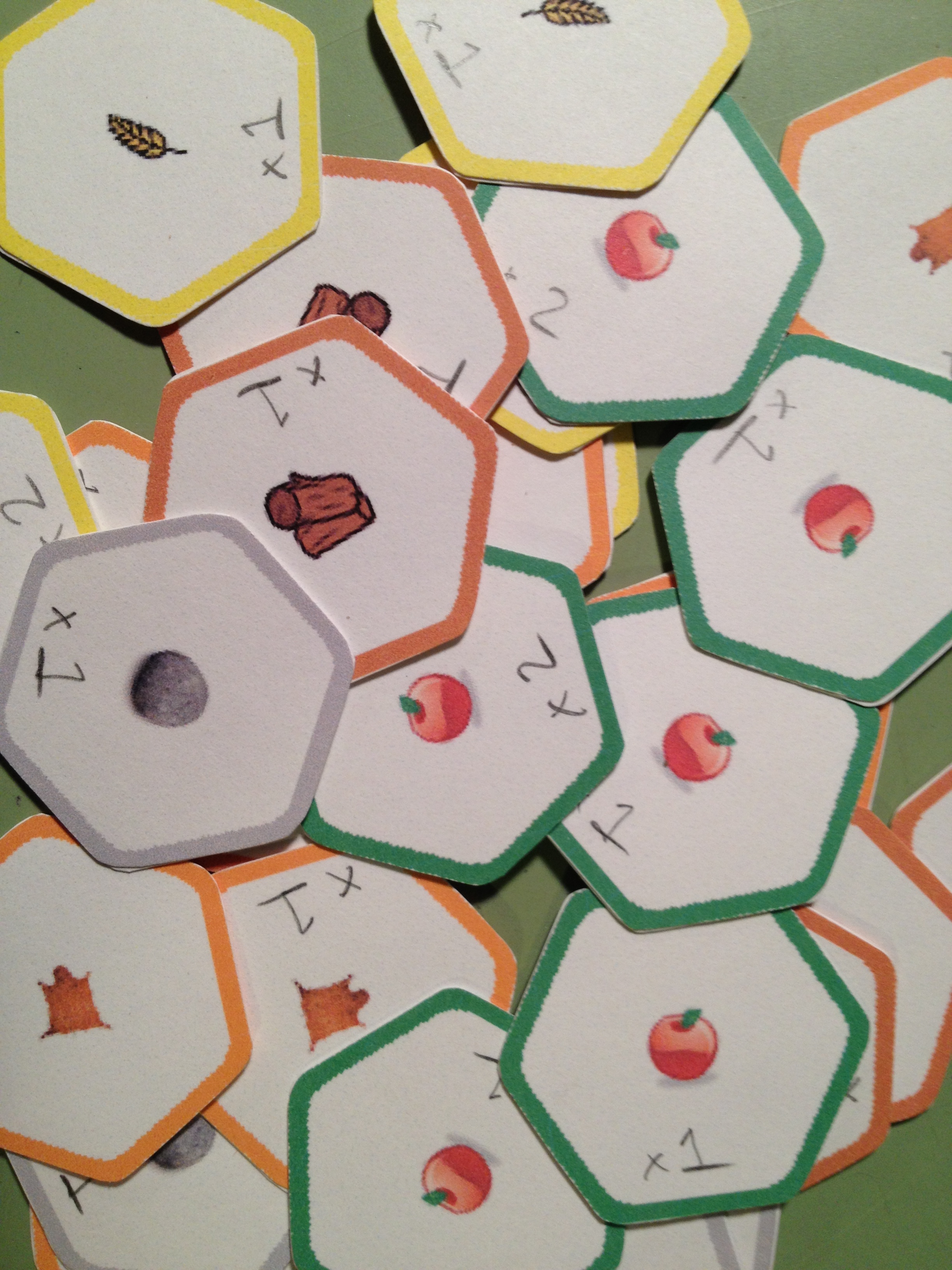
Hex punched, corners rounded, glued back to back. Aye!
Eventually I got to the point where a hex-based grid seemed like a better idea and I began to work toward a hex-based prototype. I used a computer aided drafting software called SolidWorks to render a hex grid that I could print out for the hex-based prototype. I don’t recommend using CAD software for board game design unless you’re making minis. The main problem is that the CAD software typically doesn’t allow you to save images in high quality. The downside of the change to a hex-based system was that all the effort I put into the wooden square tiles was now wasted. (I can say that it was wasted because it was never even used in a playtest).
The hex-based system didn’t change how the game was played. It just made things fit a little better and look neater & tidier on the board. It was at this point in my board game design career that I decided to purchase a hex-punch. I bought a Creative Memories Double Hex Punch off eBay for about $8. It turns out that that’s a crazy awesome price! Despite the price I recommend buying a variety of punches, especially circles. I just searched and found a few of the Creative Memories hex punches on eBay for about $37. Another free designer tip:
Punches can be your best friend!
Here is a link for punches from Fiskars. I would recommend starting on eBay, though.
Ugh. Looking back on all of this makes me wish I had been familiar with Inkscape at the time I was working on this design. All of the art and tiles could have been made with Inkscape so much more easily than what I was doing.
Well I now had my territory tiles made. Now it was time to add the other unnecessary ingredients in this poor game design…
The Event & Order Cards:
After reading the article about what makes a game good (Note: here’s the article I mentioned in last week’s Trading Post article, thanks to Neil Roberts who found the link – What Makes a Game Good?) I knew that I wanted to especially avoid monotony in the game design. I already had a random draw for territory exploration. But how else could I increase variability and replayability?
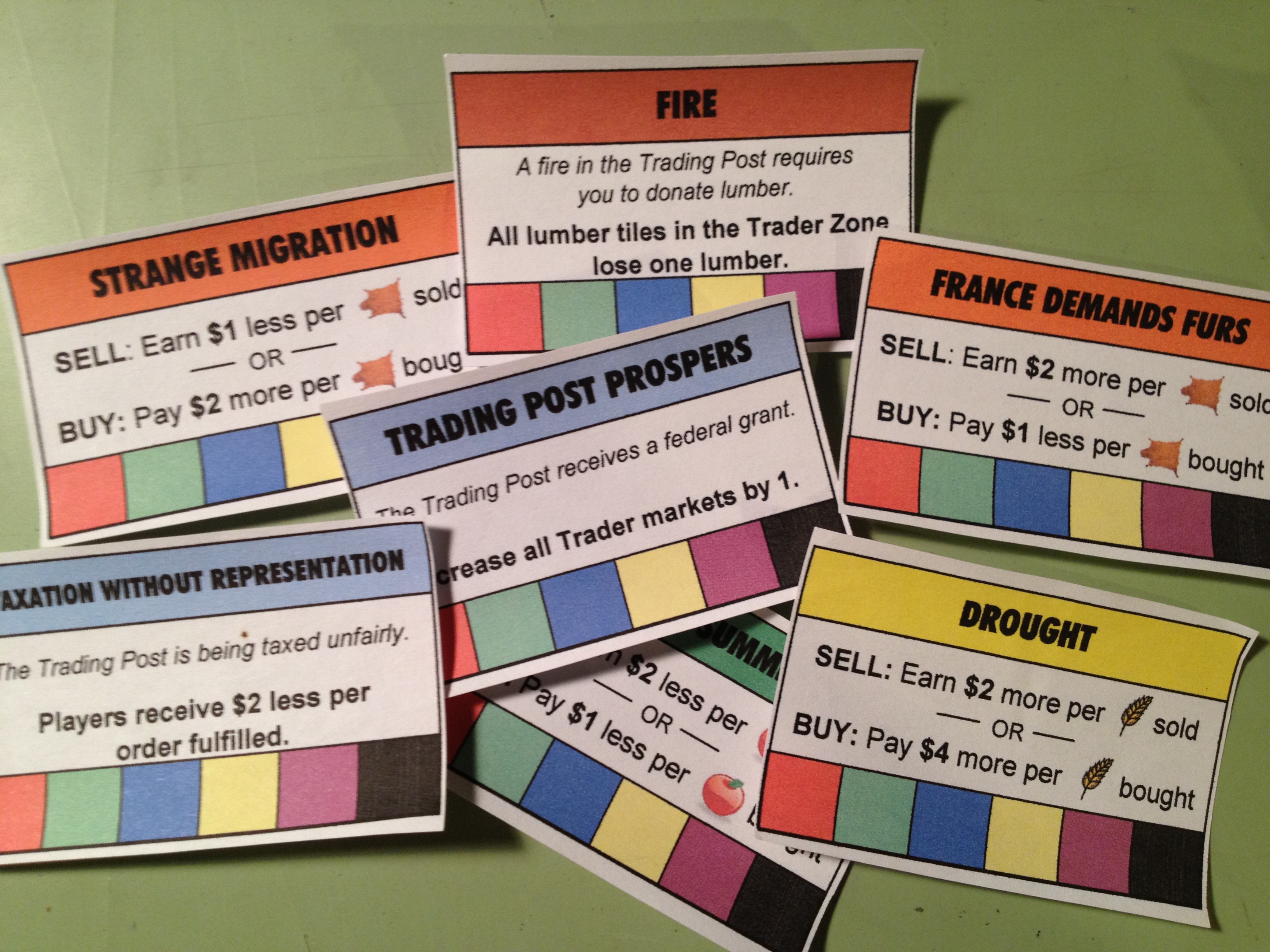
My poor attempt at adding replayability.
I came up with the idea that each “year” in the game would have something different going on. I called these “Event” cards. They typically affected how the market worked for different goods. But they also could positively or negatively affect all players. A few of the event cards are shown here on the right.
These were masterfully made in Excel. The bottom row of the event cards is a spot for players to put a cube of their player color when the card affected them to show that it had done so. Cards could only affect a player once. The top box on the cards is also color coded. The DROUGHT card in the image affects GRAIN and thus matches the yellow color of the grain. Pretty awesome, huh?
But this wasn’t enough! Another free designer tip:
Don’t add complications until the game needs it!
At the time I was designing Trading Post I hadn’t learned that lesson. So I added ORDER cards in a seemingly theme-less way to make each game different. I guess I was really worried that people would be bored with Trading Post after one or two plays.
Thematically the ORDER cards represented things the Trading Post needed during that year. That at least made sense. These things included blankets, hats, pies, buildings, flagpoles, and on and on. I struggled to make a list long enough of the sorts of things that a Trading Post might need. But eventually I got them all together and started making more “awesomeness” in Excel. Here’s a glimpse of the result:
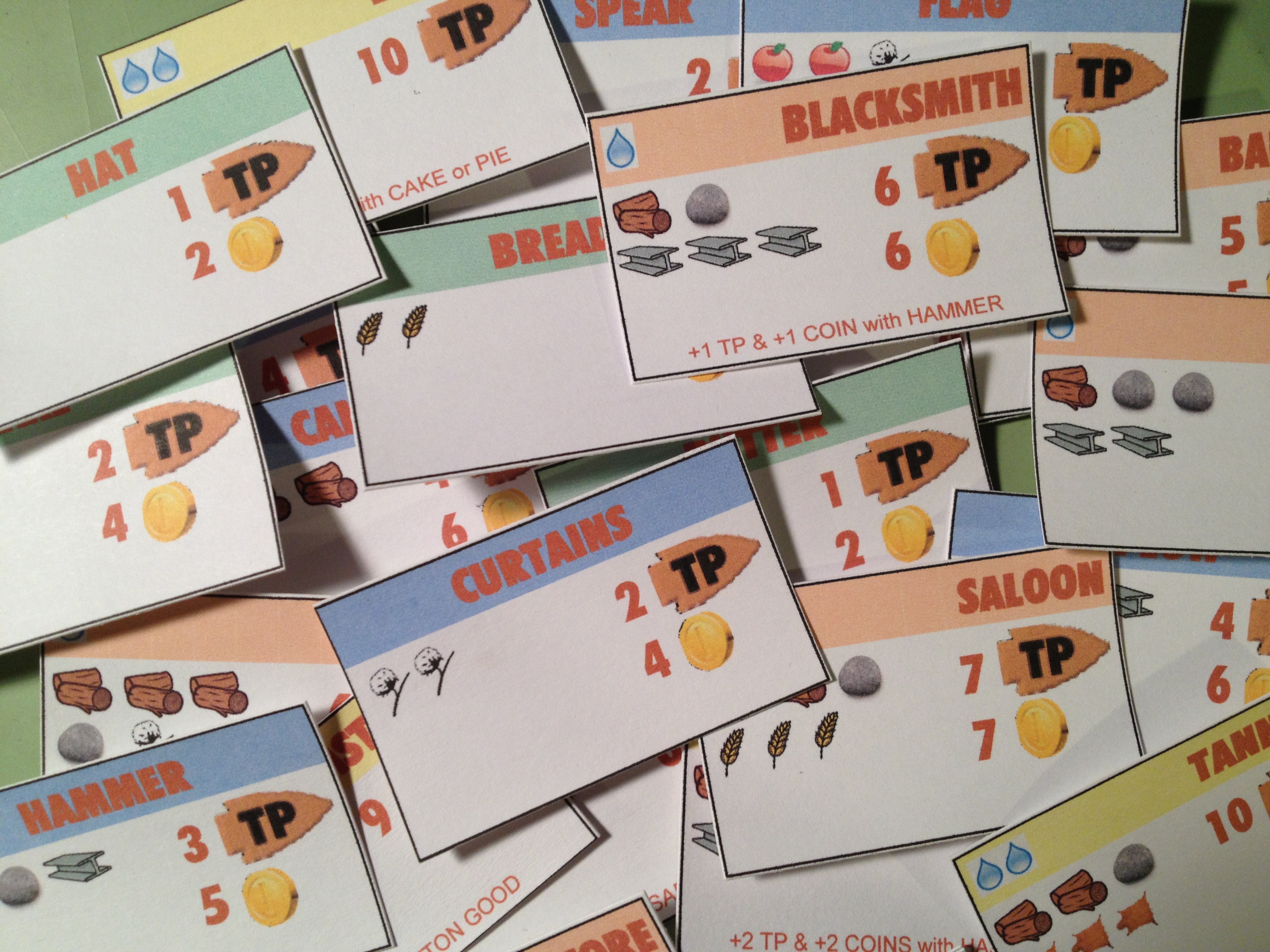
Trading Post Order Cards. Excel is NOT a graphic design tool!
So made a stack of about 50 order cards that would come out randomly, four per year. These would be available on a first come-first serve basis. The cost is shown on the left. In the image above, for example, the curtains would cost 2 cotton. The reward is on the right. In the same curtains example the reward was 2 Trading Points and 4 coins. I even added further complication by having some order cards provide a bonus if the owner already had fulfilled a prerequisite. In the image above an example is the BLACKSMITH. If you had fulfilled the HAMMER order card for the Trading Post and then fulfill the Blacksmith card you would earn an extra point and an extra coin. I suppose I added this to the design to produce a more guided decision tree to players.
In most of these images the way the prototype components were made was by printing on normal paper and glue-sticking them to 60lb. paper. The problem with this method is warping. And it was a big problem with the original Trading Post components. This is one reason that I have moved on to gluing stuff to matte board or chip board.
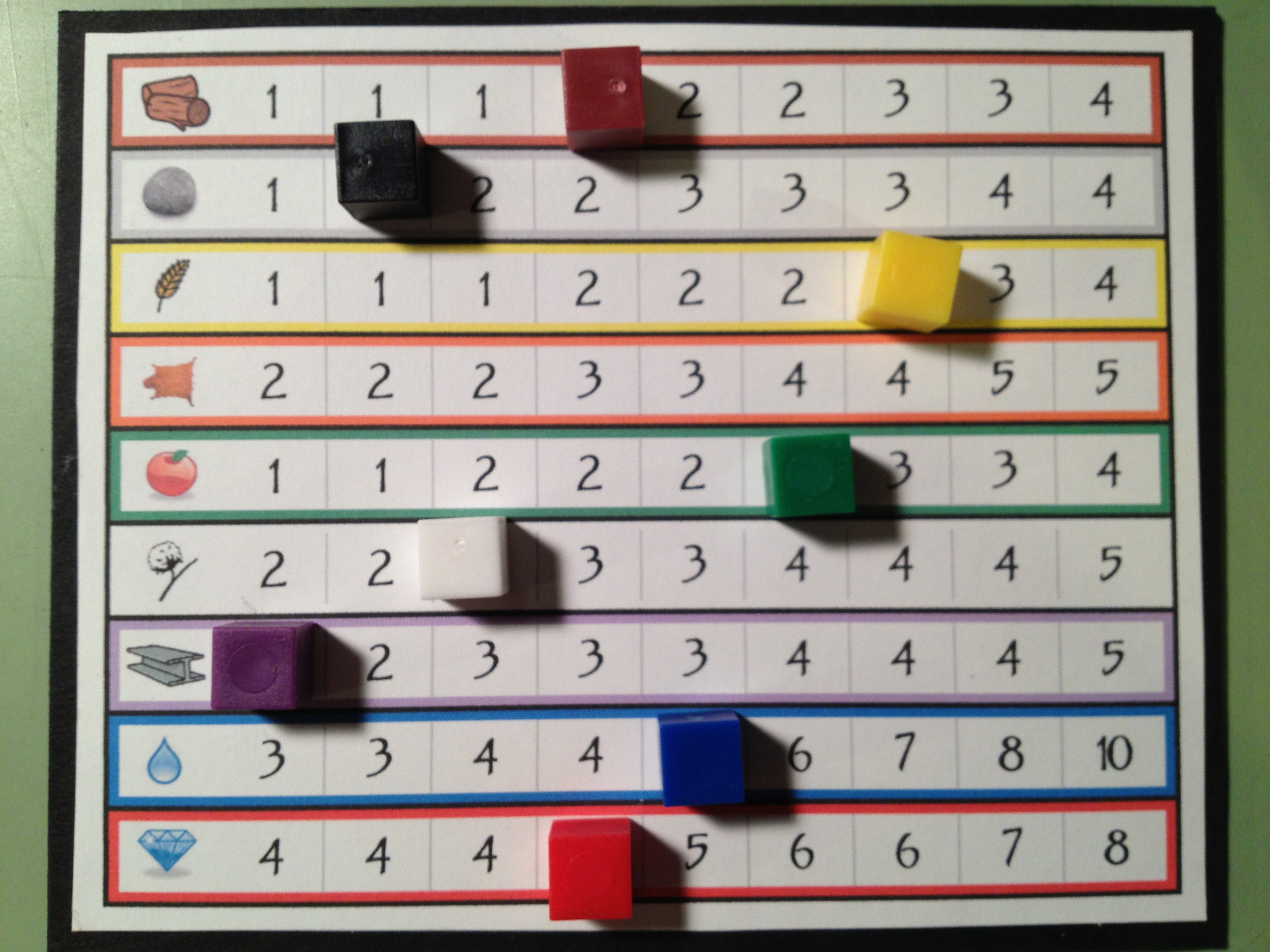
The market.
By this point in the design I had the board, the territory tiles, the event cards, and the orders. A market board was also built for the game to allow people to trade for different goods. This would be the driving economic factor of the game, but would also allow players to obtain goods that their randomly seeded territory did not produce. With all those components in place it was time to focus on what was in front of me… the player mat!
The Player Mats:
Since I knew that I wanted a main concept of the game to revolve around exploration I decided that upgrading your ability as an explorer would be critical. Thematically that meant going from a “trader” to a “trader with a horse” and eventually to a “trader with a wagon.” From early on in the design I limited the explorable zone for a “trader” to the first two rows out from the Trading Post. The idea behind this that fit the theme was that a man or woman could only walk, explore, and carry enough food for an expedition two rows out from the Trading post. By upgrading and purchasing a horse you’d be able to move faster and thus could explore more territory on the same rations. So when you purchased a horse you would be able to explore rows three and four away from the Trading Post. Finally, if you wanted to explore the outer most regions you would need to build a wagon.
So there is a side objective of all players in the game to be collecting the components they needed to be able to build their wagon. In the design I set it up so that you had to procure certain items. Once you had all these items you had a de-facto wagon. The wagon would allow you to explore the fifth row from the Trading Post.
I designed the player mats to show how far you could move and how much you could carry based on your status. And I included a Wagon Construction Area showing your progress toward a wagon. Here’s a look at the first and second versions of the player mats:

The top shows the original version. The bottom shows the cleaner, more user-friendly second version.
The cool thing, or at least what I thought was cool, was that in the second version you would actually be building your wagon by placing the pieces on top of the illustration.
One other thing to point out about how the game worked is illustrated in the second version of the player mats. There is a row for INCOME and a separate row for MONEY. Thematically the INCOME row represented any money earned during your turn. This would be like getting a paycheck. The way it worked was that after your turn, your income would be added to your money and then the income track would be set to zero. This means that any money earned on your turn isn’t available until the next turn.
I would say that through this whole prototyping process, which occurred in mid-2011, my favorite components were the player mats.
Overall Prototyping Experience:
The best possible tip I could provide to designers regarding prototyping would be this:
Just make something functional and test it. Only put in the effort to make it look good once you know it’s working.
Next week you’ll see that I don’t heed my own advice. But I’m inhibited by my desire to make things look good. And now that I know how to use Inkscape it takes much less effort to produce something that looks good.
Looking back at all the things I did for Trading Post I’ve realized that I wasted a lot of time. I built spreadsheets. I wasted hours using The Gimp to make that board. I added needless complexity, which then required me to make more components.
The game was only attempted to be playtested in its previous form twice. The effort to playtest ratio for this game is just ridiculous. So next week I’m covering my hiatus from the game, how I’ve advanced as a designer during that hiatus, and now how I’m going about redesigning the game. With that in mind I’ll leave you with one final image, which is a printout of a spreadsheet that I made so I could take notes on. This illustration sums up all the things that I am trying to avoid with the redesign!
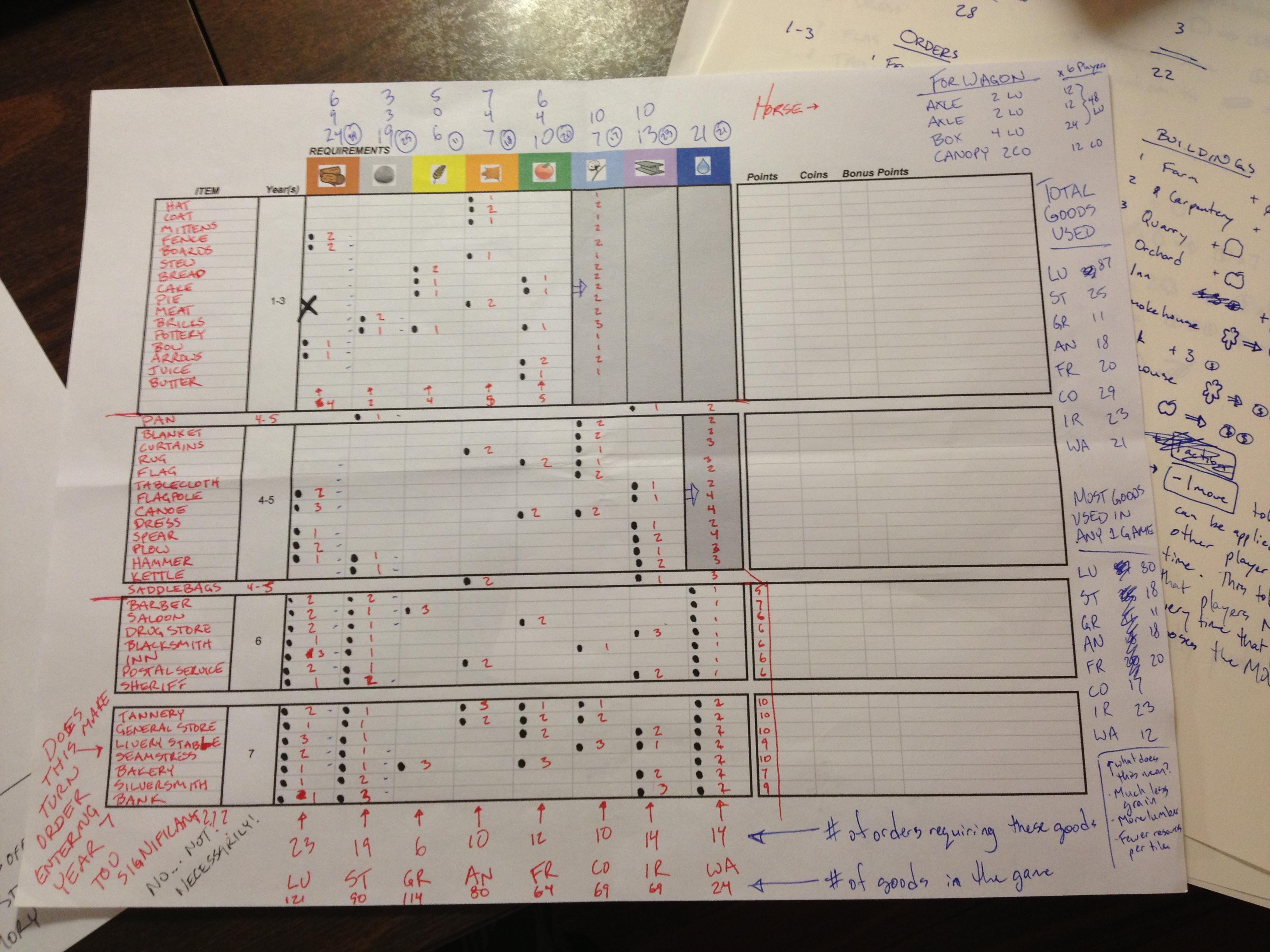
Wow. Just wow. Next week you’ll see dramatic improvements!
Thanks for reading. I’m happy to answer any questions you have about Trading Post and the things I’ve posted so far. Just share your comments below!
Trading Post Part 1: Origin
Trading Post Logo… for now.
I have a new game design I’m working on and today I am posting the first of 4 articles about it. Today, and the next three Thursdays, I’ll be writing about the game from it’s creation to the present state. Here’s the four articles I’ll be writing:
- TODAY 5-16-13: Origins of Trading Post
- 5-23-13: Prototyping Early Versions
- 5-30-13: Hiatus and Re-design
- 6-6-13: Path to GenCon
So let’s jump back to 2010 when I was first diving into game design and take a look at how Trading Post became a thing…
Concept: Theme
Here you are, explorer extraordinaire! You have been selected from an elite group of explorers to develop a new Trading Post. You role, should you choose to accept it, is to utilize the resources found on your section of their territory, and contribute the most to the Trading Post. Contributions include constructing new buildings for the Trading Post, successfully exploring all of your allotted territory, and completing trades that are beneficial for the Trading Post.
Concept: The Map
Normally when I start a new game design I start with a theme. Trading Post is an unusual case in that it started with both a theme and a map mechanic to be used in that theme. For some reason I thought that a square grid with spots on the corners for putting cubes would be a good idea. And it would seemingly work very well with the Trading Post concept.
Here’s a look at one player’s section of territory in very alpha artwork, if you can refer to lines as artwork:
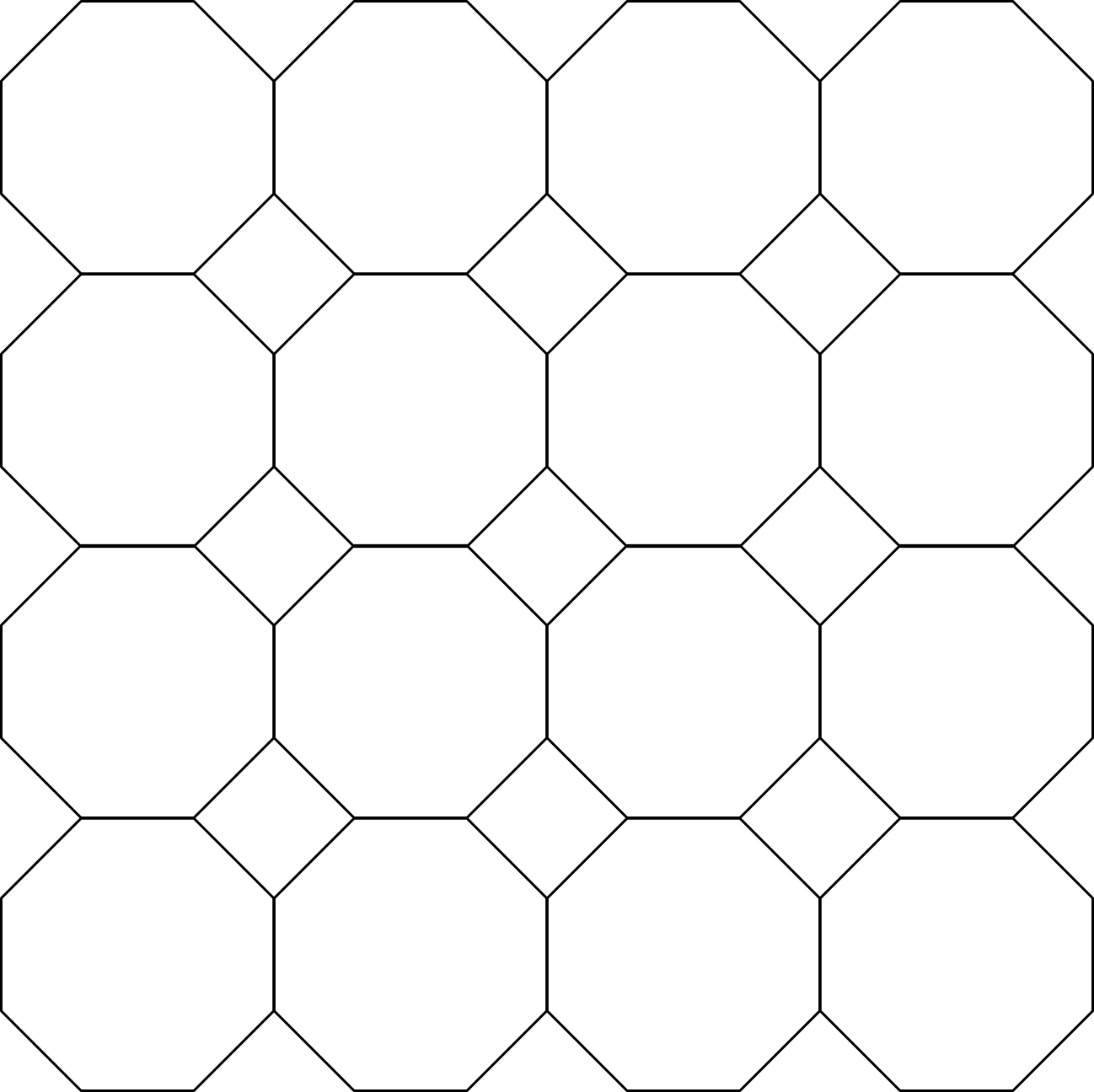
Octagons represent land/buildings. Diamonds represent resources.
The idea of the map is that you can explore the land and add buildings to the octagons. Then each building can produce something that you can place into the diamonds. The resources would be represented by cubes, which would fit very nicely into the diamonds. The really sweet part of this map design is that you have to try and move your goods into the diamonds that adjoin to your territorial neighbors so that you can trade with them without having to use the Trading post as a middle man.
Concept: Game Play
With a theme and map mechanic in place it was time to figure out how the game would actually be played. I had found a really nice article online about what makes a game good. It included things like Tension, Replayability/Variability, No Runaway Winner, No Kingmaker, No Player Elimination and more. If anyone know of the article can you share the link? I can’t ever find it. So after working through some of those things in my head I came up with a ladder type design where you would become more capable of doing more things on your turn.
The idea of this was that you would start as just a person in the Trading Post. You would thus be able to move one spot per action, and you could only explore up to two rows into your territory. Since exploring all of your land is part of the game it would be important to build up the capability. So the first step would be to purchase a horse via trade with the Trading Post.
Once you traded for a horse you would be able to move two spots per action. You would also be able to explore the next row. In the game design the tiles that would be available in this “Horse Region” were better than those available in the “Person Region” (first two rows). This would allow you to do more stuff, make better trades, and work toward the wagon.
The Wagon was the last “upgrade” you could do. To build the wagon you would have to make a series of trades to procure the necessary components: wheels, axles, canopy, box. Once you’ve upgraded to the wagon you can then move three spaces per action and explore the furthermost regions of your territory. This is vital as the most valuable resources are only available in the “Wagon Region.”
Concept: Time and Action Points
During the game each action would cost a certain amount of time. The game would be played over 7 years with each action costing a certain number of months. So moving would cost 1 month. That’s why it would be important to upgrade to a horse or wagon as early as possible to be able to move more spots with the same action. Basically with the game being 7 years of 12 months each player would have 84 action points to work with.
Because I made “time” part of the game I was able to also have the seasons play a role. Each year had a new “Event” card come up that affected something for the year. This could be seasonally dependent as well.
So I came up with a series of event cards to add several things to the game design:
- Replayability: Each game would be different since the draw of event cards is random.
- Variability: Specific scenarios of event cards could be established to promote specific game play.
- More details: Having event cards made the game deeper, in my opinion.
I found early on that having a time mechanic like this made things difficult to design. Since players weren’t always taking the same number of actions on a turn I had to incorporate a “last player gets a turn” mechanic similar to that in Glen More. By doing this I would never have to worry about how player order worked.
The other downside of having 84 actions points (84 months) in the game was that every single turn players would have to advance their “months” token and potentially their “years” token if they entered a new year. Fiddly.
Concept: Overall
I thought I really had something with this game design. I was gung ho about putting together a prototype and making this into the most awesomest game ever. With 8 different resources, 84 action points per player, upgrades to a horse and then wagon, land development, trading, exploration, etc. I knew this would be awesome. Perhaps I was being a little too optimistic.
In my mind I thought this game had a lot of potential. I put a lot of time into it early on only to realize that it was ridiculously complicated. Next week I’ll cover my initial prototyping efforts and the lessons I learned during that phase. In two weeks I’ll share with you the current re-designed version, which is night-and-day better, potentially even being a playable and fun game. And three weeks from now I’ll discuss my path forward with the game as we approach GenCon.
If you have any questions or comments about the game over the next three weeks, just let me know!
Scoville Print and Play Version 2

Version 2 awesomeness now available!
I am pleased to announce that Version 2 of the Scoville Print and Play files are available for download at BoardGameGeek.com. Here is the link:
There are no major rules revisions to the game. The only clarification to the rules is that when selling peppers you must sell peppers from your own supply. Peppers in the fields are not for sale.
There are a few changes to the Print & Play files. The most notable change is that Gold has been dropped in favor of Silver. I’d like to thank Adam “A-Game” Buckingham for the suggestion. This was done for two reasons:
- Black + White blends to gray, not gold. So from a color perspective this is much less confusing.
- There is a much lower chance of confusing yellow with silver. These two colors are now more distinct.
The PnP files also have a few other revisions. These include:
- Artwork for the Bonus Point Tiles for secondary peppers (green/orange/purple) has been adjusted to decrease confusion.
- The Field has been slightly increased in size to better fit with the pepper tiles.
- The pepper tile artwork has been changed to help with color blindness and for clarity.
Here’s a peek at the revised pepper tiles:
 By adding the pepper image to each tile it will help with color blindness. Each pepper is a different shape. And by changing the artwork to include the green border it should help to clarify where the player pawns will actually be walking. I showed this image to my wife and she said she thinks the game would be better with these rather than the cubes. This was actually a suggestion of Brett Myers (@brettspiel) during Protospiel-Milwaukee, so I must give credit where credit is due!
As usual, if you have any questions about the PnP files or the rules, or the game in general, please feel free to leave a comment here on Boards & Barley or on the BGG download page. Or feel free to email me. And I’d love to hear what you think about the game!
 Boards and Barley