Category Archives: My Games
On this page you’ll find information for the games I have designed or those that are in the works.
Scoville Coming Soon!
 Hi Everyone! I’ve been having a bit of writer’s block lately and I finally realized why. It’s because with the Scoville Kickstarter launching soon my brain has been floating in hyperspace. I completely missed October. And I don’t think there’s been a night so far in November where I haven’t dreamed about the game of the Kickstarter or the artwork. I might be losing my mind.
Today is a Friday which would normally be a Review day or a Design Me day. But I’d rather write about Scoville and give you an update.
Art by Joshua Cappel
I couldn’t be more excited with the artwork choice by Tasty Minstrel. If you’ve read my board game reviews then you know I commonly list artwork as either a positive or negative for games. That’s because artwork is a big deal for me.
So when Tasty Minstrel told me that Joshua was on board I was elated. I love his style and the flavor that he adds to the game. Here are a couple of samples of his artwork. These are not images from Scoville. The first is from Garden Dice and the second is the board for Belfort:


That’s some awesome stuff. If you haven’t played Belfort you should really go check it out. And make sure you look for all the cool easter eggs on the main board!
While the prototype is basic and I have not added much artwork to it, I have had a vision for the artwork basically from the start. And if the funding hits a certain level then that vision will turn into reality! I’m so excited to see what Joshua does with the game!
Campaign Teasers
Well, unfortunately I can’t really say very much. But I’ve seen the KS preview and I can tell you things are moving along nicely! We’ve got a great lineup of stretch goals. I’m probably not supposed to say this and I might get in trouble for it, but Pepper Farming Meeples may or may not be one of the stretch goals. *wink wink*
I’m also probably not supposed to share this potential stretch goal (peppers instead of cubes). So don’t tell anyone! (or tell the world – this awesomeness should be shared!). Here is a quickly done example of what the peppers could look like. The colors aren’t perfect and I believe the platinum pepper may have a nice shiny coat, but don’t hold me to that!

Wouldn’t you rather be planting these instead of cubes?
BGG.con
So that’s all I can share today. I’m hoping to be able to tease you with some artwork next week, but let’s not count on that. But for those of you who are attending the Board Game Geek Convention from the 20th to the 24th I will be there demoing the game basically all day and all night. If there are other games you are interested in checking out, then let me refer you to this geeklist:
So if you want a demo I’ll probably be running them every hour on the hour. But if you miss the top of the hour, don’t let that stop you from checking it out! It’s gonna be an awesome time!
Monday Brews: 10-21-13
Though over half of Monday is gone already, I’m finally able to post my Monday Brews article. I hope your Monday is going well. As per my usual approach I present to you the Boards and Barley that I enjoyed this past week:
The Barley:

Delicious!
New Belgium Fat Tire: A classic, solid choice for a beer. Enjoyable.
Ale Asylum Madtown Nut Brown: I enjoyed this with my boss and several colleagues as we greeted a former student who has returned to town. On tap it’s a pretty decent brew.
Rathskellar Red: This beer is produced by the UW Union and was very enjoyable as well.
Abita Fall Fest: I’ve had better beers and I’ve come to realize I don’t care for any from Abita. But if you’re in the mood for some New Orleans style, then Abita is for you!
Tyranena Painted Ladies: I’m a sucker for pumpkin beers and this one did not disappoint. Unfortunately it appears the season for Oktoberfests and Pumpkin beers is waning despite Halloween still over a week away.
Left Hand Brewing Nitro Stout: This milk stout was more enjoyable than the MKE Brewing Polish Moon Milk Stout that I wrote about previously. This was was much less “Earthy” tasting, thankfully!
Kentucky Bourbon Barrel Ale: I’ve decided that I do not care for strongly aged bourbon barrel beers. If I want bourbon I’ll just drink bourbon. This beer was overwhelmingly bourbon-y. I hate to say this, but I would have rather had a PBR.
North Coast Brother Thelonius: I enjoyed this while being a guest on the Building the Game Something from Nothing podcast that aired last night. It was a mighty fine brew in a delicious Belgian style that I will likely drink again!
The Boards:
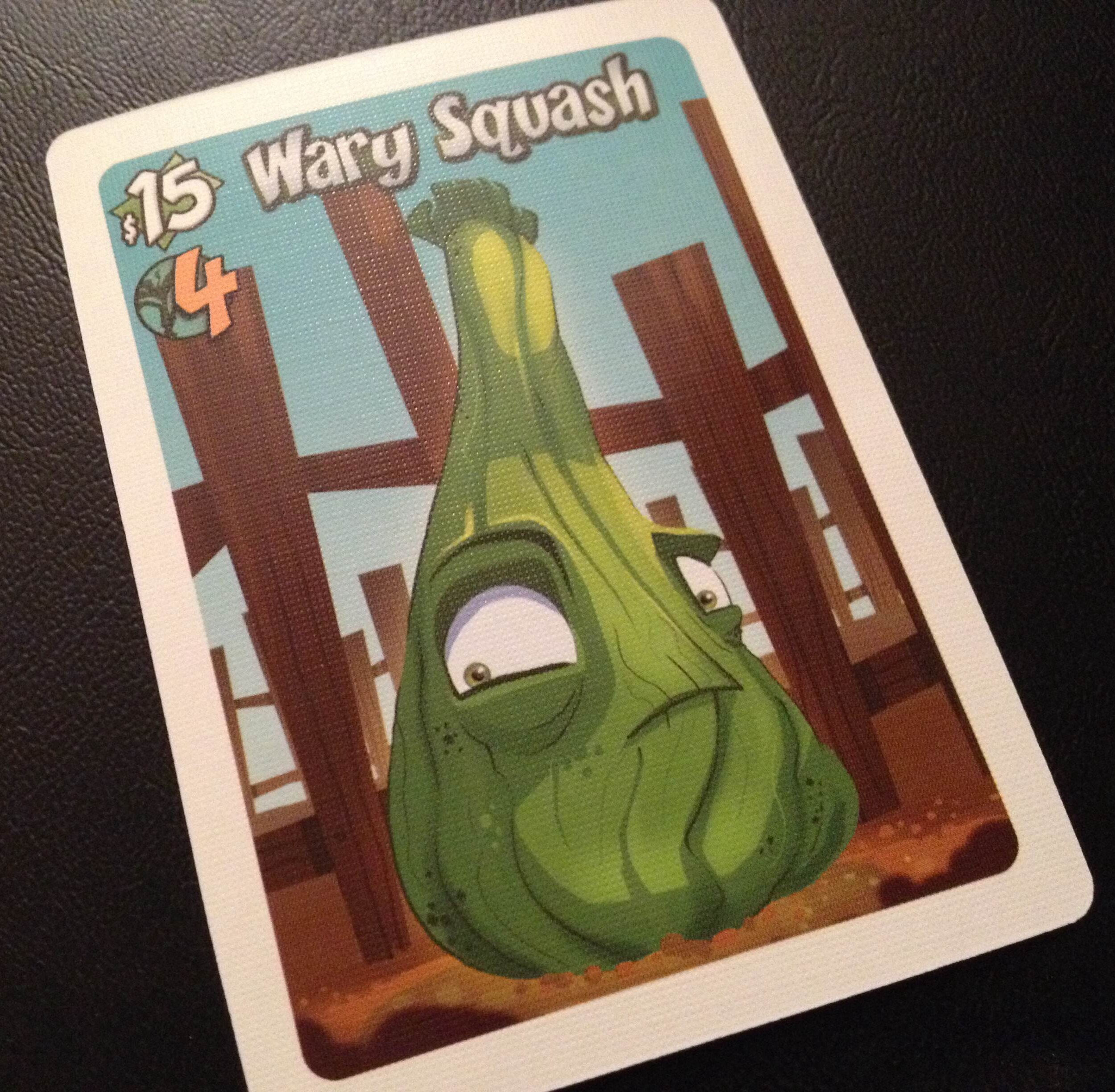
Amazing artwork and awesome gameplay make Farmageddon a great game!
Farmageddon: I broke this out at Board Game Night and it was thoroughly enjoyed for its cut-throatty awesomeness. We played a tight game that ended up being not so tight as the winner had 46 points and last place had 16. This was a very fun game and I highly recommend it!
Scoville: I got to play my game again! I taught two new players and they both enjoyed the game. Scoville will be up on Kickstarter to coincide with BGG.con in November! I don’t think I could be more excited! Here’s another exclamation point just because!
Long Shot: We played with 8 players and utilized a few house rules to speed things up. The result was that we played the game in 35 minutes! The house rules included being able to bet $10 at a time and rolling both dice twice on your turn so horses move faster. It’s such a fun game and these rules made it more enjoyable since it didn’t take an hour and a half.
***
So those are the Boards and Barley that I enjoyed this past week, What did you enjoy?
Also, is there any interest in having a “Designer’s Corner” section in these articles where I discuss the designing work I’ve done each week??
The Game Design Queue

What would you do with an extra hour each day?
Time only offers itself once. So you’d better use it as efficiently as possible. As every designer knows, it’s rare if you are ever working on only one project. I am just the same. I am currently working on four projects, not including Scoville.And I could certainly use a few more hours in the day. So I thought I’d give you a status update for each of the games currently in my “active” queue. My hope is that by writing this I’ll get a better idea of which game(s) on which I should focus my few game design hours per week.
And I’ve decided to set a goal: I want to have a playable and fun game by Christmas.
In the past I have set emotional goals, like “I want to send a game to a publisher by October.” How is that an emotional goal? It’s emotional because it has to do with making me happy versus making a good game. So this new goal is avoidably non-emotional. It’s all about the game. So I am going to attempt to spend the next three months hammering away at the stone to reveal a beautiful sculpture, and hope that it is a decent board game!
Let’s get started with last week’s Design Me game…

Quantum Orcas
I designed it last Friday and by Saturday evening it had already been through four playtests. I’m not sure what your typical Concept to Playtest timeline looks like but this isn’t my typical timeline. There are a few things that the game has going for it to have allowed for four playtests.
- It’s simple to prototype
- It’s simple to teach
- It plays in about 10 minutes
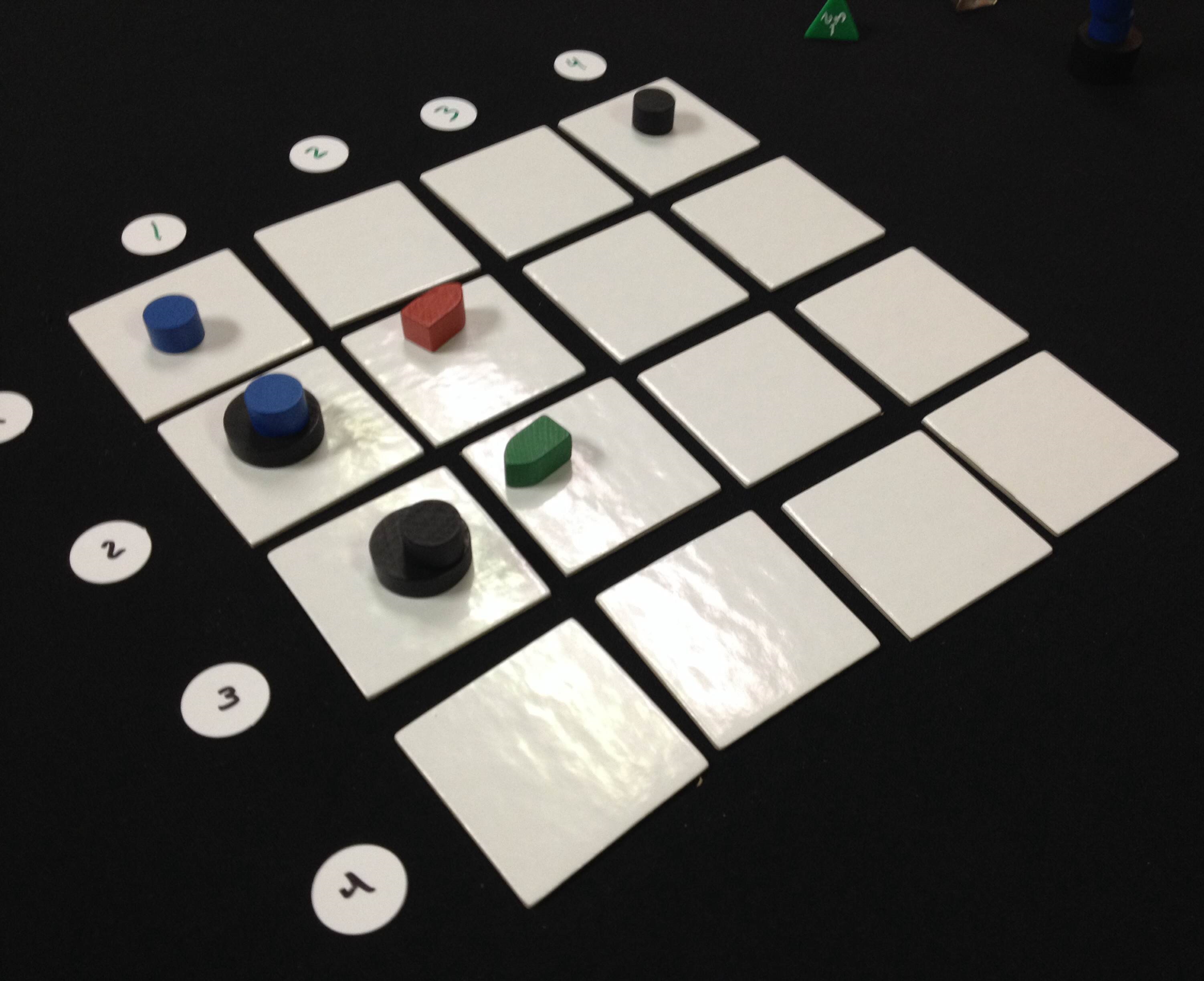
Quantum Orcas (Prototype)
So when I arrived at Protospiel-Milwaukee last Saturday I snagged a few of the free components that The Game Crafter had donated and threw together a copy.
In the game you are a killer whale who can jump across time, which is represented by jumping across the 4×4 grid. The game lasts 8 rounds. Each round two new boats are placed randomly into the grid using two d4s. Then each player chooses one card, which represents a location on the grid, to jump to. If there are boats there, they can eat them. If there are multiple boats, then they’ll have to discard cards to eat them. There are a few other rules, but the player who eats the most boats wins the game.
I think I might be able to design this into a complete game by next week, let alone by Christmas. It could also easily be rethemed. In fact, during Protospiel-Milwaukee I did retheme it based on some components available there. Several people playtested it with the theme of Space Monsters eating asteroids. So maybe I’ll have the game be dual-themed. If you like the killer whale idea you could play on that side of the tiles. If you like the Space Monsters theme you could play on that side.
The bottom line is that this game was fun, plays quickly, and comes in a small box. That’s an awesome combination.
Conclave
 I’m not typically an area control/area majority kind of guy. However, Conclave is all about area control. In the game you represent one of the Preferiti, the cardinal’s on the short list to be the next pope. You are also representing a order of Catholicism, which can allow me to do some interesting things with the design.
The current state of the game is that it isn’t very fun. While I think there are some interesting mechanics in the game, they just don’t seem to work together to make something that is fun. That’s not good.
But I have some ideas. Since the game revolves around holding the control of different tables, with varying numbers of cardinals sitting at them, then I can add in objectives to the game while keeping it reasonably thematic. The idea would be that the game can be won if a global victory condition is met, otherwise it will be won by a combination of points, which represent how well you manipulated the college of cardinals.
There would be both shared and secret objectives. Once a player completes a shared objective, they place a pawn on it and will earn those points at the end. When a played completes a secret objective it must be revealed. This card will remain in from of them and will be scored at the end.
So I have some good paths forward with Conclave. Now I just have to decide where it actually resides in my priority queue.
Trading Post
 Call me Ishmael, for I have discovered a white whale by the name of Trading Post.
Trading Post was my first experience with trying to design a really heavy game. I failed miserably. However, I love the theme and some of the core mechanics so I’d like to do a third complete reboot. Note, however, that the first two reboots were more like retrofitting rather than redesigning.
To redesign the game I want to achieve the following things:
- Make it more historic
- Make it focused on Trading, explicitly about trading furs for European goods.
- Make it fun.
- Make it complex.
So I sat down at the end of August and came up with what I think will be a really great game. The idea of the game is that you are a Trader working for a Trading Post. Your objectives in the game (read: “Ways to score points”) are to go on hunting excursions to collect furs, trade furs for goods, use goods to help build the Trading post. That’s the 10,000 foot view of the game.
There are a few other things going on in the game that I think are unique and interesting. There is a time-dependence for being able to do things in the game. For example, when you send furs to Europe, they have to ride on the boat, which takes time. There is also a concept of chopping wood and floating it down the river towards the Trading Post. So players would have to set themselves up to receive the large amounts of wood when they arrive.
Overall I’m pretty excited to be able to think about this game from a fresh perspective. It’ll be interesting to see how it comes along.
Brooklyn Bridge
This is a very recent game design of mine. As you can imagine, the theme is that of the Brooklyn Bridge. In the game you represent a crew of workers that are helping to build the bridge. It is similar to Stone Age in that you place workers in different areas of the board one location at a time. It is different from Stone Age in that one player cannot remove all their workers and take all their actions at once. Instead, players will remove their workers and take the actions one location at a time.
What that introduces is an interesting dichotomy about placing and removing workers. You might be able to get a good spot in the Materials office, but someone might beat you to building a section of the bridge. You might get lucky and not experience the bends when working in the caisson, or your worker might have to undergo a stage decompression.
This game will be a balance between obtaining goods and earning money. The goal is to contribute the most to the bridge and that will ultimately be the player who earns the most money.
As of today this is still a pretty rough concept. I’ve mocked up some tiles so that I can test a few things. I’m not sure this one (or Trading Post) could really be a full prototype by Christmas, but we shall see.
The Path Forward
So those are the four concepts currently in my active queue. This gives me enough variety and enough challenges to work on while not being overwhelming. But if I try to work on all four then I’m afraid none of them will be ready before Christmas. So I present my first ever poll, for which I am sure to get thousands of votes. Please vote for the game design you would most like to see fully prototyped:
Thanks for reading and voting! I’m hoping to bring you good game design updates over the next three months!
Design Me: Area Movement
It’s time to flex my brain muscle once again! Why? Because it’s a Design Me Friday! Every other Friday I do some exercise… of the mind! The idea behind these Design Me articles is to practice being creative and see what I can come up with in the spur of the moment.
In the last two exercises I designed a dice rolling worker placement game about brewing beer and a grid movement resource collection game about flying your aircar around a distopian world. What ever might I come up with today???
Once again I am using the tool from Boardgamizer for the inspiration for today’s exercise. Let’s see what it came up with:
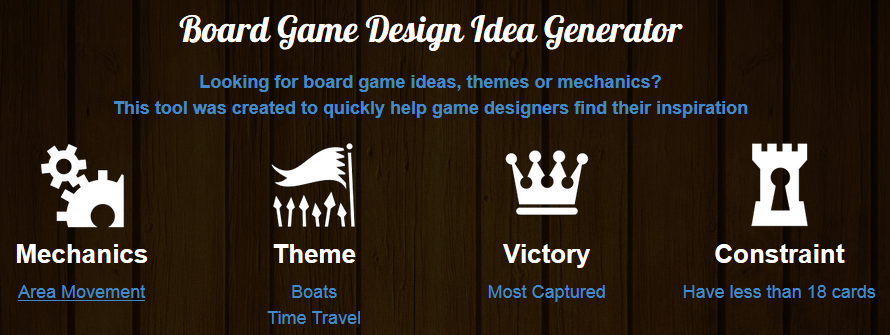
Time traveling boats capturing other boats while only having 18 cards. This could be challenging to design!
Quantum Orcas

A little closer and that boat’s a goner!
Alright, where would one begin with a time traveling boat game based on capturing other boats all while having less than 18 cards?? Time Pirates is the first thing that came to mind, but I cannot compete with the Alan R. Moon version of that game. So I’ll go a different route. Whales.
This is only my third Design Me article, but all of the names of these fake games have been terrible. So there’s no reason I can’t call this game Quantum Orcas. But I admit, it is a pretty lame title.
In Quantum Orcas you are a killer whale that likes to eat boats. You also possess the awesome ability to jump through time. Okay… you can’t really jump through time. You can merely freeze time to make it appear that you are jumping through time. I guess the whales realized that swimming was too slow so they had their scientists (Beluga whales) design time jumping suits for them to wear so they could eat more boats.
Setup
I’m designing this as a two player game of epic boat munching awesomeness. Here are the components:
- 48 Cards (16 for each player and 16 for the grid)
- 8 Number tokens to mark the grid (4 gray and 4 blue)
- 2 Four-sided dice (one gray and one blue)
- 2 Whaleeples
- 6 Large boat pawns
- 12 Small boat pawns
- Rulebook
The objective of the game is to chomp the most boats. To set up the game, shuffle and randomly place the 16 grid cards into a 4 x 4 grid. Then line up the blue and gray number tokens along the top and left edges of the grid as shown below. Then each player will roll the two 4-sided dice to determine their starting grid location. In the image below Blue rolled Gray-4 and Blue-1 while Green rolled Gray-2 and Blue-3.
Each player has a hand of 16 cards that represent the grid locations. Throughout the game you can only play each card once. The game is played over 10 rounds, so not all locations will be visited by both players.
At the start of the game each player will roll the two dice to determine the location of a small boat and a large boat. Therefore there will also be 4 boats out on the water. Note: Boats cannot be placed on the whale locations, so if that happened, the dice should be re-rolled until the boat can be placed on a vacant spot. Here’s the game after initial setup:

The orcas are getting hungry!
How to Play
In each round (except the first) players will each roll the dice to determine where to place a new boat. Once rolled, players will choose whether to place a big boat or a small boat at that location. At this point it does not matter whether or not a whale is already at that location. Place the boat there anyway because the whale will be moving off of that spot.
Once the boats have been placed then the players will choose a card from their hand, which represents a grid location. Each player will reveal their card simultaneously. Players will then move their pawns onto the corresponding grid spot.
If there is a small boat at that location, players will “EAT” the boat and move it to their area on the table in front of them. If there is a big boat at that location, players will “EAT” the boat and move it to their area on the table in front of them AND randomly discard one of their remaining cards. Over time a whale may come to a spot where there are more than 1 boat. If this is the case, the player may discard cards from their hand equivalent to the number of boats on that location and then eat them all. For example, if the green player moved to a spot where there were two small boats, that player may discard two cards and eat both of them. A player may choose to not discard any more cards and then would get to eat only a small boat from that spot. Big boats always require the discarding of a card, so if a whale came to a spot where there was a small boat and a big boat, it would cost three cards to eat them both.
Note: discarded cards are removed from the game.
Once each player has moved their whale and eaten a boat if possible, then it’s on to the next round. Note: this movement mechanism represents the whales jumping through time to come up on the boat without the boat being able to flee.
If, however, both players chose the same location then it becomes a Whale Duel! Players check to see how many boats they have eaten (Big boats count as 2 small boats). If one player has eaten fewer, that player wins the duel since their voracious appetite would cause them to womp on the other whale and win the battle. If both players have eaten the same number of ships then each player will choose and reveal a card from their hand. They will add together the blue and gray values. Whomever has the highest total will win the battle and will have to discard their card. The loser does not have to discard their card. If there is still a tie, no player eats the boat and the bosun and captain grab a bottle of rum and celebrate!
After ten rounds each player will total their value of boats eaten, keeping in mind that big boats count as 2 small boats. The player who has eaten the most boats wins the game!
Your Designer Perspective
So what would you change about this game design? Did I miss anything major? Are there holes in the design? Anything seem broken?
Those are all excellent questions that designers need to constantly be asking about their designs. I challenge you to use the Boardgamizer tool to try and come up with something on the fly. It can be a lot of fun!
Today’s Design Me exercise was actually a lot of fun. I think I could mock this game up relatively quickly and see how it plays out. Thanks for reading today, and don’t forget to exercise your game designer brain!
Scoville Print & Play Version 3

Let the awesomeness be printed and played!
Ladies and Gentlemen. I am pleased to announce the latest update to the Scoville Print and Play files!
You can find the files on Board Game Geek:
http://www.boardgamegeek.com/filepage/90053/scoville-print-and-play
On that page you can also find Versions 1 and 2 of the PnP. In case you are interested, here are the things that have changed for Version 3:
- The “Pay $6 to plant an extra pepper” rule has been removed.
- Three new “Bonus Abilities have been added: +1 Move during Harvest, Plant one extra pepper, Double Back Once during Harvest
- The recipes have been revised to be more balanced in terms of cube distribution.
That’s the current update. These changes have an interesting effect on the game play, but do not change the overall feel of the game. Bidding will likely be higher since coins can no longer be used to plant an extra pepper. The coins are now only for two things: bidding and end-game scoring.
I would love for you to test this new update. If you do, please let me know how it went! Thanks for checking out Scoville!
 Boards and Barley