Blog Archives

Monday Brews 2-10-14
Welcome to another Monday. I’m hope you are having a fantastic day! I am. That’s because over the weekend Scoville funded on Kickstarter! Woo hoo! Now we are on to the stretch goals!
Before we get into the Boards & Barley that I enjoyed last week I wanted to inform you that Tasty Minstrel Games has posted a contest to Board Game Geek. Go check it out for your chance to win a copy of Scoville: BGG Scoville Contest.
Okay… now let’s get on to the good stuff. As usual we’ll start with the Barley.
The Barley:

New Belgium Folly Pack
New Glarus Cabin Fever Honey Bock: Again… because it’s so good!
Cisco Brewing Grey Lady Witbier: My friend Ben had some of these. I had not heard of this brewery before. They are located in Nantucket
St. Francis Sloth Brown Ale: I had not heard of this brewery/restaurant until Friday. They opened in 2009 in Milwaukee, WI. It was a pretty good beer and I’m looking forward to a stop at their brewery the next time I’m in the area!
New Belgium Mighty Arrow: I bought a variety 12-pack that had a revival beer called Mighty Arrow. It was a very decent pale ale and the bitterness did not linger. The other cool thing about it was that it had the old label on it.
New Belgium Trippel: I really like the clean and simple approach for the new labels for New Belgium brewing. They still maintain the New Belgium character but now look much better. Nice move on their part. Also, their Trippel was pretty good.
North Coast Old Rasputin Russian Imperial Stout: My wife and I hosted a Winter Olympics party and I was planning to buy the large plastic 2-liter type bottle of crappy Russian beer that costs about $2. Alas, my FLBS (Favorite Local Beer Store) did not have any. So I went with a Russian Imperial Stout. While it’s not a Russian beer, it at least had the word “Russian” in it. People didn’t complain.
The Boards:
X-Wing: I think X-Wing is great! It’s a lot of fun flying through space trying to take out your opponents and trying to figure out what they are going to do. My biggest problem, however, is that my friend’s wallet is hurting a little from all of the stuff that you must have. Okay… maybe you don’t “need” to have it all, but you should!

Awesome Awesomeness!
Belfort + Expansion Expansion: We got to try out the new Expansion Expansion, which features the best name for an expansion ever! I thought it was an awesome addition to the game. With the expansion you choose one of the characters in a reverse draft each round. That character can provide you with a bonus ability during that round or they can be used to let you expand one of your properties. Expanding a property gives you another scoring opportunity, which can be really useful. Overall I am glad to have backed the project. The Expansion Expansion adds a great level to the game and gives you a cool way to build an engine in the game. I’m looking forward to playing again!
Ingenious: This is one of those stupidly simple games that I wish I had designed. I mean, line up similarly colored components for points. That’s the game in a nutshell. It’s so simple, yet also challenging and fun as well. My only beef with the game is that it is possible to end with 0 points by the bad luck of never drawing a certain color. I wish that wasn’t possible. Oh well. I guess I should design my own stupidly simple game that fixes that problem.
Designer’s Corner:
With all this Scoville stuff on my mind I’ve been able to come up with what I think will be a really interesting expansion to the game. I’m not going to give away any details just yet but I’m pretty excited about it.
In other design news, talking on podcasts lately a lot of people have been asking me what I’ve got in the pipeline. The big game in the pipeline is Brooklyn Bridge. It’s my time-based worker placement game with a twist. I’ll eventually make a post all for the game, but the idea is you have a crew that is working on the Brooklyn Bridge. It’s your job to send your workers to purchase resources and utilize them as best as possible. The crew that has contributed the most to the bridge at the end will be the winning crew.
With only 11 days left for the Scoville Kickstarter campaign I can say I’m definitely looking forward to getting back to designing again. The last few weeks have been pretty devoid of design efforts. Go back Scoville so that we can get pepper components rather than cubes!
***
Thanks for reading! What Boards & Barley have you been enjoying lately?
Decision Space in Game Design

New Belgium Brewery offers a nice decision space! Photo via Flickr user quan ha @2009
Decision Space:
– the range of options at the decision maker’s disposal
That simple definition is from a paper titled Supporting a Robust Decision Space from the Association for the Advancement of Artificial Intelligence. It is a nice definition for what I mean by “decision space.”
Decision space is an important concept for game designers to consider when working on their designs. One of the best things a game can offer is a plethora of interesting decisions. One of the worst things a game can do is limit your decisions or take them away completely. There’s nothing worse in a game when it’s your turn and you only have 1 option. It’s as if you have become a robot just going through the motions.
Today I’m going to cover how game designers should consider Decision Space in their designs. At the forefront of game design is the notion that games are supposed to be fun. With that in mind, let’s cover 3 examples of Decision Space in your game can make it better.
- Unlimited Decision Space
- Limited Decision Space
- Tailored Decision Space
Some times it’s good to offer a lot of choices. Some times it’s good to limit a player’s choices. But the point of this article is that the decision space available to players is an important concept to consider in your game designs.
Unlimited Decision Space
Okay… first off, “Unlimited” is a bit of a misnomer. I do not believe there are any games with a truly infinite decision space. Rather, this is meant to point out situations where the decision space is so large that the players do not feel limited in any way. The world is their oyster, in essence.

Build as you see fit!
One great example of an unlimited decision space is the route-building aspect of the classic game Empire Builder. There is a huge map and you have your special little crayon. You can stare at the board and your cards for a long time while yielding the power of the unlimited. Where should you begin your route? Where should the route go? Should you cross the rivers/mountains or go around? How much track should you lay? There are a lot of decisions you could make about the route you want to build.
How is “Unlimited” Fun?
There is a nice liberty in having an unlimited decision space. Players often enjoy being able to choose freely, to mess up freely, to make an awesome move freely.
Consider utilizing an unlimited decision space in games where you want players to have full control and to be fully accountable for their decisions.
Limited Decision Space
Sometimes it is prudent to limit the decisions a player can make. These situations are common at the start of a game.

Starts “Limited,” ends “Awesome!”
Two great examples are Dominion and Eminent Domain. These are both deckbuilding games. In standard deckbuilding games you start with a very limited hand of cards. One your first few turns you will be limited in what you can do.
Limiting the decision space early in a game can be beneficial to help a player get used to how the game operates.
Another example of “limited” decision space comes from the popular game Ticket to Ride. In the game you have three options on your turn. You can draw more route cards, play trains to the board, or draw train cards. And even the choices within those options are limited. You can only play trains to the board if you have the right cards in your hand. You can only draw train cards from the face up cards or the face down pile.
How is “Limited” Fun?
One of the ways that Limited decision space can be fun is by adding tension to game. Using Ticket to Ride as the example again, players have tension due to the limitation. Maybe they just need one more green train to claim that big route. But perhaps another player has already built near the green route. Not that first player is hoping that the other player doesn’t take that green connection that they’ve been working on. But because the decisions are limited, the player has a slight feeling of helplessness.
Limiting the options on a player’s turn can also speed up the game. Sometimes (or perhaps often) the Unlimited decision space games tend to get into the Analysis Paralysis (AP) regime. Limited decision space games tend to decrease the amount of AP in games.
Tailored Decision Space
Tailored decision space refers to situations in games where the decisions you previously made will shape the decisions you have available in later turns in the game. Often games with tailoring offer multiple paths to victory where once a path has been chosen it is better to continue following that path than to start working on a different path.

How will you shape the countryside?
Some of the best examples that I can think of are Uwe Rosenberg’s games Le Havre and Ora et Labora.
In Ora et Labora players start with a plot of land that they are looking to develop. Throughout the game players will add buildings to the land that provide new actions. Then on their next turn, those previously placed buildings add to the decision space available for the player.
This is actually a common thing in engine building games. Engine builders are games where you build something and increase your skills/options/capabilities. In most of these games you can build something, that let’s you improve it, and then make it really awesome. All along the way you can either diversify and build a bunch of stuff that might be mediocre. Or you could possibly build one type of thing and make it really awesome.
The card game 7 Wonders also has a “tailored decision space” feel to it. In each of the three stages you can play cards to tailor your wonder in one of several different types of things. By adding resource production you can set yourself up for different types of things. For example, if you produce the manufactured goods (gray cards) then you can usually do pretty well with the science cards (green). So the cards you choose throughout the game will tailor the decision space that makes the most sense as you move your way toward victory.
How is “Tailored” Fun?
I think having a tailored decision space in games allows players to feel like they are really accomplishing good stuff throughout the game. In Scoville the field acts as a tailored decision space. Each round as new peppers are added you are creating new opportunities for breeding peppers. Each new spot opens up the number of decisions you can choose.
Tailored decision space is also a way that you can steer your strategy in a game. By choosing card A it might make card B much more attractive. Then by choosing card B it might make card C more attractive.
Why Should You Care?
As a gamer none of this really matters. Just find a game that you think is fun and play it.
As a designer, it can be worthwhile to consider the way decision space works in your game designs. Are you limiting players? Are you allowing them freedom of choice?
Decision space is an easy thing to neglect when designing a game. Normally we’ll pick a theme or pick a mechanic and start designing. But I wonder how things would go if a designer chose the type of decision space they wanted and then added a theme and mechanic after the fact.
What are your thoughts about decision space in games? Did I get it completely wrong? Does it make sense?
Monday Brews: 2-3-14
 I’m back from my Florida vacation and I’ve got two weeks of Boards & Barley to report on, which includes a gaming weekend with my friends Brad & Kendra from Green Bay. So there is a lot to cover.
But first I want to remind you that my game, Scoville, is currently live on Kickstarter! Go check it out by clicking the link:
Scoville on Kickstarter!
Now that I got that out of the way I can resume life as normal. While there’s no “Designer’s Corner” this week since all my focus has been on vacation and the Scoville campaign, here are the Boards & Barley that I enjoyed over the last two weeks:
The Barley:
Boddington’s Pub Ale: I enjoyed this from a nitro tap at The Mucky Duck on Captiva Island in Florida while watching the sunset (see image above). Does it get better than that?

Will you ride the wave?
Kona Big Wave Golden Ale: I bought this to try something new during our trip to Florida. It wasn’t very enjoyable and the housekeeping crew was rewarding with three of them that I left in the hotel room fridge.
Red Stripe: I enjoyed this one at a beach-side restaurant in Fort Lauderdale before sitting on the beach in 80 degree weather. I didn’t have to add in that last part, but it helped make the Red Stripe more awesome.
New Glarus Spotted Cow: I don’t recall when I enjoyed this, but this is a common beer to appear on the list.
Stone Arch Vanilla Stout: Brad and Kendra brought this excellent brew for the weekend. It is out of Appleton, Wisconsin. I thoroughly enjoyed it.
Estaminet: I got this with my dinner in Fort Myers since it was a Belgian beer that I had not had before. After drinking it I think it is to Belgium what Miller & Budweiser are to the US.
New Glarus Cabin Fever Honey Bock: And then there’s my current beer crush, which will continue to be on this list because it’s so good!
Redhook Winterhook: I chose this Seattle beer during the game Sunday night because I thought it would be a good beer. It was. And Seattle went on to dominate.
Left Hand Sawtooth Ale: I chose this Colorado beer at halftime to see if it would change the fate of the game. It did not. But the beer was pretty good.
The Boards:
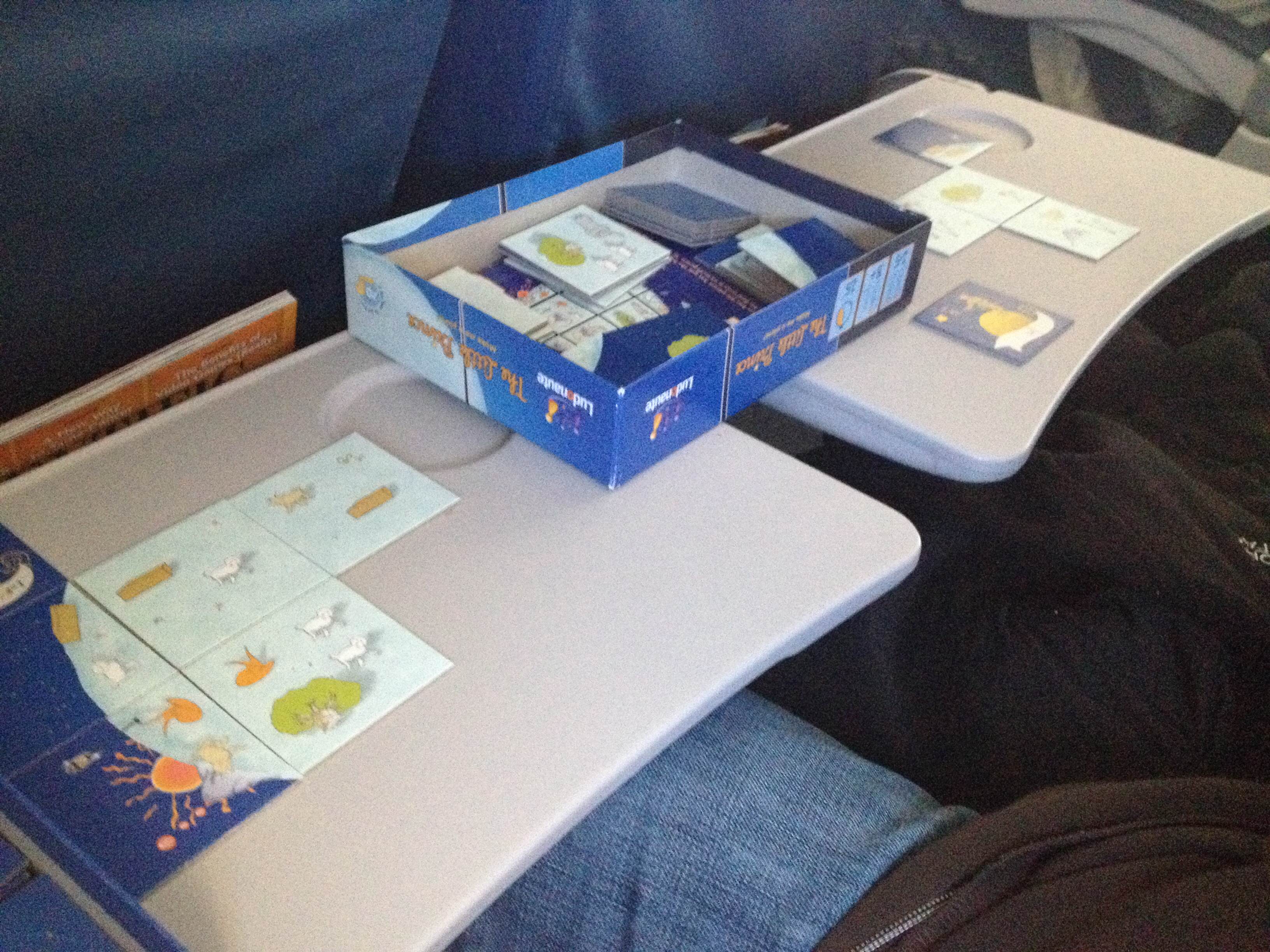
The Little Prince: Airplane Version.
The Little Prince x2: My wife and I got this to the table, sort of. The tables were really tiny and were at 37,000 feet. But The Little Prince worked pretty well in the airplane. This is a fun game for 2 players so it worked well for us to bring it on our trip.
Cribbage: My wife and I love playing cribbage and it is often a refreshing escape from meaty Euros. Unfortunately she pulled out the victory in the end.
Timeline x5: I have been wanting to play this game because it seems like a fun and light game that accessible to a lot of different gamer types. I wasn’t disappointed. We played five times with two expansions and rarely saw the same cards come up. It’s a fun, light game.
Tenzi x10: We also did some serious dice rolling with Tenzi. Tenzi is a game where each player has 10 dice and you roll them to try and get the same result on all of your dice. It’s like trying to get a Yahtzee but with 10 dice and unlimited re-rolls.
Boss Monster x2: I had not played this game before but it was a lot of fun. In the game you are trying to build a dungeon with different rooms that will destroy any hero that tries to enter. If you take too much damage you will lose. If you kill enough heroes you will win.
Kingdom Builder x3: It’s such an elegant and simple game with deep strategy, while at the same time possessing enough luck to make it frustrating when you get the wrong cards. But we love it and we’ll keep playing it.
Ticket to Ride – Netherlands: I really like the anxiety caused by the Netherlands expansion. Players have bridge toll tokens that must be paid for each connection you build on the board. Then if someone plays the same connection they have to pay you the same amount of bridge toll tokens. So there are incentives to playing your connections first, which is not the normal way I play. I love that they mixed it up!
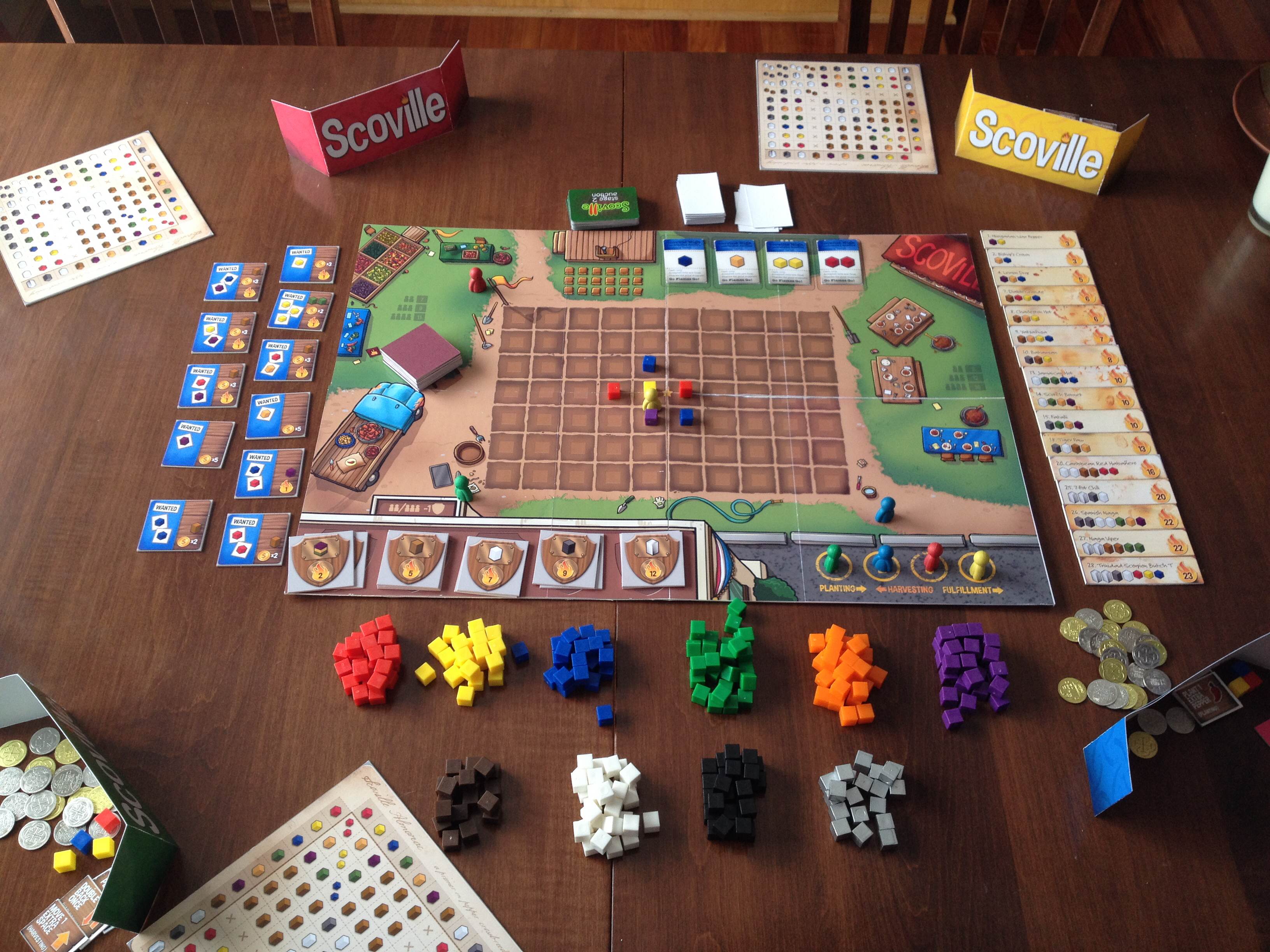
Scoville set up for 4 players during a Gaming Weekend of Awesomeness!
Scoville: With Brad and Kendra in town it was fun to put my “final art” copy of Scoville on the table for us to play. They were both involved with Playtest #4 just over a year ago so they saw how far everything has come along. I ended up winning but only because Kendra didn’t realize that my wife and I each had a Platinum pepper left. So fun!
Village: I played this game over a year ago and remembered it being a little disjointed. You collect goods to use for different things, but all the resource collection and usage felt circular to me and then your people die and it didn’t seem that great of a game. Well I gave it another shot and it still felt the same way to me. I think the death mechanic is really the driver for the game. I’d like to play it one more time before I officially rule it out, but it’s on the fence for now.
Farmageddon x2: I love this game even though it can be infuriating! Players plant and try to harvest beautifully artistic crops to earn money. But other players are lurking to hinder your progress. Can you be the best farmer and earn the most money? And a new expansion should be coming soon! I’ll be picking that one up.
Targi: I bought this at GenCon from the Cool Stuff Inc booth for $20 and I finally got it to the table. It was worth the wait. This was a lot of fun and the decisions were dramatic and tense. I really enjoyed the back and forth concept of blocking your opponent. I’m looking forward to playing this again.
Eminent Domain: I got my copy through Kickstarter and we got it to the table. It is a very fun take on the deckbuilder genre. Each card has both an ACTION and a ROLE. So depending on how you build your deck you can start to tailor your game. I’m very excited to try out the expansion!
Compounded: My wife finally got to play this and she really enjoyed it, which says a lot! We all had a great time playing this. It’s such great game. It was a bit unusual though since we played with the lab fire cards randomly located in the compounds deck. And twice the came out stacked. So the lab was pretty safe after that. I need to learn to shuffle better.
And I probably forgot a few games because we wrote them down on paper instead of recording them on my phone. Never the less, it was a great two weeks of gaming for me!
***
Those are the Boards & Barley I enjoyed, what did you enjoy?
Scoville on Kickstarter!
I was originally planning on posting an article about Decision Space in game design but certain events have caused me to postpone that article. It’s still coming at some point and I think it’s a pretty good article, but today I can’t help but share about Scoville.
Scoville has Launched!
If you are interested in the game and seeing the art or watching me in a video, then head over to the campaign page. The first 24 hours of the campaign saw 498 backers pledge $20,876. I am truly amazed at the response so far for Scoville.
Also, if you are a backer or are on Twitter, feel free to use this image as your avatar! The more we can spread the word, the more likely we will be at hitting our funding goal and the stretch goals.

Designing vs. Publishing
On the Kickstarter page you’ll notice that two of the stretch goals are to add a 5th and 6th player. While some people might grumble that the Print and Play files have always had the capability for 6 players, why does the Kickstarter version only have 4 players out of the gates?
This is a great debate between designing games and actually producing games.
As a designer I could add whatever I wanted into my designs. It could have 2000 wooden bits, 500 cards, 100 modular boards, and so on.
A publisher would never sign a game like that.
So there comes a time when designers must start to think like publishers. In order for Scoville to be up to a 6 player game, it would require more Market Orders, more Recipes, more Player Screens, More Pawns, More Coins, and more Bonus Action Tiles. Each of those elements are things I could easily produce for the few prototype copies that I made. But their are actual cost considerations for a publisher to produce them.
So while it is easy for a designer to add whatever they want into a game, it ultimately takes real money to make it happen.
That’s the case with the 5th and 6th player stretch goals for Scoville. I hope you all understand.
Go Check It Out!
The artwork for Scoville was done by Josh Cappel, who is a pleasure to work with. I love his style and it is clear that he really brought the town of Scoville to light in the artwork for the game. Here’s a picture of the box:

Will you be the best pepper farmer and win the Scoville trophy?
I’ll be sharing more art with you here and on Twitter as the campaign moves forward. Thanks so much for checking out my game.
Monday Brews: 1-20-14
Welcome to another week of awesomeness on Boards & Barley! Thanks for visiting.
This week I’m planning on posting an article about Nitro/Widget cans for beers, an article about Design Space in game design, and a Design Me article! It should be a good week for Boards & Barley. Note: these articles might be circumvented if others things come up.
But since it’s Monday, lets take a look at the Boards & Barley I enjoyed last week.
The Barley:
New Glarus Cabin Fever: This has become a winter staple around these parts. I could drink these during any board game.
Atwater Vanilla Java Porter: This is a splendid java porter with an excellent amount of vanilla. I recommend drinking this while playing VivaJava.
Capital Winter Skal: This is a decent beer from a local brewery. It tastes and feels a little like Winter, which is probably a good things since it is a seasonal winter beer.
Newton’s Oatmeal Stout: Finally making a dent in my supply of this homebrew. I think it is getting a little better with age now that it is about 5 or 6 months old.
Negra Modelo: I enjoyed this while eating chimichangas at a local Mexican restaurant. It was actually pretty good.
Old Speckled Hen: This was enjoyed while watching the latest episode of Sherlock with some friends. It was a delicious and smooth beer that I know I will enjoy again in the future.
Angry Orchard Appleginger: This was an interesting offering of apple and ginger. It tasted more like soda with it’s fizzy-ness. I’m not sure I would drink it again.
The Boards:
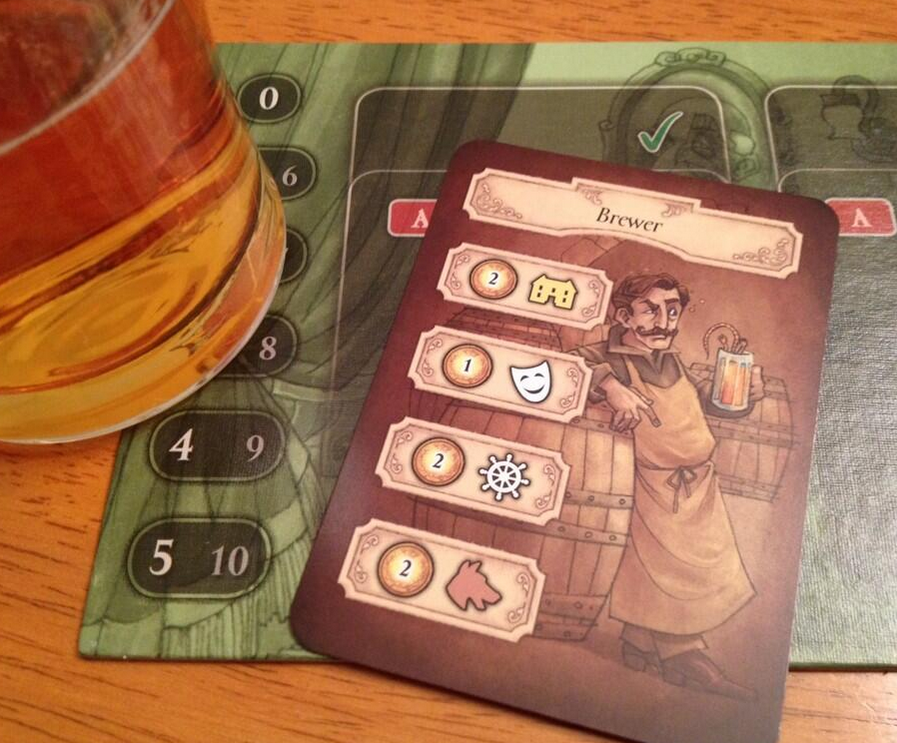
As a Brewer I didn’t want to get sacked!
Council of Verona x2: I bought this from the friendly Patrick Nickell of Crash Games at BGG.con and I am sad that it took me so long to finally play it. Sorry Patrick. However, this game is a really awesome, simple design that has a lot of subtle strategy. There are nice decisions to make in the game despite it only lasting three rounds. I love when a small package supplies a lot of gameplay experience. CoV does just that!
Last Will with Getting Sacked expansion: I love Last Will! I think it is such a clever design and it seems very well balanced. Therefore I was very excited to try it with the Getting Sacked expansion. It was pretty sweet. By having a job and needing to get sacked it steered the strategy a little bit. Also, having the nuptials cards made it desirable to hold onto them so you could play a bunch at the same time. I thought the expansion added enough to make the game refreshing again, yet without really changing the feel of the game.
Kingdom Builder: I played another game of Kingdom Builder and pulled off a nice win thanks to getting the right terrain card on my last turn. This game is fun and frustrating at the same time. I’m hoping Donald X. and Queen Games have another expansion in store!
Designer’s Corner:
I didn’t really do much design in the past week. I was slightly jealous of all my cohorts who trekked over to Delaware for Unpub 4. I hope they had a most excellent time.
I did work a little on Brooklyn Bridge and things are starting to come together. My goal is to still get this prototyped and playable for testing at Protospiel-Milwaukee in March. I hope to see you all there!
***
So those are the Boards & Barley I enjoyed last week. What did you enjoy?
 Boards and Barley