Blog Archives

Monday Brews 9-22-14
Today is the last official day of summer. Bummer. Before we know it snow will be on the ground, the days will be short, and we’ll be freezing. Aye. What a horrible way to start a blog post. Sorry for that.
Let’s cheer you up by covering the Boards & Barley I’ve enjoyed over the past couple weeks!
The Barley:

Perfect amount of pumpkin and raven!
BARLEY SPOTLIGHT: New Belgium Pumpkick
So Autumnal. So delicious. It has a very nice level of pumpkin flavoring. Much more manageable than the Southern Tier Pumking and Warlock brews. This beer makes me think of Fall, and I like Fall quite a bit, so this is an enjoyable beer for me.
- Southern Tier Warlock
- Spaten Oktoberfest
- Milwaukee Brewing Sasquash
- Deschutes Black Butte
- Brau Brothers Moo Joos Oatmeal Milk Stout
- Ayinger Oktoberfest
The Boards:
 BOARDS SPOTLIGHT: Istanbul
This game has such a nice and simple mechanism of movement. It allows for great replayability. It adds interesting and tough decisions. And can allow you to mess with other players without it seeming like a “take-that” kind of game. I’m looking forward to playing this again.
Designer’s Corner:
 I have made a lot of progress with the prototype for The Grand Illusion. I’m on pace to have it playable for our group’s Board Game Night this week.
I’ve laid out the gameplay foundation, which is quite simple mechanically. I’ve tried to include a system that will provide for some good interaction. And I’m just ready to play it. It will probably be horrible, but at least the logo looks okay! Hopefully I’ll have a report on Playtest #1 later this week.
Monday Brews 9-8-14
Welcome to September. Schools have begun. Temperatures are moderating. Seasonal board game groups (like mine) are getting back together. The hot summer months are in the rear view mirror and the best board gaming months of the year are in front of us!
But today is Monday, so it’s time to cover the Boards & Barley that I’ve enjoyed lately (last two weeks)…
The Barley:
 BARLEY SPOTLIGHT: Southern Tier Pumking
Whoa… the pumpkin is strong with this one. It’s almost like you are drinking pure pumpkin. Okay, it’s not THAT strong. But this is an Imperial Pumpkin Ale. If you are desiring a brew with a lot of spice that instantly makes you feel like it’s Autumn, then don’t hesitate to try Southern Tier’s Pumking.
- Modelo Especial – I had this at my wife’s work outing.
- Capital Oktoberfest
- Samuel Adams Harvest Saison
- Leinenkugel’s Original
- Samuel Adams Harvest Pumpkin Ale
- Leinenkugel’s Oktoberfest
- Lakefront Extended Play (India Style Session Ale)
- Vintage Polotmavy Incorrect (Czech Style Half Dark Amber Lager)
The Boards:
 BOARDS SPOTLIGHT: Five Tribes
I can’t wait to play this again. I played twice and I am in awe of the replayability. This game is very enjoyable. The decisions are awesome, yet limiting. Other player moves mess with your strategy. The artwork of the Djinns is awesome. The components are fantastic. I simply can’t wait to play this again.
- Sushi Go
- Skyline
- Astro Regatta (Prototype)
- Cranium Balloon Lagoon
- Uno Moo
- Courtier
Designer’s Corner:
Due to my play of Coutier I am happy to report that another game design, Conclave, is now completely dead. I no longer have any need or desire to continue working on that design. Courtier isn’t exactly what I had in mind with Conclave, but it’s close enough that the games are too similar for me to bother with that design anymore.
I now have a new goal. Since I’ll be attending Protospiel-Madison (October 24th-26th) I decided that it’s time to get after my designs and really start putting them together. So my goal is to have three games ready for testing. The two you have heard me speak of are The Grand Illusion and Armada Galactica. One that I haven’t written about tentatively has the name Night at the Museum, which obviously will have to change. I’ve been making extensive notes about all three.
Currently The Grand Illusion is ready for prototyping. Armada Galactica is nearly ready for prototyping. Night at the Museum needs more work before I’ll mock it up. But all three should be ready in time for Protospiel-Madison.
I may also work on an expansion for something 🙂

There you go! What Boards & Barley have you been enjoying? Anything new that was more awesome than expected?
Monday Brews 8-25-14
First of all I’d like to welcome all the new readers! Thanks for checking out the site and for your interest in my “How to (Speed) Pitch Your Game” article. Feel free to look through my archives and find more interesting articles about game design.
Second, Monday on Boards & Barley is the day I recap what beer and board games I enjoyed over the previous week. It’s a fun way to learn about new beers and interesting board games. If you have any questions about what I’ve been enjoying, feel free to ask me via Twitter (@EdPMarriott).
And without further adieu let’s check out the Boards & Barley:
The Barley:
 BARLEY SPOTLIGHT: Summit Great Northern Porter
I had this tasty Minnesotan brew while camping over the weekend. It hit the spot as I was relaxing around the fire enjoying a S’more. I wouldn’t say it was the best porter, but it certainly was tasty at that moment. Special shout out to my friend Scott for bringing the brews! Thanks Scott!
- Summit Extra Pale Ale
- Weyerbacher Merry Monks Tripel
The Boards:
 BOARDS SPOTLIGHT: Concordia
I had the chance to play Concordia at BGG.Con last November and I didn’t take it. After playing it last night for the first time I am regretting not playing it at BGG.Con. Summary: it was really good and I liked it a lot.
The game was filled with interesting decisions, moments of regret, and moments of awesomeness. There are a lot of things you could do, but the timing of playing your cards made for a great gaming experience. If you like Euros but haven’t played Concordia don’t wait any longer.
- Sneaky Snacky Squirrel Game
- Go Away Monster
- Disney Eye Found It
- Skyline
- Tapple
Designer’s Corner:
Last week I worked on Armada Galactica, The Grand Illusion, and an abstract theme-less game that I think has a lot of potential.
For The Grand Illusion I started putting together a deck of magic tricks and resources (skills). I’m getting close to the point of playtesting. I plan to blog about it on Thursday.
For Armada Galactica I worked on creating different ship layouts to add some variety with how goods and resources are stored on your ship. I also started laying the foundation of what happens on a turn.
I also was thinking a lot about two different structures in game design. Some games have turn-based gameplay while other games have phase-based gameplay. In turn-based each player will individually perform whatever action they are going to do. In phase-based all players will perform some phase-appropriate action before the game moves on to the next phase. I may end up writing about these but I have some more thinking to do about it first.
That’s it for this week’s Monday Brews. What Boards & Barley have you been enjoying? Play any new and exciting games lately? Thanks for reading!
Monday Brews: 8-18-14

It exists! And it’s awesome!
Gen Con 2014 is over and it was awesome! Why? Because I got to hang out with great friends of mine and because I got to hold, unwrap, punch, and play a production copy of Scoville! Special thanks are due to Jeremy, Adam, Ben, Mark and Mike for making Gen Con 2014 a memorable one.
If you are new to this blog, Scoville is my first published game design. It is published by Tasty Minstrel Games and should be available later this year, so put it on your Christmas lists! You can go pre-order it from your favorite local game store or the online game outlets.
So with Gen Con in the books, and with recently quitting on Brooklyn Bridge I feel refreshed and ready to move on to some exciting new designs. I have one that I’m keeping a secret, one that will occasionally mention, and The Grand Illusion, which I am openly designing and blogging about on this site.
But enough about that. Let’s check out the Boards & Barley that I’ve enjoyed over the past two weeks.
The Barley:
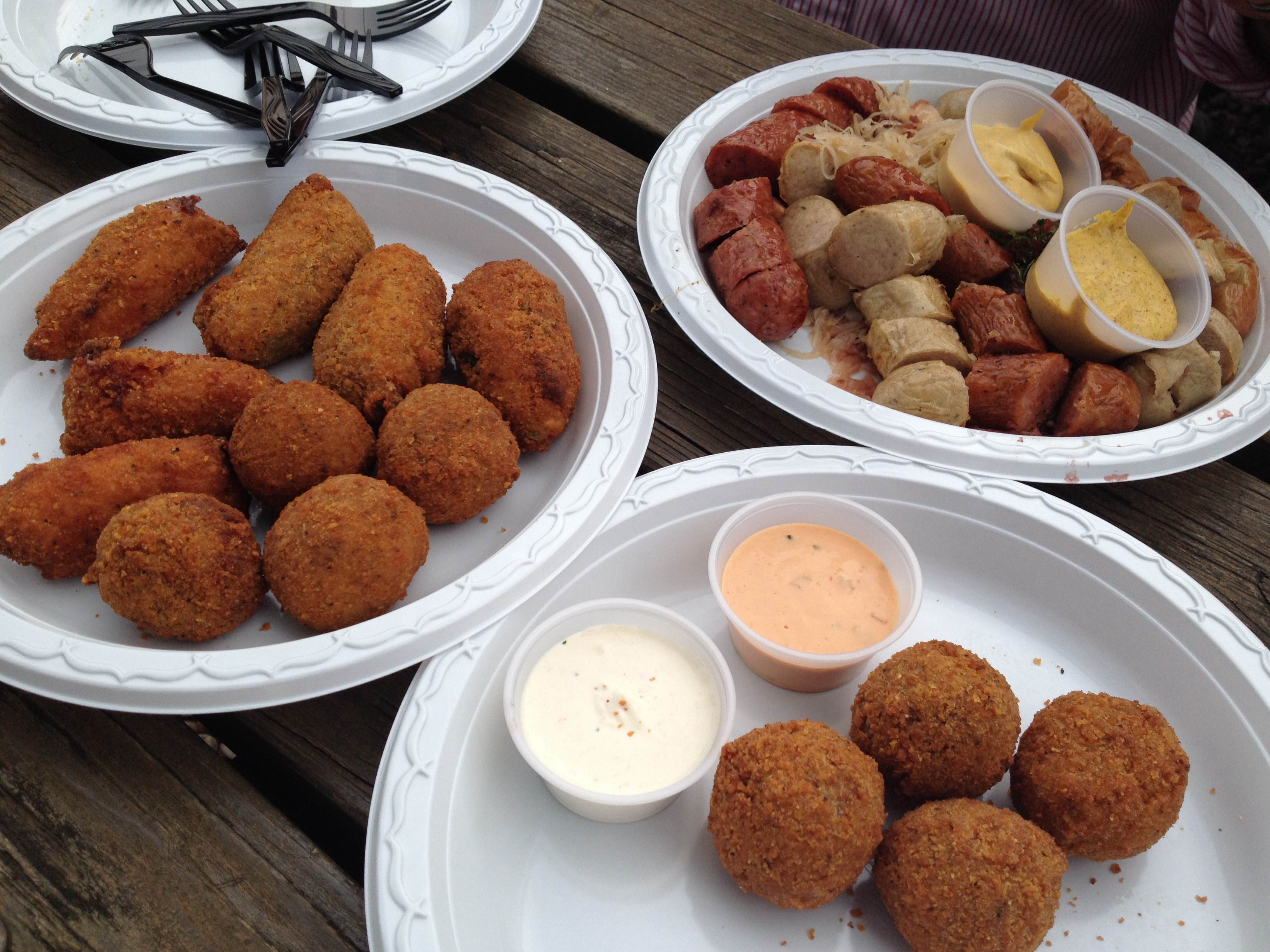
An excellent complement to Optimator!
BARLEY SPOTLIGHT: Spaten Optimator
Why such a standard brew for the spotlight? Because it was enjoyed at the Rathskellar in Indianapolis with my friends. This has become a tradition for us. On Friday night we went to the Rathskellar and enjoyed beer, cigars, and a fantastic live band. Plus, attending the Rathskellar is a great way to escape the geek world of Gen Con for a few hours. We had a great time and I enjoyed a delicious 32 ounce Optimator! The picture on the right shows the appetizers we ordered (Sausage platter, Brat balls, Jalapeno poppers, and Chicken Cordon Bleu rolls).
- Leinenkugel’s Summer Shandy
- Atwater Decadent Dark Chocolate Ale
- Capital Dark Voyage Black IPA
- Next Door Luminous IPA
- O’so English Mild
- Rock Bottom Honey Ale
- Flat 12 Hinchtown Hammerdown Golden Ale
- Sam Adams Boston Lager
- Thr3e Wisemen Rocky Ripple Pale Ale
The Boards:
BOARDS SPOTLIGHT: Scoville
How could it not be Scoville? I love the game even after over 100 plays. I love how a 2p play at Gen Con provided a situation that really tested me. The decisions are so interesting. The play changes from game to game with different players. As the fields grow from round to round there are more and more choices, so the game naturally ramps up. I love this game so much and I was so excited to crack open a new copy and get it to the table. Here are a few pictures to show how it looks. If you like how the peppers look, click on the picture and thumb it up on BoardGameGeek.com.
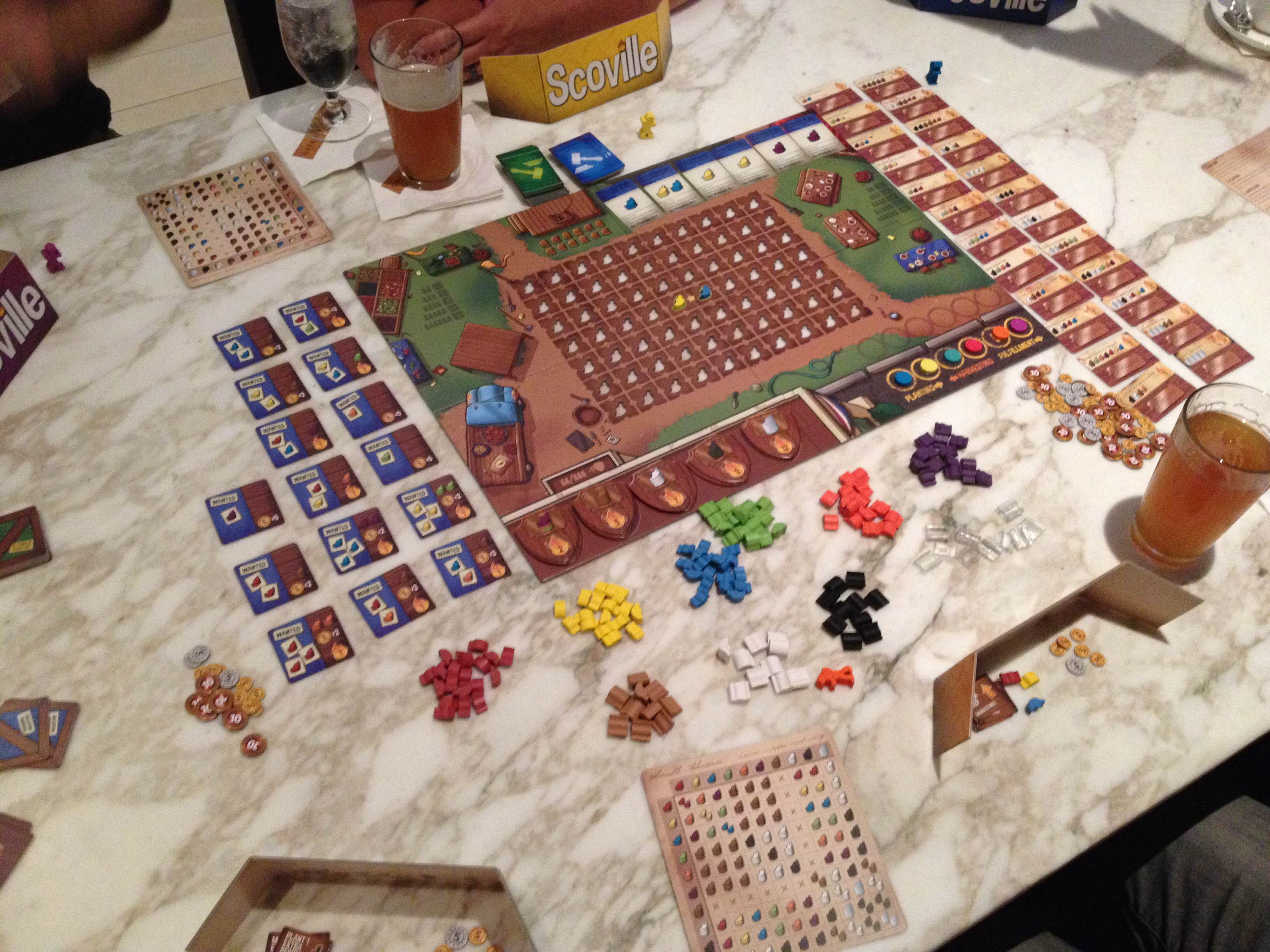
6 Player Scoville ready to go!
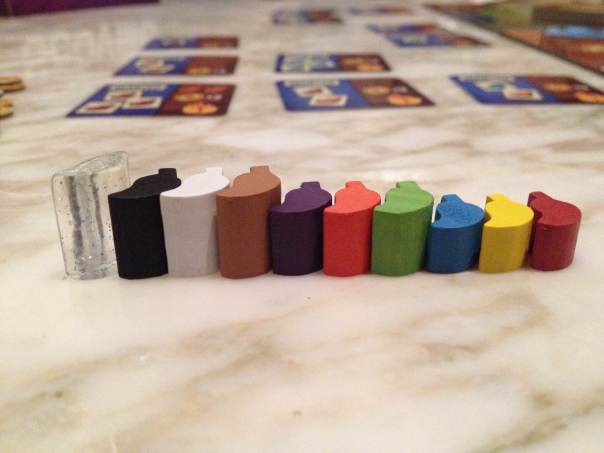
The amazing peppers! (Click to go to BGG and thumb the pic!)
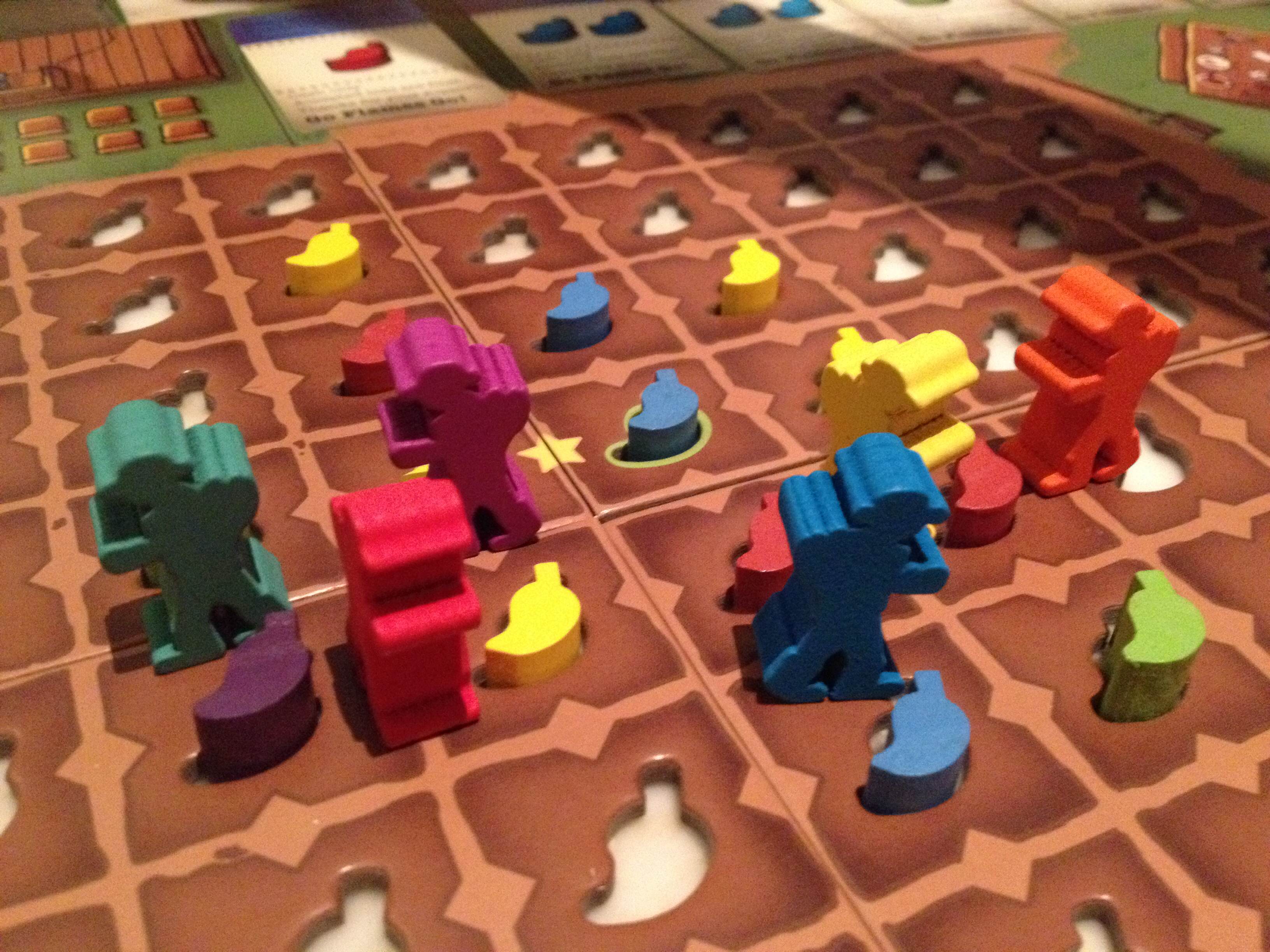
6 Player game in progress.
Here are the games I played prior to Gen Con:
- The Little Prince
- Morels
- 20th Century
- Splendor
- Unpublished Prototype (It was really intriguing – Currently being evaluated by Moon Yeti Games)
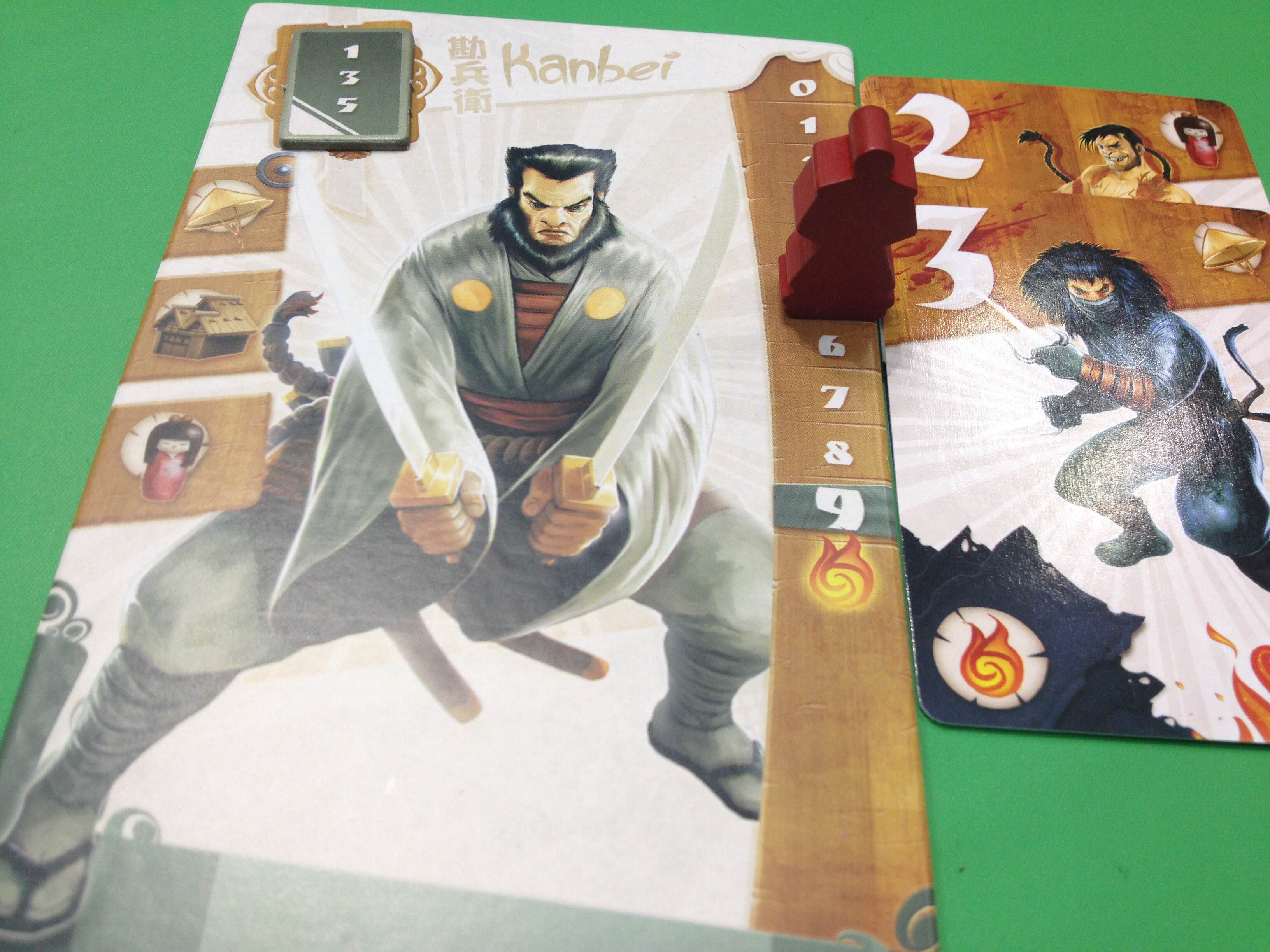
Our Samurai Spirits were crushed in defeat!
And here are the games I played at or after Gen Con:
- Legends of the American Frontier (Set up and played one round)
- Island Fortress
- Scoville x2
- Camel Up
- Penny Press
- Mutiny
- Love Letter
- Fast Track
- Weykick
- Word on the Street
- Neighborhoods (Prototype by Ben Rosset and Matthew O’Malley)
- Istanbul
- Amerigo
- Blueprints
- Samurai Spirit x2
- Lost Legacy (Starship and Flying Garden)
- Pengoloo
There was nothing on the Gen Con Preview that I felt was a “must-buy” this year but there were a few that I was interested in. The one I was most interested in was Instabul, which I bought.Here is a picture of the modular board:
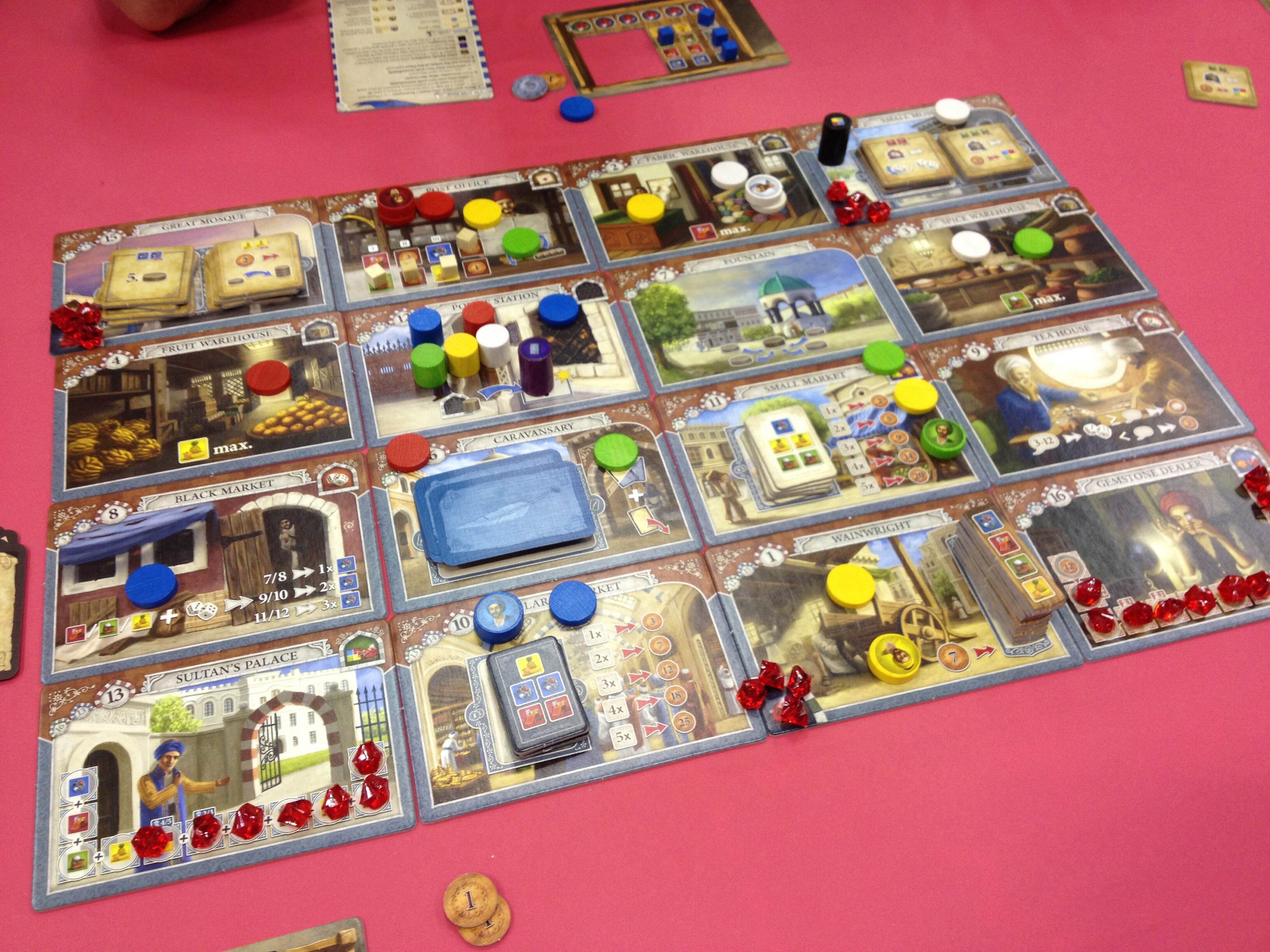
5 Player game in progress.
In Istanbul each player also has a small player board of their own. The goal in the game is collect rubies. To do so you will need to manage your resources and money as well as utilize your location placement of your merchant and their assistants. It was an excellent game and well worthy of the Kennerspiel des Jahres award.
Surprise Hit #1: Camel Up
Camel Up was awesome. We played with 7 players at the Z-Man booth and we loved it. It won the Spiel des Jahres and when you play it you can understand why. I picked up a copy because it was fun, interactive, and plays up to 8 players!
Surprise Hit #2: Samurai Spirit
I am not normally a fan of cooperative games but this one had so much awesomeness that I can’t wait to play it again. It was a struggle. We lost badly. In fact, the first time we attempted the game we died after the first (of 3) rounds. There are some very interesting choices and some really cool combinations that can be done in the game. It was a lot of fun.
And here is a picture of my Gen Con 2014 haul. Several of these games came from the math trade, some were freebies. Missing from the picture are the King of Tokyo promo cards and the Tokaido promo cards and Eriku character promo.
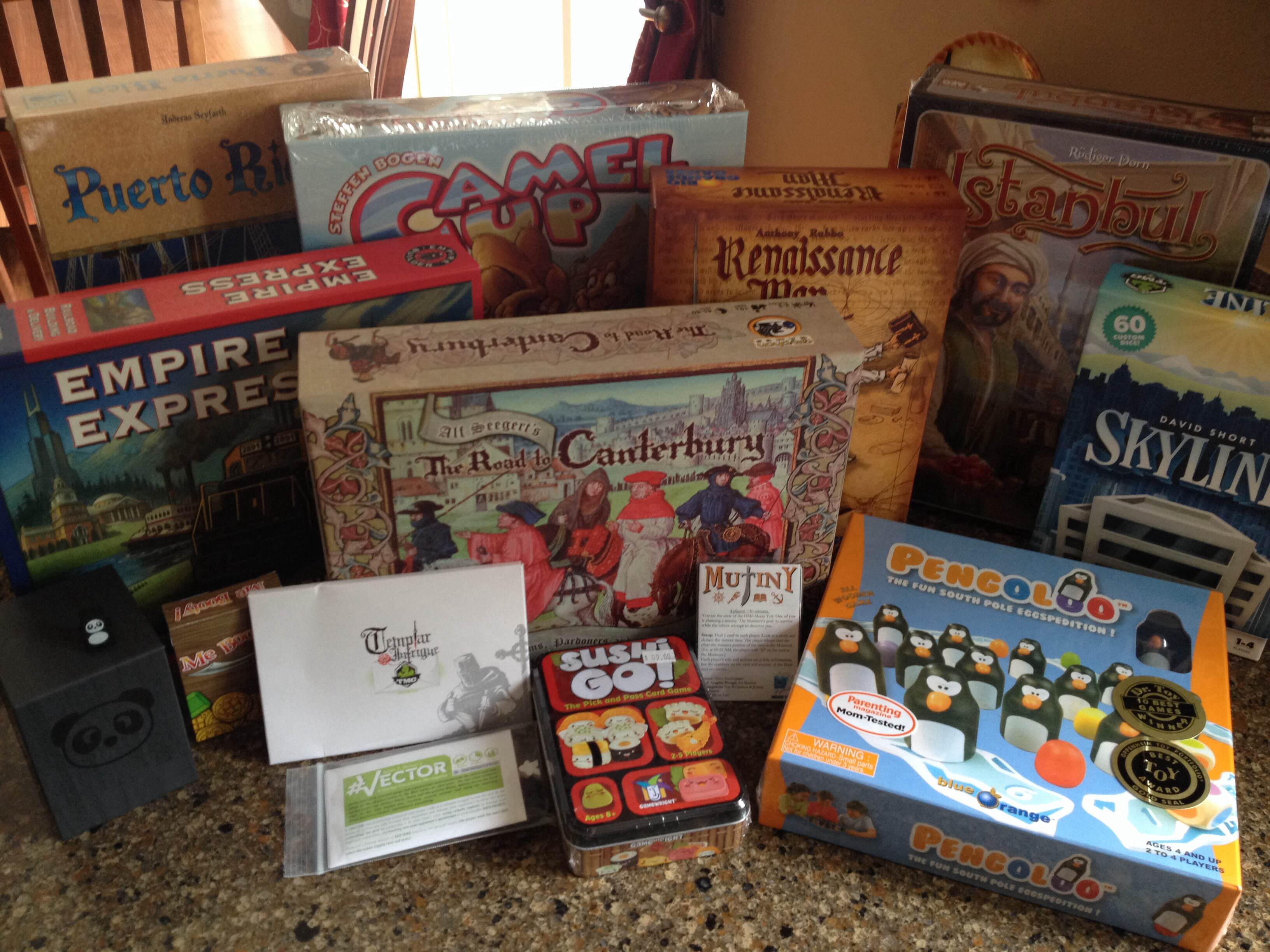
I’m looking forward to playing all these!
Overall it was a great Gen Con. I’ll be writing another post this week about one specific experience from the convention. It was great to meet so many awesome people, especially those I follow on Twitter that I had never met in real life. I’m already looking ahead to Gen Con 2015 (partially because it is unlikely I’ll attend GrandCon, BGG.con or Origins before then).
Game Design Philosophy

After killing Brooklyn Bridge I’ve been doing a lot of thinking about who I am as a designer and what I want to design. So I sat down last night and examined the top 50 games on BGG to see what elements they had in common. My goal was to understand which elements are enjoyable to me and to understand how they are incorporated into some of the best games in the world.
What I ended up with was a list of five things that I feel are important to my game designs. Please note that this article discusses the things that I personally feel are important to good game designs. Your opinions will likely vary. I urge you to create a similar list that you can use as a tool to help you make sure your game design is going down a path that is acceptable to you.
I now realize that had I had this list before working on Brooklyn Bridge, it probably would have turned out to be a better game. I may attempt to re-design it now that I have this list to use as a design tool.
My previous design philosophy was simply to make fun games. That’s not a good philosophy because it is extremely difficult to measure or quantify.
What follows are 5 elements or guidelines that I will seek to follow when designing games. For each I will demonstrate how they exist in both the immensely popular Ticket to Ride and the soon-to-be immensely popular Scoville. Using these as a guideline will provide a measurable way to know whether or not what I am designing has the potential to be an enjoyable game.
1: Quick to Teach / Easy to Understand
This DOES NOT mean the game is simple or light.
This DOES mean that it can generally be set up in 5 minutes and taught in about another 5. I don’t want to spend 20 minutes setting up a game and then another 15 trying to teach it to people.
Ticket to Ride Example: TtR (or perhaps T2R to you) can be set up and explained in about 5 minutes total.
Scoville Example: Scoville requires a little more setup than this guideline but it can be taught in 5 minutes for sure.
Other successful games like The Settlers of Catan are relatively simple to set up and teach. Of course there are very successful games that do not quite meet these criteria. There’s nothing wrong with that. Remember, this is MY design philosophy. So the games I will design will likely meet these things.
2: Minimal “Exception” Rules
“Exception” rules are those that require an individual point of emphasis when teaching. The fewer of these types of rules in a game the “Quicker” and “Easier” it is to teach and understand. This guideline ties into the first one. I will not be designing games that have a long list of FAQs or “exception” rules.
Ticket to Ride Example: There are on the order of two exception rules. 1) You can’t draw two locomotives from the face up pile. 2) If there are ever three locomotives in the face up set then you replace all face up cards.
Scoville Example: There are slightly more than than TtR, but they apply during two phases. 1) You can bid zero and ties are broken from previous turn order. 2) Harvesting: No doubling back, No sharing or going through another player.
The idea here is that the rulebook should be streamlined and straight forward. If your game has a bunch of singular exceptions that need to be covered, I recommend putting that information on a player guide for each player. Then when teaching the game you can simply point out that there are some exceptions and that players should reference the guide.
3: Limited Actions or Choices Per Turn
One easy way to add tension in a game is to limit what players can do. Agricola does this with great success. Most Stefan Feld games do this very well. The idea is that while you may not have a lot of different choices to make, there is some tension in trying to choose the optimal choice. Similarly you may have a lot of options but can only choose 1 or 2 per turn.
Limiting the number of actions or the number of choices a player has on their turn also has two notably positive effects:
- Downtime is minimized
- Analysis Paralysis is limited
Downtime decreases if a player only has a few options to choose from. Analysis paralysis, or a player’s inability to make a decision, is limited since there are only so many combinations of things to work through.
Ticket to Ride Example: On your turn you only have three options. 1) Draw train cards. 2) Draw Destination Tickets. 3) Play trains to the board. That’s it. It’s so simple. But the depth of the game comes from decisions like, “Should I draw train cards one more time or should I burn a locomotive card this turn?”
Scoville Example: Each round has four phases, each of which are simple. Bid, Plant, Harvest, Fulfill. Each phase is simple enough that you have a limited number of options. Choices include how much to bid, which pepper to plant, how to harvest, and what to fulfill.
This philosophy guideline was greatly influenced by my recent play of Attika. In Attika you have two choices: Draw tiles or build. That limitation is so stupidly simple and yet the game builds up as it moves along and is quite enjoyable. Which leads me to the next guideline.
4: Include a Natural Buildup
The idea here is that the decisions you are making during a game accelerate and either feel more tense or more important or hopefully both. Games do this differently. Some games build up because you have access to better/more resources. Other games build up because the game presents better scoring opportunities or something of the sort.
When a game builds up naturally it turns it into an emotional experience where you are drawn into the game. When you make a decision early in a game you don’t want a bad choice to destroy your chances. But when you make a decision late in the game you want a good choice to be able to greatly help you out.
Ticket to Ride Example: As the map fills up the decisions become more tense. You might begin to worry that a player will fill up a connection that you needed. Or you might worry that there are not enough turns left to complete all your destination tickets.
Scoville Example: As the fields are planted each round there are more/different cross-breeding opportunities. Your decision space opens up. As you get better peppers there is the sometimes tense choice of whether to plant it for the bonus points or save it and fulfill a recipe to prevent someone else from getting it.
Brooklyn Bridge had no build up at all. I think that good games should include some sort of build up or acceleration. If it fits naturally into the game, that’s even better. What I desire from fun games is that as the game builds up and things get more tense and exciting, that I am getting some sort of increased emotions from my gaming experience. Without a build up I feel like my game designs would lack that emotional aspect.
5: Players Should Be Rewarded
Continuing with the “emotion” idea, I feel it is important that players be able to be rewarded for the actions they take during the game. Point salad games, like several Feld games, do this on just about every turn. When every choice you make gives you points there is a natural positive emotion attached to that. On the other hand if the choices you make never reward you then you’ll likely not have a natural positive emotion during the game. There is something to the idea of moving your scoring marker around the board and seeing yourself jump past other players.
Ticket to Ride Example: A positive emotion and rewarding moment in TtR comes each time you complete a route. This is a secret positive emotion but it is present and it feels awesome.
Scoville Example: When players plant a better pepper and earn an award plaque from the Town Mayor there is a positive emotion and rewarding moment. They know that their action just earned them points that no other player will be able to match.
These types of rewards that provoke positive emotions will likely result in players enjoying the game more than an equivalent game that is void of rewards. I want to design games that will provoke positive emotions and one way to do that is by rewarding players.
I wish I had written this article a long time ago. Having these guidelines in place will allow me to check off whether or not my current designs are meeting the criteria. That should be easy enough to recognize. If they don’t meet the criteria I’ll be able to tell and hopefully it will allow me to come up with design tweaks that turn my designs into awesome games.
What’s your design philosophy? I’d love to hear how yours differs from mine. Feel free to share in the comments. Thanks for reading!
 Boards and Barley