Ryan Metzler with the Dice Tower recently posted a review video for Scoville! Check it out:

Some pumpkins (ales) are greater than others!
It is starting to get colder outside. The leaves will soon start to change colors. And a brisk breeze will be bringing in snow before we know it. Autumn is nearly upon us so I thought I would share with you some of the best beer styles to enjoy during this too-short season.
When I think of Autumn there are two main beer styles that come to mind: Oktoberfest and Pumpkin. But I’ll also mention a few others and why I think they make for good Autumn beer styles. But let’s start with the blue and white checkered beer of German awesomeness:

A local Oktoberfest that’s awesome!
Description from BeerAdvocate.com (for Marzen/Oktoberfest):
Before refrigeration, it was nearly impossible to brew beer in the summer due to the hot weather and bacterial infections. Brewing ended with the coming of spring, and began again in the fall. Most were brewed in March (Märzen). These brews were kept in cold storage over the spring and summer months, or brewed at a higher gravity, so theyd keep. Märzenbier is full-bodied, rich, toasty, typically dark copper in color with a medium to high alcohol content.
The common Munich Oktoberfest beer served at Wies’n (the location at which Munich celebrates its Oktoberfest) contains roughly 5.0-6.0% alcohol by volume, is dark/copper in color, has a mild hop profile and is typically labeled as a Bavarian Märzenbier in style.
My Favorite Oktoberfest: New Glarus Staghorn Octoberfest
Other Enjoyable Oktoberfests:

 Description from BeerAdvocate.com:
Often released as a fall seasonal, Pumpkin Ales are quite varied. Some brewers opt to add hand-cut pumpkins and drop them in the mash, while others use puree or pumpkin flavoring. These beers also tend to be spiced with pumpkin pie spices, like: ground ginger, nutmeg, cloves, cinnamon, and allspice. Pumpkin Ales are typically mild, with little to no bitterness, a malty backbone, with some spice often taking the lead. Many will contain a starchy, slightly thick-ish, mouthfeel too. In our opinion, best versions use real pumpkin, while roasting the pumpkin can also add tremendous depth of character for even better results, though both methods are time-consuming and tend to drive brewmasters insane.
My Favorite Pumpkin-ish: Milwaukee Brewing Sasquash (Brewed with pumpkins and sweet potatoes)
Other Enjoyable Pumpkin brews:
 Description (of doppelbocks) from BeerAdvocate.com:
Bocks–you know, those beers with goats on the label–are relatively strong German lagers. Doppelbocks–as the name might suggest–are typically even stronger and contain enough malty goodness that theyve been considered a meal in a glass for centuries. Generally they have a very full-bodied flavor and are darker than their little Bock brothers and sisters and a higher level of alcohol too. They range in color from dark amber to nearly black, and dark versions often have slight chocolate or roasted characters.
My Favorite Doppel Bock: Capital Autumnal Fire
Other Enjoyable Dopple Bocks:
 Description from BeerAdvocate.com:
The Belgian Dubbel is a rich malty beer with some spicy / phenolic and mild alcoholic characteristics. Not as much fruitiness as the Belgian Strong Dark Ale but some dark fruit aromas and flavors may be present. Mild hop bitterness with no lingering hop flavors. It may show traits of a steely caramel flavor from the use of crystal malt or dark candy sugar. Look for a medium to full body with an expressive carbonation.
Traditionally a Trappist Ale, many brew similar “Abbey Dubbels” to try and emulate the originals (Trappist Westvleteren 8, Westmalle Trappist Dubbel & Chimay Première).
My Favorite Belgian Dubbel: Vintage Dedication
Other Enjoyable Dubbels:
What are your favorite Autumn beer styles? What are some of your specific favorite Autumn brews?

Today I wanted to report on the progress of The Grand Illusion. Normally I do that on Thursdays and I was planning on posting a game review today but I’m excited about the game so I figured I’d write about it.
I’ve begun prototyping! I have created a deck of skill cards. These cards represent the 9 types of magic in the game. The types of magic are in two separate tiers: basic and advanced. There are 6 basic types and 3 advanced types. Here is a picture showing the skill cards (thanks to The Game Crafter for blank cards – They have blank poker cards on sale right now for 1 cent each!).
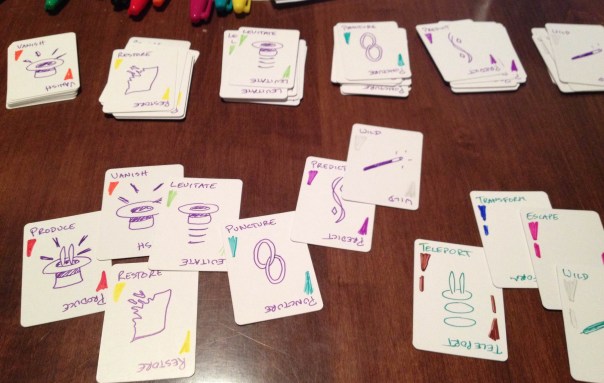
Collect these and use them to perform never-before-seen magic tricks to appease your growing audience!
Those are hand-drawn icons, people!
The next step for the prototype is to create a deck of Trick cards. These are cards that represent magic tricks. During the game you’ll need to collect the skill cards shown above and then turn them in to complete the magic tricks.
Once you perform a magic trick you will earn the rewards and audience shown on the card.
So let’s discuss audience… Audience is actually a currency in the game. It is necessary to build an audience during the game or you will not meet the requirements on your Grand Illusion card. So each time you perform a trick, if successful, you will gain audience. In the game you will collect skill cards, spend them to perform tricks, gain audience and increase your skills to be able to perform better tricks.
There will definitely be some engine building in the game. The goal of this design is to be an entry-level game with an easy rule set that is quick to teach and play. The main mechanics are set collection and engine building.
Engine building in games refers to the idea of obtaining some ability or benefit that let’s you do things a little better, then getting another one that builds on the previous ability or benefit.
In The Grand Illusion the engine is represented by the skills each magician will gain. Will you become a master of vanishing acts? Perhaps you’ll be the best at restoration magic? Ultimately you’ll have to get proficient at at least two basic types of magic and one advanced magic.
The question I’m currently struggling with is how exactly to create the engine building element. I have two options I’m considering:
In the game Splendor players turn in poker chips to grab a card from the table. Once they grab that card it usually acts as a poker chip. So for future card grabs they need one less poker chip. This would work perfectly for The Grand Illusion but I don’t want to copycat an existing game.
A tech tree is something where you must complete “Level 1” stuff before you can work on “Level 2.” So in The Grand Illusion I could have a tech tree (pyramid) of trick cards on the table. When a player would perform a trick they would place a token of their player color on the trick to show they’ve completed it. This would also direct their play as there would be advantages and disadvantages for breadth versus depth.
I think that once I create the Trick deck I’ll try out both of these options. The Splendor-like version may work better, but I’m more drawn to the Tech Tree version since it is more original.
My goal is to prototype the skills deck this weekend and aim for the first playtest next week! Thanks for reading. I’d love to hear your thoughts about the different engine building options.

Welcome to September. Schools have begun. Temperatures are moderating. Seasonal board game groups (like mine) are getting back together. The hot summer months are in the rear view mirror and the best board gaming months of the year are in front of us!
But today is Monday, so it’s time to cover the Boards & Barley that I’ve enjoyed lately (last two weeks)…
 BARLEY SPOTLIGHT: Southern Tier Pumking
Whoa… the pumpkin is strong with this one. It’s almost like you are drinking pure pumpkin. Okay, it’s not THAT strong. But this is an Imperial Pumpkin Ale. If you are desiring a brew with a lot of spice that instantly makes you feel like it’s Autumn, then don’t hesitate to try Southern Tier’s Pumking.
 BOARDS SPOTLIGHT: Five Tribes
I can’t wait to play this again. I played twice and I am in awe of the replayability. This game is very enjoyable. The decisions are awesome, yet limiting. Other player moves mess with your strategy. The artwork of the Djinns is awesome. The components are fantastic. I simply can’t wait to play this again.
Due to my play of Coutier I am happy to report that another game design, Conclave, is now completely dead. I no longer have any need or desire to continue working on that design. Courtier isn’t exactly what I had in mind with Conclave, but it’s close enough that the games are too similar for me to bother with that design anymore.
I now have a new goal. Since I’ll be attending Protospiel-Madison (October 24th-26th) I decided that it’s time to get after my designs and really start putting them together. So my goal is to have three games ready for testing. The two you have heard me speak of are The Grand Illusion and Armada Galactica. One that I haven’t written about tentatively has the name Night at the Museum, which obviously will have to change. I’ve been making extensive notes about all three.
Currently The Grand Illusion is ready for prototyping. Armada Galactica is nearly ready for prototyping. Night at the Museum needs more work before I’ll mock it up. But all three should be ready in time for Protospiel-Madison.
I may also work on an expansion for something 🙂
There you go! What Boards & Barley have you been enjoying? Anything new that was more awesome than expected?

 As I continue to work on The Grand Illusion I get more and more excited about the potential of the game. Not only is it focused on Victorian era magicians and illusionists, but I also think that the gameplay in interesting and intriguing.
Today I’m going to discuss that gameplay a little more in depth. So far I’ve discussed the theme, the core mechanics, and the drafting mechanic. Ironically both the core mechanics and drafting mechanic are changing. I’ll explain why today. But let’s recap a few things, starting with the objective of the game:
As a street magician/illusionist it is your dream to work your way up and have a popular show in a highly successful theater. To do that you must win over the crowd, from the few stragglers on the street at the start of the game to larger and larger audiences as your reputation advances.
You objective in the game is to increase your skills and earn enough reputation to successfully perform your Grand Illusion to as large an audience as possible. Points are awarded based on your skill levels, the size of your audience (this potentially may change), and the number and variety of tricks you performed throughout the game.
I absolutely love the movie, The Prestige. Here is a quote that best represents how I want things to operate:
Every great magic trick consists of three parts or acts. The first part is called “The Pledge“. The magician shows you something ordinary: a deck of cards, a bird or a man. He shows you this object. Perhaps he asks you to inspect it to see if it is indeed real, unaltered, normal. But of course… it probably isn’t. The second act is called “The Turn“. The magician takes the ordinary something and makes it do something extraordinary. Now you’re looking for the secret… but you won’t find it, because of course you’re not really looking. You don’t really want to know. You want to be fooled. But you wouldn’t clap yet. Because making something disappear isn’t enough; you have to bring it back. That’s why every magic trick has a third act, the hardest part, the part we call “The Prestige“.
I love when games escalate and this simple three-step process of Pledge, Turn, and Prestige is ideal for that. However, I don’t want players to only work on one trick throughout the game. So I would rather have the game work in three stages where things ramp up automatically as if a player were progressing from the Pledge to the Turn and finally to the Prestige. The question is whether or not I can accomplish that through the game design.
Previously I had shown these icons for the basic types of magic:

These represent the only types of magic a player can perform early in the game. It will be important to perform these because they will allow you to “unlock” new magic types by increasing your skills.
SIDE NOTE: One thing I’ve been going back and forth on for The Grand Illusion is whether I want the game to be phase based (meaning in each round players all do phase A, then phase B, then …) or turn based (meaning players have options A, B, C… and on their turn they choose one). At this point I’m going with turn based. (I’m dropping the draft mechanic for now)
So I mentioned that players can perform tricks and increase skills but I haven’t really explained that. Here we go…
There are three options for each turn. These are:
Let’s explain these in more detail.
You can turn in magic cards from your hand to complete an available face up trick on the table. These trick cards will have magic requirements. When you turn in the correct cards you will “perform the trick.” After that, take the trick card and place it face up in front of you. This card will have a magic type on it that represents a skill you can now increase. It also has an audience rating. The audience rating will be important for being able to perform your Grand Illusion.
It will be important to keep your hand stocked with the correct types of magic cards as you work up to your Grand Illusion. You can simply draw magic cards from the face up cards or the deck based on your skill levels.
Once you have successfully performed tricks those cards will be in front of you. To increase the skills shown on the cards you will have to turn in different sets of magic cards. When you do you can then place a skill marker on the trick card to show that you have increased that skill. If you have several cards of the same type you can simply stack them in a way that you can still see how many you have. Your skill level will tentatively be number of cards times number of skill increase tokens. Increasing your skills is necessary to be able to perform your Grand Illusion.
The game ends once a player has performed their Grand Illusion. When they do, all other players will have one final turn.
Points are earned from several categories:
In the game you can focus on a singular path toward your Grand Illusion and try to maximize skill points on one type of magic. Alternatively you can attempt to score via breadth of magic types and complete a high variety of tricks. Ultimately this game will be a race to complete your Grand Illusion. But hopefully along the way there will be fun and interesting decisions.
It’s time to prototype this. I’m ready to get this to the table and start playing it. I’m pretty happy with the direction it is going. After the feedback from readers regarding the drafting mechanic I think I’ll save that for a different game. I believe it was distracting from the thrust of what I want this game to be. So it’s gone and I’m ready to start playtesting (once I put some cards together). It will be my goal to create a PNP file to share once I’ve playtested a few times so that I can possibly get some early feedback from gamers and designers. I’ll keep you posted. Thanks for reading!
Ryan Metzler with the Dice Tower recently posted a review video for Scoville! Check it out:
 Boards and Barley