Blog Archives
GDP: Playtesting Big Picture
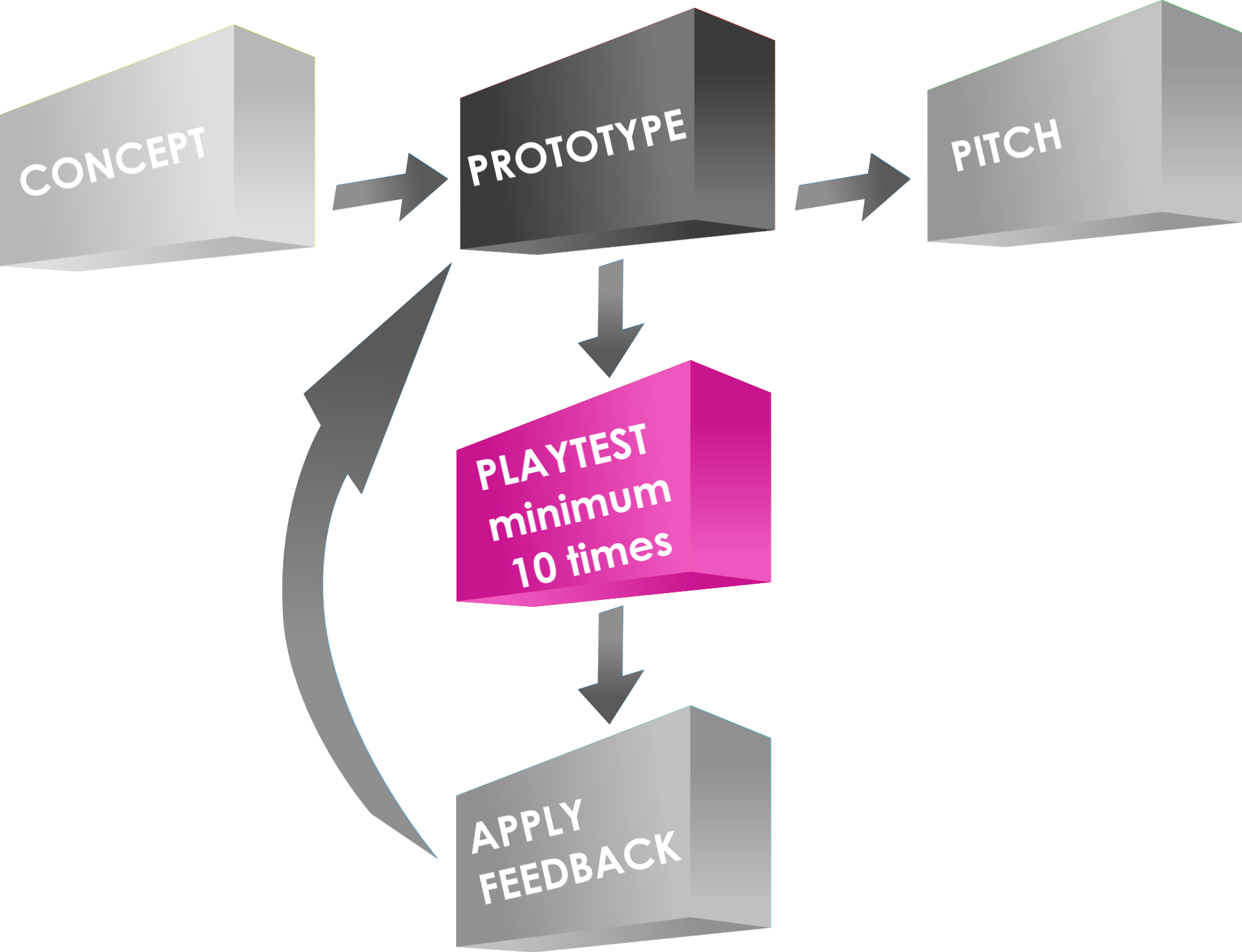
Perhaps the most important step in the Game Design process!
First things first… should there be a space between the words “play” and “test”? Does it matter? I prefer them together so for the duration of today’s article I will refer to it as playtesting.
Today I am continuing a series of articles about my take on the Game Design Process (GDP). It’s Friday so there’s probably a few of you out there who will be playing games tonight. And I’m guessing a few of you will be playing unpublished games that need playtesting. So this article should be of some assistance today!
Let’s imagine the playtesting process as if we’re carving a sculpture into stone. (In fact, one could reasonably treat the entire game design process in a similar way). For this article let’s assume you’ve already chosen the stone you want to carve (this is equivalent to creating your CONCEPT and creating the first PROTOTYPE). As Michaelangelo said (notes in parentheses are mine):
Every block of stone (protoype) has a statue (refined/perfected game) inside it and it is the task of the sculptor (designer & playtesters) to discover it.
So today I’m going to cover how the playtesting process takes that raw stone of a prototype and carves it down into something that is beautiful!
Rough Cut that Stone! (Playtest #1)

What exciting sculpture is within, waiting to be found?
So you’ve chosen your concept, decided on your mechanics, and created your first prototype. It’s time to rough cut that stone.
Getting the prototype to the table is an exciting moment! You’re ready to try it out. Don’t let disappointment cloud your excitement. And don’t expect things to work perfectly.
The goal of playtest #1, like rough cutting a stone, is to get rid of the large chunks that need not be there. To put it in gaming terms, find what’s broken. If there are broken mechanics, either eliminate them or chip away at them. The more you chip away, the closer you’ll get to a beautiful game!
Playtest #1 should be a solo playtest. Don’t submit your friends to something that is likely to be a waste of their time. Note: it will not be a waste of your time. Playtest #1 is a HUGE step in the game design process. But do it by yourself.
When sitting down for your first playtest I recommend having some questions prepared in advance. These can be things like whether or not you think mechanic A is broken, or whether mechanic B doesn’t work quite right, or whether the cards are balanced enough. For games with a lot of depth/detail it’s important to ignore the small things during this first playtest and even the first ten playtests. Remember, we are looking at the big picture here. We’re rough cutting the stone. So go ahead and rough cut your game!
Shaping that Stone! (Playtests #2-10)
Here’s a rule of thumb I try to follow when playtesting:
Don’t change things on the fly while playtesting, never change more than one thing at a time, and make sure you have enough plays under your belt to be able to compare your changes to the previous form (10 playtests seems appropriate).
Following this rule means that playtests 2-10 will be run with the same rules/components/etc. Since you’ve already rough cut your game via Playtest #1, feel free to invite your friends over to try it out. By getting 10 playtests under your belt you’ll begin to get a feel for what the beautiful sculpture within the stone actually looks like. Those first 10 playtests should provide a lot of great feedback.
But don’t change anything during those first ten plays unless there are things which obviously don’t work or are broken. These sorts of things should have been cleared up during solo Playtest #1.
During Playtests 2-10 try to pay attention to what people are saying about the game, how they react to certain elements, and most importantly pay attention to any feedback that is mentioned by different players independently. The more people that mention the same thing, the more important that thing is.
Fine Shaping that Stone (Subsequent Playtests in increments of 10)
From here forward you are in the “Fine Shaping” realm of game design. This is a VERY important section of game design. This is were things really begin to look like a final product. The objective here is to take each element of the game and work on making it beautiful. Here’s a list of things to pay attention to during these subsequent playtests:
- What is your goal/objective with this game design?
- How well does each mechanic work?
- Does each mechanic do what I want it to do? (Note: this is different from the previous bullet)
- What portions of the game are players responding positively/negatively to?
- When implementing new things (every 10 playtests) how are players reacting differently from the previous version?
- How well are things balanced? Do players always make the same choices? Is there only one path to victory?
- Pay attention to Downtime, Kingmaking, Runaway Leader, Tension, Endgame Awesomeness.
Those are just some of the things I try to pay attention to when playtesting. But the point of emphasis is not to change things except for every 10 playtests. If you change things sooner than that you’ll likely not have a good enough understanding of your game to really be able to tell if it has gotten better or worse.
That’s also why it’s important not to change two things at once. If you change two things and the game gets worse, how will you know which one caused it? Sure, sometimes it might be obvious, but it’s still an unnecessary risk. Change one thing at a time every 10 playtests so that you get to know your game really well.
Smoothing that Stone
We’re getting to the fun point. You’ve rough cut the game, you’ve shaped it, and you’ve refined it. You’re almost there. Once you’ve done a lot of playtests it’s time to start thinking about finishing it off and making a high level prototype. This is where things get a little different from the sculpting stone analogy.
When sculpting a stone, once you remove a chunk of that stone it’s gone forever. But with game design you can always add material back into the game. I chose the stone sculpting analogy because I am a proponent of keeping the game design simple. Here’s a lesson I’ve learned along the way:
It’s easy to add complexity and detail. It’s very difficult to simplify down to the game you actually want.
By this point in the game design process with numerous playtests under your belt you should only have to be changing small details. You should be at the point where you can see the beauty of your work. There’s just small imperfections in it. So smooth them away with refining.
The “Final” Product

A masterpiece, just like your game design after numerous playtests!
You’ve done all the dirty work. You’ve chipped away, you’ve refined, you’ve smoothed it out. You’re all set to pitch the game (which is something I know nothing about!). Your beautiful product is “complete.”
Okay, the word “Complete” is an absolute misnomer unless you publish the game yourself exactly how it is. Unlike a sculpture, board games can continue to be worked on incessantly. My perspective is to get the game to a point where you are confident in sending it to a publisher, and then send it to a publisher! If they sign your game, they might change it from something like David into something like the Sistine Chapel but it will still be YOUR work of art!
This has been a sort of 10,000 foot view of playtesting. In the future I’ll write another article more focused on an individual playtest session. Thanks for reading!
Scoville Print And Play Now Available!

Let the awesomeness be printed and played!
For those interested I have posted Version 0.1 of Print and Play files for Scoville, including the Rules, onto Board Game Geek. You can follow this link to obtain them:
BoardGameGeek: Unpublished Prototype: Scoville Rules & PnP
If you decide to print it out and play it I’d be happy to answer any questions. Just leave a comment below! I’d also be VERY interested in hearing your feedback from your plays of the game. So let’s stay in touch and make this game as best as it can be!
You can also hit me up on Twitter (@EdPMarriott) if you have any questions.
Thanks!
Eminent Domain: Escalation on Kickstarter

Publishers of Awesomeness!
One of my favorite game publishing companies is Tasty Minstrel Games. Why are they one of my favorites? I have two reasons:
- They publish awesome games including Homesteaders, Kings of Air and Steam, Ground Floor, Village, Noblemen, Belfort, and the topic of this post: Eminent Domain.
- They are very open and engaging about their business and they share a lot of awesome information about the board game publishing side of things. Check out Michael Mindes’ “BizOfPlay” Podcast on Soundcloud.com.
For those reasons I don’t hesitate when they launch a new project on Kickstarter. I know that their game developer, Seth Jaffee, will have done an amazing job making sure the game is refined and awesome. But most importantly, TMG’s games are fun to play!
So today I wanted to inform you about their latest Kickstarter campaign which is currently live. It is for the expansion for Eminent Domain. It is called Eminent Domain: Escalation (ED:E). It is the first expansion for the hit game.
For those of you who are unfamiliar with the game here is a little background. Eminent Domain is a deck-building game with a space-based theme. Players are trying to settle the most planets, research the most technology, and gain the most influence. Each turn you choose a card from your hand and do the action listed. These actions are things like Gain a Fighter, Colonize a Planet, Survey New Planets, and Research Technology. After performing the action the player will take a card from one of the piles on the table. They then perform the Role of that card. These roles allow the player whose turn it is to reap some benefit. Then all the other players can “follow” by doing the role or “dissent” by drawing a card into their hand. That’s basically how a turn works. To learn more check out Tom Vasel’s review of the game:
I really enjoy this game. I first played it last year in the GenCon library. This expansion looks like it will really add to the game. It adds the capability for a 5th player. It allows for direct conflict. It adds new technology cards. And it will add different starting scenarios, which adds a lot of flavor and replayability.
I highly recommend backing the game on Kickstarter. You can back the game and expansion for $50 or if you already own the game you can back the expansion for $25. Please let me know if you have any questions about the game or TMG. If I can’t answer them I’ll point you in the right direction. You can pledge on the Kickstarter project page!
Game Design Process: Concept
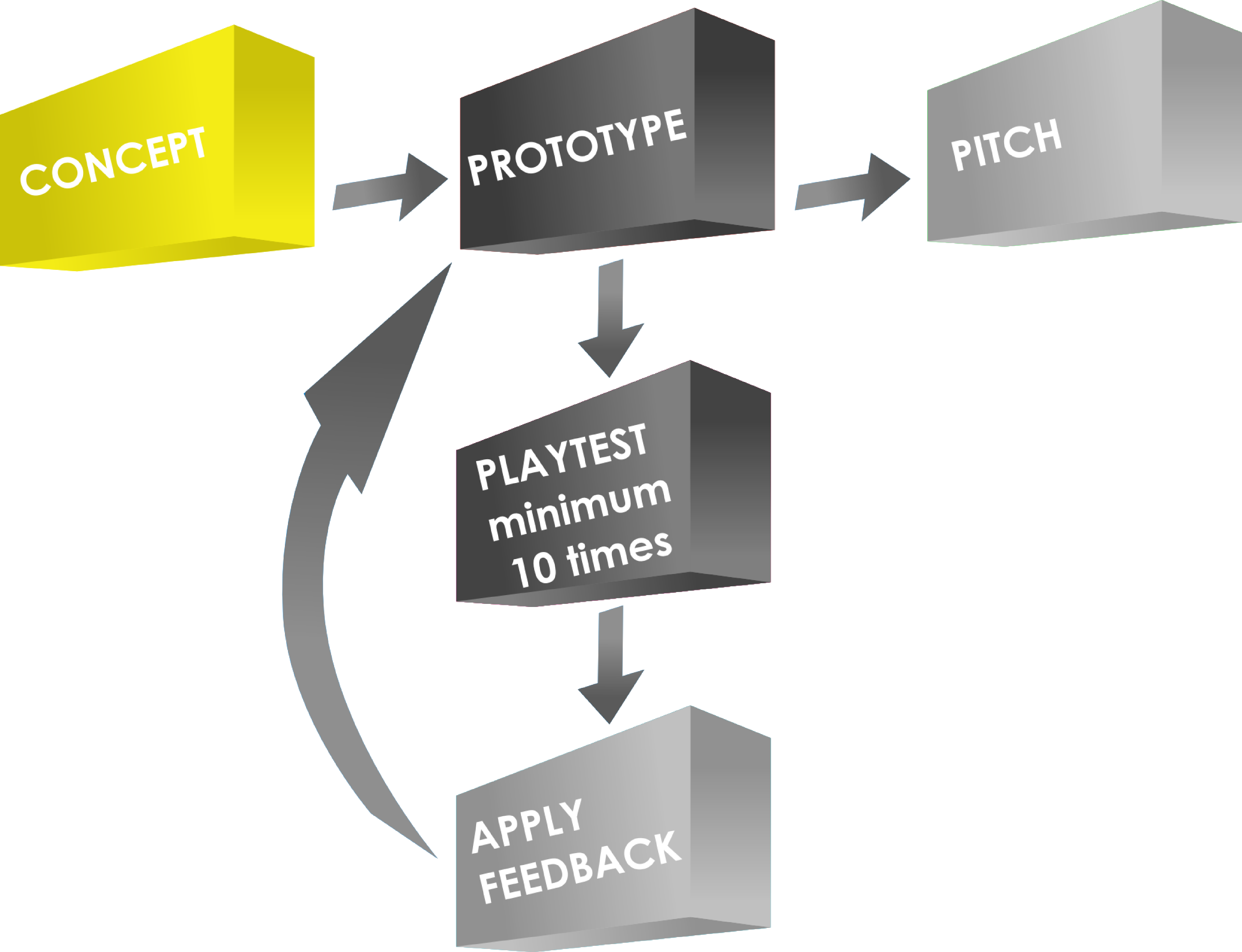
Discussing how I arrive at a concept.
Last week I wrote about prototyping a board game and I shared my prototyping techniques for Scoville. This week I am sharing my concept process. How do I come up with a game design? Do I choose a theme and then add mechanics? Or do I choose a mechanic and then slap on a theme? Do I purposefully try to integrate an appropriate theme for the mechanics? These are the sorts of questions I’m answering today in a “self-interview” format.
Q: Where do you get your inspiration?
A: Everywhere awesomeness can be found. I can be easily inspired by just about anything. Make a game about boll weevils? Sure! Make a game about nuclear radioactive decay? Why Not! My main rule of thumb for game design, whether it’s the concept phase, prototyping, or potentially pitching a game is this:
Make sure it’s fun and relate-able!
If what you are designing is something that is fun, then the theme can be just about anything. I usually get inspired by the things that I waste spend my time on. If I’m enjoying the NCAA basketball tournament I’ll probably start thinking of making a card game where you represent a team in a region of the bracket and via set collection and hand management you have to play the right cards to get your team through the Final Four and eventually to win the championship. If I’m working out in the gym I might be inspired to design a game where you are a person who is trying to lose the most weight. You’d have to compete against the other players to burn the most calories or increase your bench press weight the most. The bottom line, though, is that it must be something fun. Players may love a set collection/hand management game, but if the theme is something boring that no one can relate to, then maybe you should come up with something else.
Q: Regarding a game designer’s Chicken vs. Egg Debate: Mechanic or Theme first?

Theme or Mechanic first?
My inspiration is typically theme based, so I usually start there. I’m not a huge fan of abstract games, either. So that probably guides me toward choosing a theme first.
When you choose a theme first it allows you to sort of steer your game in a direction that fits cohesively. Once you have a theme you can pick and choose the mechanics that you think will work best. Imagine you have chosen the NCAA tournament theme. It would be important to understand how the tournament works. You have 64 teams playing games over several weekends. Each game eliminates one team. Eventually you get to a Final Four. So once you understand how the tournament works you can then start to add mechanics. One way to do this would be to have players each represent one region of the tournament. Your objective would be to get your best team into the Final Four. Other players can play the spoiler role and try to cause upsets in your region. To do all this you could use a blind card mechanic with a drafting round before players apply cards. All players could draft a card and then cards could be played onto each game. The overall idea here is that when choosing a theme first you can then go and apply mechanics that you think fit the theme AND make the game fun.
On the other hand when you choose a mechanic first you are almost automatically starting with a more abstract game. A theme could be slapped on that probably fits the mechanic. Or a different theme. Or another different theme. The reason I typically don’t start with a mechanic is because the theme part of a game is typically what makes a game fun and relate-able. That’s just how I roll!
Q: What about boring themes? People seem to like them too!
Valid point, self. So there are a lot of games that have very boring (my opinion) themes that people still really like. Farming, for example. How can a game about farming be fun? The game Agricola is the third highest rated game on BoardGameGeek.com. So clearly the theme isn’t the whole picture in whether a game is fun or not. In fact, many Euro style games involve “trading” or “resource management,” which can be very boring topics. The key is this:
When the theme is boring, make sure the mechanics are innovative and unique (and fun!) (Or have awesome artwork!)
Sometimes people buy games because of the theme. Sometimes they buy games because of the mechanics. As long as the game is fun it can have a super dry and boring theme and people will potentially enjoy it.
Q: You keep mentioning “Fun.” How do you make sure a game is fun?

It looks like they’re having fun!
When I first got into designing games I searched for articles about making games fun. I found some interesting things that I wanted to list here. Some of them are less about fun and more about making a game “good.” But it’s my philosophy that if a game isn’t good, it won’t be fun. So making a game “good” is a prerequisite for making a game “fun.” Here are my rules of thumb for the conceptual phase of the game design process:
- Interaction is Critical! (Otherwise I’d be designing solo video games!)
- Avoid Downtime.
- Provide many options on each turn – you don’t want players to only have one option on their turn. If they can only do one thing then the cease playing a game and become robots.
- Provide multiple paths toward victory. Even if there is only one victory condition, make sure that there are numerous ways to get there.
- Avoid a runaway winner.
Let’s quickly run through why each of these is important for making a game good and fun:
Interaction: If there is nothing you can do to affect the other players, then you’re playing a solo game against other solo gamers. Not fun. If there is no interaction on a verbal level then it doesn’t matter that you’re sitting around a table with friends. You may as well make your game into an app that people can play when they’re sitting on the toilet. Provide a way for players to interact in the game.
Downtime: No one likes sitting around for a long time while other players are taking their turns. Try to design your game so that people are constantly paying attention. Make sure they’re invested in what the other players are doing. It’s no fun to be sitting around waiting.
Options: Without options a game of strategy or tactics or even luck becomes a simple matter of doing whatever it is that the game is forcing you to do on your turn. That’s no fun at all! Designers: give your players options! Don’t turn us into robots.
Paths to Victory: It’s important for players to be able to play your game in different ways. This can be as simple as having destination tickets like in Ticket to Ride. Or it can be complicated like choosing the best way to fill in your estate in The Castles of Burgundy. Just make sure that you’re giving the players different ways to reach a winning condition.
Runaway Winner: I just as easily could have said to avoid player elimination. With a game where a player can get so far ahead that no one can catch up it is effectively player elimination anyway. A good and fun game design will include a way for players to catch up to a leader. This can be done several ways, including hindering the leader or benefiting a last place player. Think of the NCAA thing again. Which games are more enjoyable to watch, blowouts? or close games where a team was down big and they came back and hit a buzzer beater at the end?
Of course there are other things that can determine whether or not a game is any fun. Those above are just the main five things that I always keep in mind when designing a game. Another one that I did not mention because it is difficult to get right in a game is having an ever increasing amount of tension in a game. That is one of the things that Agricola does really well. This can be done by having limited resources or a first-come-first-serve option. Agricola has both!
Q: You’ve got a theme, now what?

So you’re going with Boll Weevils, huh? Could be worse!
You’ve chosen an interesting theme that could be fun and is relate-able. Where do you go next? I like to do a little research about whichever topic I’m thinking about designing into a game. When doing the research I try to figure out things about the topic that would work well for game mechanics.
In the Boll Weevil example I just learned that boll weevils, though not native to the United States, migrated here in the 19th century and by the 1920s had devastated much of the cotton industry. So perhaps while the boll weevil theme itself may not be very fun or interesting, as a designer I could go several different routes. I could make the game be a cooperative game about controlling the infestation. I could make it so that players represent individual boll weevils trying to infest the largest amount of territory. I could even make the game about farmers trying to grow the best cotton while other players can launch infestations of boll weevils on their opponents. So I could definitely produce a game about Boll Weevils. Question is, would anyone care?
The point is that once you choose a theme, do a little research and figure out what you really want the objective of the game to be.
Q: How do you add mechanics?
Now that you’ve gotten to the point of understanding what your objective is in your game it’s time to start turning it into a real game. The key is understanding the theme. You don’t want to add things to your game that don’t really fit the theme. I recently ran across this with the game Archipelago. There are mechanics in that game that just don’t seem to fit the theme of exploring an archipelago and dealing with indigenous persons. One example is that if the rebels are advancing you can get them to stop by selling fruit. But you aren’t selling fruit to the rebels. You simply have to sell fruit. It just didn’t make much sense to me.
So when I think about adding mechanics to the theme I figure out how the theme really works. It’s like the boll weevil example above. Since boll weevils spread and infest I would probably add a mechanic where a swarm of boll weevils is taking over precious territory.
I also like to keep in mind the 5 points I made above about making a game good. If a mechanic adds too much downtime, for example, I might not go with that mechanic. Or if a mechanic has no player interaction I’d probably leave it out. It is important as a game designer to be cognizant of how the mechanics in your game not only allow for players to reach the game’s objectives, but also to make the game good and fun!
Conclusions:
Game designers face an interesting challenge. The whole idea of creating a game is almost a game in and of itself. Designers strive to make games that are fun, induce emotions from the players, create an atmosphere of engagement between players, and be innovative all at the same time. Finding a theme, applying mechanics, and balancing the game are all things that go into making a great game. If there’s a game out there that you really enjoy, find the designer on Twitter and thank them! A lot went into that game!
Scoville Protospiel Recap

I had the privilege of attending my first Protospiel this past weekend in Milwaukee. Protospiel is a convention for game designers to bring prototypes and get feedback from other designers. So I took my game Scoville along and got some awesome feedback! I think that I’ll focus this recap on my game rather than provide opinions of the games I played that are unpublished. That would not be fair to the designers even if I really enjoyed their games since all the games I played are still in progress. So rather than posting a drawn out chronological recap of the weekend I will just post the drawn out highlights for the play tests of Scoville.
I was fortunate to have Scoville played five times and was pleased to play 8 other games by other designers. Protospiel is an awesome thing for a designer to attend!
Here’s a little background about my Protospiel expectations and goals…
Protospiel: First Contact
Coming to Protospiel I had two goals: 1) validate whether or not Scoville is any good and 2) connect with people who know what they’re talking about. A secondary goal was to leave a copy of the game with Grant Rodiek for inclusion in the Prototype Penpal Program. That was something I could always do later on, but I thought it could be cool to send a copy off with him.
I also had some expectations about the feedback I might receive. I knew that I wanted to adjust the auction phase of the game. So I to see the same feedback about it that I had seen from my prior play tests. I was also a little uncertain about the quality of my prototype (that thought was quickly vanquished!). Thanks to everyone for the kind words about the quality of my prototype. I’ll post an article sometime about how I make prototypes.
So if I received validation and made some connections then I would have considered this weekend a success. Let’s see how it went.
Scoville Play Test #1
 Getting to the convention at 8:15am on Saturday allowed me to get my game set up right away since few people were there. I got four people to give it a go and they seemed to really enjoy it. I won’t explain the game much here since I’ll be writing a post all about the game itself. Here are the suggestions that I received after the game:
- Beware of color blindness (Cool apps: Color Blind Vision (Android: FREE) and Colorblind Vision (iOS: $2.99)).
- Stage II orders seem to provide too many points.
- If everyone bids zero in the auction, flop the player order.
- Put endgame trigger scenario onto the guidesheet.
- Tiebreaker should go to the player with the most coins.
- The game was described as a “Euro with luck but no dice.”
- There should be no randomly chosen player order at the start of the game.
- During fulfillment there should be the option to pay for becoming the first player.
That’s a lot of great feedback. The game uses 10 differently colored cubes so I have been aware of the color blindness issue. There are several solutions for this. The biggest takeaway from play test #1 was that I received the auction feedback I was expecting. My plan would be to test a new auction mechanic on Sunday.
One player, who happened to be the winner by a lot, wanted to try a strategy that I am aware of but have not yet seen attempted. Since peppers can be sold for coins based on how many of that color are planted in the fields there is a strategy that you can plant a pepper of a certain color in each round and harvest that same color each round without doing anything else. I have done the math in my head and I do not believe that this would be a winning strategy (at least I hoped not because that would make the game broken). More on this below.
Scoville Play Test #2
After working on Protospiel goal #2 of making connections and meeting some awesome people, they were willing to give Scoville a try. During this second play test there was more bidding and jostling of player order. I think that was the reason that the auction was not mentioned in the post-game discussion. This play also resulted in much closer scores than the first play. Here are the suggestions I received:
- Peppers should be worth something at the end (that are currently worth nothing in the endgame: Use Them or Lose Them!)
- The artwork on the fields should somehow better illustrate where the player pawns can be placed.
- The game was described as a “medium to heavy Euro.”
So I received quite a bit less feedback from play #2. But the fact that I still didn’t receive any feedback about how anything seemed broken meant that perhaps Protospiel goal #1 (validation) was starting to become apparent.
Scoville Play Test #3
Later Saturday night a prominent figure in the board game reviewing business was able to play Scoville. So with three other players I got play test #3 going. In terms of rounds this was the shortest game I have seen. The game lasted 6 rounds. The players again seemed to enjoy the game and nothing seemed broken to them. They did mention the auction as the weak point of the game, so I received good feedback about that that I could implement on Sunday. Here’s the suggestions:
- Possible Trademark issue with the names of peppers used on the recipe tiles.
- Turn order needs adjusting. Option 1: Flop the order. Option 2: Purchase your spot.
- Perhaps just get rid of the reverse order for the harvest action.
- Brown peppers seem too valuable.
I want to point out that the brown peppers are somewhat of an enigma in the game. They don’t breed with anything except the best peppers. They take up space on the map. But they are used quite a bit in the recipes. I had not received feedback that browns were too valuable before this. The normal feedback on the brown peppers is that they seem pointless. So this was interesting feedback from a fresh perspective.
I was also pleased, in a bittersweet way, to hear the same feedback on the auction mechanic. I now knew that I could incorporate a revised auction mechanic on Sunday and expect good things.
I was intrigued by the suggestion to remove the reverse player order for the harvest. My first thought was “absolutely not.” What that would lead to is either huge bids during the auction or rounds of the game where one player can make a huge jump in points. I’ll have to examine this further.
Scoville Play Test #4
Sunday morning I was able to play Scoville for the first time during the weekend. I had not played in the previous play tests. And this time it was just a two player game. I have tried to design the game such that it scales well from 2 to 6 players. There are no AI players necessary and the game feels nearly exactly the same with 6 players as it does with 2.
Since it was now Sunday I was going to implement the new auction mechanic: Bid for Player Order. Now during the auction phase players would be bidding for turn order. Whoever bids the most gets to choose their spot in the turn order. The next highest bidder gets to choose the next spot, and so on. This way, if a player wanted to become the first harvester they could bid high and then choose the last spot, which would allow them to harvest first.
The new auction in the two player game seemed to work, but I suppose that this new auction mechanic would work even better with more players. What the new auction mechanic provided was a way to earn the first harvester spot. That is critical to strategy in the game.
Here are the suggestions I received:
- Are points balanced on the Order tiles?
- Change the artwork on the Cross-Breeding table for the cross-breeds that result in two peppers.
The points on the Order tiles may be slightly unbalanced, but not to the point of brokenness. These can be easily revised, which I may do depending on analysis of the scoring for the first 25 play tests. The artwork suggestion is an excellent one that I will definitely change.
Scoville Play Test #5
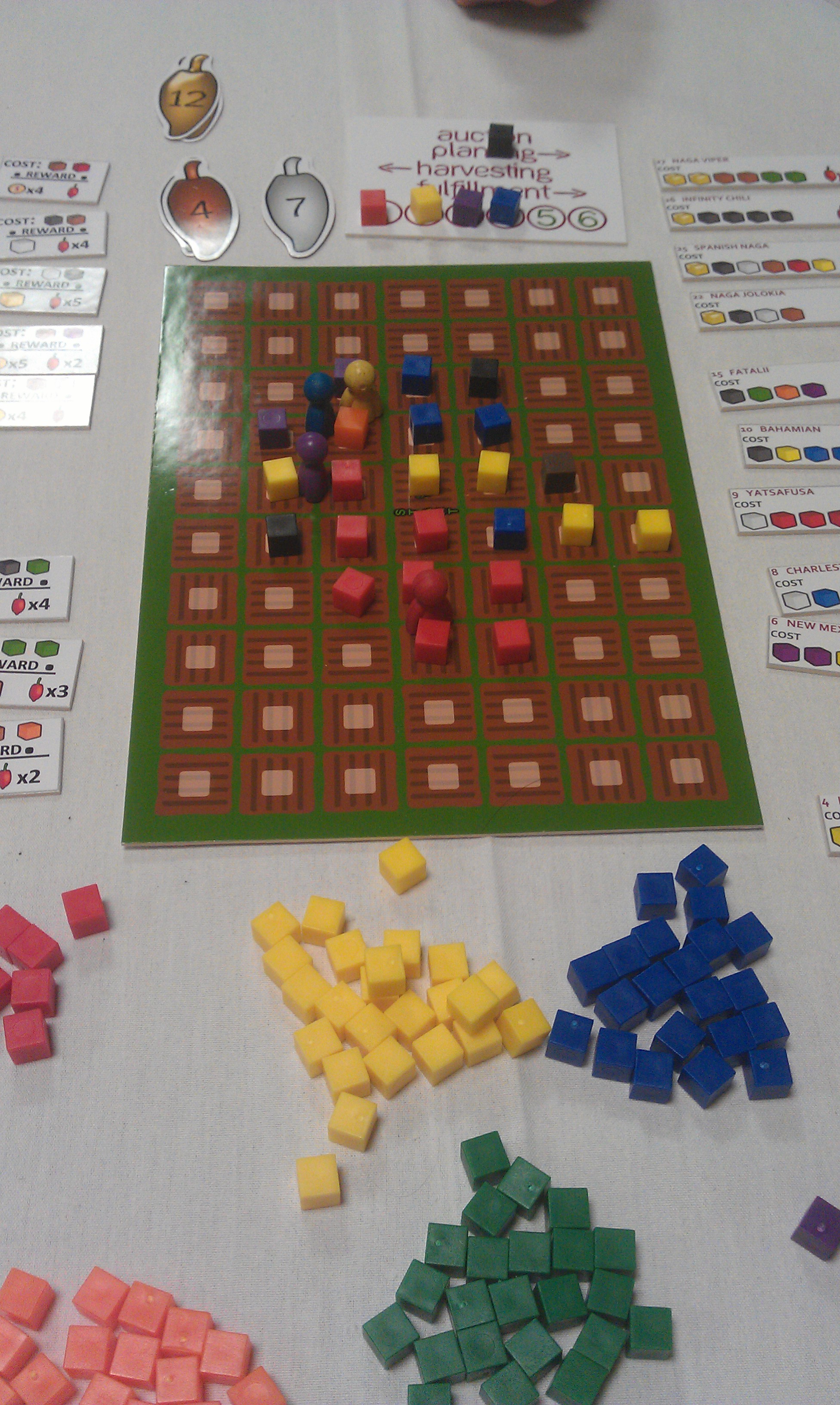
The attempt to break the game. He ended up red-faced!
The final play of Scoville included the big winner from play #1. He wanted to test the coin building theory and see if it could potentially provide a winning strategy. I welcomed him to try it but made sure that the other players were initially unaware of his proposed gameplay. It was a great final play and I was happy to see that the new auction mechanic really worked well with four players. Here are the suggestions:
- Don’t call it “harvesting, call it “breed-vesting.”
- Check out the game Santiago since there is a similar “fields” mechanic (uh oh… worried about this!)
- The different parts of the game were described by one player as Resources (Auction), Tactics (Orders), and Strategy (Recipes).
The first thing to discuss was the auction. Of note is that this game had the highest average bidding per round of all 5 play tests during the weekend. I think this is due to players now having two things to bid for (first player spot or last player spot) rather than for just moving up in player order. The thing of note was the compliment someone gave to the auction saying that the auction was a good mechanic for the game. This brought the game full circle over the weekend. Previously the auction was described as the weak point of the game. Now it was “good.” I’ll take that!
The other thing that was validated from this final play test was that the game was not broken in that attempting to get coins by planting and harvesting the same color did not result in a winning strategy. The player was going full steam ahead from the get-go with that strategy and came in last place (though could have finished in third place). I was pleased that the game wasn’t close to being won by that strategy. Overall it was a great play test.
Overall Scoville Analysis
Perhaps the best part of the analysis is that people really seemed to enjoy the game. While my goal was to validate whether or not it was any good, I came away from Protospiel very humbled by all the kind words people had for the game. Let’s dig in a little bit and check out the scoring breakdown:
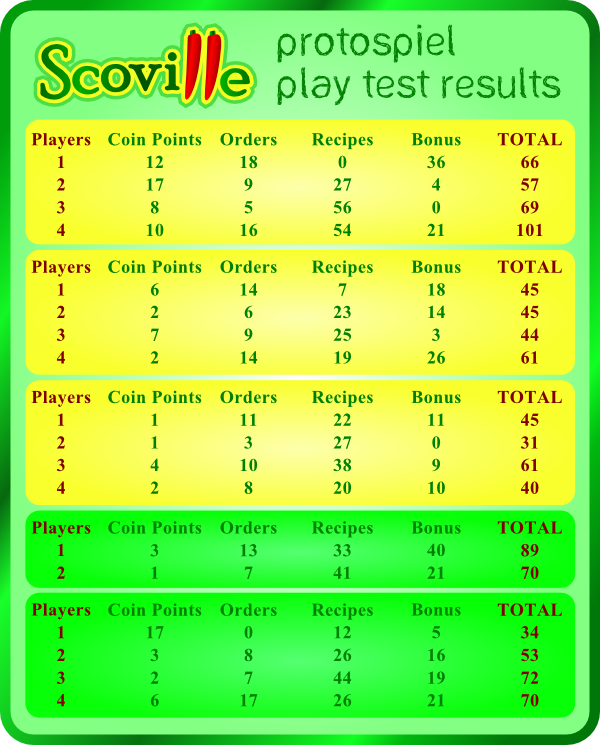
Some further analysis revealed that the number of coins bid during the game varied quite a bit. In terms of coins bid per round the numbers were 2, 6.14, 7.66, 1.38 (2-player), and 7.85 per game. The highest average was the 4-player game with the new auction, though this wasn’t unexpected.
Overall it was apparent that people had fun when playing the game. That’s the most important thing to me as a designer. There are some things that I would like to continue to develop leading up to Gen Con that I mentioned to the players. But I want to avoid the situation where I am needlessly adding complexity. That would steal from the simple elegance of the mechanics currently in the game.
Thank you to all 16 players who play tested my game. I really appreciate the feedback. It was an awesome weekend! And special thanks to Grant Rodiek for humbly accepting a copy for the Prototype Penpal Program. I know that I can expect some awesome, honest feedback!
 Boards and Barley