Blog Archives

Monday Brews – 1-5-15
A new year is upon us. It was 8 degrees below zero (F) this morning and will snow 2-4 inches tonight. Oh joy. But Boards & Barley is back! So there’s that.
If you are new to Boards & Barley or made a New Year’s resolution to read this site more regularly, then I welcome you with open arms. On Mondays I like to recap the beer and board games I’ve played since the last Monday Brews article. It’s been a couple weeks and we had gaming friends over for a few days so the Boards and Barley are both longer lists than normal.
But before we get into that I wanted to mention that I’ll be posting my 2014 Recap article tomorrow and a Scoville article on Friday. As a reminder, if there are topics you would like me to blog about, please let me know via Twitter or via comments on this article.
Now let’s start with the Barley…

The Barley:
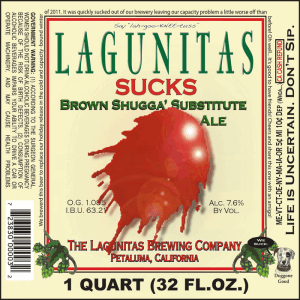
But it doesn’t suck!
BARLEY SPOTLIGHT:
Lagunitas Sucks Brown Shugga Substitute
This brew was a gift from my wife. She found a beer with a 100 rating on Ratebeer and wisely purchased it. Lagunitas’ brews are usually hoppy, as was this brew. But this brew had 63 IBUs, which is about perfect for me. This enjoyable brew had a nice balance between hops and body. I’d drink it again.
- Samuel Adams Winter Lager
- Leinenkugel’s Snowdrift Vanilla Porter
- Central Waters Bourbon Barrel Ale
- Capital Winter Skal
- Labatt Prohibition Series Bourbon Barrel Aged Blonde Ale
- Point Brewery St. Benedict’s Winter Ale
- Capital Schwarz in a Box – Don’t get it. It smelled like wet dog and tasted like Dinty Moore Beef Stew.
- McEwan’s Scotch Ale – Probably the best Scotch Ale I’ve ever had!
The Boards:

Your objective is to settle… Imperially!
BOARDS SPOTLIGHT:
Imperial Settlers x3
I love this game. I love the combo-ing or chaining of cards. I love figuring out how best to obtain and spend the resources. I love that it’s easy to teach and play. I love the artwork. I love everything about it with the exception of some downtime. But the downtime can be used to figure out what you are going to do next. The other thing I love about it is that my wife enjoys it. That means it will hit the table more often than some of the “heavier” games I own. If you haven’t already done so, check out Imperial Settlers by Portal Games.
- Kingdom Builder
- Dungeon Roll
- Scoville x3 – I love those little peppers!
- Charades for Kids – My daughter was having an absolute blast with this game.
- Tenzi
- Flash!
- The Logo Game
- Sushi Go
- Mundus Novus
- Istanbul
- Unpublished Prototype – Ziggurat – This is my design, but it still needs a lot of work.
- Garden Dice – Love that Joshua Cappel artwork! It was a really clever game.
- Undermining
- Trajan – Such a great Feld!
- Euphoria
- Skyline
- Camel Up
- Yardmaster
- The Little Prince
- 7 Wonders with Leaders, Cities, and Babel expansions
- Sequence for Kids – My daughter won 3 out of 4 games with 3 players. And I don’t let kids win. She earned it!
- Hi-Ho Cherry-O
What Boards & Barley have you been enjoying? What were your favorites of 2014? Thanks for reading and I hope to bring you lots of great content in 2015!
Monday Brews – Christmas Edition
Welcome back to Boards & Barley! If you’re new here, have a look around. I post about homebrewing and board game design. Feel free to leave comments anywhere you please.
Each Monday I blog about the beer (Barley) and board games (Boards) that I’ve enjoyed over the last week. Sometimes I also post about my recent design efforts as well. Today will be my last blog post of the year so I’ll try to make it at least slightly interesting. To accomplish that I wanted to share this awesome tweet of Scoville in the wild:
https://twitter.com/benosteen/status/546986810854113280
Pretty exciting! For those who don’t know, Scoville is my first published game and will be hitting retail stores in January. Kickstarter backers are beginning to receive their copies (at least in the EU). I can’t wait to hear what people think about it. Now, let’s move on to the Barley…
The Barley:

Delightful!
BARLEY SPOTLIGHT:
Central Waters Brewers Reserve Bourbon Barrel Stout
I had this twice over the last few weeks and it was awesome. Many bourbon barrel beers are overwhelmed by the bourbon characteristics. That often makes it feel like you are drinking bourbon instead of beer. This one, however, had a perfect balance of bourbon and beer. The bourbon character was present but it partnered with the beer rather than drowning it. Central Waters created a wonderful brew with this one and I’m looking forward to having another.
- New Glarus Apple Ale
- Point Brewery St. Benedict’s Winter Ale
- Brouwerij Palm Amber
- Lakefront Brewery My Turn #010 Andy Pub Ale
- Tyranena The Devil Made Me Do It Imperial Oatmeal Coffee Stout
- Oskar Blues Old Chub Scotch Ale
- Pearl Street Brewery Java Lava
- Brasserie Caracole Saxo
- Coronado Brewing Hoppy Daze
- Chimay Rouge (Red) Belgian Dubbel
- Wisconsin Brewing #003 Brown & Robust Porter
- Capital Brewery Winter Skal
If you’d like to follow along with my Barley consumption, find my profile on UnTappd (Username: EdPMarriott).
The Boards:

Cover art is a little weird but the game is quite fun.
BOARDS SPOTLIGHT:
Maharani
The theme is a little weird and the box cover probably wouldn’t draw me in at a game store, but the gameplay itself is fun. You basically draw and place a tile on the board. But the locations of the tiles you choose are different from your opponents. This is because the tile selector in the middle of the board physically rotates. And the region from which you draw a tile matters. The tiles are placed to earn points by connecting like colors together, or using your meeples to score. I had fun and I definitely want to play it again.
- Yardmaster x2
- Kings of Air and Steam
- Hungry Hungry Hippos x48 – Christmas present for my kids. Only to be played when the littlest one isn’t napping.
- Gone Fishin x10 – Easier than when I was a kid since the fishing poles are solid rather than a ball hanging on a string.
- Eat Poop, You Cat! x2
- New Bedford – Bummer about the canceled Kickstarter since it’s a solid and fun game.
Ziggurat: Building the Game
I designed Ziggurat the Thursday evening before Prototspiel-Madison in October. I prototyped it the Friday of Protospiel. It was played four times during Protospiel. And I am finally putting together the pieces to turn it into an awesome game!
So today I want to share a little bit about the game and the basics of how it plays. But first here’s a history lesson:
What is a Ziggurat?

Ziggurats are like the Sumerian equivalent of Egyptian pyramids. They are basically a huge brick structure with several levels. They served as the focal point of worship in those ancient cultures. Often it is believed that a temple was built atop the ziggurats.
And since I’d rather focus on the game rather than the history, here’s the Wikipedia link: Ziggurat
The Game…
The thrust of the game revolves around building the Ziggurat. As the design currently stands you have two options on your turn:
- Purchase resources (bricks, laborers, special abilities) from the courtyard marketplace.
- Spend bricks and laborers to build the Ziggurat.
One of my design goals is to come up with games that are accessible and easy to teach. Ziggurat is like that. The simplicity of limiting what actions can be taken makes the game accessible for non-gamers.
The region of interest, in terms of adding strategy, is to design compelling and interesting decisions into those two options. For example, when purchasing from the courtyard market, would you be willing to pay a higher price for a better card? Also, when building the Ziggurat, does the location where you are building matter?
These are the sorts of things I’m trying to design into Ziggurat. Let’s take a look at the prototype.
The Prototype…
I had previously obtained some components from The Game Crafter at a prior Protospiel event. It turns out that the components I had worked perfectly for what I wanted to achieve with Ziggurat. Here is a first look at the bare prototype:
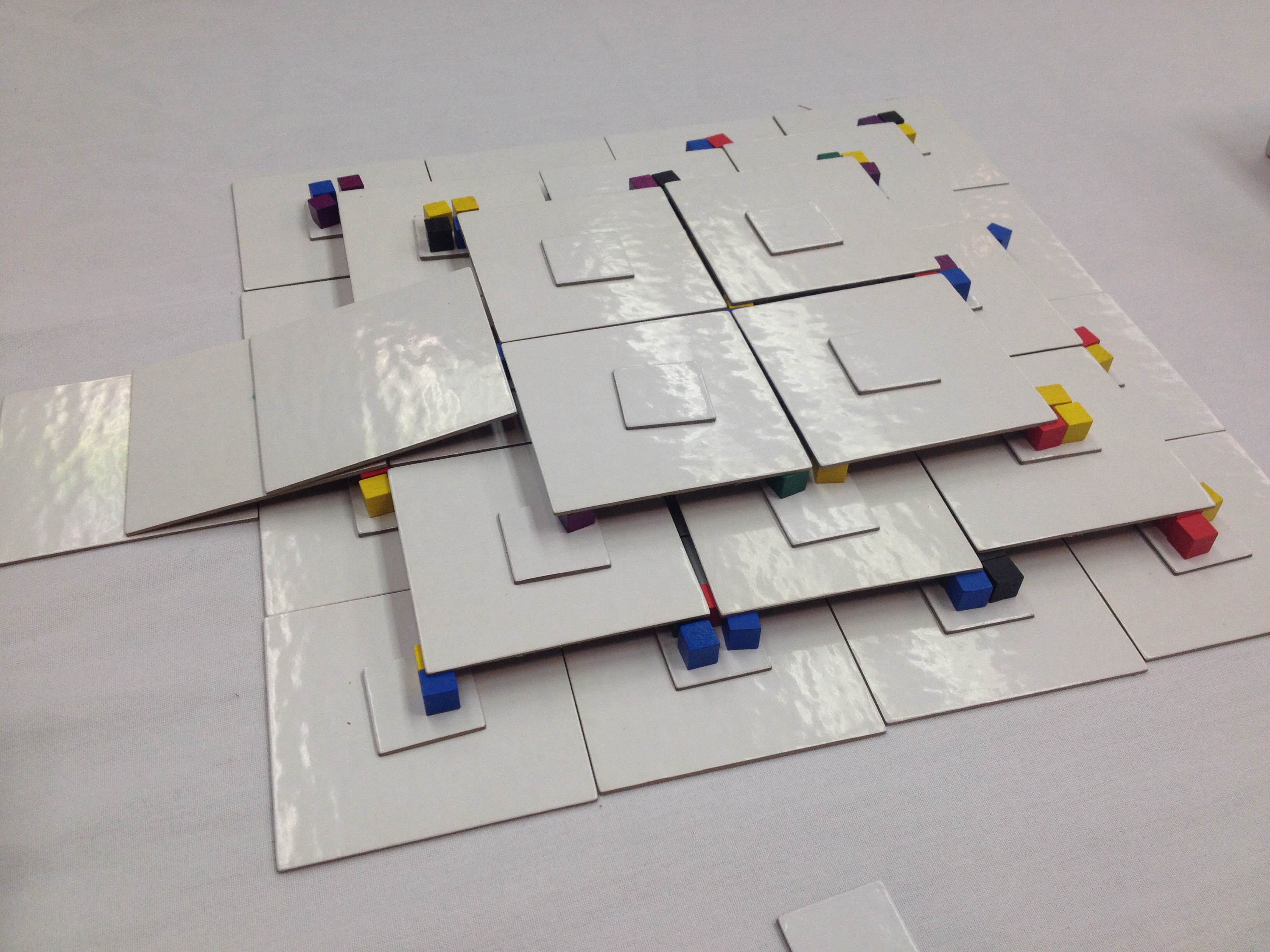
Bare bones prototype demonstrating the 3D nature of the game.
The Ziggurat is composed of three levels. On each level there are platforms that need to be built. Players will build the platforms by spending the appropriate resource and then placing one of their player cubes onto the platform. Once the first level is completed it will be scored. Then the large square tiles for the second level will be placed on top of it. Here is a look at the Prototype with more details on the tiles and platforms.
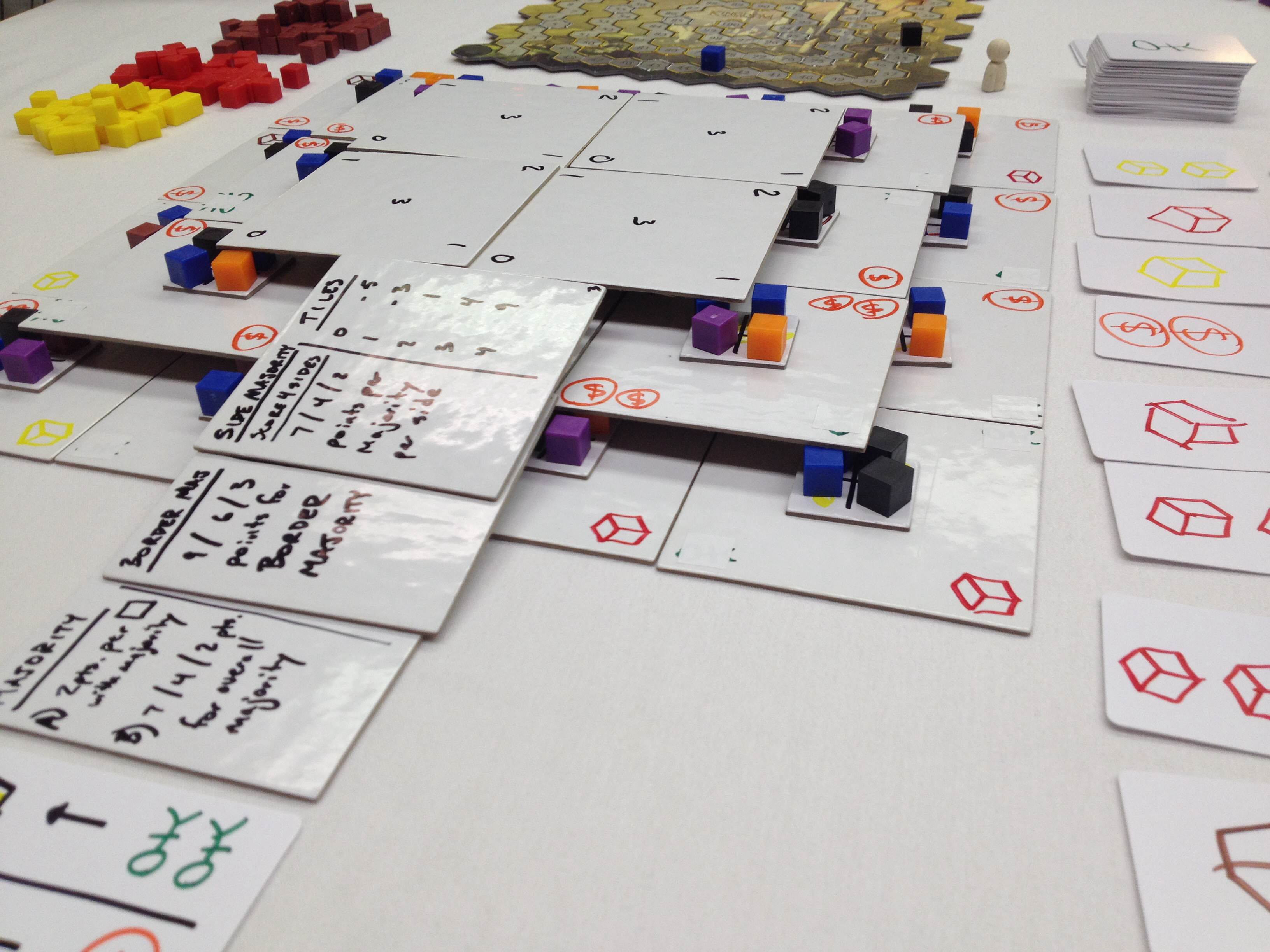
The Ramp lists what the scoring conditions are for the current game.
One thing of great importance in the game are the platforms. Each platform requires 4 cubes. When any given platform is completed, each player who helped build the platform will earn some reward. The rewards available are shown on the corners of the tiles. This is a way to ramp things up in the game and loosen the tightness of the resources. It also incentivizes building, which is the whole idea of the game.
Here’s another picture of Ziggurat at the end of a Protospiel playtest:
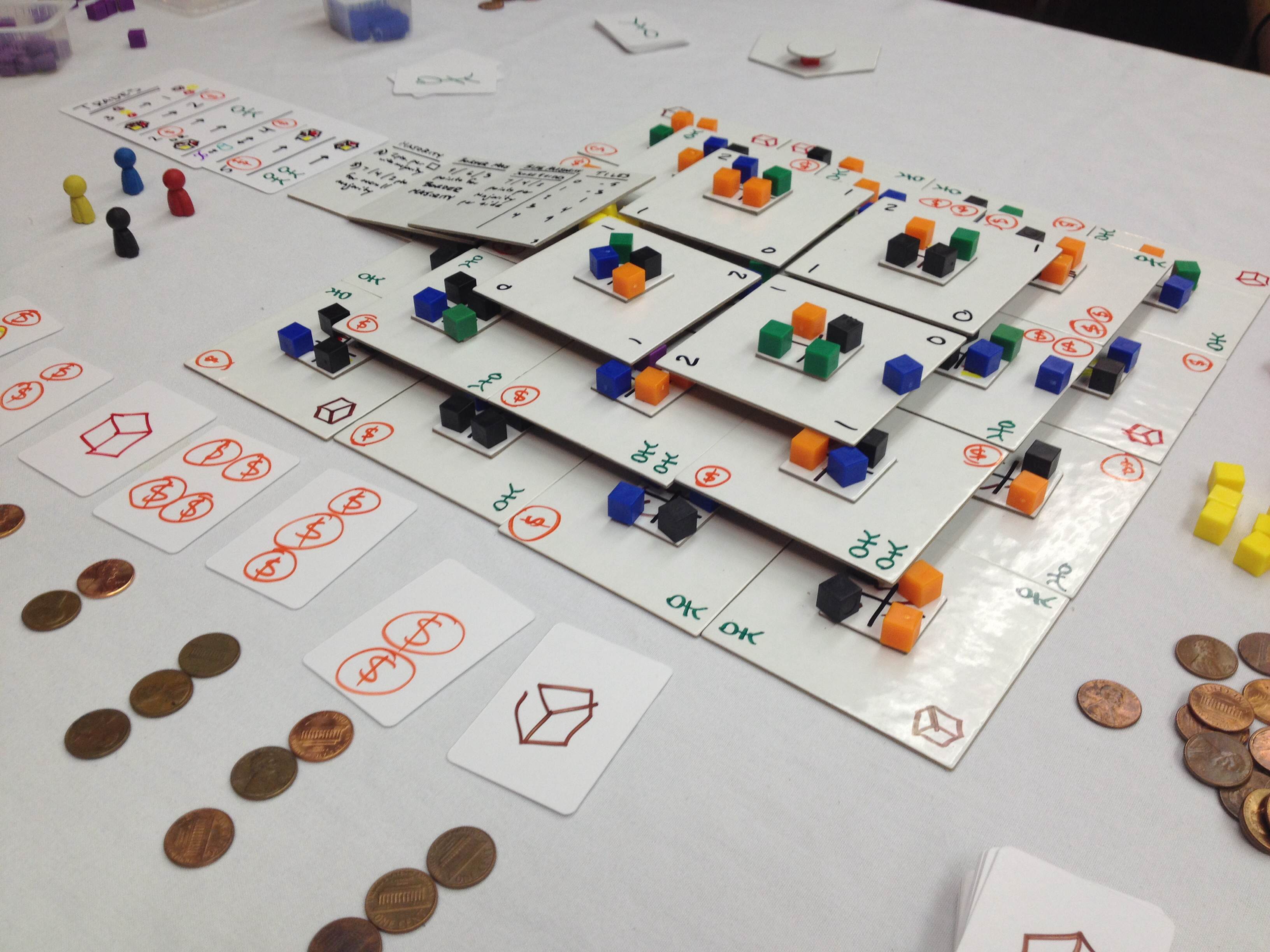
Ziggurat Completed! Time for final scoring.
In the bottom left of the image above you can see the courtyard market. In the current version of the game there are six cards in the market. Players may purchase up to two cards. The card at the end costs zero and the costs ramp up as 1, 1, 2, 3, 4. The image has different costs, which I have since adjusted.
The Latest Prototype…
I’m a sucker for creating decent looking artwork and graphics. I use Inkscape, which I recommend. I mocked up some cards and placed an order with TheGameCrafter.com. Here’s what they look like:
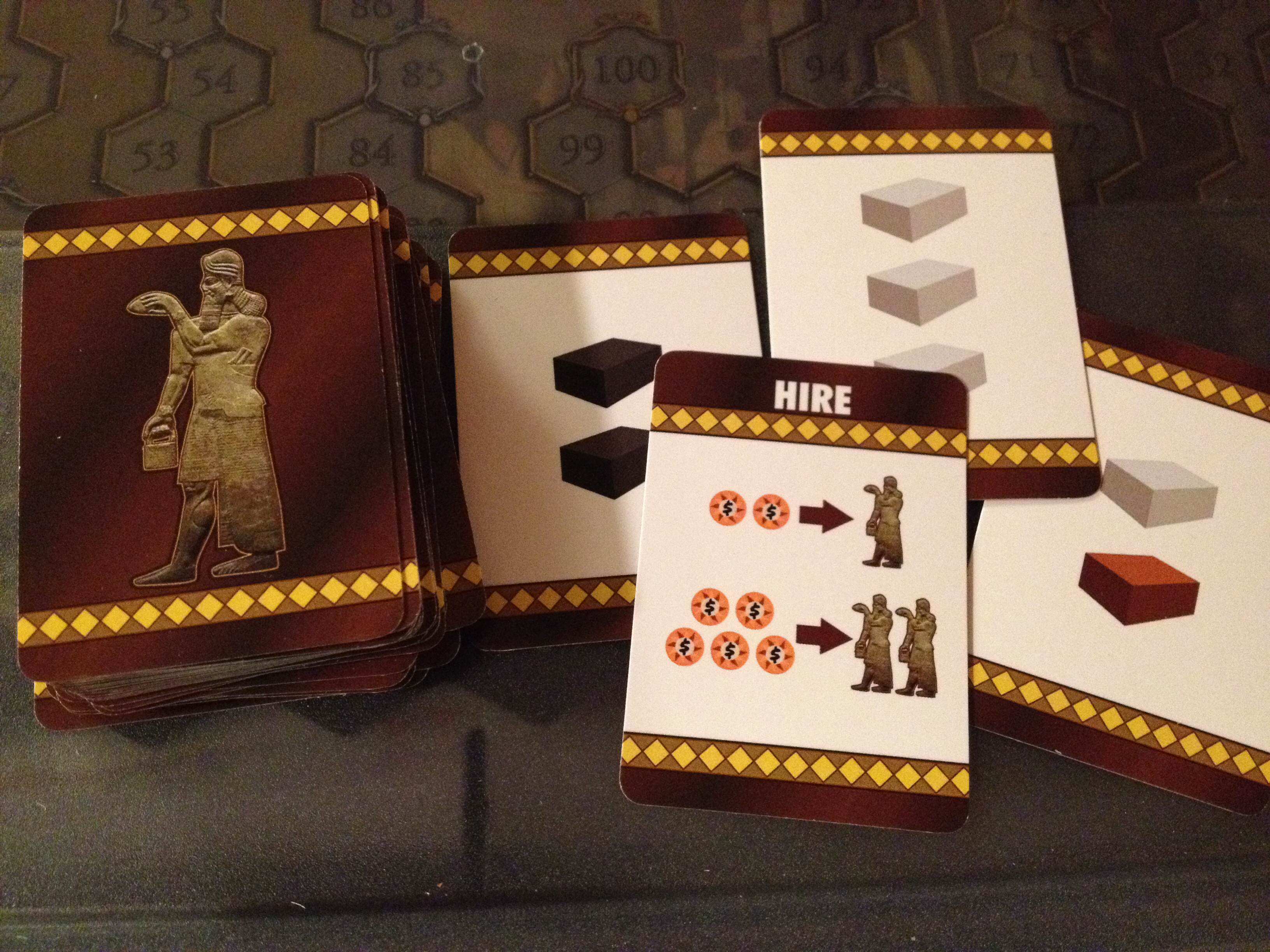
Each card represents a laborer OR the resources on the back.
With a deck made I decided it was time to upgrade the tiles and platforms as well. So I did. Here’s the final result which shows the current state of the game:
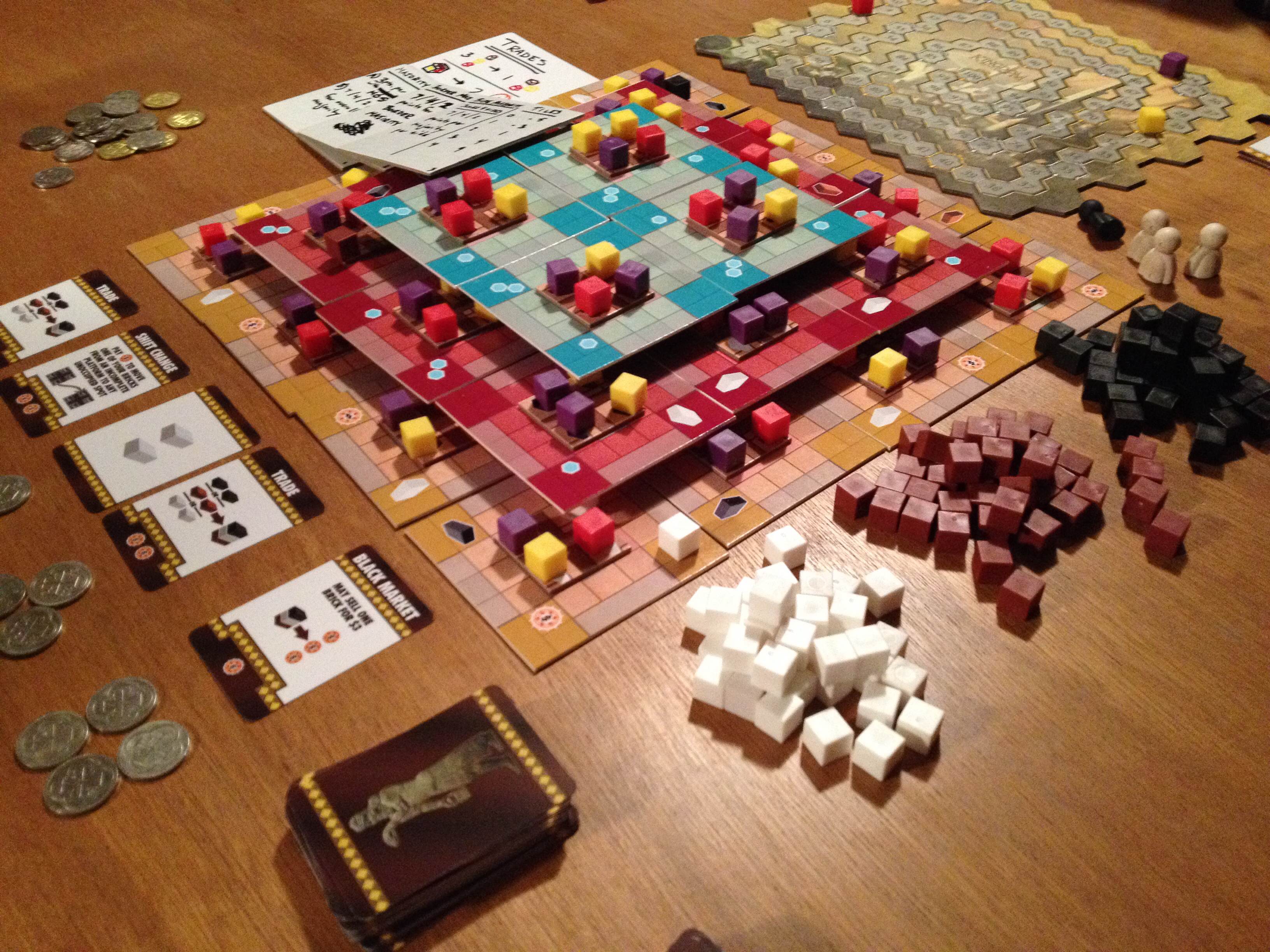
Not too shabby, for a prototype!
I have some big plans for the game. I want it to be slightly less singular in terms of your goals so I’ll be adding a few other paths to victory. But I solidly enjoy the game as it is.
Feel free to ask any questions. I’m excited to hear what people think and I’m just as excited about the future of the game. This one feels like Scoville did when I designed that. I think there’s a lot of potential here. Thanks for reading!
Monday Brews – Kickstarter Shout Outs
Hi everyone. Welcome back to Boards & Barley! I hope you had a great weekend. On Mondays I normally post about the board games and beer I enjoyed over the past week or two. But today I’m going to do something different.
Why am I changing things up? Well, my budget has precluded me from backing KS projects lately. But there are several projects, designers, and publishers that I would have supported had the budget allowed it. So since I can’t back the projects I decided I can at least promote them a little! So I’m listing four current Kickstarter board game projects that I believe in. I recommend you check these out.
We’ll start with a game from a friend and local game designer Seth Van Orden…
Stockpile

Do you have what it takes?
Stockpile, by Seth Van Orden and Nauvoo Games, is a stock market game where players have high control over manipulating the market.
In the game players are trying to maximize the market value of the stocks they own. This is done by choosing which cards you want to place face up and which cards you want to place face down. Once all players have placed they will bid over which pile they want. Eventually all players will receive a pile of cards. The cards are now reconciled by manipulating the market or dealing with a negative event.
The ultimate goal is for players to best manage the market in their favor.
This game has three days left on Kickstarter and is sitting at about 90% funding. Go help them out! $39 gets you a copy.
DragonFlame

Burn, baby, burn!
DragonFlame was my favorite game played at the recent Protospiel-Madison. Designed by Matt Loomis and being published by Minion Games, this game is packed with amazing artwork and fun gameplay.
In DragonFlame you are a dragon and your desire is to burn down the towns! To do so players will have a hand of cards. Then they will take turns placing cards either face up or face down onto one of the castles. Once all cards are played then in turn order each player claims a castle and its cards. This determines the player order for the next round.
Players will score points for burning the villages, which they can do when they receive DragonFlame cards, or for collecting treasures and avoiding knights. After six rounds, the player with the most points wins.
Rob Lundy did the artwork for DragonFlame and it really looks amazing. I’ll be buying this game when it comes out (and my budget allows for it). Go burn some villages!
It has 17 days left and $25 gets you a copy.
Steampunk Rally

That’s no bored European!
New publisher Roxley Games has their first Kickstarter project up and it looks fantastic!
Steampunk Rally is a race game involving great inventors from Edison and Tesla to Marie Curie and George Washington Carver. These are some of the greatest minds of the past and they figured the best way to find out who is the smartest is to have a race through the Alps. So each of them is set to build the best machine to win the race.
Using card drafting and dice placement players will build their machine and then operate in the hopes of winning the race.
The artwork for this game is astonishing and I would back it for that alone! Go grind some gears and check it out!
Steampunk Rally has 10 days to go. $49 US gets you a copy!
New Bedford

A Whale of a Game! (Couldn’t help myself)
New Bedford is the game I most regret that I’m unable to back. I played this for the first time a year ago at BGG.Con with Chris from Dice Hate Me Games. It is a truly great and enjoyable game.
Nat Levan is the designer and you can check out his blog here: Oakleaf Games. He has written extensively about his design process for New Bedford.
In the game you are helped to develop the town of New Bedford. You can utilize resources and send ships to see to capture whales, which provide income. This is a worker placement game that is streamlined and efficient. It is really enjoyable to play. So much so that I made my own copy with the PNP files from the Kickstarter page.
Also, they do a great job dealing with what some people consider a controversial topic. I applaud Dice Hate Me for that.
Go grab your harpoon and hit the open seas!
New Bedford has 27 days left and is 50% funded. Grab a copy for $40.
Game Design: Starter Prototyping Tools
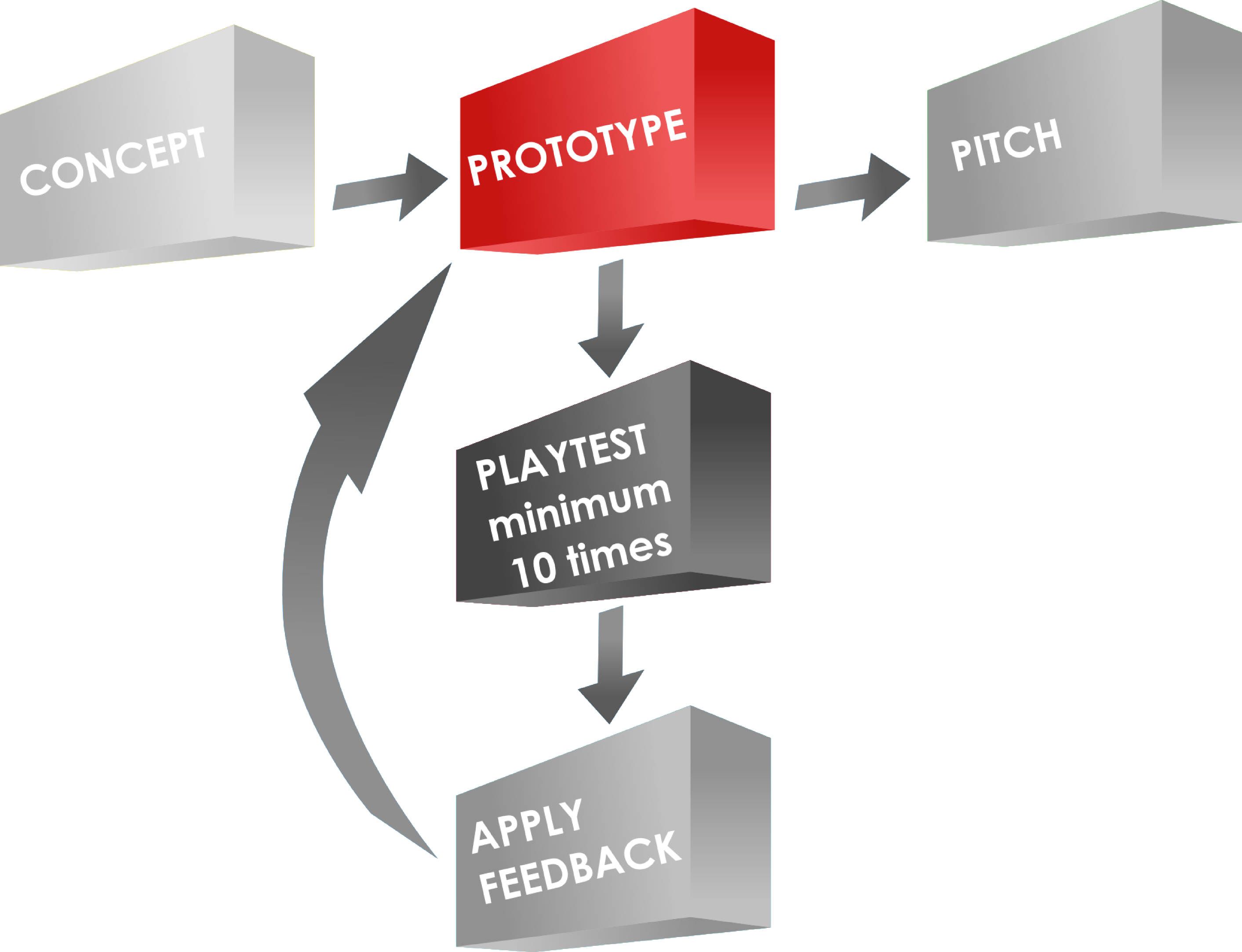
Game Design Process: Prototyping
I recently asked myself the following question: “If I were to start over with game design, which prototyping tools would I buy to get started?” I’ve made numerous prototypes and I’ve learned what to do and what not to do. So today I present a set of prototyping tools to help get you started as a game designer.
When I got started out I didn’t want to throw a lot of money at prototypes. This was because I had no idea if the prototypes would ever actually go anywhere. I was fortunate to have a wife who used to do physical scrapbooking. So I had some tools available to me that wouldn’t have otherwise been available.
Never-the-less, there are some key tools and resources that I think every game designer can utilize to make high quality prototypes at low(ish) cost and with relative ease. For the sake of this article I will assume that you can print on photo paper (I recommend Kodak 8.5×11 – 100 sheets).
Game Prototyping Resources
First, let’s cover where to get some basic resource type things. These are my go-to retailers for these items:
- CUBES: 1,000 1cm cubes from EAI Education for $16.95
- MEEPLES: Avatar pawns from TheGameCrafter.com for $0.15 each
- DICE: Buy a set of Tenzi dice! (Or search Amazon or eBay)
- CARDS: Blank Cards – Different Sizes – from TheGameCrafter.com
Game Prototyping Tools
Things that are not mentioned above include boards, tiles, tokens, reference sheets, rulebooks, and more. I generally use the same process to make all of those except a rulebook. I don’t typically make a rulebook.
To make my prototype components feel like high quality I purchase the following materials:
- Matte board remnants from Hobby Lobby for super cheap. You can get a stack of about 25 12″x12″ matte boards for about $6.
- Kodak Photo Paper (100 sheets for ~ $15)
- Non-OEM ink for my inkjet printer via eBay. (I bought 5 full sets of ink cartridges for ~$20)
- Glue Sticks – you’ll want to keep several on hand.
I often create artwork and then print it on the photo paper. I glue it down to the matte board. Then I break out my most highly recommended tool: The Rotary Cutter!
The Rotary Cutter
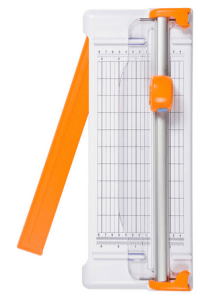
Easily worth the cost!
This has been my most-used tool for creating game prototypes.
I have a Fiskars rotary cutter similar to the one shown in the picture. You can buy it here:
It isn’t the best cutter. You can pay a lot more money for better cutters. But it does exactly what I need it to do for my prototypes. Other cutter options include:
There are more options than those, so if you don’t like those options feel free to do more thorough searching.
I use this tool to cut out the components that have been printed and glued to the matter board. This cutter works well enough for that.
Punches
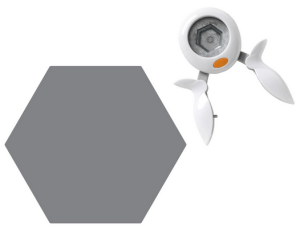
Great for cardstock chits!
Other great tools for designers are punches. These are used to quickly create tokens and chits. When I create tokens and chits I usually prefer printing the artwork onto thicker stock paper so they are more rigid. 90lb or 100lb paper is usually a good weight.
There are a plethora of different punches out there, but for the sake of board games you’ll most likely be interested in circle and hex punches and corner rounders. Here are some options.
- Fiskars Squeeze Punches
- Fiskars Lever Punches
- Fiskars Corner Rounders
- List of Punches on Scrapbook.com
As before, go ahead and do some more searching to find the right product for you.
Sharpies

I am firmly in the Sharpie camp. I love them. They are bold, colorful, and extremely useful. Sharpies can be used to create prototype components rapidly, especially in the case where you own blank cards because you took my recommendation above.
By having a variety of Sharpies you become an unstoppable force of game design awesomeness!
I use them to create prototypes. I use them to mark up my prototypes. I use them to revise my prototypes. I use them to draw silly pictures for my kids.
Seriously, Sharpies are fantastic. I feel they are a must-have for any game designer, if for no other reason than to be able to practice your signature for the time when lovers of your games will ask for your autograph for their game box!
I feel like this article needs more tools in it, but those are the only tools I utilize on a regular basis. Are there prototyping tools that you use regularly? Post a comment and let everyone know which prototyping tools you prefer!
 Boards and Barley