Blog Archives
Grand Illusion Core Mechanics
 Today is the second in a series about designing a new game called The Grand Illusion. Via Twitter I asked for examples of different types of Victorian-era magic and illusions. Here are a list of some of them:
- Levitation
- Cutting off heads / Cutting someone in half
- Disappearing persons
- Escapes
- Sword swallowing
- “Anything with doves”
Of course there are others like sleight of hand, card tricks, collapsing cages, awesome tricks with electricity, etc. What I am looking for are core genres of tricks that can be used as the currency (symbols) in the game. So with that in mind I think there are several such genres that could be used. For now I’ll go with these:
- Escapes
- Sleight of Hand
- Disappearing
- Cutting (of people)
- Levitating
- Grand Illusions
That gives 6 “currencies” in the game that can be used for set collection.
Performing Magic
The real question we need to be asking is, “How exactly do you play this game?”
As I mentioned last week the idea is that you are a street performing magician looking to gain a reputation, earn some dough, and eventually find yourself on a stage performing a grand illusion for the masses.
This will be mostly a card based game unless the direction of the game changes. For now I have created preliminary icons for the 5 main magic genres listed above (excluding the Grand Illusions).

Players will begin the game with a hand of cards. They will also have their “Grand Illusion” card, which is private. There will also be a few magic tricks to perform that are laid out on the table. In each round the magicians will perform a random draft.
Here’s how that will work. Each player will decide which card they want in the pool of available cards. So each player will take one of their cards and put it face down in the middle. Once all players have chosen a card, then one random card from the deck will be added. Then the player with the smallest reputation will pick up the pile, look at the cards, and play one face up in front of them. All other players will follow in order of smallest reputation.
Once all players have placed one of the cards face up, each will have the opportunity to perform a magic trick. To perform a trick you must have a set of cards that appropriately matches one of the face up magic trick cards. So a trick might require 2 “Escape” skills and 1 “Levitate” skill. If you have played these cards in front of you then you can complete the trick. Turn in the three cards you used and take the completed magic trick card and place it in front of you.
These completed magic trick cards will have an icon or icons on them that allow you to perform better magic. Some will have icons that are not available in the standard pool of cards that are dealt to players. So players must complete magic tricks to gain the skills they need to complete their Grand Illusion.
Once a player completes their Grand Illusion, the end of the game is triggered. All players will have an equal number of turns to attempt to complete their Grand Illusion. If only one player completes their Grand Illusion, they are the winner. If several people complete their Grand Illusion, then a tie breaker goes to the player with the most completed magic tricks.
What’s Next?
So now that the framework is set for how to play, the next step is for me to mock up some cards and solidify the actual gameplay. Here’s where you all can join me in the design. I want you to provide names for magic tricks. I’ll use these as the names on the prototype cards. If they are really good names then I’ll use them as one of the Grand Illusions.
Also, I would love your feedback on the basic gameplay here. As I was writing this article I realized that this game has a feel very similar to Splendor or The Builders. There is definitely some engine building with simple card mechanics. I’m not too worried about that since I think the drafting mechanic makes it different enough. But I really want your suggestions!

Monday Brews – 6-30-14
Another week gone by. And another summer weekend in the rear view mirror. And another tornado warning where I live. What a summer this shall be!
It’s Monday, so let’s take a look at the Boards & Barley that I enjoyed this past week.
The Barley:
 BARLEY SPOTLIGHT: Lake Louie Mosquito Beach
This is a beautifully tasteful beer and perfect for warm summer evening enjoyment. Lake Louie, a local brewer, makes some excellent brews. This particular beer, a “California Common,” is Lake Louie’s first lager beer. It weighs in at 5.8% abv and possesses 30 IBUs. And it is really tasty!
- Leinenkugel’s Summer Shandy
- Leinenkugel’s Honey Weiss
- Smith & Forge Hard Cider
What brews have you been enjoying?
The Boards:
BOARDS SPOTLIGHT: Brooklyn Bridge
I made a change to the brickyards based on a suggestion for a local world-class game developer and it took the game from “This is a game” to “This is special!”
It worked really well, increased player interaction dramatically, added a slightly more cut-throat nature, and most importantly made it more fun and enjoyable. I can’t wait to get it to the table again and keep working on it!
The only other game I played last week was Mutiny, which I should be able to write about in the near future. I’ll keep you posted on that.
What board games have you been enjoying?

Design: The Grand Illusion
Ladies and Gentlemen, I welcome you to the big show. Tonight I will be performing a series of illusions of the highest grandeur. You’ll see things that no human has ever seen before. And then you won’t see them! Tonight it’s all about the magic. For my first trick I’ll need a volunteer…
I came up with a new game design theme a few weeks ago and it’s still rattling around in my brain. So I figure I should try to turn it into a real game design. For some reason I’ve decided to do all the design publicly on this blog. I think this will be a fun way to show people what is all involved with the game design process and I’m also looking for involvement from all of you!
So these design articles, starting today and continuing on Thursdays, are meant to be an open source forum of sorts where I welcome your comments, ideas, suggestions, etc.
Game Theme

I love the look and feel of vintage magician posters from that era.
I love the movie The Prestige. It’s a fascinating movie about competing illusionists in the early 1900s. If you’ve never seen it, I highly recommend it. For me magic has always been an intriguing thing. Last year I had the chance to visit the Harry Houdini museum in Appleton, Wisconsin. It was neat to learn about his story and more about the era as well. It seems like an interesting time to have lived.
So I want to make a game about competing illusionists from that time. Therefore The Grand Illusion is all about magicians and their competition to earn the best reputation.
You are a street magician in the early 1900s beginning your career. You’ve got a few tricks up your sleeve that no one else has mastered. It’s time to build a reputation and become a household name in the field of magicians.
You start small doing a few tricks for small crowds on the street. Do them well and your skills will increase, as will your reputation. When you’ve got enough of a following then it’s time to take your show to a real stage. But beware, the crowd will always be expecting bigger and better!
If you can find a way to continually master new tricks and perform them flawlessly, then you may end up as the greatest magician of all time!
Basic Concepts and Components
My original thoughts for the gameplay involve card drafting and set collection. The concept is that you have to collect sets of cards that allow you to perform certain tricks. The bigger the set, the more likely you are to perform the trick flawlessly.
But there’s a catch. You know the old “Ball and Cup” trick? The idea of the trick is that there will be a ball under one of three cups. Then the magician will move them around and try to get you to lose track of which cup the ball is under. I want to utilize this as a mechanic in the game. If players each contribute a card to a common hand these would represent the cups. Then if there were a special card added to that hand it would represent the cup with the ball. Then players would blindly draft and whomever pulled the cup-ball card would get to perform the best trick. That’s my basic original concept for one of the mechanics in the game.
What I want players to feel throughout the game is a sense of accomplishment while teetering on a sharp edge. Players should attempt tricks and illusions throughout the game but always with some risk of failing and letting down the fans.
Each set of cards used for performing tricks will have several different symbols on them. These symbols represent different illusionary skills such as sleight of hand. When you complete a trick you can increase your skills in any or all of those categories. One emphasis for that decision making process would be that each player has a Grand Illusion that they are working toward completing.
The Grand Illusion
Like a private scoring condition, the Grand Illusion card that each player holds is a trick that could provide a huge boost near the end of the game. It is a trick that can only be attempted once, so players will want to make sure they have a skill set that will help them perform the trick with high success.
The idea is that as players become better magicians and build an audience and a reputation they realize that they have to keep increasing the awesomeness of their tricks or else the audience might go to another magician. So by performing their Grand Illusion it could put them at the top.
What’s Next?
So that’s the current state of the design. It is just a bunch of basic concepts. But that’s where you all come in. What would you like to see in a game about Victorian era magicians? What mechanics, themes, components would you like to see?
Let’s design this together. Please comment on this article or reply on Twitter. I’m looking forward to designing this publicly with all of you. Thanks for reading!
Monday Brews 5-19-14
After a week off from my Monday Brews articles last week I’ve wrangled up a long beer list. It was aided by the fact that my city was having a Craft Beer Week. And it was also aided by two playtests of Brooklyn Bridge. So I’ve got a nice long beer list for you this week.
I also brewed another beer. I’ll be writing about that later this week unless my new baby pops out of my wife’s belly. It is a wheat beer that I’m calling “You’ve Been Wheated.”
So let’s jump right in and start with the barley…
The Barley:

Best word to describe it: Yum!
BARLEY SPOTLIGHT: Tyranena Doubly Down and Even Dirtier Barrel Aged Chocolate Vanilla Double Stout
I enjoyed this most amazing beer with possibly the longest beer name ever during a Madison Craft Beer Week event. It was on tap and it was amazing. It was very rich with a beautiful flavor and a solidity to it that made it feel as though you just ate a full meal. I will definitely drink this again. Also, it’s baby brother, “Down & Dirty,” is also very good and more accessible.
- Sprecher Special Amber
- Boddingtons
- NEW! New Belgium Snapshot – I liked it at first but then it seemed to have a characteristic closer to a Sour beer. I’ll try it again.
- Young’s Double Chocolate Stout
- Lucette Hips Don’t Lie
- NEW! New Glarus Spiced Ale – Not as spicy as I was expecting, which was pleasant.
- NEW! Boulder Shake Chocolate Porter – Warm this one up a little and you’ve got yourself a full-on dessert!
- NEW! Potosi Steamboat Shandy – This was a very enjoyable shandy.
- NEW! Blakkr Imperial Black Ale – This brew is actually a partnership between three breweries. (Three Floyds, Surly, Real Ale). I didn’t particularly enjoy this brew.
- New Belgium Trippel
- Hofbrau Original
- Bridgeport Kingpin
- NEW! Green Flash Double Stout Black Ale – This was an excellent, deep, dark double stout.
The Boards:

How good of a Euro could this be? They don’t really look that bored.
BOARDS SPOTLIGHT: Aquadukt
This isn’t a new game, but it was new to me. And I loved the simplicity of it! The options you can choose on your turn are simple (build houses OR build a well OR build canals). But with those three simple choices comes a game with surprising depth. Which house tiles do you build – 1s, 2s, 3s, or 4s? When/Where should you build a well? How/Where should you build canals. This is a euro and it doesn’t try to hide it. The board is basically a big grid sectioned into 20 areas. I love games that use simple mechanics but yet have deep and interesting decisions!
- Targi – such a fun 2 player game!
- Quantum Orcas – Ran another successful playtest. Still not sure what I want to do with this game.
- Love Letter
- Unpublished Prototype – oh man… this one is SOOO good!
- Qwirkle
- Brooklyn Bridge – more below.
Designer’s Corner:
The progress currently being made on Brooklyn Bridge is making me feel much better about the game. While there are interesting mechanics that people seem to enjoy it has been all the other stuff in the game that has been needing the work.
The most major change is that money is no longer a part of the game. (Side note: I may bring money back with money being the points in the game. Currently the points are set up such that they could be equivalent to $$.) Previously players could earn money without having to build the bridge. That meant that early in the game they would focus on money to buy abilities. With the change the only way to buy abilities is with points and the only way to get points is to actually build the bridge… imagine that!
I am extremely happy with how the latest playtest went. The first half of the game worked really well, consisted of interesting decisions, and players overall seemed to be having fun. A big thing that was an improvement was the new player mats. These allowed me to get rid of the 30 red, 30 yellow, 30 brown, and 30 silver cubes that represent the bricks and mortar. Now players have one cube of each color and they move it along on their player mat.
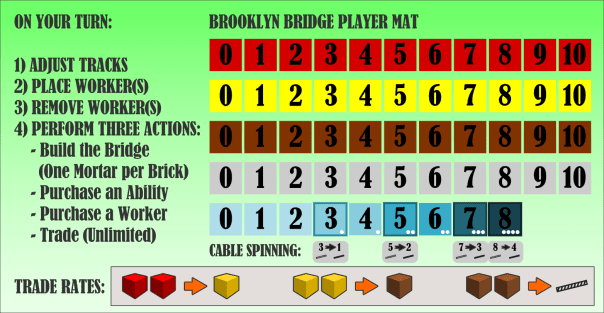
It wasn’t all good though. The second half of the game imploded. It was as if the game ran into a brick wall (no pun intended). The upside is that I have implemented a few changes which should circumvent that issue. I can’t wait to get it to the table again. This is probably the first time with Brooklyn Bridge where I really feel like there is “publishing potential.”

There you go… the late, great version of two weeks of Boards & Barley. What Boards & Barley have you been enjoying???
I’m Pulling for Him – An Interview with Chevee Dodd

Available via Kickstarter!
Today we have the first ever interview on Boards & Barley and I’m happy that it is with the magnificent Chevee Dodd of West Virginia fame and folklore. Chevee currently has a Kickstarter campaign for his awesome trick-taking card game, Pull! I played it in March at Protospiel-Milwaukee and I recommend it!
Chevee is the designer of Scallywags by Gamewright. Has has also designed several games that are for sale on The Game Crafter that are worth checking out. My personal favorite is Tuesday Night Tanks.
I have had the privilege of enjoying an Oktoberfest celebration with Chevee and consider him a good friend. If you have not had the pleasure of meeting him, seek him out some day. Or twitter stalk him. (@cheveedodd). But enough rambling… let’s learn about him and his campaign.
Interview with Chevee Dodd
Boards & Barley: Why did you start designing games? Why is this one of your passions?
Chevee Dodd: I’ve explored dozens of creative outlets in my time. Typically, I try something new and then get bored with it and move on. Games have been the one constant in my life since early childhood. I started designing because I found inspiration in James Earnest and his then startup, Cheapass Games. Suddenly there was a way for the little guy to do something on his own and succeed, so I went for it. I found that the creative outlet was extremely satisfying because I get to flex all sorts of skills: writing, design, crafting, and art. It encompasses so much of what I love to do.
B&B: We first met at Protospiel-Milwaukee last year. What do you think are the biggest benefits of designer conventions like Protospiel and UnPub?
CD: Meeting people like Ed P Marriott.
Seriously, there is a great bunch of people at these shows that are more than willing to help test and refine. They love being creative together and some awesome projects have come out of that community… but for me, it’s the people. In fact, I generally have to be coerced to test my own games at these shows. I’m there to form relationships. We are all building something much larger than a few games. We are building a collective that will herald each others efforts for years to come.
 B&B: What is your favorite non-Chevee game that you love playing more than anything else?
CD: Acquire is my all-time favorite. I would play multi-day marathon sessions of Acquire and never get tired of it. Also, Tichu. Oh my Tichu. With the right teammates, we’ll run it back to back to back. Best of 7? No problem!
B&B: Other than Pull!, which is your favorite Chevee game and why?
CD: Leathernecks ‘43/Princess Fairy Rainbow Unicorn dice is the only other Chevee game I’d actively ask someone to play. I generally don’t enjoy playing my own stuff but that design, and PULL! have both surprised me. I feel like I was able to inject just a touch of interaction into press-your-luck that makes the game something more without tacking on a bunch of thinking. I’m pretty proud of it.
 B&B: If you could have a PBR with any two game designers, who would they be and why?
CD: Michael Schacht and Antoine Bauza. I’d love to have a PBR with Sid Sackson, but I don’t think that’d go over so well. Bauza and Schacht both design the types of games I love: simple rules with deep decisions. I’d love to talk shop with them… but being that they are both from more cultured areas of the world, I have a feeling they’d balk at my PBR.
B&B: What are your three favorite pieces of advice for new game designers?
CD: 1) Fail. Fail often. We learn so much more from our failures than we do our successes. It’s hard to know why something works, it’s easy to spot why it’s flawed.
2) Try. You can’t fail if you don’t try. Talking about designing games is way different than actually doing it. Just try. Get out the pen, paper, and scissors and go at it.
3) Ask. Get help. You can’t do this alone, no matter how great you think you and your idea are. You WILL need people to help you with the design and it’s better to start early than late.
B&B: I love your “Open Source” game design approach where you utilize open source software and like involving other people. Where did this philosophy come from?
CD: I’ve been a hacker of sorts all my life. Not a hacker in the movie sense of someone that breaks into banks security systems and steals money… a hacker that makes things by learning and deconstructing. I started writing software when I was about 8 years old… that was before the Internet as we know it today… and I relied heavily on books to teach me what I was doing. When services like American Online, Prodigy, and CompuServe came along, it was like opening a floodgate for me. Suddenly there were all these free references and resources available for me to learn from and my progress with software increased rapidly. I like giving back for this same reason. If I can help someone else through my stories and tribulations, I’m all for it.
 B&B: You utilize The Game Crafter for prototypes and components quite a bit and I know you have a few games available on the site. Do you have any other “go-to” resources for game design components?
CD: The dollar store. Most of what I work with outside of printed components are things like sharpies, tape, paper, pens… all the stuff that’s readily available at a dollar store. But also, you can find stuff you didn’t think about there like glass beads and other trinkets that make great game components. I like to look everywhere I go for things that inspire.
B&B: What was the inspiration for Pull!?
CD: PULL! came about during a lull in my creativity. I asked the Twitter community to give me some ideas and it was the one that stuck out. I tried working through some of the other concepts, but this one just wouldn’t’ leave my head and I had to make it.

These awesome duck tokens are only a $5 add-on! Bump your pledges, people!
B&B: What sets Pull! apart and makes it awesome?
CD: It plays like a trick taking game, but not like any you’ve tried before. There is a deck of cards driving each round instead of the players winning the lead and those cards also score you points. On top of that, there are two tricks each round instead of just one. There are many different levels of decisions that go into each card play but it’s not so complex that you can’t just sit down and enjoy it. In fact, I’d say it feels less challenging than most trick taking games even though it offers significantly more decisions.
B&B: What are the best ways for people to share the Pull! campaign so that we can get it uber-funded?
CD: Facebook has brought me the most backers. Simply hitting the Facebook “Like” button under the Kickstarter video has had a great impact on the campaign, but also unlocks a stretch goal! For all of Facebook’s reach, however, there are more communities that are actively involved in gaming like Reddit and Google Plus. Sharing there and talking about the game all over the internet is going to help bring backers our way. So far, I’ve been extremely humbled by the support I’ve received from the backers.

Some cards and the game box.
B&B: What have been the most challenging aspects of putting together a Kickstarter campaign?
CD: Simply the sheer volume of work. Putting together all the graphics. The copy. The videos. The art. I started months in advance and I’m glad I didn’t wait until the last moment! So many campaigns are obviously thrown together, I really wanted the PULL! page to shine and I spent many many hours editing.
B&B: Do you have any sources of advice for the Kickstarter campaign? Jamey Stegmaier’s blog, for example, has a ton of great Kickstarter information.
CD: I think I’ve read most of Jamey’s posts… TWICE. Seriously… there is a ton of stuff there to think about. I don’t agree with all of Jamey’s advice, but that’s not the point. The point is to get you thinking about all the aspects of the campaign. Other than Jamey’s blog, I listened to most of Richard Bliss’ podcast and spent Monday’s researching the previous week’s campaigns. I spent a great deal of time analyzing both successful and unsuccessful launches for anything I could use to my advantage.
B&B: Do you have any personal advice to offer people that will be setting up their own Kickstarter campaigns? What key aspects of a campaign shouldn’t be excluded?
CD: The biggest piece of advice I have is to have an audience before you launch. Kickstarter is NOT a marketing platform and you need to sell yourself WELL before the campaign. I’ve spent the last two years building myself up and that got me nearly 70 backers on the first day. Now that the campaign is in full swing, they are barely trickling in… and most are finding the campaign because of my awesome backers sharing the campaign. Very few are coming in from Kickstarter alone.
As for exclusion: be transparent. Don’t hide any aspect of your game or the production. Even if there is something you are embarrassed about, you need to point it out. Dont try to trick people into backing your project. Let it sell itself. Be 100% transparent, good or bad. It may not pay off on this campaign, but it certainly will in the future!
B&B: Game design, Graphic design, Woodworking. How is the best way for people to reach out to you for design advice or graphic design work?
CD: I answer Twitter more than anything… and quickly. The notification sound for Twitter is my favorite on my phone. I grab it up as soon as it goes off. After that, email is the second best method… and my gmail account is also linked to my phone.
cheveedodd [at] gmail
 B&B: What other great things can we look forward to from Chevee Dodd over the next year or so?
CD: I designed a pretty neat 2 player zombie game that’s coming up. The artist that’s working on it is doing great stuff and I can’t wait to share it with the world. I designed it for Jayme though, so I’m not letting anyone else have it before her. I’ve considered bringing it to Kickstarter also, but it’ll likely be up as a print and play and maybe at thegamecrafter.com long before. I can only handle so much stress in one year.
Other than that, I’ve hinted at a secret project a few times over the past few months. The announcement of that should come mid-July, and it should be fun. Mayfair is still plugging away on developing Hedeby. Even if they greenlight the game, I doubt it will be out in the next year, but who knows?
B&B:Anything else you want people to know?
CD: I am forever indebted to this community and am constantly humbled by the support I receive. I would like to thank each and every person individually, and in person. I hope one day we can meet to make that happen!
Thanks, Chevee, for the interview. I wish you the best for the rest of the Pull! campaign and I hope it does really well for you. For those who read this, if you haven’t backed the project, go do so now. If you want to learn more about Chevee and what he does, head on over to his website: cheveedodd.com.
 Boards and Barley