Author Archives: edpmarriott
Bonus Trading Post Post

My Trading Post Logos
Over the past four weeks I’ve been writing about a new game redesign of mine by the name of Trading Post. Since there has been a decent level of interest in the game concept I thought I’d write one more article about the game. So far I’ve covered the following:
- 5-16-13: Origins of Trading Post
- 5-23-13: Early Prototying
- 5-30-13: Hiatus and Re-design
- 6-6-13: Path to GenCon
- BONUS Today 6-13-13: More on Trading Post
Today I’m giving you some bonus material on where the game is at, how to make it better, and some other tasty morsels. But let’s start with how good I am at focusing on things other than actually designing this game!
I’m Good at Wasting Time (and Effort!)
One of my downfalls in life is my desire for perfection. Perhaps perfection is the wrong word. That paints me as someone with OCD, not that there’s anything wrong with that. Perhaps a better word would be aesthetics. I desire for things to look good.
At the end of May an article was posted on Example of Play called, “The Benefits of Crappy prototypes.” I will provide a rebuttal for that article next week, but I wanted to mention it today because I am not a believer in crappy prototypes. And this may be my downfall.
I love a good looking prototype. I love good game art. If you’ve read my board game reviews you’ll see that artwork is consistently mentioned as either a like or a dislike. I approach game design as though I’m reading a story. I like to be enveloped in a different world and escape this one for an hour or so. Artwork is a key way to get that experience across to the players.
What this means is that I spend way, WAY too much time in Inkscape making prototype artwork. The upside is this:
The downside is that I have four logos (as seen above) for a game that no one has yet even played! I just can’t help myself.
So I had a think about what this all really means. I was a little disappointed in myself for the artwork side of things when the game design part of it seemed lagging. But then I remembered the whole purpose:
Games, and game design, are supposed to be fun! Why else design games or play them?
So I’ve realized that though the artwork doesn’t specifically help a game design move forward, I’m having a lot of fun working on the artwork. Thus, I shall continue.
Solo “Playtest” #1
Last week I showed the picture of the game setup. I’m repeating the image here for easy reference:
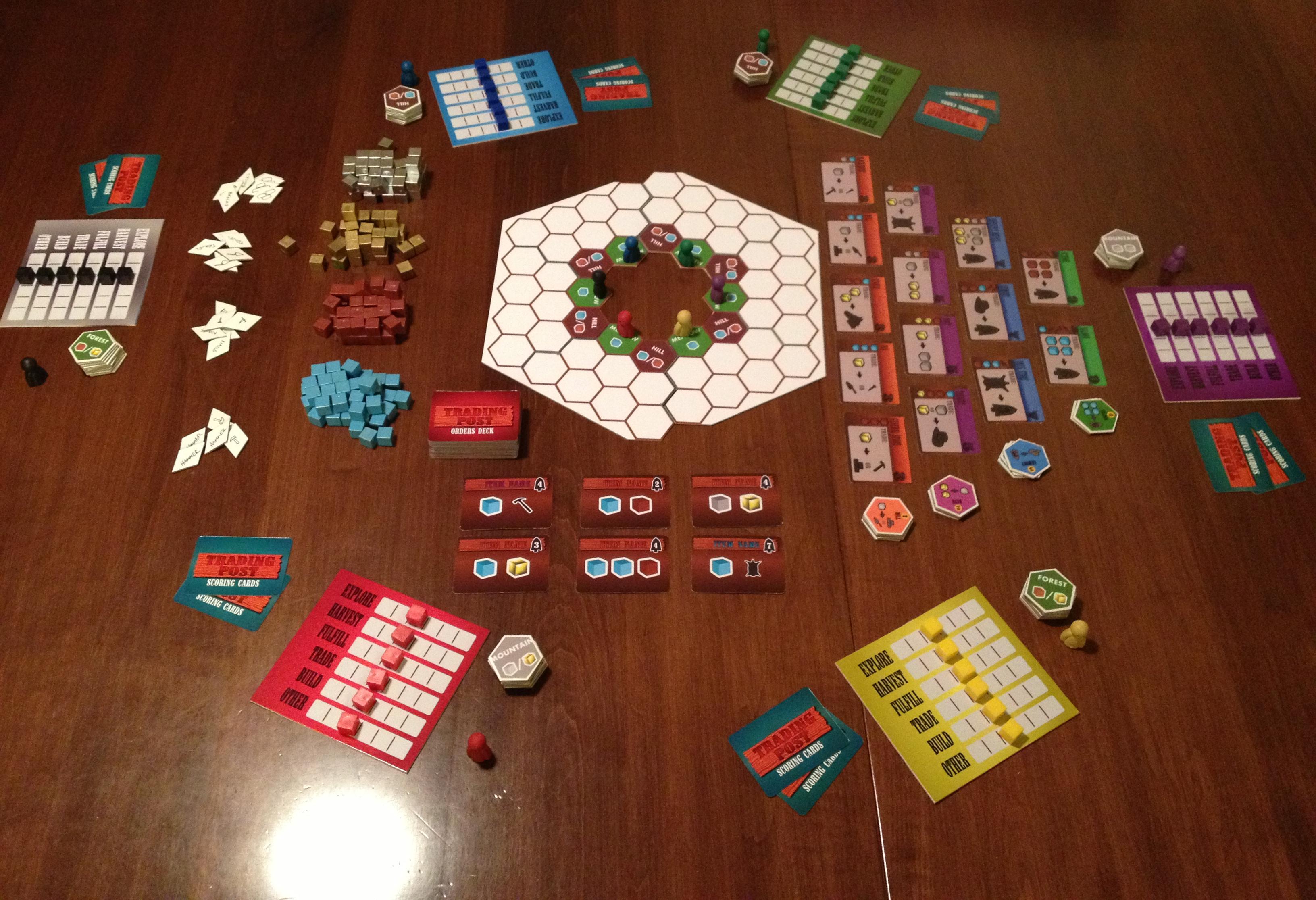
Current Trading Post prototype. I think it at least looks cool!
Since this is an insight into the inner workings of my mind I am sharing the thoughts I wrote down while attempting to play the game for the first time.
First, some rules. On your turn you can take up to 3 actions. These can all be the same, or they can all be different. That’s up to you. The actions you can take are determined by the number of action points you have for each action. For example, if you had three points in the EXPLORE action track, then you could use all three actions on your turn to EXPLORE. After you have taken your 1, 2, or 3 actions, you must then move other action’s track cubes up in value. This is what I am calling a “Zero-Sum Action Point Allowance System.” (I would go with the acronym ZSAPAS, but I’m not going to use the term again in today’s article). Basically, for every action you take there is an equal an opposite reaction.
Here is a little game design nugget that you might enjoy:
During testing, if it seems like the first turn for all players is dictated, SKIP that first turn and make the result the new starting condition in the game.
What that means is that if all players have no choice (or only one beneficial choice) for what their first turn should be, fix it! Ever wonder why players start with 4 train cards in Ticket to Ride???
During the first solo playtest I made it 6 turns before I realized I wasn’t happy with the design. Here is the list of my chosen actions on this six turns:
- Explore/Harvest/Explore – Increased Fulfill/Trade/Trade
- Harvest – Increased Explore/Explore/Trade (I suppose you can always move up three action cubes – so much for “equal and opposite”)
- Explore/Explore/Trade – Increased Harvest/Harvest/Harvest
- Harvest/Harvest/Build (Stable) – Increased Explore/Explore/Explore
- Explore/Explore – Increased Harvest/Harvest/Harvest
- Harvest/Explore Quit.
After 6 turns I had been unable to fulfill any orders and I was only able to purchase one building. In Scoville players only have a total of about 7-10 turns. So after these 6 turns I realized that I have basically done nothing. At least nothing very fun. I need to adjust it so players feel a sense of accomplishment on each turn, or at least feel like they are setting themselves up for accomplishment soon.
Here are the notes I took at this point:
- Should the “Orders” be stacked? (What I meant here is that should the low level orders come out first, then the better ones, then the best, a la Power Grid Power Plants?)
- Should the highest valued Order card be replaced each turn that an order is not fulfilled?
- Should players always get to move their pawn 1 spot per turn without taking an action to do so? (Using the Explore action seemed critical and it was thus used very often. Then it had to be refreshed, so there were turns where I couldn’t move anywhere.)
- It takes too long to build even the basic buildings, which means it takes too long to get the man-made resources. How can this be sped up?
- Should players be able to complete a trade even if their pawn is not on a spot with another player or in the Trading Post (a la Settlers of Catan)?
- How do I make TRADING the focus?
That last point is a big one. Let’s talk about that…
Put the “Trading” in Trading Post!
Thus far in the design the trading aspect of the game has, for some lame reason or another, been the lesser focus of the design. I have always been more interested in the land exploration and development side of things. Why?
I don’t know. So I am going to switch over the focus of the game to actually put TRADING at the forefront. Sometimes I wonder how I get this far without realizing something so critical to the design. Which leads me to another game design nugget:
Designers should step back from their design every once in a while and pick apart every aspect. Ask yourself specific questions about each design decision and try to think if there is a better way!
One big example is when a level 1 friend pointed out that the black and white peppers in Scoville should cross-breed to silver/platinum/other grey color rather than gold. Color-wise it made sense. But since my original design was that they made gold I had simply stayed with it because I had never gone back and questioned why I did it that way. And I never asked myself if there was something better.
So the new thrust of the design for Trading Post is to bring trading to the forefront. Now I think that on every turn you will complete a trade at the start of your turn. This could then aid you when you choose your three actions for your turn. I’m imagining a “Trade Route” of trading cards on the table, which would still represent things the Trading Post needs. They could be set up like the races in Small World or the foraging trail in Morels or the buildings track in The Manhattan Project. In each of those games players can choose the first option(s) for free or pay to take one further done the path. This mechanic would work very well for the “Trade Route.” Or I could use a rondel for increased Euro-y awesomeness!
Another way that trading would become more integral, and increase player interaction at the same time, is to allow trading with other players no matter where you are located. Sometimes it’s easy to let thematic correctness run the show. But this is game design and we can fudge things now and then. Settlers of Catan is a very popular game that allows player to trade resources with other players no matter what. Now, explain thematically how that makes sense. What if your settlements and their settlements aren’t anywhere near each other on Catan? Well, if it’s good enough for Catan, then it’s good enough for this game!
The bottom line is that trading needs to be what makes this game special. If you want a game where exploration is the focus, then find some 18XX game.
How to Reboot…
A game is in there somewhere… I just have to find it!
So I am going to jump back a little and try to re-figure out how to play this game. Admittedly it wasn’t ever really set to begin with. But to make trading the focus will take some effort. I really think this can be a fun theme/game and so I will continue to work on it.
So it’s time to take some of the blank cards I ordered and put them to use. I’m excited to work on the Trade Route/Rondel idea and see how it changes the focus on the game.
Another thing I’ll probably change is that players should draw all their land from their set of ten land tiles as part of their setup. What this would do is drastically lower the exploration aspect of the game. Players would also be able to plan their moves more deeply and more intentionally. I like the sound of that.
Once I nail down how I want the trade route to work then I can put the pieces back together for how the rest of your turn would work. This should be pretty interesting and I’m going to take an open-source approach to this design. That means I’ll be posting about it for all of you to read. I hope to provide you with a designer’s perspective on making appropriate choices within the design process, and how to keep things simple. Trading Post posts likely won’t be weekly from here on out, but they will definitely pop up now and then as I work through stuff.
Thanks for reading and joining me on this ride!
Brewing Process: Bottle Prep
When it comes to home brewing there are two approaches to the bottling stage. The first is kegging, which is awesome, but very expensive. The second is bottling. Bottling can be nearly free and today I’m discussing my three step process to prepare bottles for holding your precious creation.
Step 1: Bottle Procurement
Everyone has friends. And if you share the other hobby that this blog covers (board games) then you likely get together and hang out quite often. Well, if you’re a home brewer this is a great opportunity for you. During our board game nights my friends typically each bring a 6-pack of beer.
Is it weird when at the end of the night I ask to keep their empty bottles? Not at all. One friend thanked me for taking his trash. But beware… here are some tips for successful bottle procurement.
- Don’t be sneaky. Just ask if you can have the bottles.
- Don’t take any twist off bottles since they aren’t good for home brewing. (Life tip: avoid twist off bottles if you enjoy quality beer!)
- On the drive home, put the bottles in your trunk. I can’t emphasize this one enough!
Now that you’ve procured your bottles (about 50 for a 5 gallon batch) you’re ready for step 2.
Step 2: Label Removal
This is the worst part of home brewing. If I weren’t also trying to save money by home brewing I would just purchase new bottles. But I’m guessing I’m not the only one out there who removes the labels from bottles so here’s how I do it.

It’s a Utility Sink Party!
I first fill my utility sink full of hot water. Then I place the bottles in there for a good half hour. The idea here is to soak the labels and get them ready to be peeled off.
After a half hour I take one bottle at a time and peel off the label. There will likely be some residue left on the bottle. To remove the residue I take a dish scrubber or dish wand and apply a little elbow grease.
This is sort of a buy beware point, though. Some bottles have great labels that basically fall right off. Others have very gummy labels that leave behind some terrible glue that is nearly impossible to get off. In Wisconsin I’m blessed to have the New Glarus Brewing Company in my back yard. They have the best labels ever! Soak them and they fall right off.
And the best part about labels that fall right off is that you can make some really cool art with them. Here is a collage I made with the New Glarus labels:
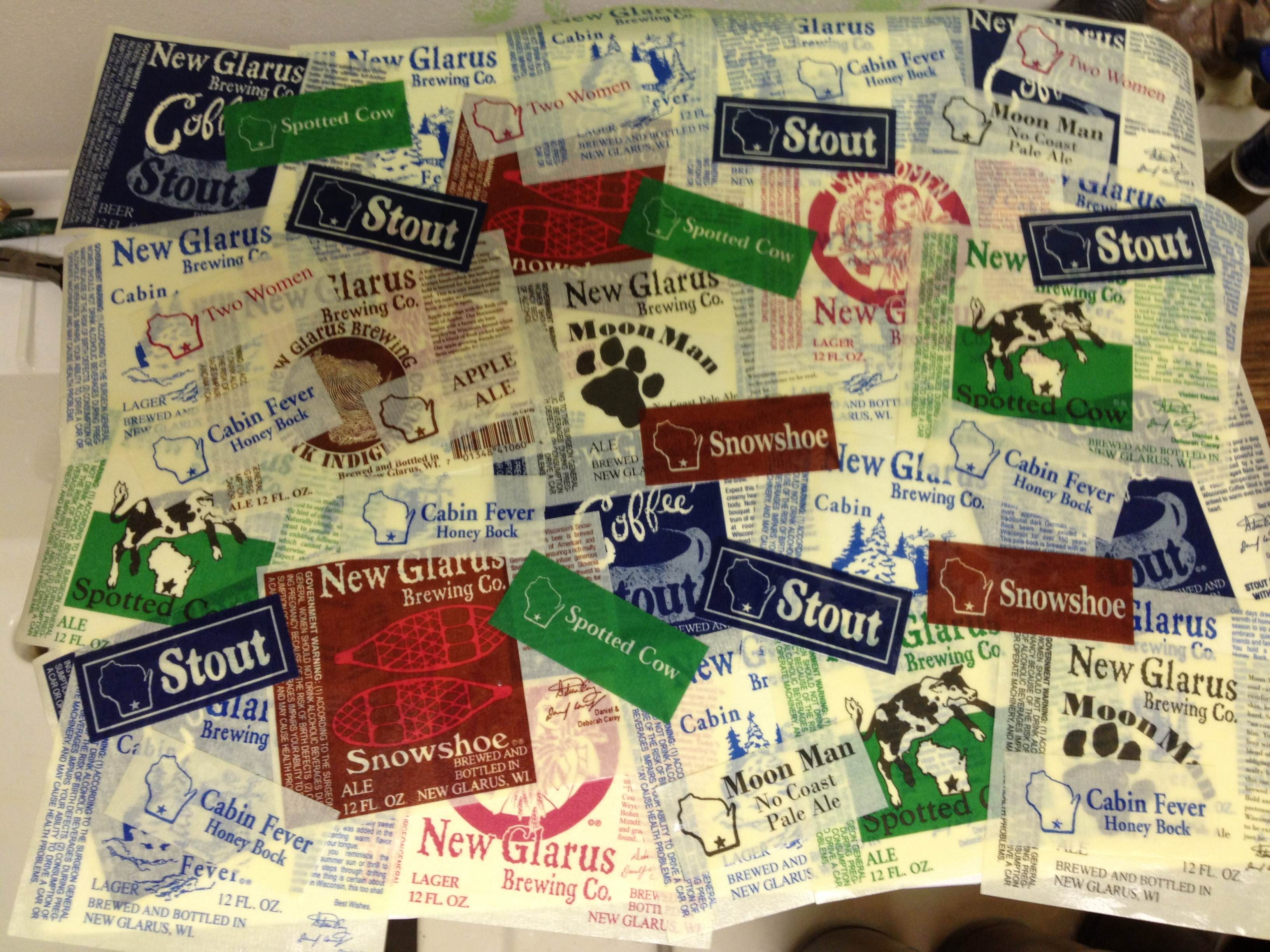
New Glarus Label Art
To get all the labels off and residue removed will take a little while. Be prepared to stand over the utility sink for a while. But once you’ve got the bottles all spic and span I like to move on to step three.
Step 3: The Dishwasher

Dishwasher parties are hotter than Utility Sink parties!
Now that your bottles are free of all denigrating marks of previous ownership they are ready to visit the dishwasher. This step helps to remove any leftover residue from the inside of the bottles and helps to sanitize them as well. And for some reason I really like how they look all lined up in the dishwasher.
The key here is to run it as a normal wash cycle, but do not use any detergent. These bottles aren’t likely to be caked with peanut butter or broccoli or any other typical dinner fare. They were filled with beer. So they really only need to be rinsed.
So run the cycle a few hours before you are going to bottle the beer. That will give you enough time to let the bottles cool off from the hot dishwasher cycle.
Bottle Prep: Simple but Tedious
And that’s it! You now have bottles that are ready to go for bottling. I would, however, make one more recommendation. And that is to do one final rinse in your sanitizer before bottling, especially if these are sitting around for too long. Better safe than sorry. If you have a preferred method for bottle prep, please let me know. I’m always looking to get more efficient!
Trading Post: Path to GenCon

I have a new game design I’m working on and today I am posting the last of 4 articles about it. Here are the four articles in this series:
- 5-16-13: Origins of Trading Post
- 5-23-13: Early Prototying
- 5-30-13: Hiatus and Re-design
- Today 6-6-13: Path to GenCon
Today we’re looking at my path forward with Trading Post as we near GenCon. I am hoping to have a game that has been playtested, is fun, and is able to be played near the Blue Noodle (UnPub area). So I’ll cover some development and what I’m hoping will happen with the game.
The Development Phase
Currently the game has not been played. What? You mean you’ve been reading a month’s worth of posts about some guy’s game that hasn’t even been played? Yes. And thanks for reading! I have nearly all the components together for the game. All that is missing is a scoring track and coins. Here is a picture of the game in its current prototype state:
Current Trading Post prototype. I think it at least looks cool!
So let’s talk about the different components that we see in that picture and discuss their purpose in the game.
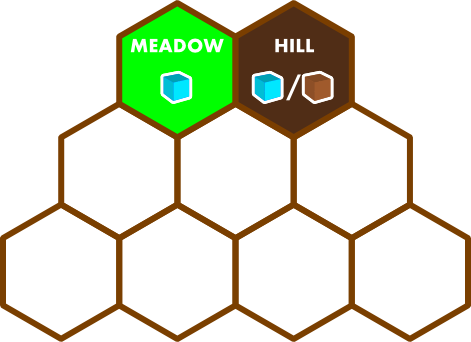
A player’s territory.
Let’s start in the middle and work our way out. In the center is the land portion or map portion of the game. Each player has their own region, which is shown on the right. It is a player’s objective to explore their territory throughout the game. As they explore their territory they will draw a tile from their land tiles. These tiles are shown in the image above as the stack of hexes next to the player mats. The tiles will be either Meadow, Hill, Forest, or Mountain.
On the right of the map portion is the tree of buildings. Besides exploring your territory during the game you will also want to build buildings. The downside of building is that you lose a resource region of your territory. The upside is that you have a new trading opportunity in your own territory. Other players may visit it to complete the trade shown on the building hex, but they will have to pay you to do so. Buildings also count towards some of the scoring cards, which I will explain below.
To the left of the map portion are the resources. There are four natural resources in the game and four man made resources. The four natural resources are gained by harvesting them within your territory. The man made resources can be earned through the trade opportunities in certain buildings.
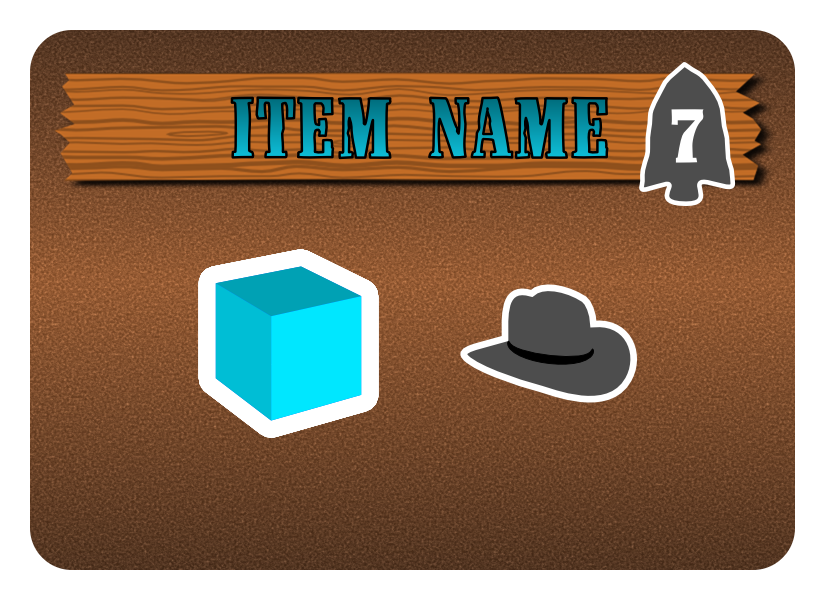
Example of a “Blue” order. This requires a Water and a Hat (Fedora?). The player earns 7 points.
Below the map portion in the image are the Orders cards. Thematically here the Trading Post is requesting certain orders to be fulfilled. On your turn you have the opportunity to fulfill any number of these if you have the action points available. Along with building buildings it is also critical to fulfill orders during the game. This is a significant way to earn points. It is also a way to earn endgame points if you have a scoring card that requires certain colored orders be fulfilled. Once orders have been fulfilled, at the end of the current turn they are restocked to the number of players.
In the image the game is set up for six players. Each player has a player mat, their ten territory tiles, a pawn for the scoring track that is not in the image, and two scoring cards. Each player will also have some coins to begin the game, but I have not yet totally figured out the role I want coins to play in the game. They may ultimately be excluded.
Scoring cards represent hidden endgame scoring conditions. These are similar to the route/destination tickets in Ticket to Ride. Some of these are requirements for building certain combinations of buildings. Others are for fulfilling certain combinations of orders. But they are all ways to score points at the end of the game. I chose this because I like all players to be able to hold on to hope. And endgame scoring is a mechanic for hope.
The player mat is where I think a lot of the interesting strategy comes into play. The mats in the picture do not have numbers on them, but you can imagine each row having 0 1 2 3 4 5 on them. Each row is a different action. The number on which your cube sits tells you how many of that action you have available on your turn. At the start of the game all players have two of each action available. On your turn you can do three different actions, each as many times as your cubes indicate. The cool part is that as those actions decrease, other actions have to increase equally. What we have here is a zero-sum action point allowance system. Here is an example of a first turn where the player has chosen to EXPLORE twice and HARVEST twice. This allows them to discover new parts of their territory, set themselves up to have more resources available on subsequent turns, and have some resources to use on their next turn. So they spent a total of four action points. Then they have to move non-used actions up by four points. In this case they chose to increase FULFILL by 1 and TRADE by 3.
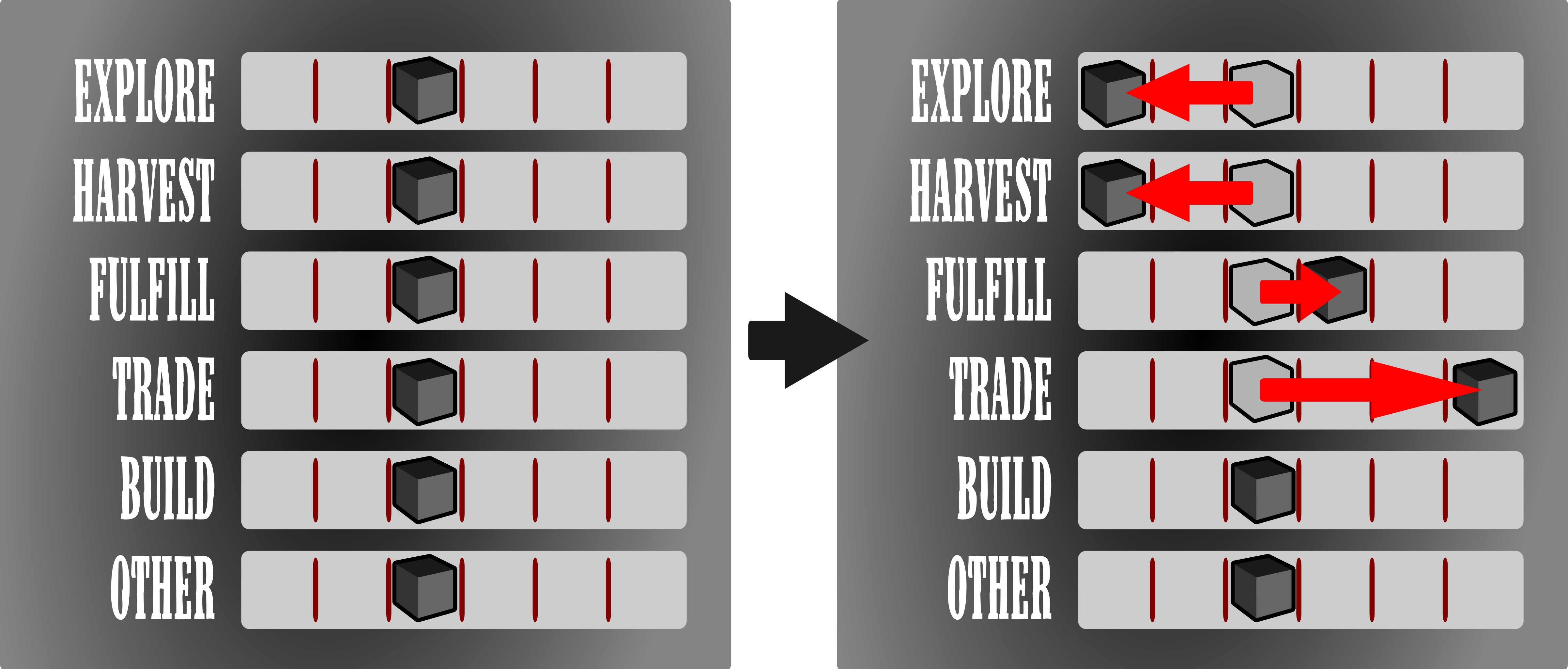
Player performs EXPLORE and HARVEST twice each. Then chooses to increase FULFILL one spot and TRADE three spots.
On their next turn they will be unable to explore and harvest. So likely their only option is to move their pawn to the Trading Post and hope they can fulfill an order or perform a trade based on the resources they harvest on their first turn. I think having this zero-sum action point allowance system in place will lead to some tense decisions in the game. Players will have to make sure they’re leaving themselves with the action points they want for the next turn.
Obviously, since this hasn’t yet been tested, this zero-sum action point allowance system will have to be extensively played. That leads me to the next thing I wanted to mention…
Playtesting
The first time I tried to play Scoville it played through to the end in a surprisingly well manner. I am a little worried about that with Trading Post. I feel like this will require much more testing than Scoville to get it to a point where I am comfortable showing it to a publisher. But GenCon is two months away, so the testing shall commence soon.
My main objective with any playtesting is to continually make sure the game is any fun.
It’s all about fun, right? Who wants to play a boring, crappy game with some weird, offbeat theme that doesn’t relate to anyone?
Now, perhaps there are a bunch of you who think the western trading post scene is for old guys who grew up watching John Wayne. I can assure you that in Trading Post out here a man settles his own problems. Trading Post is designed with a Euro identity in mind, but without anyone from the 13th-18th centuries looking boring on the cover of the box. I am very excited about this game and its potential.
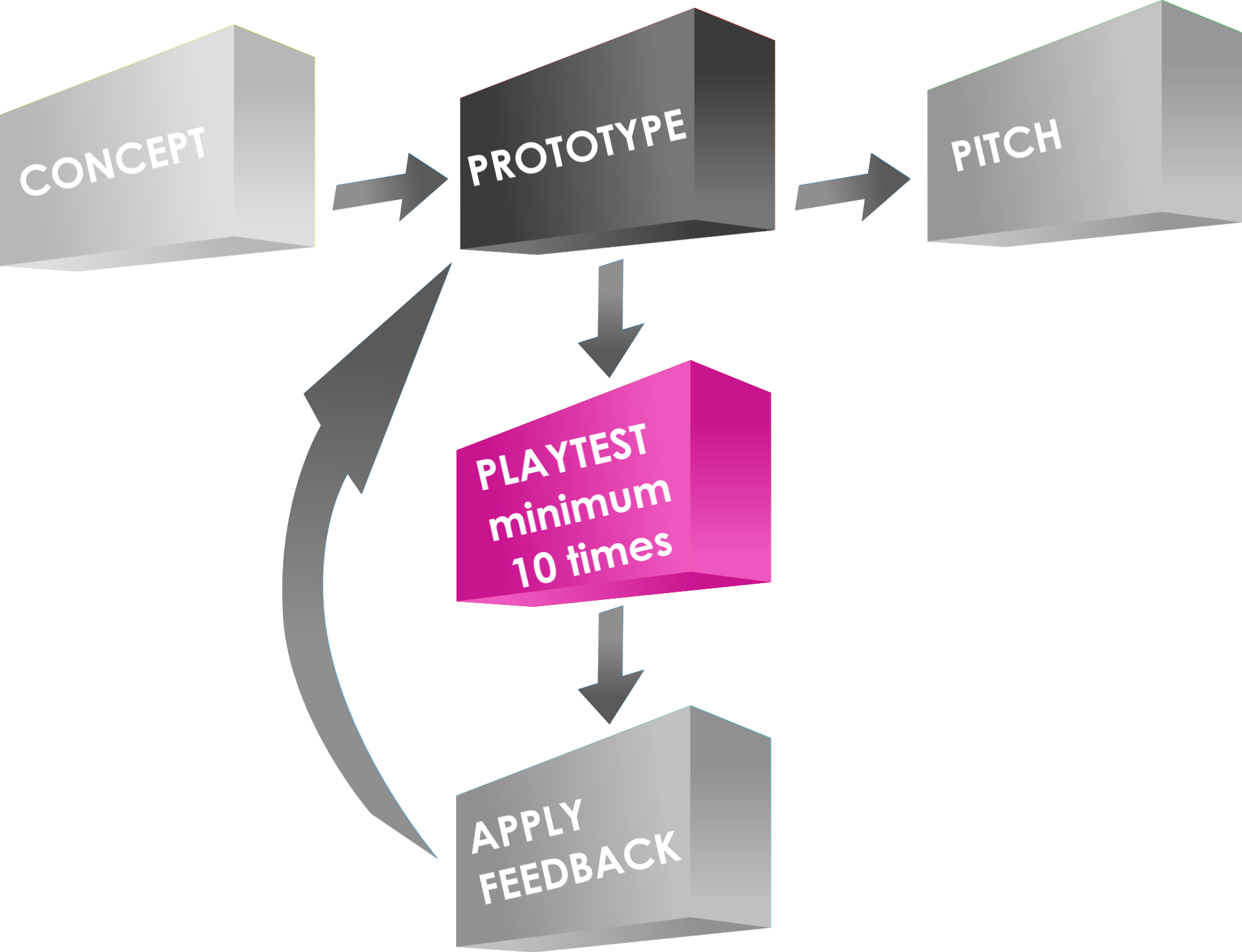
Perhaps the most important step in the Game Design process!
I am fortunate to have a great group of friends who are willing to playtest my games here in town. So I am guessing they’ll try out this one as well. Since playtesting will be my focus for Trading Post over the next two months I figured I would list the things that I view as important during the playtesting phase of game design.
- Keep your design objectives in mind – do not get carried away on wild tangents just because one player mentioned something unusual. Keep asking yourself why you are designing this particular game and why you think it is unique and interesting.
- Offer bribes of beverages, snacks, and an awesome atmosphere to lure playtesters. And telling them their name would be in the rulebook if it were to get published doesn’t hurt either!
- Try to make sure the game is playable before subjecting anyone to it. This means solo playtesting.
- Don’t change major things on the fly during a playtest.
- Don’t implement more than one major change at a time between playtests – if you add two things and the game gets way better or way worse you may not know which change should be attributed to the difference in play.
- I recommend playtesting at least ten times before integrating major changes. This gives you a solid pool of plays from which to draw an understanding of an “average” game and also gives you enough opportunity to perhaps see any unusual play.
- One of the keys to playtesting is watching for patterns. If several different people all mention the same thing (not in the same playtest) then you’d better start paying attention to it.
- And I’d like to recommend shooting for a playtest goal of 100 playtests, but I’ve not done that with my games, so how could I hold you accountable. Do it! I don’t. You should. So 100 it is!
Those are just some guidelines. I also like to get into some nitty gritty stats when playtesting. For Trading Post I’ll be keeping stats on how often each color of orders get fulfilled, how often each type of orders get fulfilled, how often players will get to the green buildings, and so much more. There is a lot I could analyze with Trading Post so I have another recommendation for playtesting:
If your design is complex, playtest the game ten times and only focus on one element. Make no changes to anything else. Once that element seems “good,” move on to another.
I think I will have to proceed this way with Trading Post. I may start by watching how the buildings get purchased and built for a set of ten playtests. Then for the next ten I may focus on how the scoring conditions seem to play out. (Note: the data from the first ten playtests where scoring conditions were not the focus can still be used in this portion of the playtesting).
My goal over the next two months is to get 15 playtests completed. That’s one every four days, which might be a bit much, but you gotta have ambition if you wanna get anything done! Entering Protospiel-Milwaukee I had had 18 playtests in on Scoville. By then, even with only 18 under my belt, I felt I was able to teach it quickly and explain the thrust of the game. That way I was not wasting other playtesters time. I hope to meet this goal so that I don’t waste anyone’s time at GenCon where there is so much awesomeness to be had!
Pitching at GenCon
 Well I’d be a knucklehead if I assumed that a game that hasn’t even yet been played could be pitchable by GenCon. That will depend on how playtesting goes. So I am not going set of goal of pitching this game while there. My goal for moving forward with this game as GenCon approaches is to have something where the wrinkles have been ironed out and it seems fun.
But for those of you who may be pitching your own games I recommend reading the following two articles:
- Networking Earns Pitching – http://www.cheveedodd.com
- Pitch Like a Pro – http://www.hyperbolegames.com
The first is something you should probably be working on right now if you haven’t already done it. The second is an awesome guide to how it all works and how to do it right. I’m guessing my 2014 GenCon will be more about pitching than my 2013 GenCon.
While I won’t be pitching the game at GenCon I will definitely have at least one copy with me. If you want to give it a shot just let me know and we can schedule something! Head for the Blue Noodle! (www.UnPub.net)
Path Forward for Trading Post
Now I just gotta sucker my friends into playing an unpublished game that likely has no balance, and no reason to be good. Of course I’ll have to figure out those insignificant things like what you actually do on a turn. But I’m getting very close to solo testing. If this game seems to work after a decent amount of playtests then I’ll likely send a copy into the Prototype Penpal Program run by Grant Rodiek. It’s a great way to get designer level feedback and to see if your game is broken. Plus, it’s always fun to know that somewhere out there other people are playing your game!
Well I hope you’ve enjoyed my articles over the past few Thursdays about Trading Post. I’ve received some interesting feedback already and I appreciate all the kind things you’ve all said. I hope that this game seems fun to you. I’ll keep moving forward with it and will definitely keep blogging about it. Someone also suggested making Thursday the default Trading Post day. We’ll see. Thanks for reading! And don’t be shy with any comments about any of this.

The Monday Brews 6-3-13
Well, we’re off to the start of a great week! And since it’s Monday, that means I get to talk about beer! It’s been a while since I discussed my brewing adventures. They’re just not as exciting as board game design. But I’ll get you all up to date on what I’ve been up to.
Alberti Amber
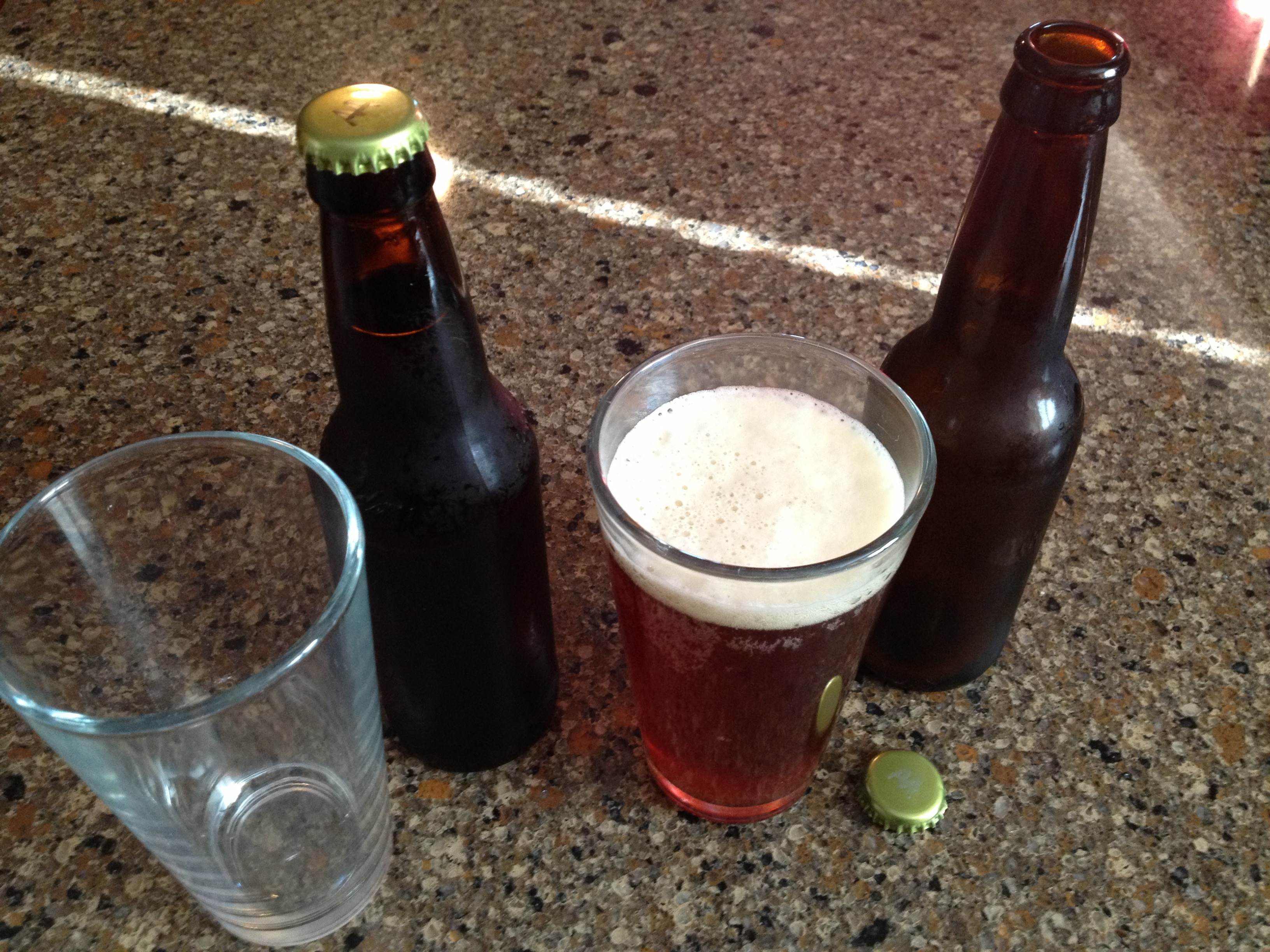
My first taste of Alberti Amber
As you know I bottled my first beer about a month ago. That was my Alberti Amber. It is named after Leon Battista Alberti, a 15th century Italian renaissance man who invented the Alberti cipher.
I have now been able to enjoy the beverage and I was asked to give a 140 character “Tweetable” review of the beer. After the first bottle, which had been in the bottle for about two weeks, here’s what I had to say:
I have since had a few more and I can tell that maturing is making them better.
One of the things that I was worried about was during fermentation my basement was a little too cold for the yeast to throw the kind of party they like to throw. So the result is that this particular Amber Ale is a little sweeter than normal. I actually think it helps to give the beer a little character.
Overall I’m very pleased with how it turned out. I may try to brew the same thing again and see how much different it would taste.
Ben Franklin’s Honey
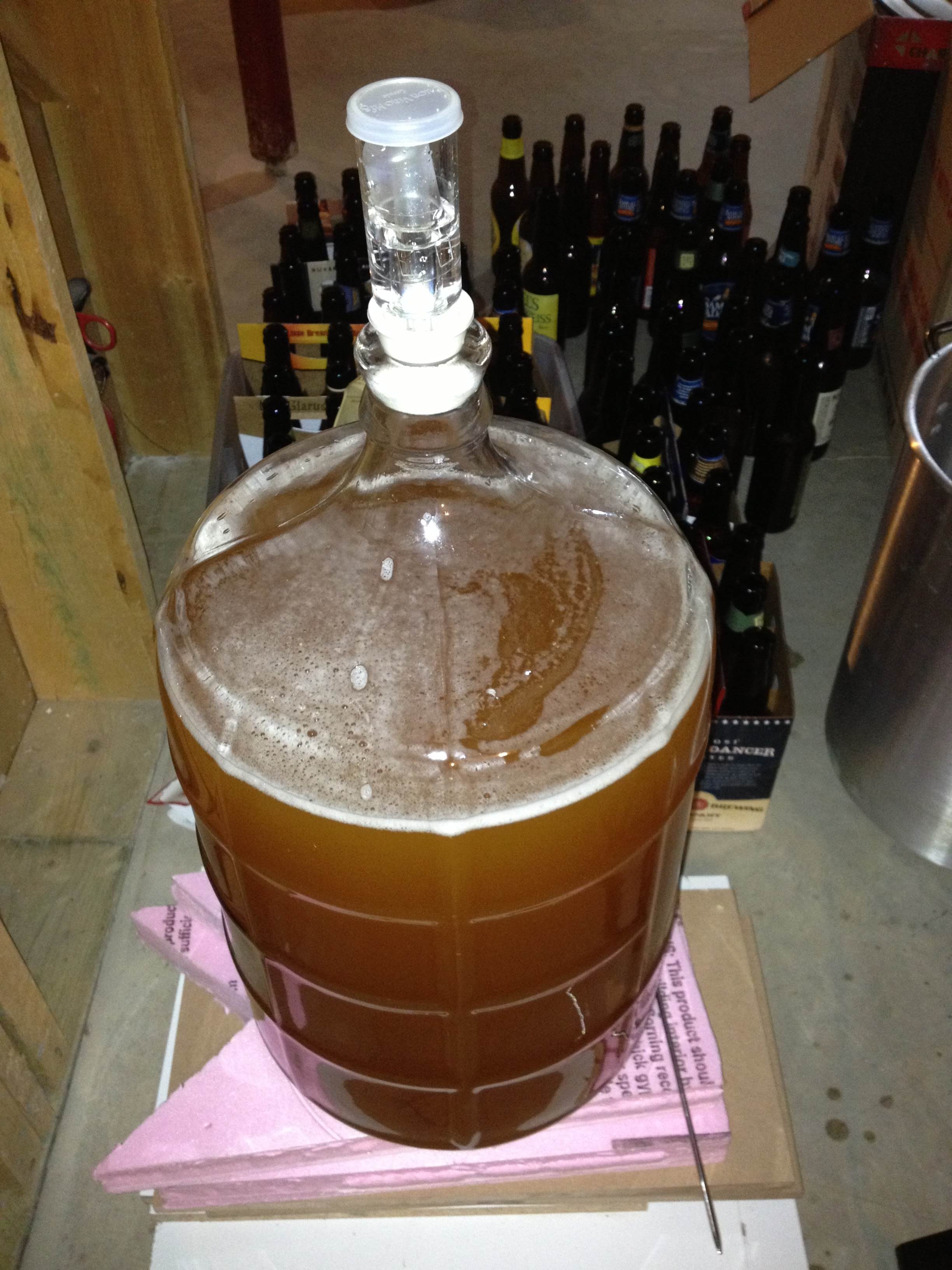
I think this one will be good!
My second beer is currently in the carboy. It has been in there for just over a week and is therefore ready for bottling.
When this was in the plastic fermenter it was really bubbling like crazy. Bubbles were coming through the fermentation lock every two seconds. For the Alberti Amber at its peak bubbles were coming through every five seconds. The faster bubbling could be due to the large amount of honey in the brew. All that sugar was really giving the yeast something to chew on.
So the brew is sitting patiently in the carboy, just waiting to be bottled. I may try to get that done tonight since I’ve got a busy week. I sure hope it goes better than with the Alberti Amber.
The bottling process seems to be the worst part about brewing. You have to peel off the labels of the bottles, unless you buy new bottles. You have to wash the bottles. You have to boil the sugar that will get added to the beer so that it can carbonate within the bottles. You have to transfer the beer from the carboy back to the plastic fermenter. I suppose you don’t “have” to transfer it, but it’s easier if you do. And then you have to fill and cap about 45-50 bottles.
That’s all part of it though. I hope this turns out to be an awesome summer beer! Hopefully I won’t drink it all before summer officially starts.
Interview with Bellwether Games
 Today is Friday so I should be posting a board game review, but instead I will provide something even more awesome.
About a month ago Bellwether Games (@BellwetherGames) tweeted that they were looking for aspiring game designers who wanted to be interviewed. Since I am an aspiring game designer I figured I should see if I would be the right person for the interview. They took a look at my website (this website) and replied that I was in fact the right kind of person for the interview.
I might have done a little dance with my hands in the air at that point. Don’t worry, no other humans eyes were injured by watching me dance. I was alone.
So they sent me an email with a few starter questions and I got right to filling them out. After a few back and forths with follow up questions they told me that the interview would be posted at the end of the month. Well, today is the end of the month and right on time the interview has been posted!
Ed Marriott Designer Interview with Bellwether Games.
Let me know what you think!
 Boards and Barley