Category Archives: The Boards
Prototype Art: Cubes in Inkscape

Inkscape Logo of Squidy Awesomeness
There are a lot of you out there who are working on board game prototypes. Often those prototypes will utilize the ever popular cube. And that usually results in the cube being placed onto graphics such as cards or tiles or the board itself and then later on, in the rulebook. So today I wanted to give you a quick tutorial to show you how I make a cube for board game graphics using Inkscape.
You can create your own set of awesome looking Scalable Vector Graphics versions of cubes using the free Inkscape software. If you don’t have the software, you can download it from their website: inkscape.org.
Let’s Get Cubing!
Once you’ve downloaded and opened Inkscape you’ll see a plain canvas outlined in front of you. I like to leave it turned on, but you can turn off the “edges” if you visit the document properties under “File.”
What we are going to do first is click on the “Create 3D Boxes” icon on the left. Here is a picture showing what this should look like:
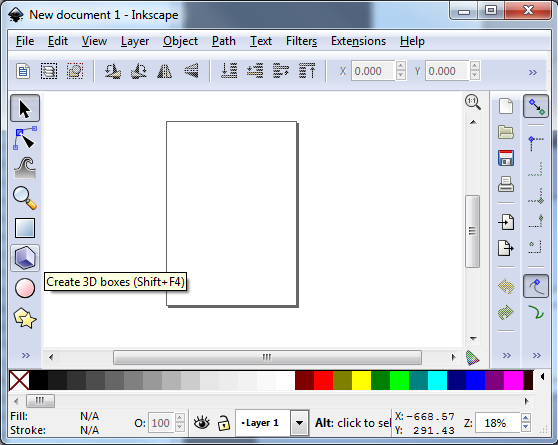
There… on the left… the icon that game designers love!
Click on the icon. Then click and drag within the framed region to create a generic box. It should look something like this:
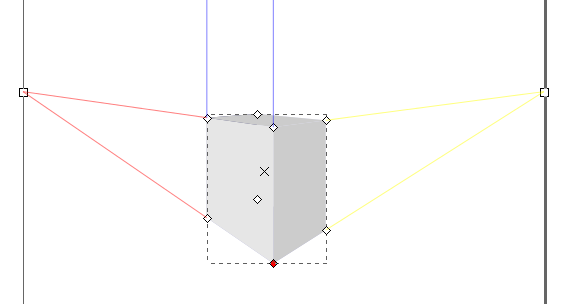
Great! You’re doing it!
You can see we’ve created a generic gray box. Now it’s time to make it look like a cube of awesomeness that you would be proud to include in your board game graphics!
So the next thing you should do is “shape” the box to look like a cube. This can be done by clicking and dragging the little diamonds on the corners of the generic box. Go ahead and try it out. Once you’ve dragged then to the positions of your liking then you might end up with something like this:
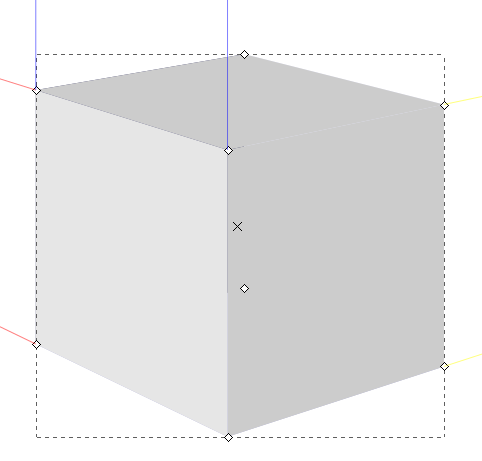
Our cube of awesomeness is started to be awesome!
Assuming you’re pleased with the shape of you cube it’s then time to make it look good. Normally you can just click on an object using the “Select and Transform” icon (it’s the black arrow on the left). Once you’ve selected the “Select and Transform” icon, click on the cube. Then you can change the color by selecting any color from the color row at the bottom of Inkscape. But that’s not the way I do it. Why? Because you end up with a flat monotone cube of ugliness rather than a sweet cube of awesomeness. Here’s what it might look like:
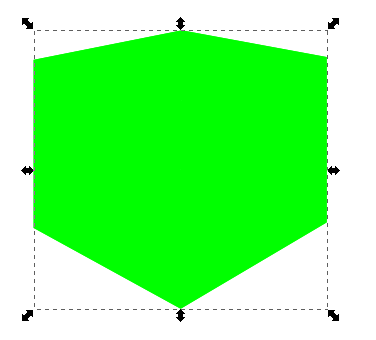
Our awesome turned ugly. Let’s fix that!
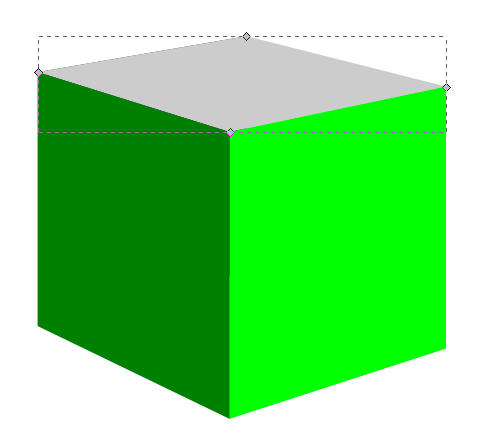
Don’t be afraid! We can transform that cube from ugly to awesome in just a few easy steps! First, we’ll want to use the “Edit paths by node” tool, which is right below the “Select and Transform” icon. This one looks like a quarter of a circle, with three nodes, and a black arrow. By clicking on this icon you can then go and choose a specific face of the cube. Once you’ve selected a face of the cube you can then change its color without changing the other faces. In this next picture I have changed two of the faces and have selected the top face:
Looks like we’re back on track!
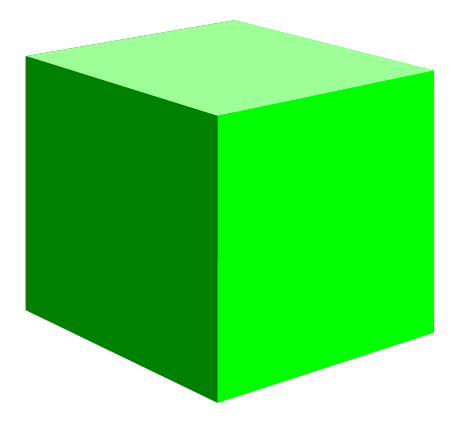
So I had selected the right face and made it a light green. Then I selected the left face and made it a dark green. Now with the top face selected I can choose its color, in this case an even lighter green. Now you should have something like this:
Not too shabby!
Alright!
Just a side note, if you have trouble selected the individual faces, make sure you’ve chosen the “Edit Paths by Node” tool rather than the “Select and Transform” tool.
So we’ve got a green cube with differently colored faces. What’s next? I found that sometimes the hidden faces will show through along the edges. So we can change their colors too. This is a little tricky though, so follow closely.
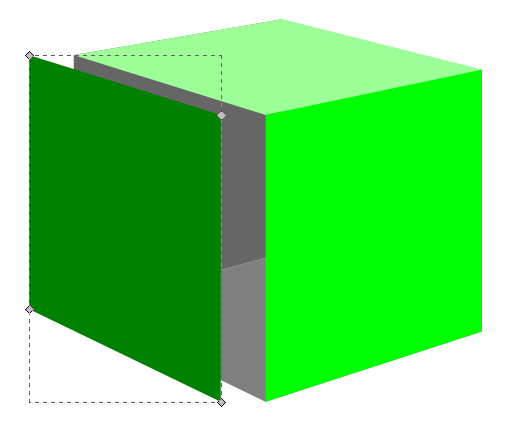
Go ahead and click on the left face. Then what you want to do is press the “left” arrow on your keyboard to move the face over. Don’t use your mouse to drag it since it will be almost impossible to easily put it back in the right spot. It should look something like this:
The hidden “ugly” faces show themselves!
With two of the three ugly faces exposed you can click on each one and change them to a color that matches your cube color. In this case I just choose a dark green for these two hidden faces. Then slide the moved left face back into place using your “right” arrow key. You can then move the right face or the top face to expose the third hidden side and change its color.
Now you’ve got your beautiful cube. You can call it quits right there if you want a nice simple cube. Just select the cube, click “File > Export Bitmap” and you can save it as a nice little .png file. And I also recommend saving the .svg file so that you don’t have to recreate the cube every time. But if you want to spruce it up a bit then keep reading!
Adding Awesomeness!
Sometimes cubes can look better with a border. There’s a very easy way to create one. With the cube selected click on “Filters > ABCs > Black Outline” to get something like this:

Oh boy! Things are looking good!
Pretty dec, right! (Note: dec is short for “decent,” all the cool kids know that!) Just be careful because the smaller your cube the larger the border will appear relative to the cube.
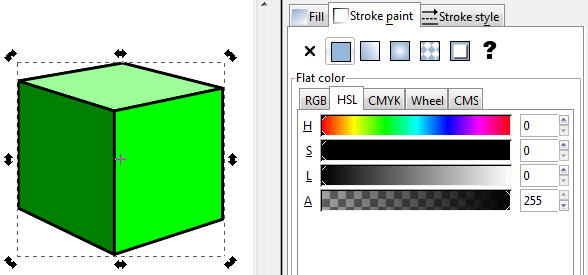
If you don’t want a black outline there are other options, but it’s slightly more complicated. With the cube selected you’ll want to click on “Object > Fill and Stroke.” That will open a panel on the right. “Fill” will color the main area of the object. “Stroke” will add a border to the object. We want to use Stroke. Taking our border-less cube and applying a simple black stroke will result in a cube like this (Note, on the Stroke Style tab you will want to choose the “Round Join” option):
Not quite as awesome as I’d hoped!
I am not a fan of the lines along each edge. It just doesn’t look that clean to me. So here’s my trick: duplicate the cube and apply a stroke to the copy in the back. To duplicate the cube make sure it is selected and then right click. On the pop up menu click “Duplicate.” This will create a duplicate directly on top of the original. Adding a stroke to the copy in back will show allow only the outside edges of the stroked cube to show past the unstroked cube. Then you can create cubes that look like this:
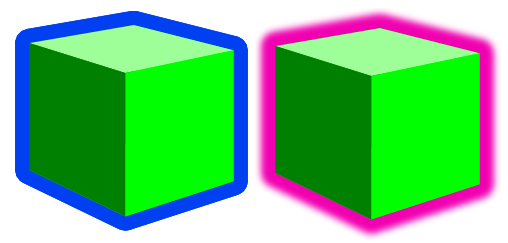
Awesomeness complete, even though these two examples look pretty ugly!
On the left is a duplicate cube with a blue stroke applied to the back copy. On the right is a duplicate cube with a blurred pink stroke applied to the back cube. One final note is that if you choose the duplicate cube option you will want to group the two together so that when moving them around you won’t have to constantly be lining them up.
Lesson Complete!
Now you know how to use Inkscape to create nice looking cubes for your board game graphics! If you are a starving artist and you have little computer skills then I have a special bonus for you. I am supplying a .svg file for all of you with a slew of cubes that you can use freely without crediting me, without paying me, and without worrying about getting sued. Feel free to use this file and the cubes wherever you want, however you want, and in whatever way you want so long as you use them for the greater good! Here is an image of the .svg file:
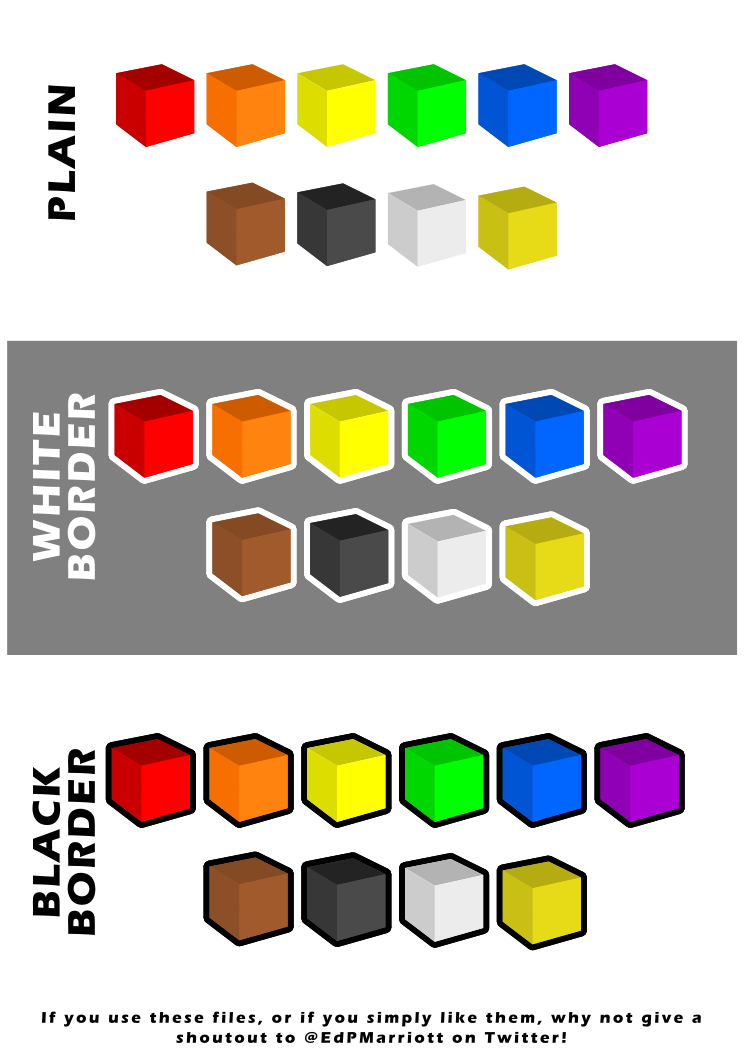
Go on… use this artwork freely! Make your prototypes look awesome!
To download it just click here: Google Drive > FreeUseCubesbyEdPMarriott.svg
Note, if you have trouble downloading the file from Google Drive you might want to allow third party cookies. You can read more here: http://productforums.google.com/forum/#!topic/docs/_pXrQmwkrGU . If you have further problems, please let me know!
And let me know how they work for you. Now get Cubing!
BGR: Empire Builder

A game with crayons? Aren’t I too old for crayons?
Today on Boards & Barley I’m reviewing a classic game called Empire Builder!
Empire Builder is a “crayon rails” game where players try to build a network between cities such that they can deliver the goods that those cities desire. Hold your horses there big fella… did you say “Crayon” rails? Yes I sure did, kind sir.
Here’s a definition from BoardGameGeek.com for crayon rail games:
The Crayon Rail System is a subcategory of Route/Network Building. Types of these games use crayon or other non-permanent methods of making connecting lines on a board, often eraseable. The most popular Crayon Rail games are part of the Empire Builder system.
The way this game is played allows players to actually draw (as in, use a crayon to draw on the board, not as in draw a card) their train connection routes onto the game board. On your turn you will first move your “train” pawn up to the number of spaces allowed by the type of engine you control. Once you’ve moved your pawn you can then pay to add train tracks to your network. The objective of the game is to connect 6 of the 7 major cities and possess $250 million. The first player to get to that point wins.
So how do you get money? Players each have three cards. On each card are three demands. Each demand lists a city and a resource that they want. It also lists the money that city will pay if you can drop off that resource to them. Throughout the game players will be picking up resources in one city and then delivering them to another city. Each delivery gets them some cash. The tricky part of the game is to know when the best time is to start focusing on income rather than network building.
I’ve played this game about 15 times and would play it again tonight if the circumstance arose. It is a very simple game to learn in terms of mechanics. But the satisfaction one gets from fulfilling an demand on one of their cards is great!
Here’s a look at the game components (image from BoardGameGeek.com):

Notice the crayons? It’s time to color!
The Upside:
- GAME PLAY: This game is fundamentally simple to play. It is easy enough to teach to non-gamers and those I’ve taught really seem to enjoy it. There are not any hugely daunting decisions in the game that would turn people off.
- STRATEGY: I love the strategy in this game. Players have to attempt to balance building a larger network with delivering the most appropriate goods. My favorite is when I can fulfill two demand cards in the same city on the same turn!
- THEME: So some people are sick of train games. That’s fine. This isn’t as much a train game as it is a network game. That’s why the theme can work almost anywhere. There are versions of this game with maps from Australia, China, Japan, Britain, the Moon, Mars, and more! Choose your geography and start networking!
The Downside:
- COMPONENTS: Each of the resources has a stack of three or four tiny poker chips. These can really get fiddly. And the worst part is when you accidentally knock the box over. Empire Builder is one of the few games that I make certain to never set on its side!
- TIME: Beware… with 6 players this might be the only game to hit the table at a game night. It can take a long time to play since there are a lot of decisions that can’t be addressed until you draw a new demand card. I would almost recommend to keep this to 2 or 3 players.
- ARTWORK: I understand that the board needs to be white so everyone can see what color tracks people are drawing on the board. That doesn’t mean I have to like it. The artwork is one of the worst parts of the game for me.
Designer Perspective – What Would I Change:
This game has been around for a very long time (since 1980). It seems to be very well designed and I am tempted to not change anything about the game. But since this portion of the column exists I might as well make a suggestion. I would like to see different scenarios in the game including different victory conditions. Sometimes a 6 City/$250 million game can take a long time. If there were setup or start game scenarios that could guide players decisions it could make for quicker game play with less downtime. If you think this start game scenario idea would be good, check out Empire Express!
Preferred Beer Pairing:
 This game can tend to roll on and on. I recommend a nice beer to sip on. One I particularly enjoy for a game like this is Anchor Steam by the Anchor Steam Brewing Company. It also helps that this is a very “American” beer and you’re building your network across the good old US of A (unless you’re playing British Rails, Lunar Rails, Martian Rails, Australian Rails, China Rails, I think you get the point). A not-too-heavy, not-too-light beer is perfect for Empire Builder!
OVERALL RATING:
Empire Builder is great. I really enjoy it for a game night where I just want to relax. It’s not overly tense. But it is a great feel-good game. Dropping a load in San Francisco never felt so good! And the crayons just make it fun. You can see your network growing as the game progresses and there’s something neat about that. I’ll rate this as a 8 out of 10 according to the BoardGameGeek rating system:
-

Very good game. I like to play it. Probably I’ll suggest it and will never turn down a game.

Eminent Domain: Escalation on Kickstarter

Publishers of Awesomeness!
One of my favorite game publishing companies is Tasty Minstrel Games. Why are they one of my favorites? I have two reasons:
- They publish awesome games including Homesteaders, Kings of Air and Steam, Ground Floor, Village, Noblemen, Belfort, and the topic of this post: Eminent Domain.
- They are very open and engaging about their business and they share a lot of awesome information about the board game publishing side of things. Check out Michael Mindes’ “BizOfPlay” Podcast on Soundcloud.com.
For those reasons I don’t hesitate when they launch a new project on Kickstarter. I know that their game developer, Seth Jaffee, will have done an amazing job making sure the game is refined and awesome. But most importantly, TMG’s games are fun to play!
So today I wanted to inform you about their latest Kickstarter campaign which is currently live. It is for the expansion for Eminent Domain. It is called Eminent Domain: Escalation (ED:E). It is the first expansion for the hit game.
For those of you who are unfamiliar with the game here is a little background. Eminent Domain is a deck-building game with a space-based theme. Players are trying to settle the most planets, research the most technology, and gain the most influence. Each turn you choose a card from your hand and do the action listed. These actions are things like Gain a Fighter, Colonize a Planet, Survey New Planets, and Research Technology. After performing the action the player will take a card from one of the piles on the table. They then perform the Role of that card. These roles allow the player whose turn it is to reap some benefit. Then all the other players can “follow” by doing the role or “dissent” by drawing a card into their hand. That’s basically how a turn works. To learn more check out Tom Vasel’s review of the game:
I really enjoy this game. I first played it last year in the GenCon library. This expansion looks like it will really add to the game. It adds the capability for a 5th player. It allows for direct conflict. It adds new technology cards. And it will add different starting scenarios, which adds a lot of flavor and replayability.
I highly recommend backing the game on Kickstarter. You can back the game and expansion for $50 or if you already own the game you can back the expansion for $25. Please let me know if you have any questions about the game or TMG. If I can’t answer them I’ll point you in the right direction. You can pledge on the Kickstarter project page!
200th Twitter Follower Giveaway!

Love Letter cover image from BoardGameGeek.com
Yesterday I got to 200 followers on Twitter! So to express my gratitude and share the love I’ll be purchasing a copy of Love Letter to send to one lucky follower!
Here’s how it will work. I’ll tweet about this article. To be eligible to win Love Letter all you have to do is favorite the tweet and be located in the continental US. I will randomly choose one eligible lucky winner from the list of people who favorited the tweet. Pretty simple!
Once the winner is chosen I will send a direct message to obtain the shipping address. The game will come directly from the online game store.
Thanks to everyone who follows me! Hopefully some day I’ll be able to give a published game of my own design as a giveaway prize! Don’t forget to favorite the tweet!
UPDATE: I’ll choose a winner at 8pm tonight (central)
UPDATE: You can favorite the tweet here instead of scrolling through my tweets to find the right one:
Game Design Process: Concept
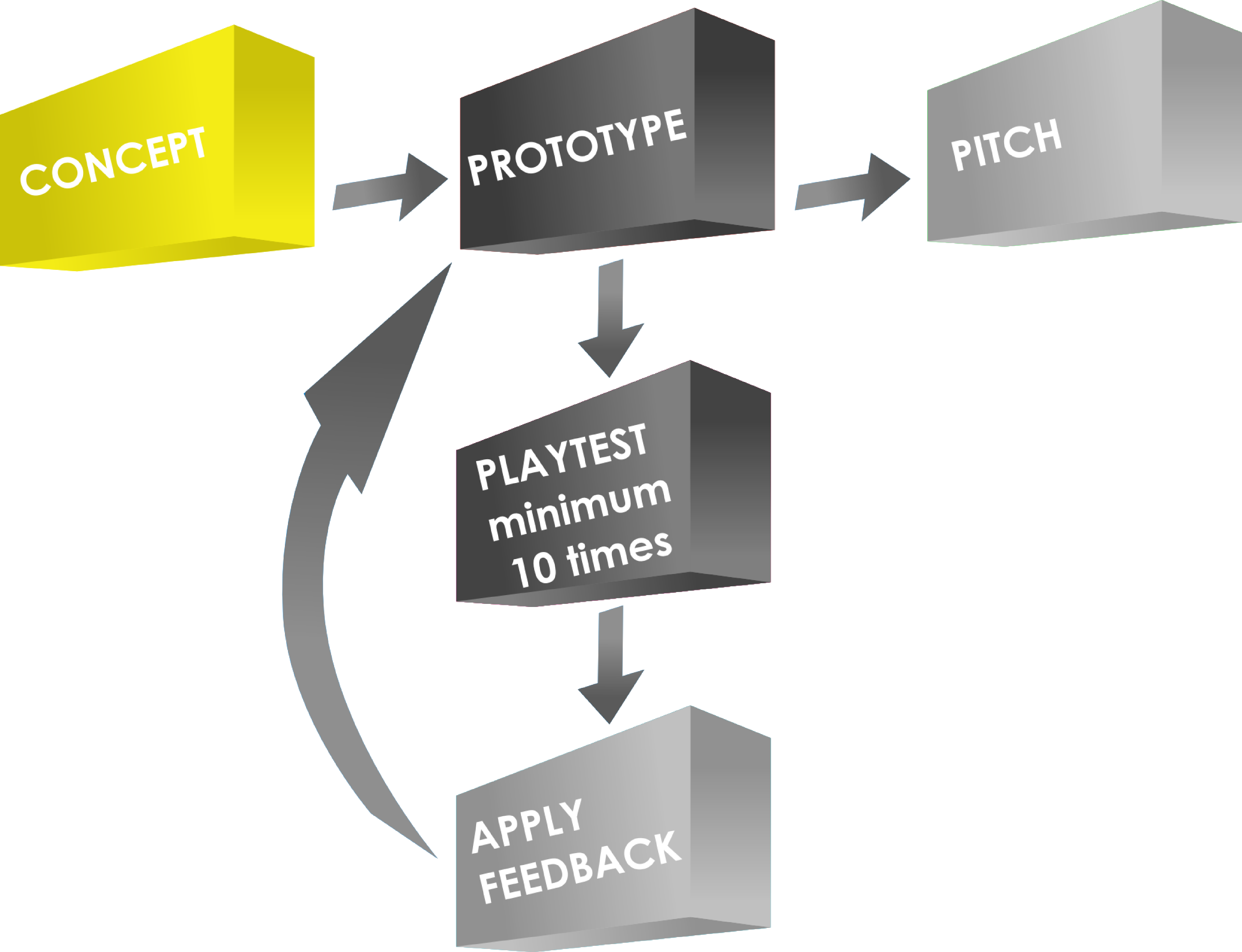
Discussing how I arrive at a concept.
Last week I wrote about prototyping a board game and I shared my prototyping techniques for Scoville. This week I am sharing my concept process. How do I come up with a game design? Do I choose a theme and then add mechanics? Or do I choose a mechanic and then slap on a theme? Do I purposefully try to integrate an appropriate theme for the mechanics? These are the sorts of questions I’m answering today in a “self-interview” format.
Q: Where do you get your inspiration?
A: Everywhere awesomeness can be found. I can be easily inspired by just about anything. Make a game about boll weevils? Sure! Make a game about nuclear radioactive decay? Why Not! My main rule of thumb for game design, whether it’s the concept phase, prototyping, or potentially pitching a game is this:
Make sure it’s fun and relate-able!
If what you are designing is something that is fun, then the theme can be just about anything. I usually get inspired by the things that I waste spend my time on. If I’m enjoying the NCAA basketball tournament I’ll probably start thinking of making a card game where you represent a team in a region of the bracket and via set collection and hand management you have to play the right cards to get your team through the Final Four and eventually to win the championship. If I’m working out in the gym I might be inspired to design a game where you are a person who is trying to lose the most weight. You’d have to compete against the other players to burn the most calories or increase your bench press weight the most. The bottom line, though, is that it must be something fun. Players may love a set collection/hand management game, but if the theme is something boring that no one can relate to, then maybe you should come up with something else.
Q: Regarding a game designer’s Chicken vs. Egg Debate: Mechanic or Theme first?

Theme or Mechanic first?
My inspiration is typically theme based, so I usually start there. I’m not a huge fan of abstract games, either. So that probably guides me toward choosing a theme first.
When you choose a theme first it allows you to sort of steer your game in a direction that fits cohesively. Once you have a theme you can pick and choose the mechanics that you think will work best. Imagine you have chosen the NCAA tournament theme. It would be important to understand how the tournament works. You have 64 teams playing games over several weekends. Each game eliminates one team. Eventually you get to a Final Four. So once you understand how the tournament works you can then start to add mechanics. One way to do this would be to have players each represent one region of the tournament. Your objective would be to get your best team into the Final Four. Other players can play the spoiler role and try to cause upsets in your region. To do all this you could use a blind card mechanic with a drafting round before players apply cards. All players could draft a card and then cards could be played onto each game. The overall idea here is that when choosing a theme first you can then go and apply mechanics that you think fit the theme AND make the game fun.
On the other hand when you choose a mechanic first you are almost automatically starting with a more abstract game. A theme could be slapped on that probably fits the mechanic. Or a different theme. Or another different theme. The reason I typically don’t start with a mechanic is because the theme part of a game is typically what makes a game fun and relate-able. That’s just how I roll!
Q: What about boring themes? People seem to like them too!
Valid point, self. So there are a lot of games that have very boring (my opinion) themes that people still really like. Farming, for example. How can a game about farming be fun? The game Agricola is the third highest rated game on BoardGameGeek.com. So clearly the theme isn’t the whole picture in whether a game is fun or not. In fact, many Euro style games involve “trading” or “resource management,” which can be very boring topics. The key is this:
When the theme is boring, make sure the mechanics are innovative and unique (and fun!) (Or have awesome artwork!)
Sometimes people buy games because of the theme. Sometimes they buy games because of the mechanics. As long as the game is fun it can have a super dry and boring theme and people will potentially enjoy it.
Q: You keep mentioning “Fun.” How do you make sure a game is fun?

It looks like they’re having fun!
When I first got into designing games I searched for articles about making games fun. I found some interesting things that I wanted to list here. Some of them are less about fun and more about making a game “good.” But it’s my philosophy that if a game isn’t good, it won’t be fun. So making a game “good” is a prerequisite for making a game “fun.” Here are my rules of thumb for the conceptual phase of the game design process:
- Interaction is Critical! (Otherwise I’d be designing solo video games!)
- Avoid Downtime.
- Provide many options on each turn – you don’t want players to only have one option on their turn. If they can only do one thing then the cease playing a game and become robots.
- Provide multiple paths toward victory. Even if there is only one victory condition, make sure that there are numerous ways to get there.
- Avoid a runaway winner.
Let’s quickly run through why each of these is important for making a game good and fun:
Interaction: If there is nothing you can do to affect the other players, then you’re playing a solo game against other solo gamers. Not fun. If there is no interaction on a verbal level then it doesn’t matter that you’re sitting around a table with friends. You may as well make your game into an app that people can play when they’re sitting on the toilet. Provide a way for players to interact in the game.
Downtime: No one likes sitting around for a long time while other players are taking their turns. Try to design your game so that people are constantly paying attention. Make sure they’re invested in what the other players are doing. It’s no fun to be sitting around waiting.
Options: Without options a game of strategy or tactics or even luck becomes a simple matter of doing whatever it is that the game is forcing you to do on your turn. That’s no fun at all! Designers: give your players options! Don’t turn us into robots.
Paths to Victory: It’s important for players to be able to play your game in different ways. This can be as simple as having destination tickets like in Ticket to Ride. Or it can be complicated like choosing the best way to fill in your estate in The Castles of Burgundy. Just make sure that you’re giving the players different ways to reach a winning condition.
Runaway Winner: I just as easily could have said to avoid player elimination. With a game where a player can get so far ahead that no one can catch up it is effectively player elimination anyway. A good and fun game design will include a way for players to catch up to a leader. This can be done several ways, including hindering the leader or benefiting a last place player. Think of the NCAA thing again. Which games are more enjoyable to watch, blowouts? or close games where a team was down big and they came back and hit a buzzer beater at the end?
Of course there are other things that can determine whether or not a game is any fun. Those above are just the main five things that I always keep in mind when designing a game. Another one that I did not mention because it is difficult to get right in a game is having an ever increasing amount of tension in a game. That is one of the things that Agricola does really well. This can be done by having limited resources or a first-come-first-serve option. Agricola has both!
Q: You’ve got a theme, now what?

So you’re going with Boll Weevils, huh? Could be worse!
You’ve chosen an interesting theme that could be fun and is relate-able. Where do you go next? I like to do a little research about whichever topic I’m thinking about designing into a game. When doing the research I try to figure out things about the topic that would work well for game mechanics.
In the Boll Weevil example I just learned that boll weevils, though not native to the United States, migrated here in the 19th century and by the 1920s had devastated much of the cotton industry. So perhaps while the boll weevil theme itself may not be very fun or interesting, as a designer I could go several different routes. I could make the game be a cooperative game about controlling the infestation. I could make it so that players represent individual boll weevils trying to infest the largest amount of territory. I could even make the game about farmers trying to grow the best cotton while other players can launch infestations of boll weevils on their opponents. So I could definitely produce a game about Boll Weevils. Question is, would anyone care?
The point is that once you choose a theme, do a little research and figure out what you really want the objective of the game to be.
Q: How do you add mechanics?
Now that you’ve gotten to the point of understanding what your objective is in your game it’s time to start turning it into a real game. The key is understanding the theme. You don’t want to add things to your game that don’t really fit the theme. I recently ran across this with the game Archipelago. There are mechanics in that game that just don’t seem to fit the theme of exploring an archipelago and dealing with indigenous persons. One example is that if the rebels are advancing you can get them to stop by selling fruit. But you aren’t selling fruit to the rebels. You simply have to sell fruit. It just didn’t make much sense to me.
So when I think about adding mechanics to the theme I figure out how the theme really works. It’s like the boll weevil example above. Since boll weevils spread and infest I would probably add a mechanic where a swarm of boll weevils is taking over precious territory.
I also like to keep in mind the 5 points I made above about making a game good. If a mechanic adds too much downtime, for example, I might not go with that mechanic. Or if a mechanic has no player interaction I’d probably leave it out. It is important as a game designer to be cognizant of how the mechanics in your game not only allow for players to reach the game’s objectives, but also to make the game good and fun!
Conclusions:
Game designers face an interesting challenge. The whole idea of creating a game is almost a game in and of itself. Designers strive to make games that are fun, induce emotions from the players, create an atmosphere of engagement between players, and be innovative all at the same time. Finding a theme, applying mechanics, and balancing the game are all things that go into making a great game. If there’s a game out there that you really enjoy, find the designer on Twitter and thank them! A lot went into that game!
 Boards and Barley