Blog Archives
Brewology 101: Kegging
You’ll never want to bottle again!
I have an awesome neighbor who used to brew. One of the ways he is awesome is that he is letting me borrow (indefinitely, I believe) his 6 gallon carboy, wort chiller, and double keg system!
A friend came over the other night to help me with kegging. I had never done it before and I was a little nervous.
But before we get to the kegging I wanted to mention my process for bottling:
- Save bottles from friends. You typically need 45-50 bottles per 5 gallon batch. (Time requirement: months)
- Soak bottles and peel labels off. (1 hour)
- Wash bottles in dishwasher. (1 hour)
- Transfer beer from carboy to plastic fermenter. (15 minutes)
- Sanitize a group of 10 bottles. (3 minutes)
- Fill and cap ten bottles. (10 minutes)
- Repeat Steps 5 & 6 four more times. (~45 minutes)
- Clean counter, plastic fermenter, carboy, tubes, etc. (30 minutes)
All told the bottling process usually takes about 3 hours on any given evening, which doesn’t include the bottle soaking/label peeling portion. It’s not enjoyable work. Thus, I was very happy when my neighbor loaned me his kegging gear.
What is a Keg?

Cornelius (“Corny”) Keg
A keg is basically just a metal tank in which to put beer. The keg allows for the introduction of high pressure (~10-25 psi) Carbon Dioxide to the beer.
Soda producers and beer producers often use these types of kegs to store their product. These will be distributed to restaurants and bars where they will be connected to the taps.
You can buy these types of kegs online or at a local brewing store for roughly $50.
 But you’ll also need some other equipment. The American Homebrewers Association has a nice run-down of the equipment you’ll need here.
These include connectors for the keg, plastic tubing, a CO2 tank, and a pressure regulator. I’m not providing an exhaustive list of the items you need. You can find that elsewhere. Rather, today’s kegging article if focused on the kegging process.
Racking Your Beer
Usually a homebrewer till use a carboy for secondary fermenting. If this is the case for you, you’ll want to rack your beer before transferring it to the keg. This is a simple process.
First, make sure everything that will touch the beer is sanitized. I use One Step for my sanitization. This means you’ll need to sanitize your plastic fermenter, the transfer tubing, the keg, etc.
Then I prefer utilizing an auto-siphon to draw the beer out of the carboy and into the plastic fermenter. By doing this step you help eliminate much of the sediment from the beer getting into the keg.
Fill the Keg!
This is the portion of the brewing process that replaces bottling. Instead of doing all those steps I listed above, simply use your auto-siphon to transfer your beer from the plastic fermenter into the keg. So. Much. Easier!
Do You Have Gas?
I hope you’ve got gas. Once the beer is in the keg, seal the keg and hook up your CO2 tank. Here’s where you’ll need a little information. You’ll need to know the temperature of the beer so that you can apply the right pressure. Here is a handy (?) chart to help you set your pressure correctly (Click for full size):
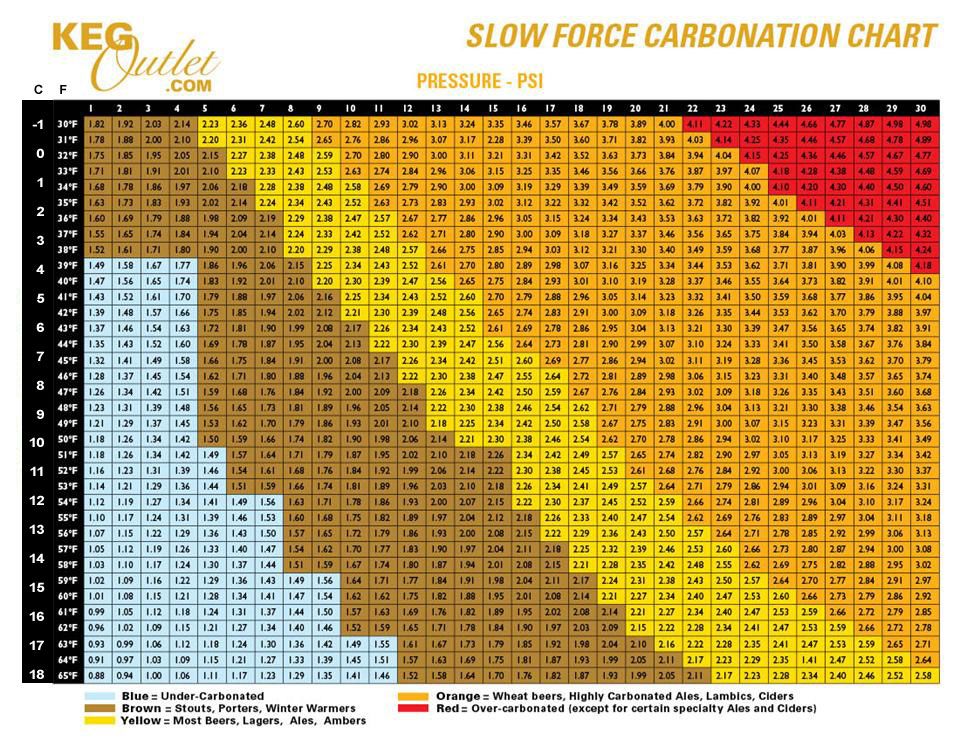
Image courtesy of KegOutlet.com
Some people force carbonate their kegged beer. This can be seen in the video below. Basically this utilizes a higher pressure of CO2 for a few days. Once those few days have passed, hook up your dispensing line, lower the pressure to dispensing levels (10-20 psi) and try your brew!
Today was a very brief article on kegging. Here are some picture of my kegs and equipment:


Helpful Video:

Monday Brews 9-29-14
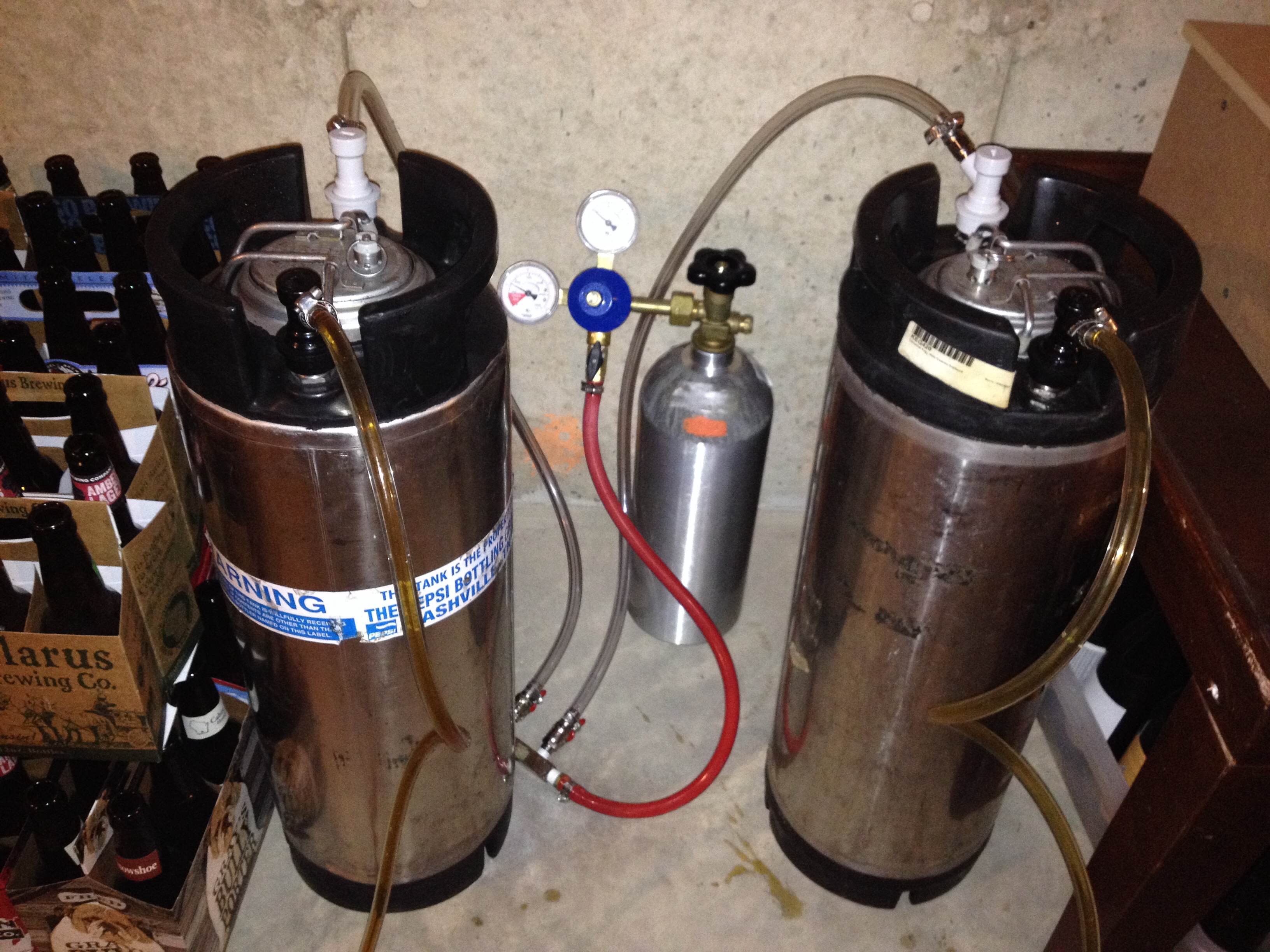
10 gallons of beer that I didn’t have to bottle!
I totally missed out on National Drink Beer Day yesterday. I’ll redeem myself by enjoying one of my two kegged beers shown in the picture. I’ll write about my first kegging experience tomorrow. (Spoiler: I never want to bottle again!)
But today is Monday, so it’s time to cover the Boards & Barley that I’ve enjoyed over the last week. With a Board Game Night and a date night with my wife where we played games I was able to get a nice assortment to the table. But let’s start with the Barley.
The Barley:
BARLEY SPOTLIGHT: New Glarus Staghorn
My friend Jeremy describes this as the best domestic Oktoberfest. I agree with him. This is a very excellent beer and I’ll often choose it over the German Oktoberfests. Is that beer heresy? Doesn’t matter to me. New Glarus has produced a truly fine Oktoberfest. Next time you’re in Wisconsin in September or October, make sure you try it!
- New Belgium Pumpkick
- Tyranena Painted Ladies
- Lake Louie 10-81
- Boddington’s (My British colleague gave this to me as a gift)
The Boards:
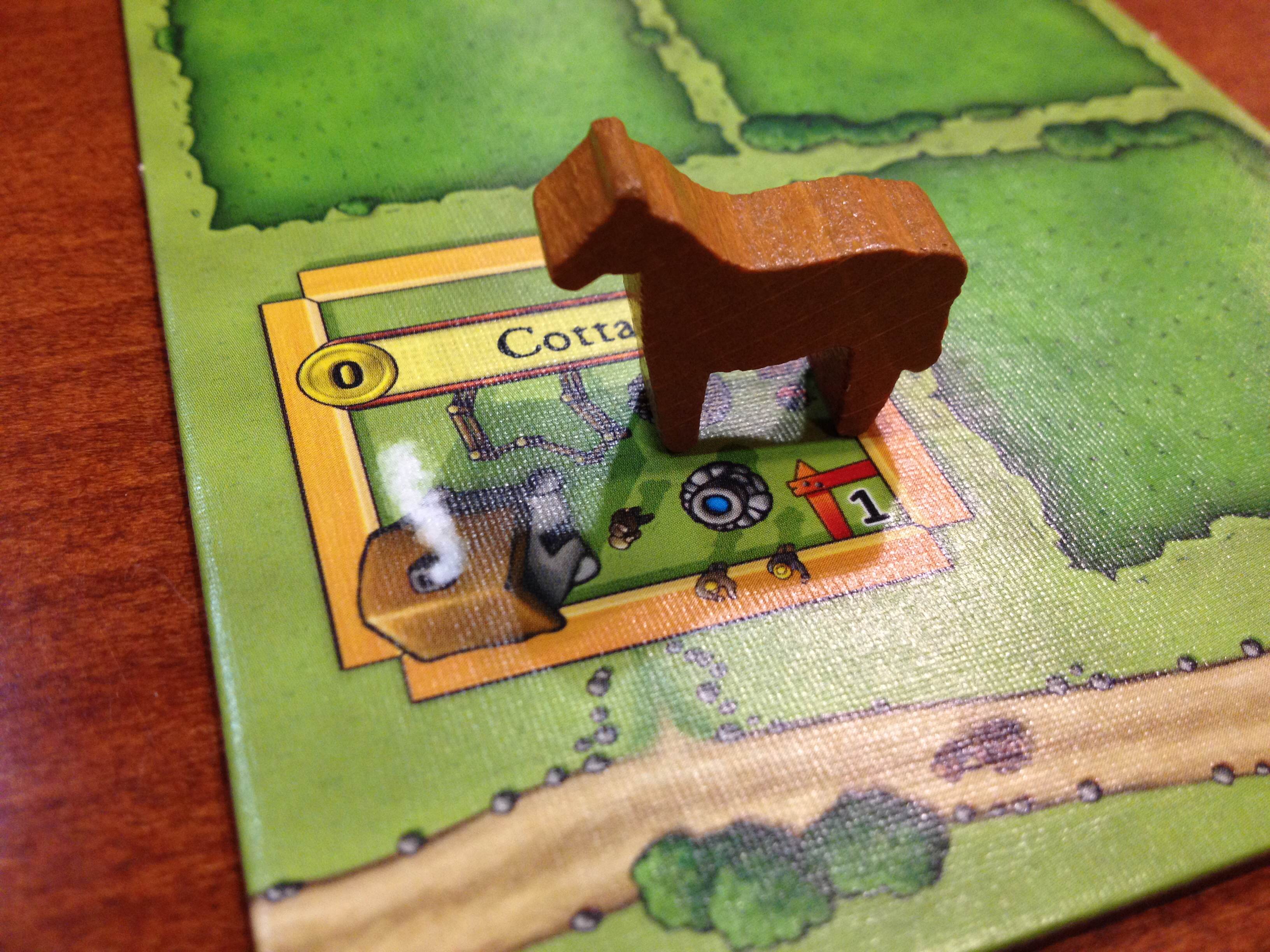
Don’t worry. He wasn’t lonely for long!
BOARDS SPOTLIGHT:
Agricola: All Creatures Big and Small
This game is my Spotlight game this week because I was able to get my wife to play it. She graciously learned a new game and when it was done said she’d play it again! That’s a big win for me. I’ve wanted her to learn Agricola for a while so introducing her to ACBAS seemed like a good intro. The gameplay feels roughly the same and the pasture/animal elements emulate those in the full game. So I think she got a feel for how Agricola would go. I’m excited about that.
Designer’s Corner:
This past week was a good one. I finished up prototype art (haven’t done that in a long time) and I got The Grand Illusion to the table for it’s first two playtests (It had been a long time since I put a new game design on the table).
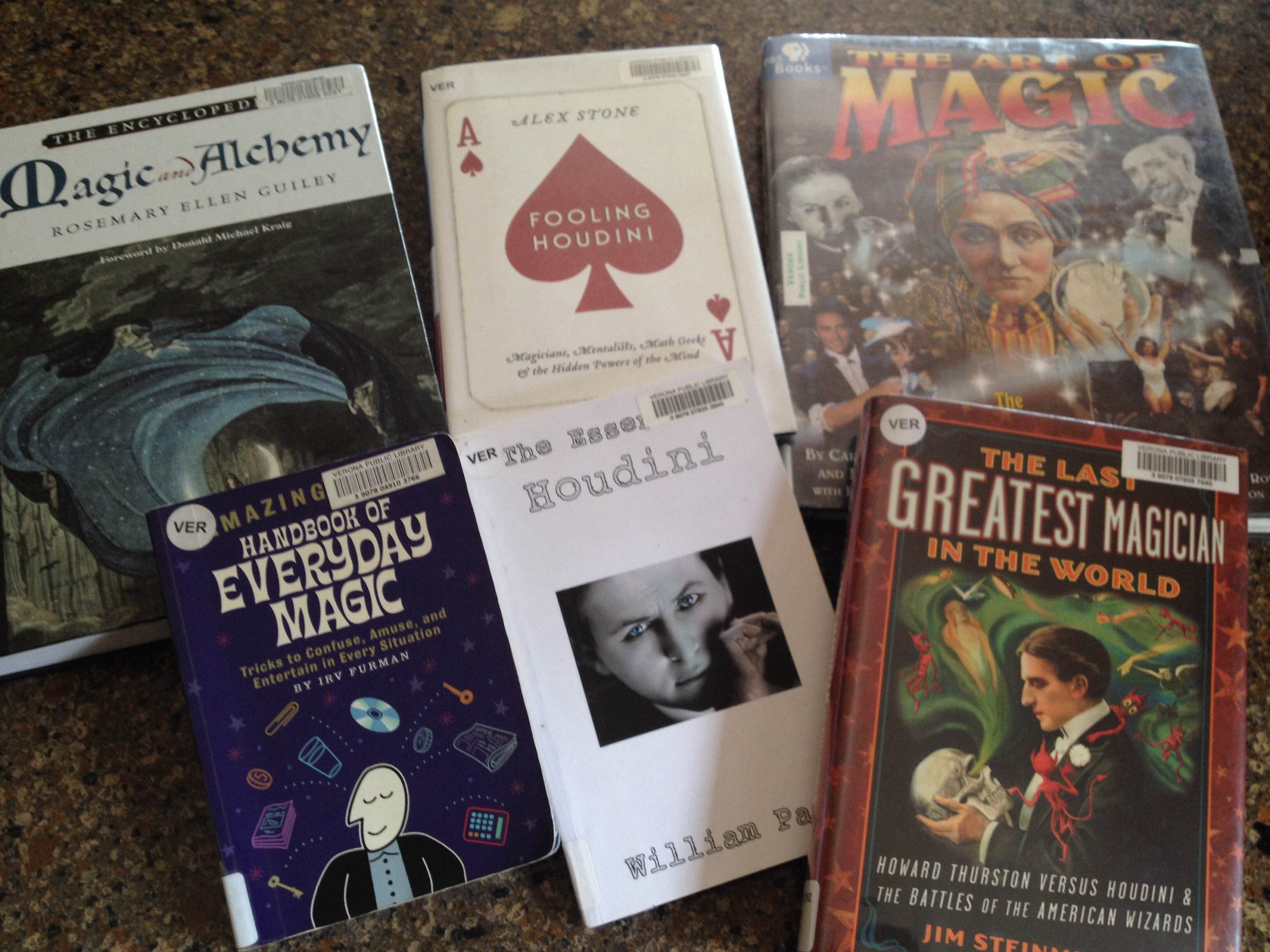
It’ll be magic if I can find time to read these.
Since the playtests were successful (I should write an article on what makes a playtest successful because I think that can mean a lot of different things) I thought I’d do a little more research into magic and the late 1800s-early 1900s magicians. I picked up a few books. I have no idea when/if I’ll have time to read them.
I think the playtests were successful for two main reasons:
- Both played to completion.
- It was fun (Or at least I had fun playing).
Playing to completion is a big metric for me. If you can design a game on paper or in your head and bring it to the table such that it can be played in full, that is a big accomplishment. Of course, that doesn’t matter as much if the game stinks.
So I had the two successful playtests and I’m ready to implement some good initial changes to things that were obviously not perfect. I think there are good things ahead for this game.
Monday Brews 9-22-14
Today is the last official day of summer. Bummer. Before we know it snow will be on the ground, the days will be short, and we’ll be freezing. Aye. What a horrible way to start a blog post. Sorry for that.
Let’s cheer you up by covering the Boards & Barley I’ve enjoyed over the past couple weeks!
The Barley:

Perfect amount of pumpkin and raven!
BARLEY SPOTLIGHT: New Belgium Pumpkick
So Autumnal. So delicious. It has a very nice level of pumpkin flavoring. Much more manageable than the Southern Tier Pumking and Warlock brews. This beer makes me think of Fall, and I like Fall quite a bit, so this is an enjoyable beer for me.
- Southern Tier Warlock
- Spaten Oktoberfest
- Milwaukee Brewing Sasquash
- Deschutes Black Butte
- Brau Brothers Moo Joos Oatmeal Milk Stout
- Ayinger Oktoberfest
The Boards:
 BOARDS SPOTLIGHT: Istanbul
This game has such a nice and simple mechanism of movement. It allows for great replayability. It adds interesting and tough decisions. And can allow you to mess with other players without it seeming like a “take-that” kind of game. I’m looking forward to playing this again.
Designer’s Corner:
 I have made a lot of progress with the prototype for The Grand Illusion. I’m on pace to have it playable for our group’s Board Game Night this week.
I’ve laid out the gameplay foundation, which is quite simple mechanically. I’ve tried to include a system that will provide for some good interaction. And I’m just ready to play it. It will probably be horrible, but at least the logo looks okay! Hopefully I’ll have a report on Playtest #1 later this week.
Monday Brews 9-8-14
Welcome to September. Schools have begun. Temperatures are moderating. Seasonal board game groups (like mine) are getting back together. The hot summer months are in the rear view mirror and the best board gaming months of the year are in front of us!
But today is Monday, so it’s time to cover the Boards & Barley that I’ve enjoyed lately (last two weeks)…
The Barley:
 BARLEY SPOTLIGHT: Southern Tier Pumking
Whoa… the pumpkin is strong with this one. It’s almost like you are drinking pure pumpkin. Okay, it’s not THAT strong. But this is an Imperial Pumpkin Ale. If you are desiring a brew with a lot of spice that instantly makes you feel like it’s Autumn, then don’t hesitate to try Southern Tier’s Pumking.
- Modelo Especial – I had this at my wife’s work outing.
- Capital Oktoberfest
- Samuel Adams Harvest Saison
- Leinenkugel’s Original
- Samuel Adams Harvest Pumpkin Ale
- Leinenkugel’s Oktoberfest
- Lakefront Extended Play (India Style Session Ale)
- Vintage Polotmavy Incorrect (Czech Style Half Dark Amber Lager)
The Boards:
 BOARDS SPOTLIGHT: Five Tribes
I can’t wait to play this again. I played twice and I am in awe of the replayability. This game is very enjoyable. The decisions are awesome, yet limiting. Other player moves mess with your strategy. The artwork of the Djinns is awesome. The components are fantastic. I simply can’t wait to play this again.
- Sushi Go
- Skyline
- Astro Regatta (Prototype)
- Cranium Balloon Lagoon
- Uno Moo
- Courtier
Designer’s Corner:
Due to my play of Coutier I am happy to report that another game design, Conclave, is now completely dead. I no longer have any need or desire to continue working on that design. Courtier isn’t exactly what I had in mind with Conclave, but it’s close enough that the games are too similar for me to bother with that design anymore.
I now have a new goal. Since I’ll be attending Protospiel-Madison (October 24th-26th) I decided that it’s time to get after my designs and really start putting them together. So my goal is to have three games ready for testing. The two you have heard me speak of are The Grand Illusion and Armada Galactica. One that I haven’t written about tentatively has the name Night at the Museum, which obviously will have to change. I’ve been making extensive notes about all three.
Currently The Grand Illusion is ready for prototyping. Armada Galactica is nearly ready for prototyping. Night at the Museum needs more work before I’ll mock it up. But all three should be ready in time for Protospiel-Madison.
I may also work on an expansion for something 🙂

There you go! What Boards & Barley have you been enjoying? Anything new that was more awesome than expected?
Monday Brews 8-25-14
First of all I’d like to welcome all the new readers! Thanks for checking out the site and for your interest in my “How to (Speed) Pitch Your Game” article. Feel free to look through my archives and find more interesting articles about game design.
Second, Monday on Boards & Barley is the day I recap what beer and board games I enjoyed over the previous week. It’s a fun way to learn about new beers and interesting board games. If you have any questions about what I’ve been enjoying, feel free to ask me via Twitter (@EdPMarriott).
And without further adieu let’s check out the Boards & Barley:
The Barley:
 BARLEY SPOTLIGHT: Summit Great Northern Porter
I had this tasty Minnesotan brew while camping over the weekend. It hit the spot as I was relaxing around the fire enjoying a S’more. I wouldn’t say it was the best porter, but it certainly was tasty at that moment. Special shout out to my friend Scott for bringing the brews! Thanks Scott!
- Summit Extra Pale Ale
- Weyerbacher Merry Monks Tripel
The Boards:
 BOARDS SPOTLIGHT: Concordia
I had the chance to play Concordia at BGG.Con last November and I didn’t take it. After playing it last night for the first time I am regretting not playing it at BGG.Con. Summary: it was really good and I liked it a lot.
The game was filled with interesting decisions, moments of regret, and moments of awesomeness. There are a lot of things you could do, but the timing of playing your cards made for a great gaming experience. If you like Euros but haven’t played Concordia don’t wait any longer.
- Sneaky Snacky Squirrel Game
- Go Away Monster
- Disney Eye Found It
- Skyline
- Tapple
Designer’s Corner:
Last week I worked on Armada Galactica, The Grand Illusion, and an abstract theme-less game that I think has a lot of potential.
For The Grand Illusion I started putting together a deck of magic tricks and resources (skills). I’m getting close to the point of playtesting. I plan to blog about it on Thursday.
For Armada Galactica I worked on creating different ship layouts to add some variety with how goods and resources are stored on your ship. I also started laying the foundation of what happens on a turn.
I also was thinking a lot about two different structures in game design. Some games have turn-based gameplay while other games have phase-based gameplay. In turn-based each player will individually perform whatever action they are going to do. In phase-based all players will perform some phase-appropriate action before the game moves on to the next phase. I may end up writing about these but I have some more thinking to do about it first.
That’s it for this week’s Monday Brews. What Boards & Barley have you been enjoying? Play any new and exciting games lately? Thanks for reading!
 Boards and Barley